Author Archives: gaussling

About gaussling

Gaussling is a senior scientist in the chemical business. He occasionally breaks glassware, spreads confusion and has been known to generate new forms of hazardous waste. Gaussling also digs aerospace, geology, and community theatre.

Philomena and the Physicist

One of my favorite YouTube characters is Philomena Cunk, otherwise known as Diane Morgan. She is a British humorist who deadpan parodies those fine British television programs where a host narrates the script and talks about history while visiting the actual locations of that history. Most programs are about well-established British history. The difference is that she is so uninformed that she can’t even ask good questions or come to reasonable answers. But this doesn’t stop her from asking questions to experts based on deeply faulty assumptions which she openly expresses. Philomena is able to ask these questions with a straight face and directly to a subject matter expert. A few are even hosts of their own programs. When the expert provides an answer to what they think Philomena is really asking, she usually expresses disbelief and moves on to the next question.

Case in point- In an interview with a well-known physicist and host of his own TV program, she asserted that we do not know how an airplane works and asked how that could be. The physicist looked puzzled, but as all with interviewees, he kept a straight face and tried to gently answer the question that should’ve been asked. The look of puzzlement on their faces is priceless.

The physicist’s initial reply was to answer with the comment that “we have equations …”. Realizing that using equations to brush off the question was not enough so he tried to do what he should have done in the first place- use the English language to describe qualitatively how a wing generates lift.

This struck me as emblematic of physicists. Go straight to equations to answer the question to the public. Physicists can be shameless reductionists. At least in my experience. Such a reference to the equations, even though rigorously correct, is a poor answer given to the non-physics world. The public and especially Philomena need a few succinct sentences with ordinary vocabulary, but without patronizing them.

Source: Facebook. Original image source unknown.

My suspicion is that nearly everything can be described at least qualitatively with the English language. This is my conclusion after having done public outreach for a few decades. To non-specialists, explaining equations can easily go sideways in the conversation. Equations are succinct expressions of relationships between quantities. If more detail is requested, then going to the whiteboard and easing into a fuller quantitative explanation with math and illustrations should be done.

Speaking for myself only, Philomena’s interviews cause me to immediately pop into cringe mode. Sometimes my cringing is so bad I become painfully embarrassed for the guest and I have to move on to a different channel. This is a general response for me when I see people innocently exposed to embarrassment. Searching for a polite answer while retaining a shred of dignity is difficult for many people.

Wherein I faintly Mock a Harvard Professor

Ok, so there is this Harvard professor named Avi Loeb who attracts media attention with his suggestions that a new comet or asteroid may be an alien spaceship, especially if we’re sure that it is from outside our solar system. Any given new object arriving from “way out there” has the possibility of being made and operated by extraterrestrials. Yes, it is a remote possibility, but still non-zero.

What gets my attention is how his pronouncements of possible alien spaceships are leapt upon by media who publish and promote with breathless and fanciful headlines. Ok, media are in a 24 hour or less news cycle and feel the need obligation to publish a story with breathtaking headlines. Or at least the writer of the story intends it will attract the reader’s engagement,

Is the professor just looney or is there method to his madness? Perhaps his personal threshold for signal to noise ratios is set just a bit too low. I just don’t know.

With this, however, the ET credibility gap is bridged by the fact that a professor at Harvard University is making the statement. This affords instant credibility because, as we all know, God himself spends Thursday afternoons at Harvard and what is more sanctified than a tenured Harvard faculty member? In fairness, it must be said that God spends Thursday mornings across town at MIT, though half-assed claims of ETs are a bit rarer from there.

As Carl Sagan or someone else once said, incredible claims require incredible evidence. In this example, where was the incredible evidence? Extremely distant, small and faint objects detectable only in the visible part of the spectrum with very sensitive equipment tend to reveal only faint evidence. Even if some kind of signal can be discriminated, would aliens want to broadcast their appearance to the whole flippin’ solar system straight away?

For myself, if there were aliens strapped inside this object, the more interesting problem is how did they manage to cross interstellar space in a way consistent with sufficient fuel for their propulsion system and critical supplies?

My faint mockery of the Harvard professor is now complete. Time to move on.

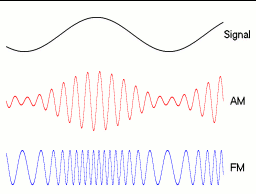
Perhaps aliens have picked up our radio transmissions, remembering that TV transmission is also a kind of radio transmission. Amplitude modulated transmissions, AM, would be easiest to investigate since it is only a narrow carrier frequency that is modulated by wave amplitude.

A radio signal modulated in two ways- AM and FM. Source: Wikipedia.

Black and white television used AM for video and FM for sound. AM is the easiest to understand, but the FM signals are quite different. Frequency modulation, FM, takes a fixed carrier frequency and combines it with signal that is near the carrier frequency, but the frequency is modulated in a way that the sum of the carrier and sound frequencies combine in such a way that the combined carrier and sound signals produce peaks and valleys resulting from combining two signals of somewhat different frequencies. The peaks of the carrier frequency end up adding or subtracting with the other signal.

AM receiving equipment has difficulty discriminating between signal by variable amplitude noise. Lightning or other sources of radio frequency energy easily interfere with the clarity of the signal. If you have listened to an AM radio station in stormy weather, you know how interfering lightning can be.

FM, on the other hand, is from the addition of a set carrier frequency plus a variable frequency sound signal. Electrical mechanisms that produce RF noise generally do not produce an FM signal, thus the quiet sound of FM reception.

Interlacing raster scan lines on a TV screen. Alien receivers of TV signals would have to assemble images from an interlacing raster scan signal with a proper sweep frequency across the screen. Image: Wikipedia.

This is a superficial explanation of television. Television images of the Lucy show, or the Three Stooges received by aliens has been speculated on to our great amusement, but we should understand that a transmitted TV signal is generated taking into account of specifically how it will be read. On a monochrome TV receiver screen, the picture is produced by interlacing two half vertical images alternating every 60th of a second so a whole image is received by our retinas every 30th of a second exploiting our persistence of vision to prevent flickering images. Below 30 frames per second, the images begin to flicker. Aiding in this is the fact that the phosphors in the picture tube glow momentarily after the beam has passed. In order to produce images from a radio frequency signal, this method would first have to be recognized then a receiver built by the aliens to “decode” the signal. Also, the aliens would have to recognize that the analog information is visual in nature and presented as an interlaced raster scan on some kind of display. Misinterpretation of our signals as hostile in nature would be avoided, hopefully.

Ok, movie projection just for fun

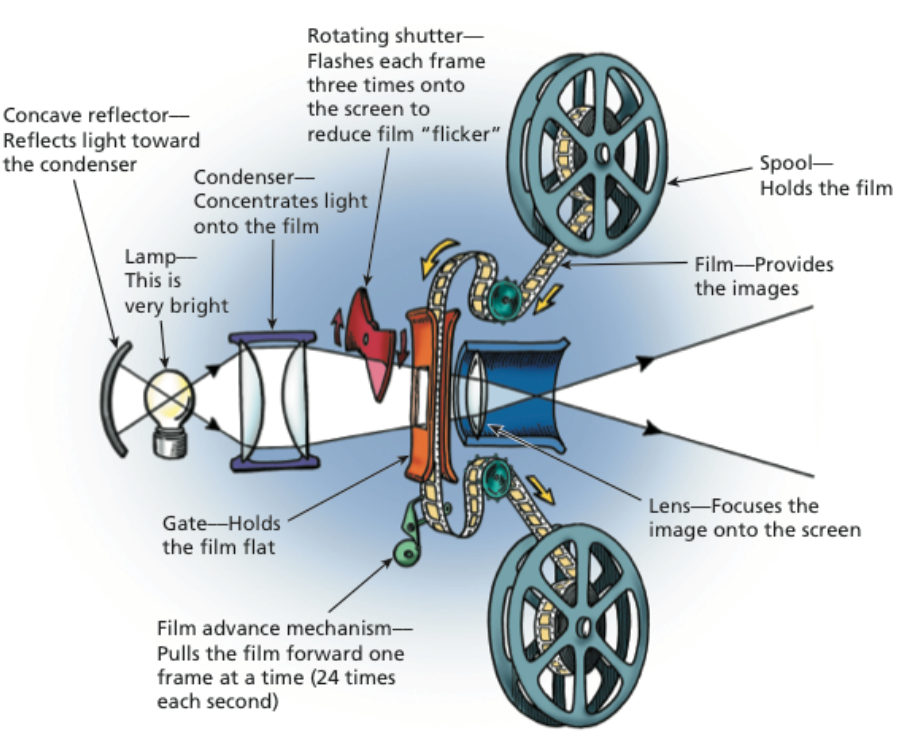
The passage of movie film through a movie projector is at 24 frames per second but flickering is avoided by projecting each frame twice to give a frame rate of 48. The classic sound of a movie projector results from the advancing of each frame past the shutter, stopping the film momentarily while the shutter rotates in the light beam and shines light through the frame twice. Slack is built into the continuous flow of film through the projector using loops of film above and below the aperture and shutter to allow continuous movement of the film but also stopping for 1/24th of a second so that a steady image is projected twice per frame. The source of the flickering sound is in large part from the upper and lower loops jumping up and down every 1/24th of a second.

If only we’d ship reels of movie film to the aliens, they could better understand us. For starters, I’d suggest a recent Godzilla movie.

The essential parts of a movie projector. Note the loops above and below the shutter. Source: Smithsonian.

Cancer #4 for My Tumor Collection

I’ve found that one of the best ways to think is to write. Writing is thinking. This is why I sink so much time into writing this damned blog: To think my way through questions. It seems to work, though my conclusions aren’t always right.

=================================================================

To date I have been diagnosed with basil cell cancer, two squamous cell cancers and prostate cancer. What I have learned is what others have said all along- cancer is often a long-term affliction rather than an immediate death sentence. I’m in remission 4 times over.

Most of the time it is hard to appreciate simple and routine activity. The pertinent example here is how, during the process of chewing and swallowing food, we shift food around in our mouths with our tongues and use other musculature we are ordinarily unaware of. This is true for solid food and liquids. Highly automatic activity that we rarely think about. Then one fine day we can lose much of our ability to chew and swallow. I recently had that fine day.

Aspects of chewing and swallowing are two parts of our anatomy rarely considered: The epiglottis and the uvula. Radiation has damaged a swath of tissues and neck surgery has disrupted nerves that control of these two throaty bits of tissue. In 2013 I had a cumulative radiation dose of about 50 Gray to my neck in 1.8 Gray doses over 4 weeks. The Gray is a unit equal to 1.0 Joule of energy absorbed in 1.0 kilogram of tissue. Your onco-doc will prescribe a daily and cumulative dosage to a specific 3-dimensional section of tissue. The damage to tissue that radiation produces is grossly similar to sunburn (which is also radiation damage), but to the entire volume the beam passes through.

A digression into radiation

The clever machine that delivers the therapeutic x-radiation is called an IMRT- Intensity Modulated Radiation Therapy. It has an electron accelerator that slams high speed electrons into an angled copper target which causes the electrons to abruptly lose energy in the form of x-radiation. Prior to every treatment the tattoos on the patient are aligned with external laser beams and then an x-ray CT scanner mounted on the IMRT rotates around the patient lying on an adjustable table. This is to assure that the patient is properly placed for the IMRT to dose the desired volume yet limit the radiation dose to surrounding tissue.

X-rays result from an inner orbital electron being ejected by collisions with impinging outside electrons to leave a partially empty low energy orbital which is immediately refilled by upper level, higher energy electrons dropping to a lower energy orbital and conserving the energy change by emission of what we call an x-ray. There does not seem to be a sharp energy dividing line between x-rays and gamma rays.

The latest tumor

If you knew me anytime before September of this year, you’ll note that I spoke normally, absent slurs or other speech impediments. Today I speak with a distinct slur when attempting to speak certain sounds like s, ch, sh and words. I am as yet unable to lick my lips or stick out my tongue. You know that smacking sound you make while giving a short kiss? That’s gone too.

In August 2025 I was diagnosed with having a tumor on the left side of my tongue. Two years earlier what was to become a tumor was just a dysplasia and it was removed surgically. In September of this year, I had the tumor removed as a slice off the side of my tongue the width and thickness of a dime during a partial glossectomy procedure.

Another brief digression

In our college library during grad school, I would check the book carts to see if the book I sought hadn’t been shelved yet. One day while perusing the book cart I found a medical school text on maxillofacial surgery (1960’s). Being a curious person, I picked it up and thumbed through it. I was shocked and sickened to the point of hurling by what I saw. For the first time ever I had to run immediately to the restroom to vomit. Never again did I look into this topic.

The maxillofacial textbook detailed surgical techniques, the results of large-scale removal of large facial sections and underlying bone structures, and facial protheses. This often-left gaping, gruesome holes in the faces of patients, revealing parts of the anatomy never meant to be on display.

Circling back

So, imagine my dismay when, in 2013, I was diagnosed with stage 4 throat cancer. Then again 2 months ago I had another squamous cell tumor pop up on my tongue. Images of the maxillofacial textbook came back afresh. The throat cancer was HPV-induced and highly treatable but the tongue cancer was not, so they were not considered to be related.

My guess is that, of the 4 different cancers I have, the cancer that sends me into the crematory will likely be the stage 4 prostate cancer. My quest to remain above the grass will be at an end.

From all of this I have learned that swallowing difficulties with food inhalation can lead to pneumonia. My pneumonia wasn’t horrible, but it kills a lot of senior citizens. It’s been called something like the “the old man’s friend” since it can sometimes lead to a softer death.

The immediate effect that a cancer diagnosis has on most folks is to believe that you’re a dead-person-walking. Sometimes true, but not always. I’m in remission 4 times over. I’m always amused when at the dentist they put a radiation shield over me to get a low dose dental x-ray. Big whoop. A dose of 20 Gray all at once is considered to be an LD50 dose. Since 2013 I’ve absorbed over 100 Gray between 3 separate x-ray therapy treatments, two PET scans, and multiple CT scans too numerous to mention.

One final paragraph. While taking chemotherapy in 2013 for throat cancer, I spent 6 sessions in the infusion ward with cisplatin dripping into my vein. My chemo experience never had an adverse effect on me. However, each visit there were women a few seats away with breast cancer, presumably, getting their chemo. Often they were moaning and vomiting in heartbreaking discomfort. It was a picture of what some unfortunate folks have to endure, and I felt guilty about the ease with which I was receiving chemo. So far, I have been very, very lucky.

And so it goes.

Navigating the Rocky Coastlines of the Chemical Business

[Note: Formerly named “PhD Chemists are freaks!!,” this essay has been renamed to better match the content.]

Preamble: Yes, yes, yes. Obviously, I’m aware that my experience in no way represents the careers of nearly all chemists. As usual, I drift into adjacent chemistry topics. Get your hands away from the keyboard and just read.

Bud (a pseudonym), a PhD chemist consultant and coworker, claimed that people with the exalted PhD degree were freaks of nature. Bud opined “Just look at us! Who goes to school for as long as we did and then ends up in a place like this?” I didn’t add at that moment that between a BA, PhD, 2-year postdoc and a stint in the professor trade, I was in academics for 16 years and walked away from it. Just then I couldn’t defend how smart it might have been to tread down this path only to end up in an old office trailer where we were sitting at that moment.

Bud used to argue that PhDs in general were freaks in society. Only a small fraction of undergrads will go on to grad school and fewer still complete a PhD program. The fraction is smaller yet in the general population.

In science you need a PhD in order to have even a hope of leading an R&D project, technical C-Suite corporate position, institute or professorship. The degree isn’t intended to resemble a trade, but rather to be a highly educated scholar and a subject matter expert with good communication skills and a sharp mind. If one is investigating for new phenomena, an intimate knowledge of known phenomena is needed to discriminate a finding. No awards for rediscovery.

Bud retired from a career at a big chemical corporation only to jump back into the hairball as a sales consultant for us in his retirement. I was a couple of years into what would be my major career “choice” and was managing the sales & marketing department then. Somehow, I had stumbled into the business side.

Our other sales consultant, the “Great Gondini”, retired from a photocopier company as a PhD chemist developing magnetic media, charge transfer agents and other xerographic-related materials. From his soapbox he advised us to-

It’s not that non-chemical-company chemists couldn’t rise up the career ladder, but being in a niche subspecialty at a company that produced photocopiers was not the way to grow your career in chemistry. Often such a chemist may be the only chemistry PhD on site and is likely to suffer from professional isolation. Experience with project execution on time and on budget is a great way to rise in a company. Engineers frequently rise to top level positions because they understand technology AND quantitative economics.

I knew 2 BS/BA level chemists and 1 PhD level chemist who obtained MBAs. Their careers leapt into higher gear with their move to the business side. In business it is important for at least someone to understand how finance works in addition to the technology. Even graduating with a business minor might be helpful but not as much as an MBA. I got an A in ECON 101 but only I cared. Education in basic accounting is very helpful on the business side.

As I see it, some realities of being in industrial chemistry R&D.

In my organic-synthesis-oriented research group in grad school, the big dream was to get an R&D job in pharma R&D. Cool medicinal chemistry and a chance to help to cure disease for the benefit of mankind. It is an honorable and, if I may be permitted to say so, prestigious career as a pharmaceutical scientist. At least in the world of chemistry.

Since then, more than a few in my grad school cohort had been laid off by the pharma companies or joined another. A few have been laid off 3 times from what they believed were secure slots. Pharma companies, like most others, aren’t run by chemists for the most part. Quarterly EBITDA is a major driver for the board of directors. The C-Suites are packed with corporate and patent lawyers, retired CEOs, MBAs, Md/PhDs, CPA finance people and perhaps a PhD chemist heading up the R&D operation as a Director or Vice-President.

After my academic career and my short rotation through the polymer world, I ended up for 6 years in chemical sales and marketing which was limited by my personal geographic requirement of living in the mountainous western US. As my opinion of the pharma business matured, I discovered that, as a raw material vendor, to be ever so careful with pharma customer promises and purchase orders. Not because they are liars, but because many felt free to cancel orders even after bulk raw materials arrived and after our R&D effort to meet specs. Their interest in us was based on using our low bid to leverage another supplier on price. This is common actually and I have done it myself. They waved future business in our faces knowing that, probably, they would never send receive an invoice. Still, not unheard of. But the hassle and our wasted R&D and opportunity costs were especially galling. But we were a spot supplier and susceptible to such disruption. My company didn’t like to sign contracts at that time, so we always took the risk on spot buys. Spot sales gave us manufacturing flexibility as a custom chemical producer, but at the expense of uncertainty. Later, attracted by the same sweet songs of Lorali that led hapless sailors into the rocks, we would repeat this fool’s errand once more.

Off-topic advice

Back to our regularly scheduled programming

On one occasion a big pharma customer wanted a product delivered across the Atlantic to Ireland. Time and distance weren’t the issue, though. It would equilibrate and precipitate below about 15 oC on the transatlantic voyage, so we bought heated shipping containers and installed them in Ireland on a site that wasn’t afraid of the W (indicating a water-reactive hazard) on the hazard labels or the safety data sheets. Scheduling heated transport could be sketchy in fall, winter and spring because most were booked for shipping fruits and vegetables. So, a month into the campaign and after an encouraging site visit by two of us sales guys (Tipperary isn’t so far after all), I received a call saying that they had changed their process (!?) and that a competing European supplier was chosen to ship directly from the continent on demand and without the (our) expense of staging heated storage. Once a pharma company writes in each raw material into their drug filing, changing suppliers or a change in specifications requires the heavens to open up and thunder “make it so.” In the end, they reimbursed us for raw material costs only. &#$@%*&^!! This would happen again later but with a more difficult product to produce.

My early career path led me away from the fabulous pharma world and into undergraduate teaching, initially. The other group members achieved their goals of a pharma R&D position. While I spent the next 6 years in academia one way or another, my grad school colleagues were drawing big salaries with 401(k)s in well-equipped labs, but in locations on the US East Coast, Gulf Coast or Midwest- regions that I would never consider moving to. In the end, most buoyantly bobbled up the career ladder to become directors and vice-presidents of R&D or technology as their final positions. No disrespect, just envy.

A few talented chemist colleagues from grad school climbed up the corporate ladder without business training, learning what they need on the job. Most others, though, remained in the tech end. The reality of being a scientist in industry is that upward mobility in a large corporation very much depends on your improvements in job performance, profitability, volume or especially the successful execution of a capital project. But capital projects are normally given to engineers because they are trained to deal with the cost of the equipment and in the cost of operation.

In my experience, a BA/BS, MA/MS or PhD chemist can usually retire as a senior bench chemist, analyst or lab project leader managing bench chemists. If you enjoy lab work, this is it. By retirement you’ve already topped out on the salary scale and have put away a fair sum in the 401 (k). It is a good life for a great many. But for myself, my interest in bench work dropped from hot to tepid after my 2-year postdoc. I got into molecular modeling and dynamics as a postdoc and actually answered a vexing question about kinetic vs thermodynamic control in a reaction that gave contradictory results. Even got a JACS paper out of it. It was fascinating stuff, but it made me look away from straight synthetic chemistry long enough to appreciate computational and physical chemistry.

As a postdoc I used AMBER and SPARTAN, I did molecular dynamics and molecular mechanics to make a stab what was possibly the global minimum strain energy. Ring strain calculations were used as a coarse screen for potential comonomers for the ring-opening polymerization (OP) reaction we were hoping to commercialize. The homopolymer was amber colored, brittle and rattled when handled as film. The comonomer idea based on the notion that the homopolymer contained too much crystallinity. The glass transition temperature needed to be at least below room temp. Suppressing the crystallinity and retaining certain key properties along with biodegradability was crucial. Even worse, the proposed comonomer must participate in reactive extrusion with the original monomer and be available in commercial quantities at a low cost. Finally, the copolymer needed to be water white. The color spec was difficult to achieve.

Final Comments:

My comments in this essay are based on personal experiences in my world. Your world is almost certainly quite different.

I haven’t mentioned analytical chemists because their world continues to be overtaken by automated instrumentation that will calculate the results and put together a report for you. Sampling and wet chemistry are still hands-on operations as far as I can tell. But this is taken as a challenge to instrument makers who will try to engineer around the hands-on requirement to provide something that can be automated. In my world I see more employee turnover with BA/BS analytical chemists than with organic R&D chemists.

As far as employee turnover goes, analysts are under continuous pressure to produce results so that production can proceed or to get product out the door. With hundreds of raw mats, intermediates, and final products, each with their own standard test methods and specs, I certainly wouldn’t last long as an analytical chemist.


WTF MTG?

Marjorie Taylor Green’s status as a GOP MAGA wingnut seems to be evolving. In fact, she has been having episodes of actual sensibility of late. What could have happened in her camp? Her open opposition to Trump is actually courageous for an elected Republican.

According to Global News, Greene said she was drawing a line on her agitational tactics on Sunday, saying America needs “a new path forward,” and for people “to come together and end all the toxic, dangerous rhetoric and divide.”

“I’m leading the way with my own example, and I hope that President Trump can do the same,” she said.

Perhaps she is having serious negative feedback on her wacky outspokenness from her district in Georgia? Or possibly the ghost of political future visited in the night to show the disastrous future of her politics for America. In any case, she has had a political Come-to-Jesus moment and is using the remainder of her term to reign in some of the MAGA madness.

Trump has refused to endorse her bid for the Georgia Senate seat and word is that she took it poorly. A cynical explanation would be that her change of heart could just be a public performance, but maybe not. Open opposition to Trump seems fatal to her career in the GOP.

I’ll offer that she should be given the benefit of the doubt in the sincerity of her transition to a lower state of rabid behavior. Especially since stepping away from #47 took courage and is likely irreversible.

So, hats off to MTG.

Problems with West Texas Intermediate Crude

According to Argus there are problems with the processing of Permian West Texas Intermediate (WTI) crude oil. Natural gas liquids, NGL, and additives are being blended upstream into WTI in an effort to boost profits in the face of low prices for crude oil. This is causing processing problems downstream. The problematic NGL component is butane.

The purpose behind adding NGLs is to lighten the WTI into a higher grade. Refineries not accustomed to receiving WTI that has been lightened with NGL are having problems with excessive light fractions that the refinery was not designed for. Crude enhanced with NGLs produce a higher output of light end yields, leading to production bottle necks. Further, the NGL enhanced crude is less dense and occupy more space in pipeline than does typical crude. As of the time of the report by Argus, is was unclear where the NGLs are coming from. NGLs are naturally found in crude oil.

Mercaptans are increasingly problematic, especially for export to countries with more stringent requirements for sulfur. Sulfur compounds are destructive to refinery operations and are subject to regulatory restrictions in some fuels like diesel and jet fuel.

Offshore US Gulf medium sour Mars refers to oil produced by a platform in the Gulf of Mexico and it serves as a benchmark for quality. Recently zinc contamination has been found in Mars crude stream. This has led to supply chain interruptions and refinery problems.

The Looming Shortage of TNT in the USA

On CNBC today there was a report describing a looming shortage of trinitrotoluene, TNT, in the USA. According to this report, the USA quit manufacturing TNT in favor of importing it around 1986. Weapons-related consumption of TNT occurs both in military explosives for US stockpiles and for exported munitions. With Putin’s ridiculous war against Ukraine, America’s export of TNT-related munitions has increased, depleting the national inventory.

According to CNBC, the USA has been importing TNT from countries like Poland, Turkey, South Korea, Australia, and India. Recently, the price of TNT has increased to $20 per pound, increasing the cost of blowing rock, tanks and people to smithereens.

Some business considerations

If the competitive price for TNT is $20 per pound, then you want to ship it at a cost of at least $10 per pound. Even better would be $5-$8 per pound. This would be wonderful, but the fact is that the commodity chemical business is a high volume, low margin business. A margin squeeze is to be expected. Margins of a few dollars per pound wouldn’t be unusual for commodity chemicals.

Product below specifications can either be reworked or sold as a lower grade of product if there is demand. Commonly, below spec product can be blended with above spec product to pass QA. A TNT production plant coming online will increase the amount of product in the market, leading to depressed prices. What I’ve just said applies to the chemical industry at large, not just for explosives like TNT.

Unlike products such as bulldozers and trucks that leave the plant and go to work to create wealth, military armaments are not tools for wealth creation when used. They are consumables made for offensive or defensive destruction. Mining explosives are used to create wealth, but artillery shells are spent in conflict.

In the meantime, in Kentucky

In response to the precarious dependence on foreign vendors, the US government has awarded a contract to Repkon USA to construct a TNT manufacturing facility in Graham, KY. None other than the elderly Kentucky Senator Mitch “Grandpa” McConnell was present for the ceremony in Kentucky.

A bit of nitroaromatic history

TNT was first synthesized in 1863 by German chemist Julius Wilbrand during research in the area of synthetic yellow dyes. It wasn’t until 1891 that the explosive properties of TNT were discovered by German chemist Carl Häussermann. The earliest reported use of TNT as a military explosive was in 1902 and was used to fill artillery shells. As luck would have it, TNT is relatively insensitive and can be safely melted and poured into artillery shells or other munitions. According to Wikipedia, unlike the British explosive Lyddite, aka picric acid, TNT-filled artillery shells would not explode in contact with ships. Rather, TNT could withstand penetration of armor and then detonate internally. Artillery shells filled with the more sensitive picric acid would explode on contact with armor and explode externally, wasting its energy.

The older cousin of TNT, Picric acid, was used in the Battle of Omdurman, the Second Boer War, the Russo-Japanese War, and World War I. Picric acid was first synthesized from indigo by Peter Woulfe in 1771. It was synthesized purposely in 1841 by French chemist Jean-Baptiste Dumas. Of interest is the fact that the synthesis of indigo and other dyes was a target of much experimentation in Germany in the 1800’s.

Nitroglycerin

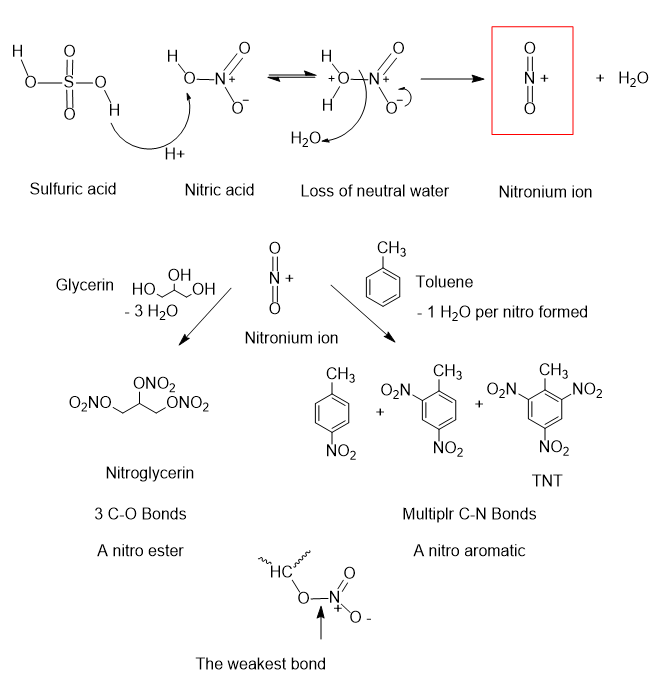
A quote from Wikipedia “The nitration of glycerin in 1846 by Ascanio Sobrero. He initially called it ‘pyroglycerine, and warned vigorously against its use. In fact, he was so frightened by what he created that he kept it a secret for over a year” (Wikipedia). Nitroglycerin is a nitrate ester wherein the three carbon atoms of glycerin are connected to the nitrogen through an oxygen atom. while TNT is a nitro compound with the nitrogen is connected to carbon atoms of toluene. The great sensitivity of nitroglycerin lies in the C-O-N connections while TNT and picric acid have C-N connections. Nitroglycerin is classified as a “nitro ester” while TNT and picric acid are “nitro aromatics.” The nitro ester functionality is much more susceptible to rapid disassembly by a stimulus like mechanical shock or heat.

The nitration of aromatic substances like benzene, phenol and toluene led to the introduction of powerful and relatively easy to manufacture explosives. Naturally, substances that are explosive attract great attention and have undergone a high degree of practical use to perfect.

People routinely disregard the ills of society, but when it comes to developing weapons of war, we become freaking Leonardo Di Vinci.

WWI saw the wide use of picric-acid-filled artillery shells that produced a new degree of violent destruction where used. At the same time the gas automatic machine gun, invented by Hiram Maxim, was introduced into warfare. WWI set the standard for violent death with the introduction of the Maxim machine gun and high explosives.

Interestingly, there is a medical use for nitroglycerin. It is used to treat angina. I have some at home myself, though I’ve never had to use it, thankfully.

Some words about nitration

Nitration of alcohols and aromatic compounds requires a source of -NO2, usually it’s nitric acid. However, the nitrating ability of nitric acid alone is weak, rather it must be activated to produce a more reactive form of nitrate. Sulfuric acid is a stronger acid than nitric acid and consequently is able to remove an oxygen atom by dehydration of the O-H group of nitrate anion producing water and affording a highly reactive (NO2)+ cation. The 6 electrons sandwiching the carbon skeleton of aromatic rings as with TNT, etc., are susceptible to attack by positively charged species and the (NO2)+ cation does the job. The advantage of nitric acid in all practicality is that a hydrogen atom, H+, is already attached producing a water molecule that will easily detach from the nitrogen to form the reactive species, (NO2)+. [As an aside, in chemical processing, liquids are easier and safer to transfer by pumps and piping as opposed to solid addition.]

Formation of nitro esters and nitro aromatics. Graphics by Buford Pusser.

The production of TNT might seem fairly simple- all that is needed are the cheap commodity chemicals toluene, sulfuric acid and nitric acid plus reactors and other process equipment that can resist strongly corrosive acids. The scale of the process will need to be large enough to capture the economies of scale in accordance with capital costs. Utilities like heating and chilling will be needed as well as possible on-site water treatment if allowed. And don’t forget an idiot-proof written procedure and EHS staff as well as talented management. A properly equipped analytical lab will be required for QA/QC.

More fundamentally you’ll need a remote site on which to build a plant that is supplied with sufficient electrical power as well as water and sewer. The state, county and nearby towns will insist on iron-clad assurances of worker safety and proper hazardous waste management. The state will be watching air emissions closely. Then there is finding an insurer to cover the plant and operations.

If you start a nitration operation, why not plan for products in addition to TNT? It can be unwise to operate a 1 act pony. What if the pony dies?

An involuntary grunting reflex (another lap)

Note: This is one of my most instructive memories from 10th grade and has been dredged up from the murky past. By 10th grade I had already absorbed a book on the electronics of vacuum tube radios. At this time you could go to a drug store and find a vacuum tube tester which also had an inventory of common vacuum tubes shelved below the tester. If the tube you plucked out of the TV set failed the test, you could buy a replacement. A burned-out filament was common and easy to spot because the tube was not illuminated by the filament from inside and was dark.

Oh yes. The involuntary grunting noise is the sound one makes while being electrocuted.

=================

Make magazine is one of my very favorite publications. It’s made for hillbilly engineers and aspirants like myself.  Their Maker Shed Store offers kits as well as plans for making all sorts of cool gadgets.

Kit building and garage engineering are important activites for aspiring young scientists. We senior scientist types should be on the ready to mentor local high school students in their bid to learn about technology from the ground upwards.

Electronic experience is invaluable to all experimentalists- physicists, chemists, geologists, biologists, etc., and is a subject of lifelong utility. Many students do not have peer groups or family members who can help them get into this subject. [for many years I’ve trained new hires twice monthly in electrostatic discharge safety and am constantly amazed at how few people know even the most basic aspects of electricity. This includes drawing a schematic of a flashlight which led to the shrugging of shoulders.]

As a junior high school kid, I worked on TV sets (tube electronics) and acquired some electrical and mechanical ability in doing so. I actually fixed a few problems, surprisingly. A family friend had a TV repair shop (remember those?) and as a result I had a steady supply of TV chassis to take apart for my collection of parts like potentiometers, switches, vacuum tubes and variable capacitors.

Like most kids tearin’ stuff apart and eyeing the construction methods and components, I gained valuable electrical insights and personal experience with electrical current.  Like the time I discharged a picture tube through my hand while trying to remove a flyback transformer from my grandparent’s color TV. It was great lesson in capacitance and isolated static charge. As my grandparents sat on the Davenport and watched, they heard a sudden and involuntary grunting noise burst from my mouth as I hurled myself from a squatting position by the opened console TV set and backwards across the room. I probably absorbed more joules of energy from landing on my backside than the joules absorbed by my hand. Luckily, I was not burned. The next day I learned how to properly discharge the aquadag in the picture tube.

The impulse to do science is also the impulse to find boundary conditions of phenomena. Where are the edges? How does it switch on or off? You have to be willing to leave some skin in the game to find out about things.

RIP Crew of UPS MD-11 Crash in Louisville, Kentucky

RIP to the crew of the UPS MD-11 that crashed on takeoff in Louisville, KY.One senior airline pilot believes that the incident possibly began on takeoff in the gap between V1 and V-rotate speeds where an airplane is most vulnerable to engine failure. V1 is the speed where a decision must be made to continue the takeoff or abort. Aborting at V1 is still slow enough to stop before the end of the runway. Exceeding V1 speed obligates the crew to take off lest they depart the end of the runway. V-rotate is the speed where the nose is lifted to begin the climb off the ground.

The MD-11 that crashed. Notice the tri-jet configuration with the engine at the bottom of the vertical stabilizer. An MD-11 is a modified DC-10.

On takeoff the MD-11 is full of fuel (35,000 gallons in this case at 6 lbs. per gallon) and at full power. Near max gross weight and with no further power to add, an airliner might lift a few feet off the ground in ground effect but settling down off the runway at high speed and full of fuel is a gamble most are likely to lose. For commercial jet aircraft, the maximum landing weight and the maximum takeoff weight are different, with the landing weight being a bit lower. A jet taking off at max gross weight and then wanting to return to the airport right away must either dump fuel or loiter nearby to burn off excess fuel. Landing too heavy may result in blown tires and/or landing gear damage. Loss of a main landing gear will result in the wing and possibly the engine contacting the ground which can result in the plane pivoting abruptly and possibly tipping over.

What Happened in Louisville? Pilot Reacts to Crash Footage

The above explanation rests on the cited airline pilot’s early assessment as well as basic aeronautical knowledge. I watch this pilot’s videos regularly and have come to trust his content. The NTSB is investigating and will issue a final report in due time. Explanations prior to the release of the final report will contain some amount speculation. However, some speculators are better than others.

The senior airline pilot on YouTube referred to the fire as an “uncontained” engine fire. A contained engine fire within the engine cowling is almost always survivable, but when the entire engine with pylon breaks off at the wing mount as with this MD-11, the airplane will naturally want to yaw and roll over the missing engine as in what happened. It’s reminiscent in some ways of the engine fire and crash of the Air France Concorde crash in Paris in 2000. In the Concorde crash, a left engine sucked in some tire fragments from a blown tire after running over debris on the runway.

The loss of the entire left engine with pylon resulted in the American Airlines flight 191 crash at Chicago O’Hare in 1979. The cause was due to stress fracturing and failure in the attachment assembly between the left engine pylon and the wing during engine maintenance. Instead of disconnecting just the engine, the airline found it saved 200 hours of maintenance time to disconnect the pylon from the wing instead of detaching only the engine.

Aircraft structures are designed to withstand forces along certain directions. For example, a bird impacting and entering the cockpit may not be a major design criterion. Side loading of a landing gear from landing partially sideways results in forces that otherwise may be tolerated, but lateral forces may overstress the gear assembly, destroying the tires adding to the fa8lure sequence. A pressurized aircraft is designed to withstand internal air pressure and pressure cycling, but not necessarily from other directions beyond some conservative specification. Wings are designed to withstand a certain amount of positive and negative g-forces as well as some flexure, but beyond these specs, the crew are airline test pilots expanding the performance envelope.

The Latest Crusades

You’ve probably heard that #47 has asked the Pentagon to be ready for action. According to an article in The Hill, President #47 has labeled Nigeria as a “Country of Particular Concern”, or CPC. This designation stems from news that Islamic terrorists are allegedly attacking Nigerian Christians. A group of approximately 30 American Christian religious leaders and a few politicians like Ted Cruz and Rep. Riley Moore (R-W.Va.) as well as the entertainers Nicki Minaj and Bill Maher have made a convincing enough case for the President to make the CPC declaration.

If you read H.R. 2431 (2018), you’ll find:

Title IV: Presidential Actions – Subtitle I: Targeted Responses to Violations of Religious Freedom Abroad – Directs the President, for each foreign country in which the government engages in or tolerates violations of religious freedom (including particularly severe violations), to oppose such violations by taking certain actions and promoting the right to freedom of religion in that country. [emphasis mine]

(Sec. 405) Specifies among the actions the President may take: (1) public condemnation; (2) delay or cancellation of scientific and cultural exchanges; (3) withdrawal, limitation, or suspension of U.S. development assistance and U.S. security assistance; (4) instruction of U.S. executive directors of international financial institutions to vote against loans primarily benefiting the foreign government responsible for such violations; (5) restrictions on the issuance of licenses to export any goods or technology to such foreign government; (6) prohibition against the making, guaranteeing, or insuring of loans, or extension of credit by certain U.S. financial institutions to the violating government; and (7) prohibition of U.S. Government procurement of goods or services from such government. Provides for: (1) commensurate actions in substitution for any of the above presidential actions; and (2) binding agreements with foreign governments obliging them to cease, or take substantial steps to address and phase out, the acts, policies, or practices constituting violations of religious freedom.

(Sec. 407) Authorizes the President to waive the requirements of this Act if certain conditions are met.

My reading of Title IV of H.R. 2431 is that the President is compelled to take certain actions against Nigeria. While taking no action does not seem to be specifically barred, I didn’t see it listed as an option.

The potential threat by the President is in sending an expeditionary military force to Nigeria to stop the violence on Christians. According to Wikipedia, the population (2023) of Nigeria is estimated at 236,747,130 people. Unless the terrorists are wearing military uniforms, how will our troops find them and what’s to prevent a guerrilla war with the terrorists gradually taking bites out of our soldiers as they did in Viet Nam, Iraq and Afghanistan? Guerilla warfare has time and again proven successful against superior military forces.

America does not need another distant land war … this time in west-central Africa with guerilla fighters in the jungle. Peace through superior firepower only works if you can find the targets. Perhaps we should call in favors from Israeli special forces?

Finally, conflict between religions is a conflict between ideas. When both sides believe that they have authority based on the supernatural, short of religious conversion or death how do you decisively win such a war? A war of attrition, perhaps?

As a military conflict progresses, what is to prevent escalation on the part of US forces. Or is this just to be the work of a few military advisors? Remember, that is how the US stumbled into the Viet Nam war.