Author Archives: gaussling

About gaussling

Gaussling is a senior scientist in the chemical business. He occasionally breaks glassware, spreads confusion and has been known to generate new forms of hazardous waste. Gaussling also digs aerospace, geology, and community theatre.

Carbonate Fusions

I’ve been reading about extractive metallurgy in my spare time for the last 18 months. Finally I get to try it. The other day I rediscovered the solvent power of molten sodium carbonate. At 1000 C it dissolves porcelain crucibles. Luckily an hour at 1000 C wasn’t enough for a catastrophic failure, just some melt through on the bottom.

Somehow, seeing your reaction vessel glowing yellow-orange (on purpose) is deeply satisfying and awe inspiring.

At these temperatures, the notion of acidic and basic conditions needs to be recalibrated for low temperature chemists like me. Irrespective of the crucible, I did digest my sample and convert it into a yellowish meteorite shaped like a flattened cupcake.

Carbonate fusions are used to release metals from silicate matrices. Molten carbonate hydrolyzes the silicate matrix and renders the resulting mass amenable to attack and dissolution by mineral acids.  Platinum is the preferred crucible material of construction.  I have such a Pt crucible. It’s beautiful.

On the pitfalls of science outreach to the public

There was a time when I cared about spreading the gospel of the periodic table. I was a believer in the inherent good of knowledge and in chemistry in particular.  I knew in my heart that the examined life was a good life and that knowledge of chemical phenomena could enrich ones life greatly. And for me it has for the most part.

I flamed out a few years ago in the public outreach of science. I was involved in an organization that had some astronomy equipment that was available for public use.  I was enthusiastic about science and gave a lively talk that was often well received by members of the public. I had been an astronomy hobbiest since I was a boy.

But over time, I began to see that a sizeable fraction of people weren’t really too interested at all. Parents there with their kids usually just sat there waiting for it to be over.  The kids, usually boys, wanted to hear about black holes. In fact, we could have gone “All Black Holes All the Time” and could have kept the attendance up. All people wanted to hear about was black holes and aliens, it seemed. On occasion there would be some interest in eclipse phenomena. But how fascinating can a shadow be, anyway? It’s just a shadow people. Let’s move on.

Being bored with black hole talk (or my superficial understanding of them) I began to talk about matter and how it seems to have come about. I read about nucleosynthesis and stellar novae phenomena. I read about the insanely energetic Wolf-Rayet stars and tried to introduce the matter side of things.  People would politely sit and listen for a while, but eventually the squirming kids would blurt out a request to hear about black holes.  So,  I would relent and give the canned spiel.  Nobody was interested in hearing about matter. I was on a fools errand.

Space science people and astronomers would come by now and then and speak about star stuff to the community during an open-house. I became increasingly impatient with this and began to ask questions about the star stuff. What the hell is it? What do you mean when you use the word “ice”. 

I finally realized two things. That I’m not an amateur astronomer and I have no interest whatever in being one. And I was bone-weary of the public.  I was not indifferent to the public. Rather, I was annoyed by the public and had no business standing in front of them trying to sell science because, in the end, I just didn’t care if they got it.

Why was I annoyed? Because they didn’t want to work for their insights. They just wanted to pick through it like a box at the flea market. Screw ’em, I thought. The ones who go home and continue their search will eventually get the prize. That I could respect. The rest are out of luck.

I realized that as a PhD scientist I was a member of a small group of actual freaks who were set well apart from the rest of the bell curve in at least one regard. The willingness to dive into deep and prolonged study on really basic concepts and phenomena. I imagine a similar situation for a sculptor facing a block of marble. The answer is in there, but you have to work to bring it out.

All this being said, what about chemistry?  I have done some classic demonstrations for the public. People like watching flash-bang demo’s or other fairly superficial displays. But what everybody wants to see is razzmatazz. The underlying principles are where the deep and meaningful beauty is. But this is to be enjoyed by the few who are willing to hike deep into the bush for a glimpse of it.   I can’t say for the life of me if my talks and demos made a whit of difference to anyone beyond simple entertainment.

Fact is, society doesn’t need a lot of actual scientists at any given time.  It doesn’t even need too many to be even moderately educated in science.  But we do need to provide opportunity for some to learn and grow in scientific concepts. I’m inclined to think that those who show a natural interest in science are the ones we should take care to educate and cultivate. Most people can lead a perfectly happy life without knowing the work of Newton or Einstein, Seaborg or Woodward. For most of human history, this has been the case. Yet we got to the moon and developed the microprocessor.

The real motivation behind broad science education is in the matter of public funding. We need public funding to support the scientific culture. The public needs to feel that it is important to justify the expenditure. So, to keep up appearances, we beat the drum.

anti-IYC 2011

So, what does it mean to have an International Year of Chemistry?  What should it properly celebrate or advance?

I think we chemists have a bit of a professional inferiority complex. The physicists have control over astronomy and space science with its endless pageant of high profile activities and imagery. Glamor-boy physicists have numerous programs on cable channels. Any synthetic utterance of Steven Hawking turns into a documentary.  Medical science people are glorified to embarrassing levels for the most slender blips of therapeutic progress.  Begoggled chemists do flash-bang demonstrations for whomever will watch.

Who will love us for the gift of cheap and abundant synthetic goods? Who will love and adore us for our facility with bond making and breaking?  How many times has the product of your long endeavor been little more than a clear, colorless oil or a white crystalline solid?  Besides you, who could boggle at this? Who will stop and take in a lingering look and shake their head in admiration and wonderment?

I think chemists should clam up about what it is that makes our field so endlesslly fascinating.  We should resist the urge to share the wonder with the world. We should be stingy with the insights and the beauty.  Call it “The Craft” and make it a mystery.  Create scarcity and let the world pay a premium for us to divulge our hard won wisdom.  If we want to create a buzz, then why not try to be quiet about it?  The world adores a mystery.

On the mysteries of show business. Th’ Gausslings 14th Epistle to the Bohemians.

Last night, our production of The ODD COUPLE had its biggest audience to date. The audience enjoyed the show. They laughed at our delivery of Neil Simon‘s lines and were engaged in the story.  The suspension of disbelief actually happens.

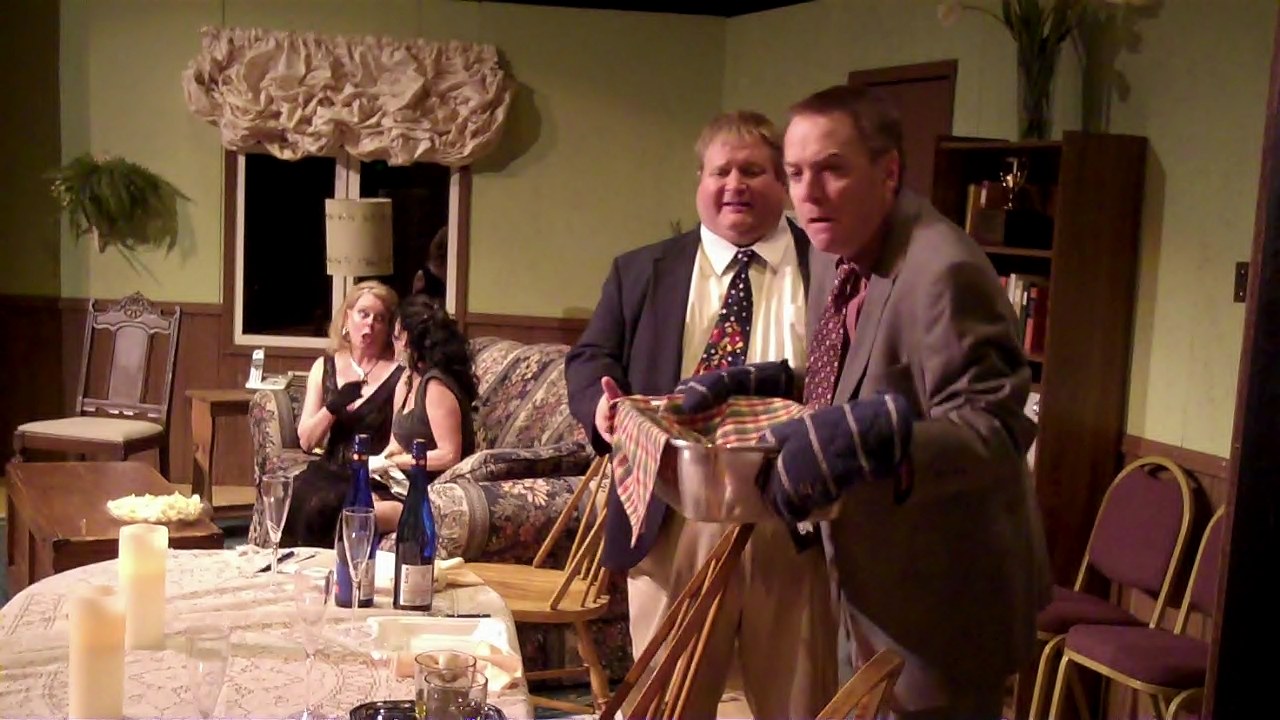
The ODD COUPLE, Felix with burned London broil (1/21/11, Moon Theatre Company)


What is clear to one who is involved in this sort of thing is that once you have the show cast and directed properly, the play takes on a life of its own.  But not all aspects jump to life and run around.

Show business has two sides- the art side and the business side.  As I said above, the art aspect is taken care of by the director.  The business side, the haunting space of the producer, is perhaps more difficult in my experience.

The business side comprises the nuts and bolts of funding cast & crew, props, the venue, set design and construction, etc.  This is very concrete and relatively easy to understand and manage.  What is less than easy to understand is the publicity function. 

Publicity today must be done in the schizophrenic world of print and internet media.  The center of the community theatre-going demographic are the retired people and those over, say, 60 years of age. Go to most any production and you’ll see the Q-tips and Blue Hairs in the seats.

In order to put butts in seats, this group must receive the message and thence be wrenched from the recliner in front of the DirecTV and compelled to go out into the evening traffic, find a parking spot, and buy a ticket. 

After rehearsal the other night, a few of my fellows and I repaired to the local establishment for some beverages. This public house featured an open mike performance by local musicians who were actually quite good. The tables were filled with an entirely different demographic group than we had set our sights upon and the air was full of expectant optimism.

After the waitress delivered my cold glass of liquid bread I put  to her a sincere query.  I asked her what it is that would compel her and her fellows to attend community theatre?  This fine specimen of a 20-something stood there flummoxed. She was accustomed to fending off the unwanted advancements of inebriated customers, but this sort of question was completely unexpected. She left to tend another table, promising an answer on her next visit. 

On her next visit, the waitress, a former theatre major, said that she would be attracted to a production that was … edgy.  That was it.  I acknowledged her comment and asked her if she ever goes to live theatre performances. She said “no”. I asked her how would such a message find its way to her and her compatriots. She thought about it and replied that she didn’t know. There was no single information outlet that percolated up.

I suspect that this interchange represents the situation in miniature. We have so many channels with densely packed data streams pouring into our consciousness that we are overwhelmed with it. Information is cheap and abundant. The value of any given notice of a public event is diluted to an infinitesmal level by the sheer volume of similar such notifications across the multidimensional space of media.

We do suspect that the Blue Hair demographic still reads newspapers and in the future we’ll throw a handful of money at print advertising. But like everyone else, we’ll be uneasy with the expenditure.  It is very difficult to predict the effect of low intensity advertising in any given medium.

High intensity advertising, on the other hand, is a good way to get the message out. But high intensity advertising is high intensity spending and that isn’t an option yet.

Frequently wrong, but never in doubt

At some point, self-confidence more resembles a learning disorder. This is one of the great truths of history, I believe. The unwise advancement into adverse conditions with little more than the loincloth of bravado has lead to the demise of many. In that group of the many are military and political leaders, businessmen, frontiersmen, ponzi scammers, technocrats, and adventurers of all sorts.

We all like to be around people who are self-assured and cool. The air of self-confidence is a necessary attribute for those entrusted with the authority to commit resources on the large scale. But often the authority is not backed with a durable feedback loop for checks and balances. This is a fatal weakness in any system that focuses the authority on a few to delegate resources.  Sweet enthusiasm may quickly ferment into the delerious elixor of greed. Beware those who are frequently wrong, but never in doubt.

This is the Darwinistic force that lead to the evolution of that curious species, the auditor. The auditor is an omnivore with slender and dextrous fingers for prying under the bark to tease out burrowing pests. The large ears of the auditor and cavernous nasal passages evolved to detect burrowing vibrations and the unusual odors of malfeasance.  The bulbous eye stalks have special neural GAAP networks for the detection of tell-tale body language and with laser-like focus, can pierce the corporate veil and lock onto fraudulent transactions.  Woe is he to whom the auditor has taken special interest.

China’s Stealth Fighter Revealed

It is interesting that China’s new J20 stealth aircraft has been revealed before deployment. US stealth aircraft were long a source of UFO reports before they were officially acknowledged.  The Chinese J20 aircraft, called a “fighter” by some, bears a striking resemblance to the US F22 Raptor, though larger and perhaps capable of a fighter-bomber role.

China's J20 Aircraft

While some discount the real maturity of Chinese stealth technology, it is clear that they are on track for parity with the US in this regard.  Stealth technology has as much to do with the shape and angle of surfaces and edges as it does radar absoptive coatings. The Chinese already know what it takes. They just have to come up with flight control systems and manufacturing processes to build the aircraft.

Stealth aircraft and nuclear powered aircraft carriers are a potent combination for the projection of power. Will the sun rise on a Chinese nuclear carrier group patrolling the Atlantic by 2020?  Where will their authoritarian marketplace take them, and us?

Antimony Funnel Formation at Stibnite, Idaho

In the Pnictogen Hall of Fame there is at least one p-block compound with a town named after it. The ghost town of Stibnite, Idaho, sits silently in the Yellow Pine mining district 40 or so miles NW of Cascade, Idaho.  The town of Stibnite is named after the sulfide of antimony- Sb2S3.  The chemical symbol, Sb, is related to this mineral name.

Idaho sits in the great North American cordillera.  A cordillera is a grouping of mountain ranges at the continental scale. In the case of the North American cordillera, it begins ca 103 west longitude and extends to the Pacific ocean. The Black Hills are found somewhat east of 103 degrees, but I’m generalizing again. In the US, the Rockies, Wasatch, Cascades, and the Sierra Nevada ranges are part of the cordillera formation.
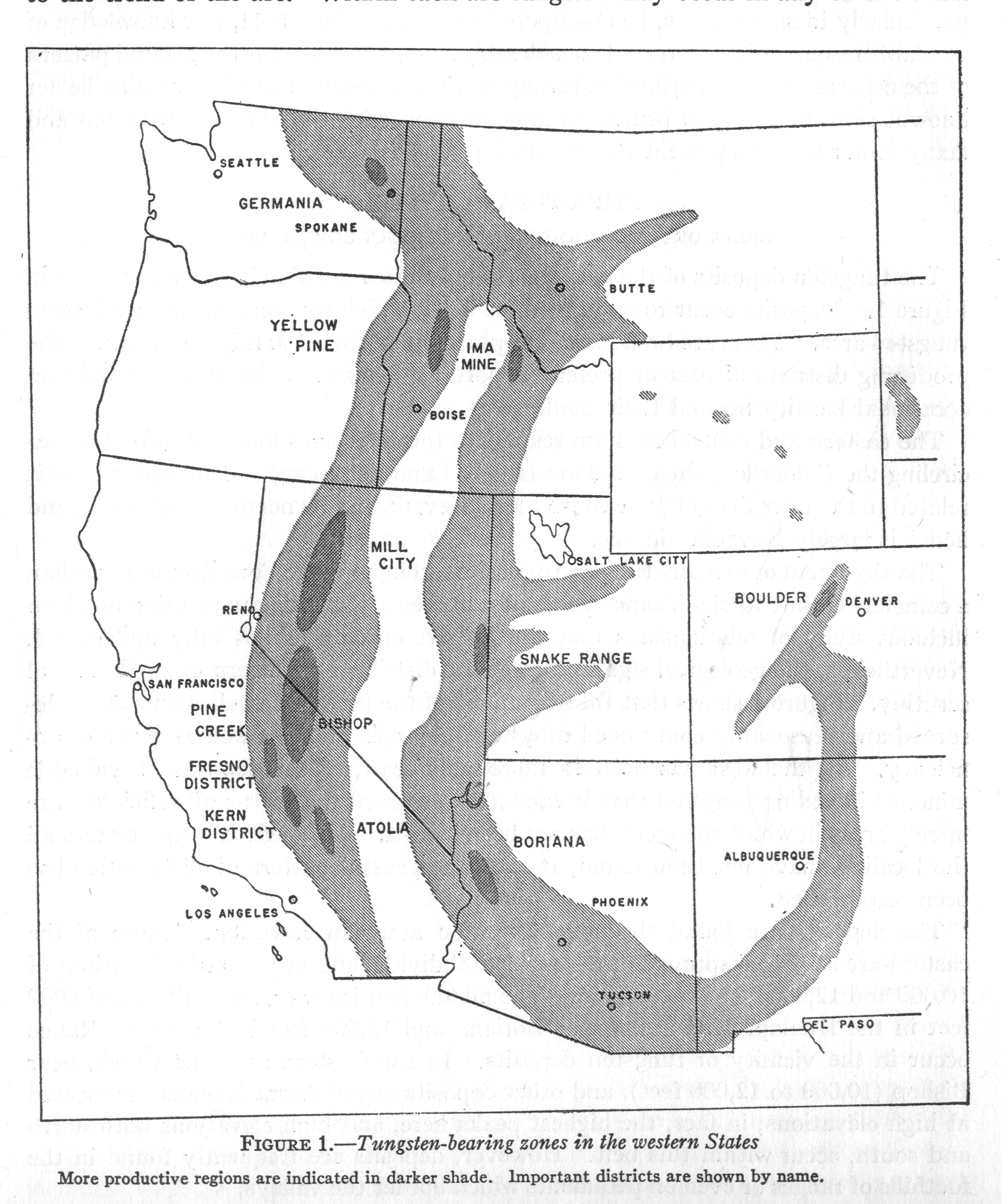
North American Tungsten Belt. From Paul F. Kerr, Tungsten Mineralization in the United States, 1946, Waverly Press.

One characteristic of the cordillera is the broad occurrence of economically important metal deposits. In the illustration above, the occurrence of tungsten is associated with the mountainous regions of the west. An important feature found in economic metal bearing districts within the cordillera are vein deposits. Metals can be disseminated in rock or concentrated in veins. 

In Colorado, the Cripple Creek & Victor mine is situated in the throat of an ancient volcano. This ore body is an example of highly disseminated gold ore which is interlaced with vein structures containing higher concentrations of gold.

Rather than perform underground mining, the economics allow the large  scale removal and crushing of rock to pebble size followed by extraction with cyanide to isolate the value.  This mining technique was not possible until the advent of large scale mechanization. In the early days, the Cripple Creek district was limited to underground mining of vein formations that were more highly enriched in gold.

What is crucial to the placement of a metal ore body is some process that leads to concentration of valuable metals. Recall that the definition of an ore is based on economic considerations.  At some level of dilution all ore becomes just gangue or country rock. Concentration of value in the ore body near the surface can arise from several mechanisms.

A common process that concentrates desirable minerals is hydrothermal deposition. This is found widely in the cordillera. A natural consequence of mountain building is the generation of stresses within the upthrusting  rock. At some point stress gets relieved by fracturing which results in the formation of void spaces within the rock.

Underground water, which at depth is at high temperature and pressure, will dissolve components of rock in contact with the water. This water will naturally convect and flow towards the surface, carrying whatever solutes that were favored by higher solubility.

Deposition occurs as the water flows to the surface within whatever fracture network the waters find themselves in and may continue to deposit until the vein seals itself shut. Over the fullness of time the formations are thrust upwards and erosion wears down the rock to expose outcroppings of the desired mineral at the surface. 

Such processes have put vein lodes in place all over the world, including the American west. Deposits of gold, silver, antimony, iron, mercury, and tungsten are examples of metals that are concentrated in this manner. Ostensibly, this is happening in geothermal hotspots like Yellowstone or Iceland today.

These exposed outcroppings weather and oxidize, generating new mineral compositions. In the case of gold, its relative inertness leads it to form the native metal in these weathered formations and, under the influence of gravity and the hydraulic forces of snowmelt, gold will work its way downhill and into the alluvium.

Other elements besides gold are also mobilized, particularly the sulfides. In the deep crust, well below the depth to which oxygenated meteoric water can flow, is an environment rich in the anionic subunits oxide, sulfide, silicate, and aluminate. Metals and metalloids like Cu, Sb, Ag, As, Pb, Hg, etc., form complexes with the various anions and correspondingly, 3 dimensional networks of inorganic polymeric species. To the extent that a 3-D network of shared atoms, edges, and faces of tetrahedral crystalline subunits can be formed, the resulting bulk material may have a high melting point and high strength.

However, when connectivity is lowered by chain or network terminating constituents, the melting temperature and hardness of the material may be lowered.  An example is soda glass. When silica is diluted with chain or network terminating components like soda or lime, the high strength and high melting point of quartz, which is just pure polysilicate, is lost. The same thing can happen naturally in mineral formation processes.

Other kinds of ore are put in place by fractional melt crystallization and layer deposition by density within a magma chamber. The major ocurrences of platinum group metal (PGM) deposits are an example of such a process. Eventually, tectonic processes raise the frozen and extinct magma chambers to the surface where erosion exposes a narrow banded horizons referred to as a reef.  The Bushveld Igneous Complex in South Africa and the Stillwater Complex in Montana are examples of this mechanism.

The deposits found near Stibnite, Idaho, are comprised of antimony and tungsten as well as lesser amounts of gold and silver. In about 1900 gold, silver, and antimony were discovered in the area, leading to a gold boom at Thunder Mountain.  During the years from 1938 to 1944, the Yellow Pine (W, Sb) and Meadow Creek (Au, Ag, Sb) mines in this part of Idaho were the largest producers of tungsten and antimony in the United States.

The details of this mining district can be found in:

John R. Cooper,  Geology of the Tungsten, Antimony, and Gold Deposits Near Stibnite, Idaho; 1951, Geological Survey Bulletin 969-F.  Stibnite Idaho USGS

In the abstract, Cooper describes the W, Sb, Au, Ag deposits as being confined to an area about 1 mile by 3.5 miles in scope (as of 1951). The principal rock of the area is quartz monzonite which is extensively fractured and has been penetrated by dikes of basalt, quartz latite porphyry, trachyte, and rhyolite.

Cooper describes a deposit whose metallization has taken place in three stages with intervening episodes of fracturing. The first stage is described as extensive replacements by gold-bearing pyrite and arsenopyrite.  The second phase of deposition or replacement is less extensive and is by scheelite (CaWO4) within the gold ore bodies.

The third stage of growth or deposition is of stibnite and silver, largely within the same fracture systems as the scheelite. The ore bodies occur with the Meadow Creek fault and associated subsidiary faults in the quartz monzonite. The tungsten-antimony ore body within the formation took the shape of a

“flat upright funnel flaring to its widest diameter at the surface and tapering to a narrow neck, which extends below the bottom of the minable tungsten ore. The underside of the ore body is very irregular in detail.  The highest grade of tungsten ore was concentrated toward the center of the mass and was surrounded by an envelope of antimony ore containing only a little tungsten.”    – John R. Cooper

The Meadow Creek ore contained 0.23 oz gold per ton and 1.6 percent of antimony.  The Yellow Pine ore contained little gold but 4 percent of antimony and 2 percent of WO3. The Yellow Pine deposit was exhausted of tungsten in 1945, producing 831,829 units of WO3 equivalents in the concentrate. One unit of WO3 is 20 lbs of tungsten trioxide.

Much of the scheelite was found disseminated in brecciated gold ore.  Some scheelite was found in branching stringers and veinlets within the groundmass.

The stibnite occured as “disseminations, microveinlets, stockworks, massive lenses, small fssure-filling quartz stibnite veins, and euhedral crystals coating late fractures. ”  Oxidized antimony minerals such as kermesite (Sb2S2O) were reported as being very scarce.