Author Archives: gaussling

About gaussling

Gaussling is a senior scientist in the chemical business. He occasionally breaks glassware, spreads confusion and has been known to generate new forms of hazardous waste. Gaussling also digs aerospace, geology, and community theatre.

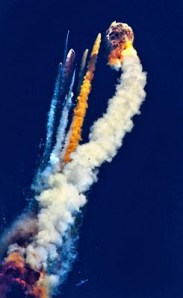
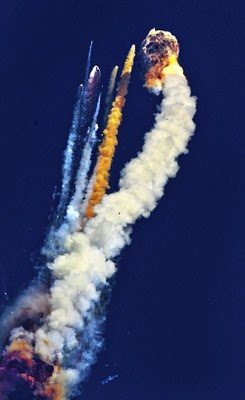
Comics Saddened Over Launch Failure of Comedy Central Satellite

Kennedy Space Center,  January 6, 2011.  Officials at the Kennedy Space Center released spectacular photos of the recent launch and explosion of SITCOM 2WTF. The $300 million comedy satellite was to be the first of 3 satellites to go into geostationary orbit exclusively for the Comedy Channel. Underwriters at Acme Insurance, however, weren’t laughing.

Launch Failure of SITCOM 2WTF

Lewis Black, Director of Launch Operations at the Comedy Central network, was quoted as saying “Sonofabitch!!  We put a bird on orbit dedicated to Law and Order reruns just the other day. What the hell happed to this one?”

A spokesman for Kathy Griffin, Satellite Procurement Officer for Comedy Central, said the comic had been on the phone all morning with Pixar’s Comedy Rocket Motor Division headquarters in Malibu. Griffin is reported to be quite upset and is preparing a Comedy Central tell-all special on her drunken encounters with comedy satellite celebrities like Jerry Seinfeld and George Wallace.

Veteran comic Phillis Diller is reportedly shocked by the event. She was selected to be at the cape to light the fuse for the launch.  Diller was unavailable for comment.

Words from the Great Gondini

I used to work with a sales consultant who would say smart things now and then. As sales manager, consultants were usually the bane of my existance. Not because they were no good- often they were quite competent- but because they were problematic. Management brought them in because, with its all seeing eye, it believed that we foot soldiers were unable to make certain changes.

So when a consultant arrived we had to bring them up to speed and then watch them slowly fail to make the changes. They nearly always failed. Management was looking for change in the lower eschelons but never considered that change at the top was necessary. Ever. One day we’d hear that so-and-so had moved on to other things.

Working for a corporation is very one-sided unless you are at the very top. Employees are expected to be loyal and hard working no matter how outrageous the working environment and no matter how incompetent the management. Fail to impress management and you’ll face the prospect of job hunting without good references.

But I’ve gotten off track. The Great Gondini (I’ve scrambled the letters in his name) used to say this-

Never work for a company as a chemist if chemistry is not their main activity.

He spent much of his career with IBM and later, Lexmark, involved in magnetic coatings for disk drives, charge transfer agents and other xerography chemicals, and toners. IBM and Lexmark are not chemical companies.

The point my friend was trying to make was that professional isolation within a company has consequences. One consequence is that promotion to upper management is difficult owing to the lack of participation in the management of core projects.  It is understood that there are exceptions.

There are benefits to isolation. You get to be the company wizard. Often management is loath to mess with you because, while they know that you do something important, they aren’t really sure what it is. I experienced this phenomenon when I was a chemist in a dairy lab. It can be quite amusing.

The isolation issue exists even for chemists in chemical companies. Your ascendency to upper level positions is stunted if you have not been involved in the major company projects in a significant way. If you’re running an small lab somewhere in the organization, especially if you’re in a service role, it is hard for management to promote you to VP of Chemistry over that project manager whose successful project went to market on time and on budget.

If you’re not interested in this kind of advancement, then it is a moot point.

Some chemist friends have mentioned to me that I make sweeping generalizations and this is surely true. There are exceptions to all but the most specific statements, eg., x = 3 (wait a minute, doesn’t x = 4 as well !!??).  Generalizing is a rhetorical technique. The view from 50,000 feet is meant to show the overall topography.

Chemists love details and, like a pig in shit, we love to roll around in the data. And for some, no detail is too small to bring the show to a complete halt while they wrestle with details. I’ve seen this many times. This makes it difficult for some chemists to make the transition to other job descriptions. It is a simple fact that we sometimes have to move forward with an incomplete picture.

Back to reality.

The holidays are over. The christmas lights are now obsolete. The first big snow storm of the season has come and gone. The cryosphere is unceasing in its wicked attempt to thermally equilibrate my house to a ΔT = 0 across the walls. Only high thermal inertia and a near constant stream of methane into the burners will hold it off.

That jolly elf brought Th’ Gaussling a 1 terabyte external hard drive. Years of pdf downloads and treasured jpeg’s streamed silently onto the drive via the fabulous USB port.  Papers on mining & metallurgy, LiBeB cosmochemistry (on the Lithium dip, one of my fascinations), and thousands of photos.

While picking at the guitar the other day it dawned on me why some people choose to play the base guitar.  Four strings are mechanically easier to play than six. Maybe there are other and better reasons, but this seems like a good one. Then, as you advance, there is playing notes from the fifth fret and above.  My brain plasticity turns vitreous at this level. It comes down to repetition of the basics.

Remember the basics: Task at a time- correction in the right direction;  attitude, altitude, cross check;  and, runway behind you is useless!  Dave Benton, Th’ Gausslings flight instructor, ca 1978.

For me and my day job, 2011 will be very much about thermokinetic issues in process safety. We’re going to install a reaction calorimeter and much time and effort will be needed not only in operating the device, but in folding its use into the development cycle. It is one thing to collect thermochemical data. It is quite another to use it to make decisions concerning engineering and process safety.  Considerable effort in my industrial career has been spent in building structure for information archival rather than just bench chemistry.  I didn’t anticipate that.

Our upcoming production of The ODD COUPLE opens in 2 weeks. I’m still rough with my lines, so there is no shortage of stress there. The thought of opening night and sitting on stage in the lights in front of a darkened audience wonderfully concentrates the mind. Neil Simon wrote some great lines in this play.

Who is best served by the chemistry degree pipeline??

Having interviewed numerous bachelors degree job candidates recently, I’m beginning to question some fundamental assumptions about the value of a BA/BS chemistry degree to industry.  Let me say from the outset that I wasn’t interested in hiring an analyst. There are plenty of analysts out there in the market, especially in the temp agencies. I’d been looking for someone to do synthesis. Both organic and inorganic.

Just to be clear, the slot has been filled, so don’t send your resume to me. Sorry.

I had the experience of interviewing a fresh BS chemist from a good- dare I say “elite”- school this week.  He had fulfilled the requirements for graduation and was sitting there at the table beaming at me with great confidence.  This fellow fared poorly on our application chemistry test, but was undeterred.

When asked as to the length and breadth of his organic synthetic experience in school, he admitted that it was limited to that obtained in sophomore organic chemistry.  He did have a trifle of inorganic synthesis experience- he made ferrocene once.  That being said, his interpretation of the NMR spectrum on the test was wrong, his understanding of carbocation stability trends was wrong, and he couldn’t calculate his way out of a paper bag.

This is not so unsual.

So here is what I have observed in the past 6 or 7 years interviewing BS chemists. Precious few of them had any demonstrable interest in organic chemistry or synthesis. It is not because they were lacking ability- they had not had the opportunity to practice the art. They might have been involved in some kind of research in their senior year, but very often it is involved in some highly specialized work with a very narrow scope. OK. That is the nature of research. It’s specialized.  I believe the college chemistry curriculum and the shifting interests of faculty to ultra specialized research are failing students.

I’m glad to hear that students at the local university have experience in operating a tunneling microscope or picosecond  laser equipment. But what about experience in basic synthetic transformations in actual glassware? How about a reduction of an ester or an amide with LAH? What about a catalytic hydrogenation or running a reaction with a Grignard reagent?  Are students limited to the microscale experience? Do chem majors get to handle greater than 100 mg of reagents? Do they learn to handle hazardous materials in a smart way, other than just learning tofear them?

This graduate that I interviewed had experience in some kind of nanoscience, but couldn’t say much at all about basic synthesis. When asked about Grignard reagents, he could not recall having heard of it.  What the hell good did the professor do for this kid?? The kid burned up his senior year doing deep-niche chemistry with skills of questionable transferability. He should have been doing distillations and crystallizations until he could coax pure subtsances out of a mixture that he/she made. That is what an undergrad should be doing.  An undergrad should be refining basic manipulation skills and accumulation experience in running diverse reactions.  Experience is proportional to the number of experiments run.

I have no reason to believe other than undergraduate chemistry education is failing to prepare bachelors students for the practice of the synthetic arts.  It has been my experience- perhaps yours is different- that students with an interest in synthesis go to grad school.  The problem with that is that it immediately doubles the cost of doing synthetic chemistry per unit chemist in society at large.

So, who is best served today in undergraduate education? The students or the institutions? Chemistry departments are faced with rising costs and diminishing funding, especially in public institutions. Faculty do what they know how to do. They promulgate scholarship. That is the comfort zone. And they develop strong opinions about who should join their ranks- people of like mind for the most part.

The pressure to minimize waste streams in undergraduate labs enabled the transition to microscale lab equipment. The development of computer technology has enabled the accumulation and treatment of data by semi-automated data collection tools and spreadsheets. Some of this is good- drudgery for its own sake is dumb. But we are removing students from contact with the very materials they study.  This is not how to accumulate expertise. This is expertise in automation and not automatically in chemistry. 

These graduates move into important roles in industry. Industry, contrary to a popular academic sentiment, isn’t merely a big sack of tedious details. It is a colossal part of our culture. We’re tool users and chemistry is one of the things that tool-using citizens do to improve our lot in life.  The synthetic arts in the USA are somewhat in decline as industry continues to outsource manufacturing and R&D (!!?) to India and China. The USA needs affordable labor to do synthetic chemistry. Continuing to stamp out PhD’s is not the answer. PhD’s are very expensive to have around, and while perhaps they do most of the critical discovery work, the costs are prohibitive. Just look around.

The USA needs a new cultural paradigm. We need a chemistry labor pool that consists of workers of high and medium skill to bring affordable and competitive products to market. Unless we figure this out we are headed for that realm of self-satisfied mediocrity that some of our neighbors across the Atlantic find themselves in. There are many examples of fallen empire around the world and the US is slouching in that direction.

A Collection of Links

Some interesting links on Th’ Gaussling’s Favorites List-

Many moons ago, as a 9th grader, I built an atomic cloud chamber. I fabricated a galvanized sheet metal reservoir for dry ice and methanol and attached a chamber on the top made from the top of a metal Folgers coffee can. The can had a plexiglass viewing window and three curved plexiglass windows on the side for illumination. The plans were from C.L. Stong’s column “The Amateur Scientist” in Scientific American.

Going into 10th grade I managed to borrow a Polonium-210 source from the physics teacher. It was just a needle with a small spot of radioisotope on one side and a cork on the other. I never did see any activity from the source, but I did see a few stray vapor trails from background radiation. Turns out that the source had a short half life and was long dead.

One of the more interesting websites is United Nuclear.  They sell various nuclear related items, ball mills, as well as NdFeB super magnets. Most notably, they sell a cloud chamber that looks quite well designed. They also sell sources.

The best place to buy electronic cables is MonoPrice.  A USB cord selling for $30 at Best Buy will go for just a  few dollars at MonoPrice.  Same story with HDMI cables.

If you love to listen to speakers talk about exciting ideas and technology, then TED is the place to go.

The MetaFilter community weblog is a treasure trove of unusual links dredged up by many contributors. The site is updated continuously.

Patently-O is a consistently well produced weblog on patent law and worth visiting now and then. 

An excellent aggregator of earth science related news is Geology.com. They are reasonably good at finding rare earth element related news.

Benchtop ESR Spectrometer, Rare Earths, and Global Politics

A company called Active Spectrum is marketing a benchtop ESR unit called the Micro-ESR that performs electron spin resonance measurements. The site says that the system operates at 3.4 and 9.6 GHz and has sub-micromolar sensitivity.  It’s pretty amazing, really.

I don’t know for a fact but the easy guess is that this ESR instrument and the picoSpin NMR spectrometer are based on some kind of rare earth magnet technology. Both instruments use very small cross section sample space, presumably to accomodate a design scheme to bring magnetic field lines together as closely as possible in the probe giving a useful field strength without a big electromagnet.

A quick patent search fails to turn up patents based on some obvious key words. I’ll have to spend some time looking more intently.

Now that I’ve got you hanging on to the rotating frame, lets tip you over with this.  China’s new policy of restricting rare earth element (REE) export as well as the recent announcement that it would be inposing fairly stiff tariffs means that wonders like these two magnet-based technologies are going to feel a pinch in raw material supply and competition real soon. The aggregate demand picture for REE’s will exceed supply by 2014 or so.  Market purists will nod knowingly and chant their homily on the rational allocation of goods by the market. 

But to what extent is China part of a rational market? China, Inc., really consists of a highly nationalized array of business fronts that are backed to the hilt by the Chinese government by internally favorable regulations on ownership and local sourcing. Don’t forget that Chinese currency is shielded from valuation excursions. 

To a large extent, China is leveraging technology developed in Japan and the west with metal resources highly concentrated within its borders to apply a pincer attack on the market place. China has industrial policy that it is steadfastly acting to strengthen its manufacturing base while the USA has an emphasis on aligning its citizens to be more receptive to consumption.

Wouldn’t it be nice to live in a country that tried harder to make its manufacturing industry more robust rather than the present fascination with finance and the well being of financiers?  Wouldn’t it be nice if westerners transferred a bit less of our magic to countries who will turn it into a stick to beat us over the head with? 

It is going to take a lot more than glib talk about the free market to deal with China and the growing influence of nationalized companies around the world.

New NMR on the Market: Non-Superconducting FT System.

Check out the picoSpin website. This company is coming out with a 45 MHz permanent magnet NMR in 1Q2011 that produces FID’s so the user may collect FT spectra.  The instrument is somewhat larger than a toaster and is sensitive enough for many undergraduate and industrial applications. The customer must provide the computer and data workup software.

The other company out there offering non-superconducting FT systems is Anasazi Instruments. They have been refurbishing the fleet of 60 & 90 MHz CW systems sitting in storage rooms throughout academia into FT instruments.

I am jazzed. I think we might get one. OK. It is low field and low sensitivity. But that is often enough.  For an in-process check very often you’re just looking for one or two diagnostic peaks to collapse or grow to indicate reaction progress. This instrument could fit the bill.

I think many people will agree that the big supercon systems on the market, while well endowed with capability, often provide wildly more capacity than is actually used. A sort of creeping featurism.  This instrument is utterly utilitarian in conception and priced at $20,000.

I think this is a welcome addition to the selection of NMR instruments for the chemical field and I wish them well in their endeavors.

A willing suspension of belief. Anatomy of a liberal.

I keep getting emails from conservative friends and acquaintances who are obsessed by what they call political correctness. In these emails, some kind of sarcastic parody is made regarding an alleged trend to ban the use of the phrase “Merry Christmas”.  Neoconservatives latch onto this like barnacles on the bottom of a tramp steamer. Inside their pointy heads they imagine that a cabal of liberals are scheming to take their guns and their religion from them.

If other liberals are like me (an admitted dissident), then not only do we not want to deprive them of  their damned firearms and bibles, but we want to put as many miles between us as possible. At least out of shooting range.

Christmas has a secular component and practice that even a bitter, crusty, non-religious liberal like myself can feel comfortable with. But as far as possible insensitivity to Jews and Muslims, well the decendents of Abraham will have to work that out amongst themselves.

In my limited sphere I don’t know of a single liberal who is trying to replace “Merry Christmas” with “Happy Holidays”. Only conservatives carp about this.  It’s a red herring promulgated by that famous yapping vaudevillian cur himself, Rush whatshisname, in the name of ratings.

——————

I’m moved to comment on what makes some people liberal.  A recent article in Slate was written by a conservative, Daniel Sarewitz, who seems to be genuinely perplexed at the apparent trend of scientists, or at least academics, to be liberal. It is though he is talking about a smallpox epidemic.  While I have no idea as to the C/L ratio of scientists and academics, I can say that from my perch on a small and obscure branch of the tree of science, liberals like myself are rather scarce.

Indeed, most of the industrial chemists I am in contact with are libertarians or evangelical conservatives or plain vanilla orthodox conservatives. So, from my limited data set,  Sarewitz’s complaint appears specious.

He probably refers to the life and eco-sciences, earth science, astronomy, big-time-physics, etc. I suspect that the balance is different in these fields.

But why would scientists trend towards a liberal viewpoint?  I have some ideas. First, the scientific approach to the world relies heavily on study and measurement.  Scientists tend to study analytically or, to use another term, critically. Critical study of the physical world requires a willing suspension of belief.  A scientist must keep a loose grip on beliefs because experimental results frequently force one to re-examine fundamental assumptions.  Fame and glory in science goes to those who tip over the apple cart of concepts with contrary results.  All scientists are excited at the prospect of looking at something in a new way.

I would offer that one attribute of a liberal person is the ability and willingness to reexamine ones fundamental assumptions. A corollary to this is that liberals are eager to acquire a new perspective on things in general. It is simply an artifact of curiosity.

Conservatives whom I know also appreciate study and measurement. But I think there is more of a trend towards devotional study rather than critical study. It’s about a greater knowledge of doctrine or greater fidelity with a catechism of policies.

Religionists upset with the notion of the separation of church and state often assert their right to be heard and to express their religiosity in public spaces.  Some liberals might take this as a simple matter of freedom of speech. And if that is all the religionists want, that would be fine. But if you look closely, they don’t want simple speech, they want to hold services in public spaces. They want to bring the civil sphere into alignment with their doctrine.

Religious services are about the veneration of the sacred. But “sacred” means that which is beyond question or understanding.  In a real sense, holding something sacred is to set apart a concept or doctrine from critical analysis. Religionists are not interested in a public critical analysis of their precepts. They are only interested in broader devotional covereage.

A liberal person is compelled to do critical analysis.  The very notion of sacredness is antithetical to one who seeks analytical truth. The policy that some concepts are beyond analysis is simply a form of thought control and is more suited to the Iron Age than the present.

For a good many people, college is a time and a place for intellectual experimentation and openness.  The university is an institution where critical analysis of the great world systems takes place.  The active examination of our world is the realm of the progressive.  Progressives push the boundaries of knowledge irrespective of where it might lead. Sometimes our analyses reflect well on our human or national institutions and sometimes it does not. But knowledge hidden is knowledge abused. That universities are loaded with liberals is a natural outcome of the shared intellectual adventure students are taking.

Merry Christmas from your liberal friend,

Th’ Gaussling

UN to Convene Special Pronunciation Session

United Nations, New York, USA.  The United Nations has scheduled a special session on pronunciation aimed at the ultimate goal of harmonizing the pronunciation of Roman alphabet characters around the world.  Sir Angus MacGuiness, MP and Adjunct Undersecretary to Her Majesty’s Standing Council on Inflections and Pronunciation, has requested and required the British Delegation to the UN, via unanimous consent of Parliament, to petition for a special session on the subject of the pronunciation of the Roman alphabet.

Speaking for the office of the Adjunct Undersecretary, assistant Duncan Hiney Peebles disclosed to members of the press that the issue of how to pronounce words written in the Roman alphabet has gotten completely out of hand. “Between Polish, Welsh, and Icelandic, we have no idea even how to sound out these words” Peebles flatly stated. “We believe that the situation has gone completely bonkers and that an international body needs to convene on the matter.” 

When pressed on the matter of standarization, Peebles replied “naturally, we believe that British English should be the standard for pronunciation.  Minimally,” Peebles said, “words should be phonetically translated when printed in English speaking media.”

Peebles then went on to cite examples of words that should be phonetically translated even though they use Roman characters. “Take the case of the Islandic Volcano ‘Eyjafjallajökull’ ” Peebles pleaded. “For Christ’s sake!  It is pronounced eh eeya fyatla yokutla. How is anybody supposed to know to pronounce a double ‘ll’ as a ‘t’ sound? And then there is Polish and Welsh. This is insane and we have stop pretending that it is not a problem, ” Peebles pleaded.

A resolution been proposed and will come before the General Assembly in June of 2012, but is not expected to pass.

On Thermokinetic Safety

So I’ve been working out a process for the last few days. Among other things the compound is a ketal and it’s synthesis is pretty simple. Ketone and diol brew in a pot of refluxing hydrocarbon and through the magic of equilibration, the water and hydrocarbon vapors condense and phase separate in a Dean-Stark apparatus. The water phase drops to the bottom of a graduated collector and the progress of the reaction is monitored by watching the water volume accumulate. 

This reaction is straight forward enough that I can easily make up the procedure myself. So I calculated a favorite weight percentage for concentration and pitched in the reagents. I chose a few of my favorite acid catalysts as well for a series of trial runs. Everybody knows that these reactions run faster with an acid catalyst. Such mechanisms are used to torment sophomore organic students everywhere.

After satisfactory completion with a few catalysts, I decided to round out my table of data with a run without catalyst. What better way to show the critical nature of the catalyst than to run a blank?

As luck would have it, the reaction ran splendidly without added catalyst. In fact, there was precious little increase in yield over the test interval with added catalyst.  Even better, without the catalyst the color of the reaction mixture was lighter (the substrate is a little sensitive).

So I took the carbonyl reagent and shook it up with some water and plunged a pH probe into it. What I had assumed to be a neutral organic material was quite acidic on contact with water. Hmmm.

A dive into the literature (patents, actually) revealed that the history of the compound most likely involves exposure to HCl from a continuous acid hydrolysis and steam distillation. And the Aldrich bottle did say that ca 1 % water is present. A fact that I neglected in my haste to set up the reaction.

The upshot is that I didn’t anticipate that there was residual acid catalyst in the reagent itself.

This is good to know from the scale-up perspective. An acid catalyst probably won’t be needed and loading procedures and sourcing do not have to be done to use a separate catalyst.  

Now the trick is to determine if it is safe to combine all of the reagents in the reactor or if one needs to be fed in as the reaction proceeds. A run where all of the reagents are in the pot from the start is called a batch run.  A run where one or more reagents are fed into the vessel over the course of the reaction is called a semi-batch run.  The reaction rate is greatest if all of the reagents are present from the start, but it does represent an accumulation of energy in a low phi-factor vessel that could be a runaway hazard. I’ll have to noodle through this issue if this reaction gets scaled up.

Taking into account the phi factor, or the thermal inertia of the system, is one of the crucial details in scale-up. Eventually, you have to make a decision on whether to configure the run as a batch or a semi-batch process. The precautionary principle usually leads to semi-batch unless you can prove that a batch configuration is safe.

Running a process at reflux with a heated jacket relies on the overhead condenser to be the primary thermal safety device. This usually is very effective in knocking down condensable components in the gas phase. A good condenser has a huge effect on the heat balance of a reactor system.

Knocking down condensable components helps to regulate the pressure and temperature of the pot. The transition from liquid to gas phase carries heat away from the reaction mass quite effectively under ordinary conditions.

However, it is possible for a reaction to accelerate to a point where the condenser capacity is inadequate. At such a point the jacket may be filled with heating fluid and a switchover to chiller fluid may take a relatively long time. 

A reactor can behave as an adiabatic system if you pick a time interval that is short enough. So, a reaction mass that exotherms rapidly enough may find itself in an approximately adiabatic containment. In this condition, the reaction mass can accelerate with gusto as pressure and temperature ramp skyward, multiplying the reaction rate. Decomposition reactions kick in and non-condensable gases are evolved that further pressure the system. Hopefully, the rupture disk and vent were properly sized because there is going to be an administrative mess to clean up afterwards.

This scenario is one to be avoided. Reaction calorimetry and ARC testing give results that help tremendously with engineering around a runaway scenario. A parameter of particular interest in the adiabatic Time to Maximum Rate (TMRad).  TMR is extracted from the slope of a linear portion of an Antoine curve determined by ARC. A formula for the line can be substituted with a desired time and a temperature can be calculated.

A particularly useful value to come from this is the temperature affording a 24 hour TMR. Many companies will determine the 24 hr TMR and set a policy to operate at a set temperature margin below the 24 hr TMR temp:  a 60 C margin is not uncommon.