Author Archives: gaussling

About gaussling

Gaussling is a senior scientist in the chemical business. He occasionally breaks glassware, spreads confusion and has been known to generate new forms of hazardous waste. Gaussling also digs aerospace, geology, and community theatre.

Old Knowledge and New Problems in Chemistry

I’ll admit to having a bit of a book fetish. I love everything about books except moving them. I collect new and old books. I have a professional chemistry library that is consuming quite a bit of wall space. And that doesn’t include the boxes of JOC, Organometallics, and JACS. It’s getting out of control.

My amateur geology library has gone from one book last summer to about 50 books and USGS circulars today, and more are enroute this very minute thanks to Amazon.com, Paleopublications, and many more booksellers.

What I’m beginning to see is that university libraries across the country are withdrawing older chemistry books from their shelves. I do not refer to textbooks. I am referring to the valuable secondary literature that has accumulated descriptive chemistry knowledge.  These books are snatched up by specialty book sellers and are placed on the internets for sale where odd characters such as myself will gratefully buy them.

Recently my fetish for old books is helping me solve a thorny contemporary inorganic analysis/synthesis problem. You see, the older texts are rich in wet chemical methods. While a book like Chemistry of the Elements by Greenwood and Earnshaw is fantastically broad in its scope, it is not meant to transfer the pargmatics of procedure. The older chemistry and ore refining texts are full of practical information that seems to be fading away. While the primary literature may be available on SciFinder, books that cover accumulated descriptive chemistries are becoming scarce.

I can’t reveal the details of my revelation. But I can say that a process development person can learn quite a bit about materials processing from the late 19th and early 20th century literature. Our predecessors couldn’t depend on ICP or GDMS or XRD to help them follow the process. The wet chemical methods they developed also give us insights into the transformations necessary to produce purified products.

The unit operations of calcining, comminution, reduction, oxidation, flotation, dissolution, drying, etc., have not changed much in a fundamental way since the days of Agricola. But they are better quantified by virtue of a century of research.

Our collective drift from wet chemical methods to instrumental and computational approaches to analysis are also taking many of us away from the pragmatics of chemistry. The hyphenated instruments of today are leading large numbers of chemists away from the art of chemical transformation and isolation in favor of chemist-as-software-expert. Certainly this computational intensive investigation is not lost in our university curricula. Our hypnotic embrace of technological triumphalism meshes with the perceived need to minimize hazardous material inventories in the chemistry department stockroom. And with the perceived need to minimize chemistry students to exposure to chemicals.

Chemical industry is centered on the art of making things. In the end, somebody has to figure out how to make chemical substances and somebody else has to do the actual work. We chemists have to make sure that university curricula meets the needs of society and that the librarians of the world understand the importance of older chemistry books.

On the pitfalls of process intensification

As any process development chemist knows, there is motivation to optimize a chemical process to produce maximum output in the minimum of reaction space. In the context of this essay, I’m referring to batch or semi-batch processes. Most multipurpose fine chemical production batch reactors have a capacity somewhere between 25 and 5000 gallons. These reactors are connected to utilities that supply heat transfer fluids for heating and cooling. These vessels are connected to inerting gases- nitrogen is typical- and to vacuum systems as well.

Maximum reactor pressure can be set as a matter of policy or by the vessel rating. Organizations can, as a matter of policy, set the maximum vessel pressure by the selection of the appropriate rupture disk rating. Vessel pressure rating and emergency venting considerations are a specialist art best left to chemical engineers.

Reactor temperatures are determined by the limits of the vessel materials and by the heat/chiller source. Batch reactors are typically heated or chilled with a heat transfer fluid. On heating, pressurized steam may be applied to the vessel jacket to provide even and controlled heating.  Or a heat transfer fluid like Dowtherm may be used in a heating or chilling circuit.

Process intensification is about getting the maximum space yield (kg product per liter of reaction volume) and involves several parameters in process design. Concentration, temperature, and pressure are three of the handles the process chemist can pull to increase the reaction velocity generally, but concentration is the important variable in high space yield processes.  Increasing reaction temperatures or pressures might increase the number of batches per week, but if more product per batch is desired and reactor choices are limited, then eventually the matter of higher concentration must be addressed.

The principle of the economy of scale says that on scale-up of a process, not all costs scale continuously or at the same rate. That is, if you double the scale, you double the raw material costs but not necessarily the labor costs. While there may be some beneficial economy of scale in the raw materials, most of the economy will be had in the labor component of the process cost. The labor and overhead costs in operating a full reactor are only slightly greater than a quarter full reactor. So, the labor component is diluted over a greater number of kg of product in a full reactor.

The same effect operates in higher space yield processes. The labor cost dilution effect can be considerable. This is especially important for the profitable production of commoditized products where there are many competitors and the customer makes the decision solely on price and delivery. Low margin products where raw material costs are large and relatively fixed and labor is the only cost that can be shaved are good candiates for larger scale and higher space yield.

But the chemist must be wary of certain effects when attempting process intensification. In general, process intensification involves increasing some kind of energy in the vessel. Process intensification through increased concentration will have the effect of increasing the amount of energy evolution per kilogram of reaction mixture.

Energy accumulation in a reactor is one of the most important things to consider when attempting to increase space yield. It is crucial to assure that process changes do not result in the accumulation of hazardous energy.

Energy accumulation in a reactor occurs in several ways. The accumulation of unreacted reagents is a form of stored energy. The danger here is in the potential for a runaway reaction. Accumulated reagents can react to evolve heat leading to an accelerated rates and eventually may open further exothermic pathways of decomposition. As the event ensues, the temperature rises, overwhelming the cooling capacity of the reactor. The reactor pressure rises, accelerating the event further. At some point the rupture disk bursts venting some of the reactor contents. Hopefully the pressure venting will result in cooling of the vessel contents and depressurizing the vessel. But it may not. If the pressure acceleration is greater than the deceleration afforded by the vent system, then the reactor pressure will continue to a pressure spike. This is where the weak components may fail. Hopefully, nobody is standing nearby. Survivors will report a bang followed by a rushing sound followed by a bigger bang and BLEVE-type flare if the system suffers a structural failure.

Energy accumulation can manifest in less obvious ways. Here is an example. Assume a spherical reaction volume. As the radius of the sphere increases, the surface area of the sphere increases as the square of the radius. The volume increases as the cube of the radius. So, on scale-up the volume of reaction mixture (and heat generation potential) will increase faster than the heat transfer surface area. The ratios are different for cylindrical volumes, but the principle is the same. Generally the adjustment of feed rates will take care of this matter in semi-batch reactions. Batch reactions where all of the reagents are added at once are where the unwary and unlucky can get into big trouble.

Process intensification via increased concentration may have deleterious effects on viscosity and mixing. This is especially true if slurries are produced and is even worse if a low boiling solvent is used. Slurries result in poor mixing and poor heat transfer. Low boiling solvents may be prone to cavitation with strong agitation, exacerbating the heat transfer problem. Slurry solids provide nucleation sites for the initiation of cavitation.  Cavitation is difficult to detect as well. The instinct to increase agitator speed to “help” the mixing may only make matters worse by increasing the shear and thus the onset of cavitation.

Denser slurries resulting from process intensification are more problematic to transfer and filter as well. Ground gained from higher concentrations may be lost in subsequent materials handling problems. Filtration is where the whole thing can hang up. It is important for the process development chemist to pay attention to materials handling issues before commiting to increased slurry densities. Crow is best eaten while it is still warm.

Alien Fasteners. Wingnuts from space.

Imagine that you and a companion are out for an evening stroll after a big dinner, say in a park somewhere. You hear a curious whining sound and look up to see an alien spaceship on a landing approach to the park. The craft lands and the crew scuttles off to perform some tedious abduction or organ harvest in the neighborhood.

Your companion exclaims “Golly! There is something you don’t see every day!”. But you’re unmoved by your companions incisive commentary. Because you see this as a long sought opportunity to examine an alien craft up close.

What would you look at? The propulsion system? Or perhaps the weapons array or guidance system? Pffft.

I would look at something much more mundane. I think it would be very enlightening to see what kind of fasteners they use. That’s right. Fasteners. Nuts, bolts, latches, bungees, straps, nails, hinges, hooks & loops, and rivets. How do these confounded exo-buggers hold things together? What’s the deal?

Fasteners are mechanical contrivances used to restrain objects into a desired configuration, often by the application and fixing of tension or compression through some structural element.  Think of all of the fasteners we encounter before we set foot out the door every morning.

Elastic articles of clothing perform a fastening function through the application of tension about numerous body parts through the miracle of Spandex/Lycra.  Shoe laces are fastening devices that apply and hold tension on opposing shoe upper elements wrapped over the arch of the foot.

Moving upwards, the zipper is a fastener that works in concert with a trouser/skirt button or snap fastener.  The belt and buckle are a fastener ensemble that together apply and hold tension about the circumference of the waist to keep ones trousers from succumbing to the pull of gravity.

Other fasteners include shirt buttons, brassiere connectors (damn those things!), earring wires, eyeglass frames (they connect to your face), cell phone belt attachments, the deadbolt on the front door, all manner of electrical connectors, and the list goes on and on. Electrical connectors are  especially interesting because they combine the functions of electrical continuity and fastener. All are a compromise between the competing interests of biomechanics, convenience, safety, regulatory standards, and custom.

So, back to the space ship. How would space faring beings approach the problem of fastening materials and components. Would they use individual components fastened together or would they use integrated component assemblies that support multiple functions? Perhaps the mechanical fastener question is moot because components would be cast, glued, or welded.

Integrated components have a certain appeal, but, by their integrated  nature could serve as a node from which to initiate failure propagation to multiple systems. For instance, if a battery was built to serve as a structural element for the craft, could a battery failure of some sort serve to initiate a structural failure mode? At what point is it foolish to integrate systems rather than leave them distributed? As always, it depends.

I think an alien spacecraft would have at least a few kinds of obvious fasteners. Surely alien technologies are subject to component failures and would require occasional repair.  Of interest would be the concessions to alien biomechanics.

Humans occasionally use wingnuts to fasten objects that need not be permanently affixed. The wingnut is simply a style of threaded nut that has two modest protuberances that allow for torsion and compression to be applied by the fingers and wrist. The wingnut is not functional for beings who lack the sort of articulated digits that we have. Perhaps an alien being would have a latch or other contrivance to accommodate its appendages.

Of course, all of this alien talk is just a device with which to cast the matter of fasteners into a more interesting light. Fasteners are part of our collective technological heritage and are rather under-appreciated. But, if you are unfortunate enough to be abducted by aliens, I suspect that the matter of alien fasteners might be of immediate interest.

Schneier on Security

Over at CNN.com there is an excellent post by the security expert Bruce Schneier. Finally, somebody has spoken what must be said. Schneier, by the way, was the one who invented the Blowfish encryption algorithm.

“Security theater” refers to security measures that make people feel more secure without doing anything to actually improve their security. An example: the photo ID checks that have sprung up in office buildings. No one has ever explained why verifying that someone has a photo ID provides any actual security, but it looks like security to have a uniformed guard-for-hire looking at ID cards …

Despite fearful rhetoric to the contrary, terrorism is not a transcendent threat. A terrorist attack cannot possibly destroy a country’s way of life; it’s only our reaction to that attack that can do that kind of damage. The more we undermine our own laws, the more we convert our buildings into fortresses, the more we reduce the freedoms and liberties at the foundation of our societies, the more we’re doing the terrorists’ job for them. –Bruce Schneier

My take on Schneier’s thesis is that the public, i.e., the teeming masses, must not allow the many arms of government to further tighten its grip on our liberties. Liberties once taken are hard to recover. The combination of media sensationalism, advanced information gathering, and authoritarian reflex is driving the USA into a permanent security state. A mature and thinking public must buffer the exaggerations and sensationalism that is broadcast into our homes every minute of every day.

Counterterrorism is also hard, especially when we’re psychologically prone to muck it up. Since 9/11, we’ve embarked on strategies of defending specific targets against specific tactics, overreacting to every terrorist video, stoking fear, demonizing ethnic groups, and treating the terrorists as if they were legitimate military opponents who could actually destroy a country or a way of life — all of this plays into the hands of terrorists. –Bruce Schneier

By closely following the exploits of a handful of radicals as though they could bring down our civilization, we legitimize their efforts as being worthy of our sustained attention. These are low frequency high visibility events.  Unfortunately, lingering and repeated gawking at sensational events against a constant buzz of soaring narrative is what television does best.

PETN in his BVD’s

History will record an underwear bomber and a shoe bomber. Luckily for the passengers of one transatlantic flight, the anonymous martyr on board was incompetent. Like the shoe bomber before him, this murderous buffoon failed to plan for a reliable means of triggering his bomb.

PETN, or pentaerythritoltetranitrate, was found to be the explosive agent used in the attempted inflight bombing of  Northwest Flight 253. This is a relatively common and powerful explosive in the category of aliphatic nitrate esters. It is a colorless powder that can be used in mixed and cast explosives or as the pure material. Like many detonable materials, it does not need to be placed in confinement to produce an explosion. PETN becomes unstable above 71 C, a fact that limits its suitability for some applications. My references do not clarify what is meant by unstable, but the material could be prone to chemical degradation above this temperature which would adversely affect its quality.

Other aliphatic nitrate esters include nitroglycerin, BTTN or 1,2,4-butanetriol trinitrate, EGDN or ethylene glycol dinitrate, and PETRIN, the trinitrate analog of PETN. A nitrate ester has a C-O-NO2 linkage and differs from aliphatic or aromatic nitro compounds which have C-NO2 linkages instead.

Nitrate esters are made from an alcohol or polyol and nitric acid. Nitro aromatics like TNT are made by acid catalyzed nitration of reasonably electron rich aromatic compounds like toluene or phenolics. The oxygen in the C-O-NO2 ester linkage confers some extra measure of instability to the molecule.

PETN is commonly used in Primacord, an explosive cord comprised of a PETN core inside a thin fabric or plastic sleeve. Primacord can be used as a blasting agent itself or it can be used as a fuse or delay line to trigger other explosives from a central point.

PETN is an explosive with a high brisance value. That is, it produces a shock that has a shattering effect on materials. In fact, brisance is quantified by the “sand test” which measures the production of fines from the shattering of 200 g of 30 mesh Ottawa sand. After the test, the sand is re-screened and the finer material that later passes through the screen is weighed. The greater the mass of fines, the greater the brisance.

Explosive         Sand Crush (g)   Heat of Explosion (cal/g) 
Black powder         8                                    684
Lead Azide            19                                  367
Comp C-4             55.7                            1590
TNT                      48                                1080
RDX                  60.2                        1280
Nitroglycerin         51.5                           1600
AN                               nil                                346
Picric Acid              48.5                           1000
PETN                         62.7                            1385
Source:  Cooper & Kurowski, Introduction to the Technology of Explosives, 1996, Wiley-VCH, p76-77. ISBN 0-471-18635-X

Pentolite is a composition prepared from a 50/50 blend of trinitrotoluene (TNT) and PETN with wax as a bonding agent and plasticizer. There are many blends of explosive materials. The composition is adjusted for the application.

The job of an explosive is to do PV work on objects. It does this by generating an abrupt pulse of heat and a large number of small gas molecules like N2 and CO2. The detonation velocity of PETN is ~ 8 km/s, so that a relatively small number of PETN molecules in a small volume are converted rapidly into a larger number of  gas phase molecules, all seeking to occupy the molar volume of 22.4 L/mol. 

The prompt generation of many moles of hot, small molecules results in the expansion of decomposition gases which forcefully press against the surroundings. The gases resulting from the 8 km/s detonation wave in the bulk solid explosive expand and compress the nearby air into a shock front that expands approximately spherically. As it does this the gases cool and the shock dissipates.

Explosive Power is a measure of an explosives ability to do work. Explosive power = Q x V,  Q = heat of explosion and V = volume of gas generated. The Power Index of a material is the ratio of explosive power to that of picric acid times 100 %. The power index of PETN is 167, TNT is 119, and RDX is 169.

Avatar

I’ll be brief. Having viewed James Cameron’s new 3D  movie Avatar, I have to admit that it was simply stunning. It has all of the elements of a blockbuster movie: strong emotional appeal, a compelling story line, just enough character development, and fantastic visuals. And with production and marketing costs that some are estimating to approach half a gigabuck, it’ll need all the buzz it can get to give a blockbuster return to the investors.

As we filed out of the theater last night I couldn’t help but think that we had just witnessed a paradigm shift in the business and technology of cinema. Going forward, the bar has just been raised in the expectation level of audiences. 

Hmmm. I wonder if Unobtainium occurs as the sulfide or the native element?

Mercury Mining

One of the least appreciated aspects of the 19th Century gold mining boom in North America was the necessary and parallel boom in quicksilver, or mercury. Numerous mercury bearing minerals are known, but by far the bulk of historical mercury production has come from cinnabar, or HgS. For clarity, cinnabar is distinct from vermillion which is a pigment derived from cinnabar. 

Recovery of gold can be performed by methods as simple as plucking nuggets from a pan or by gravity separation in the form of sluicing. Unfortunately, in many areas placer gold is quickly exhausted by eager miners. Where there is placer gold there is often a lode formation to be found. Gold in a lode can be much more problematic in its recovery.  

Gold from a lode may be found comingled with quartz in bulk form, partitioned in a vein, or dispersed at high dilution in a host rock at a large scale. Lode gold very often has to be extracted from a problematic matrix. In this circumstance, chemical means are necessary to extract and concentrate the value from the rock.

A chemical solution to gold isolation is limited to only a few economically viable possibilities. Beyond macroscopic placer gold there is amalgamation with mercury, borax, cyanidation with NaCN, and chlorination with Cl2 or NaClO. 

Amalgamation has been attractive historically because of its great simplicity. First, cinnabar is readily coerced to liberate mercury by simple roasting and condensation. Dispersed gold is contacted with mercury and selectively extracted. The resulting solution of Au-Hg is relatively easy to isolate by natural phase separation. Finally, gold is easily recovered from the amalgam by heating in a retort. Chemists would call this a simple distillation.

Some silver will also be amalgamated, but it is separated by roasting to silver oxide followed by amalgamation of the residuals. Unfortunately, gold tellurides are problematic for direct gold amalgamation. Gold tellurides must be roasted first to liberate volatile tellurium oxides and native gold residues. Energy becomes a major cost driver at this stage.

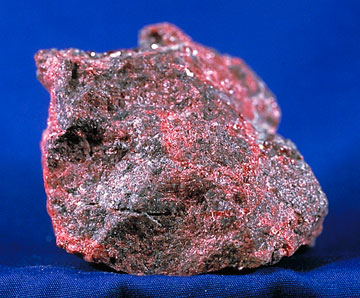
Cinnabar ore (Image from Mineral Information Institute)

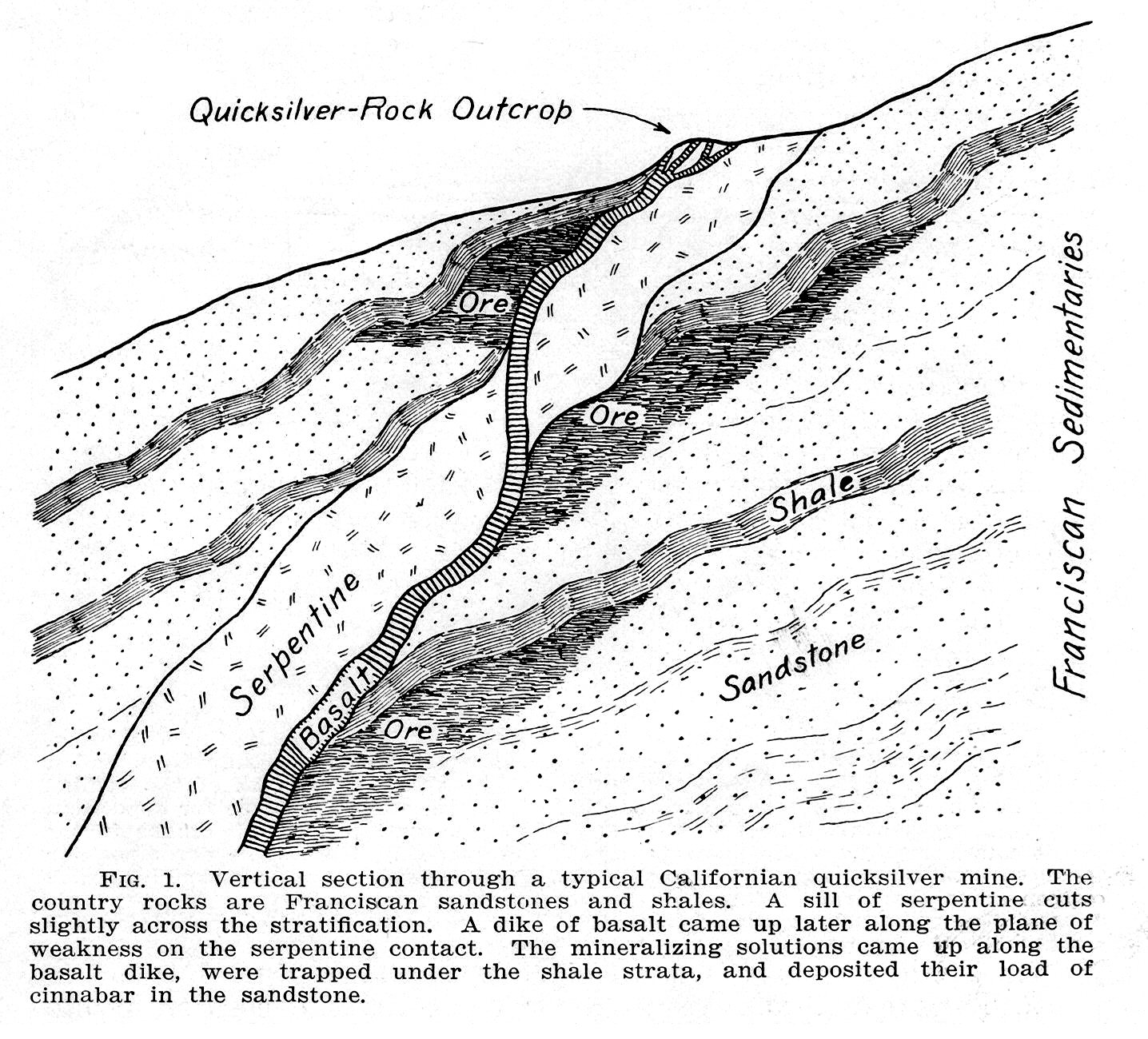
US cinnabar ore deposits are found predominantly  in California and to a lesser extent in Nevada, Oregon, Arizona, Texas, and Arkansas. The geology of cinnabar ore bodies share a few general features. Cinnabar ore is found in zones historically associated with volcanic activity and alkaline hydrothermal flows.  Ascending flows of metal sulfide saturated water infiltrated faults and fractures and deposited HgS rich mineral.  This is a common ore forming mechanism and is responsible for diverse metalliferous deposits, including mercury. 

Figure 1. Franciscan Quicksilver Ore Body Structure (C.N. Schuette, The Geology of Quicksilver Ore Deposits, Report XXXIII of the State Mineralogist, January 1937.)

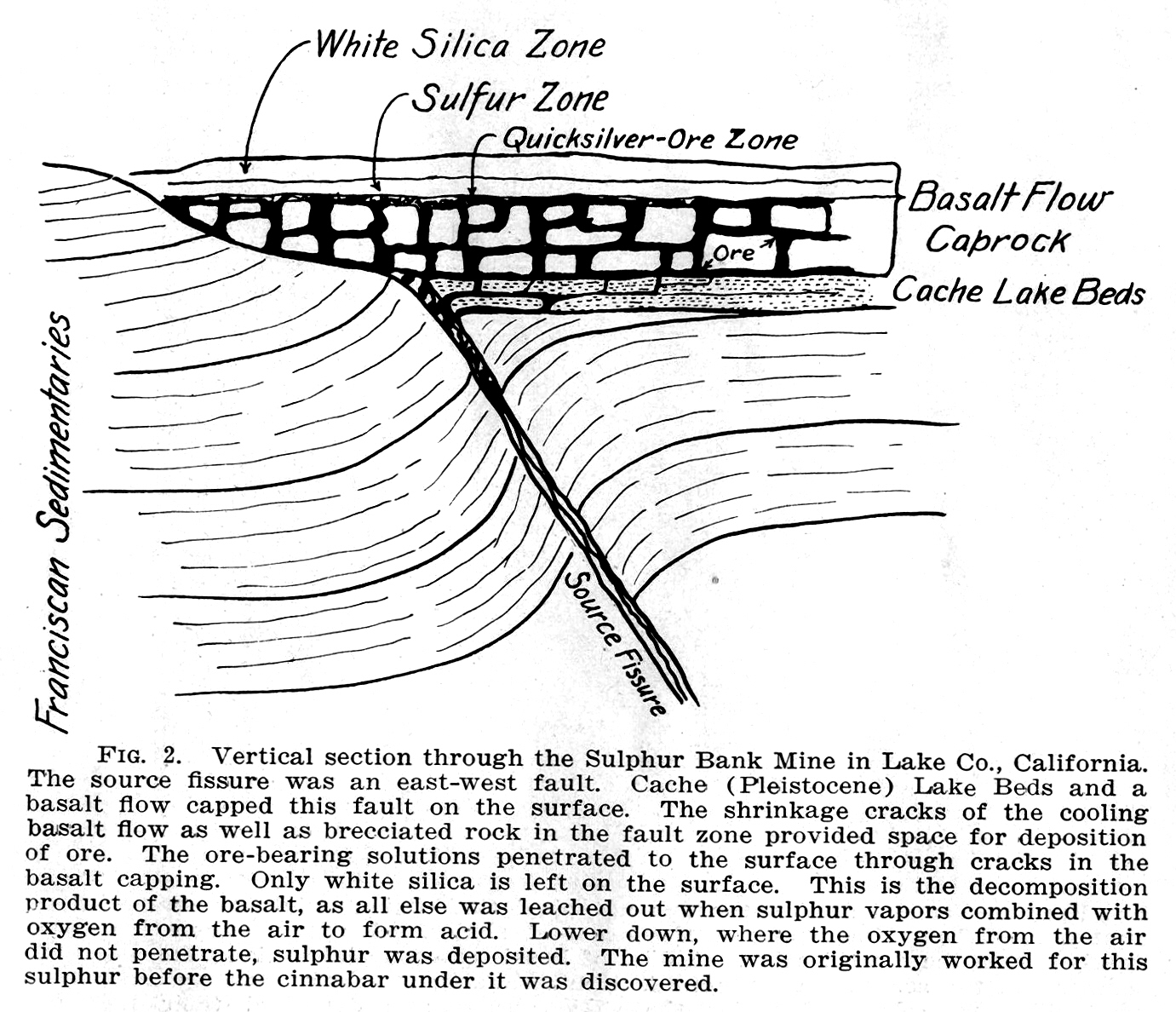
According to Schuette, a common feature to economically viable cinnabar occurrences was the presence of a cap rock formation over the ore body. The infiltration of cinnabar laden hydrothermal fluids into fissures and shrinkage cracks in basalt intrusions as well as deposition in brecciated rock in the fault zones lead to enrichment of the mineral.  An impermeable layer above caused a pooling accumulation of mineral and a barrier to oxidation. 

Figure 2. Diagram of Sulphur Bank Mine (C.N. Schuette, The Geology of Quicksilver Ore Deposits, Report XXXIII, of the State Mineralogist, January 1937.)

In these California formations cinnabar is regarded as a primary mineral, meaning that it is the direct result of transfer from deeper source rock. An example of secondary rock would be serpentine (Fig 1) which is formed as a result of aqueous alteration of another mineral. Serpentine is a group of minerals comprised of hydrated silicate which may contain some combination of  Mg, Fe, Al, Mn, Ni, Ca, Li, or Zn. According to Schuette, serpentine is often found associated with cinnabar formations. 

The Sulphur Bank Mine near Clearlake Oaks in Northern California offers an interesting example of cinnabar mineralization. Figure 2 shows a fault that provided a channel for fluid flow to upper level rock formations. Over time oxygen and water caused the oxidation of sulfur to sulfuric acid which aided the decomposition of cinnabar and the host rock. 

Note that the uppermost layer is said to be white silica which resulted from extensive demineralization of solubles from a silicate matrix. Further down, native sulfur was discovered in more reducing conditions and was actually recovered in early mining operations. Cinnabar was located below the layers of oxidized mineral. 

This phenomenon of surface oxidation of an exposed ore body is observed in gold and silver mines as well. Miners often lamented that the nature of the lode changed as the mine operations got deeper. Of course, what was happening was that oxidized formations are encountered near the surface and as the mine gets deeper, progressively greater reducing conditions are found with a corresponding change in mineral species present. 

Air oxidation or infiltration of meteoric water with dissolved air and CO2 would cause the alteration of sulfide minerals to more water soluble H2S and sulfates, leaving native gold behind. But at greater depths, the composition of the ore changes to afford heavier sulfide loading and therefore a requirement for a different kind of milling. 

As it happens, the recovery of mercury from cinnabar is quite simple and has been done since Roman times. Typically, the ore was crushed and roasted in the combustion gases of a reverberatory furnace. This kind of furnace was constructed to isolate the fuel from the ore by a partition and rebound or reflect the hot gases off the ceiling of the furnace onto a heap of ore. Despite the name there is no acoustic aspect to the process. 

The hot gases would produce HgO and sulfides which would oxidize in the gas stream to volatile sulfur oxides. Thermal decomposition of HgO at ca 500 C produced mercury which was condensed out of the exhaust gas stream and collected as the liquid. 

Keeping up with the data stream

After many years of immersion in technical work I still marvel at how an organization can become mired in raw data. Smart people can easily succumb to the notion that data equals knowledge. Especially in circumstances where data is accumulated faster than it can be assimilated.

It is relatively easy to collect data in a chemical lab. You take a set of samples and prep them for testing, load the sample vials into the sample tray, and let the automated sampling widget move through its paces. In a few minutes or hours the software has accumulated files bulging with data points.  It is even possible to construct graphs with all sorts of statistical manipulations on the data, but still not morph the data into usable knowledge. I’ve been to meetings where graphs are presented but were not backed up with interpretation. What was the presenters point in showing the graph?

Computerized chromatography stations will spew data all day long onto hard drives based on selections from a cafeteria-style menu. With hyphenated instrumentation, an innocent looking 2-dimensional chromatogram is actually just a part of a higher dimensional data set with corresponding mass spectra or UV/Vis spectra.

The task for the technical manager is to get control of this stream of data and render some of it into higher level knowledge that will help people run the organization and get product or research out the door. This is the true work product of the experimental scientist: knowledge woven from a data cross-fire and supported by accepted theory.

I do not know what others do when confronted by a data tsunami. I can only speak for myself on this. When the data flow gets ahead of me, it usually means that I am spread too thin. It indicates that I am not taking enough time to properly devise experiments for maximum impact and am skimping on the analysis in favor of other duties.

Another issue relating to managing diverse data output is the matter of storing accumulated data and knowledge for easy retrieval. It is easy to throw things into folders and file away. But in a few months, the taxonomy used for filing a given bundle of data becomes murky. Soon, one is forced to rummage through many files to find data because you’ve forgotten details on how you organized the filing system.

There are ways around this problem. Laboratory Information Systems (LIMS) are offered by numerous vendors. A good LIMS package goes a long way towards managing data and distributing knowledge. We have a homebrew LIMS system (built in MS Access) that seems to work rather well for analytcial data. However, it was not constructed with process safety information in mind.

What I have constructed for my process safety work is an Access-based application that structures various kinds of information graphically into regions on a form. Within each region is a set of data fields that are subordinate to a given heading or context. The form is devised to prompt the user to consider many types of thermokinetic experiments and provides fields that are links to specific documents. The form provides both actual data and links to source documents. It can be used to enter data or to retrieve it.

This is what Access is designed to do, so I have described absolutely nothing conceptually new. Access allows me to aggregate related kinds of experimental results, reports (the knowledge part), and source documents in one field of view so as to allow the users visual processing capability the chance to browse more efficiently.

An example of “related kinds of experimental data” would be DSC, TGA, ARC, and RC1 reports. What connects these fields is the domain of thermal sensitivity of a compound or reaction mixture.

Another aggregation of fields would be the conditions related to an incident. I like to select key descriptors to an incident so as to aid in incident type studies at a  later date. It is useful to be able to sort incidents resulting from a blown rupture disk or a spill, fire, triangulated drum, etc.

A database is rather like a garden. In order to be useful it must be planted and then cultivated. Ignore it and it will lose its comprehensiveness, casting into doubt its continued use.

Next up is the development of an in-house Wikipedia style browser application for aggregating product, process, and safety information. This offers the best opportunity yet for making information and diverse data available to employees. It can be written in narrative form so as to impart knowledge and history. Why was a particular vendor chosen or how did we decide on that specification? What was the rationale for the process change in step 4.2?  The ability to explain and link to in-house source documents from a familiar and single point of access is key to potential success.

CT scan abuses. Who is actually in charge of the use of X-rays?

The latest news  about CT scan abuse and the subsequent excessive radiation exposure to the public is very disturbing. A recent issue of the Archives of Internal Medicine features 2 articles describing their findings in regard to the use and possible misuse of CT x-rays. There is no point in my regurgitating the details of the two articles. The reader can study the articles without my noisy input.

What I would like to point out is that this is a case of faulty administrative control over the exposure of patients to hazardous energy. Who is the gatekeeper for access to a CT scan-  the primary care doc or a consulting radiologist? If it is the primary care doc, is he/she up to speed on the exposure/dose details? Does the primary care doc know the dose and variability in radiation exposure for a given workup? Does the dose vary with the model of CT scanner? How much resolution is really necessary, anyway? Does half the dose give half the resolution, or is there some other law relating transmitted energy to resolution?

Maybe the gatekeeper should be the radiologist. The radiologist should be able to calculate a radiation dose and speak knowledgeably about the details of the risk. But should the radiologist be in a position to second guess the primary care doc? Does anybody provide feedback to the primary care doc as to the wisdom of a given CT scan? Doesn’t sound like that would work very well.

So, who is really the gatekeeper in regard to the merits of any given CT scan given to the patient? But more importantly, how the hell can it transpire that radiation exposures are far higher than anybody apparently realized??? Radiation technology and radiation biology are mature sciences now. And presumably, radiologists are trained to pay attention to these kinds of details.

Where the HELL were the radiologists when these instances of excessive exposure were accumulating?? Isn’t that why we train them … to provide expertise in the use of ionizing radiation in medicine??  Were they busy? Did they have something else to do besides monitoring the use of radiation on actual patients?

Could it be that people in the CT business are more captivated by the industrial light and magic of imagery and special effects rather than the grubby details of dosimetry?