Author Archives: gaussling

About gaussling

Gaussling is a senior scientist in the chemical business. He occasionally breaks glassware, spreads confusion and has been known to generate new forms of hazardous waste. Gaussling also digs aerospace, geology, and community theatre.

Green Hummus

Since converting to vegetarianism two months ago I have begun to notice curious bursts of dietary defensiveness in friends, family, and coworkers. First let me say that I am not evangelical about my shift to vegetarianism. Others can eat what ever they please with no lecture from me. I’m happy to discuss this choice if asked, but I generally prefer to remain silent about it.

I’m finding that people will quiz me in conversation about the particulars of a vegetarian diet, perhaps looking for apparent contradictions or logical flaws in my response. Some are quick to mark out their meat eating territory so that it is known far and wide that they really dig being an unrepentant carnivore. They’ll ask “if we’re not supposed to eat animals, then why are they made of meat”?

Others just shake their heads and marvel at how someone could make such a silly choice.  I can’t say how many times I’ve been asked if my choice of vegetarianism was based on some political philosophy or ecological theory.

Nope.

I’ll explain that with my new menu, cycling, and running I’ve lost 11 % of my body weight and am still dropping weight. Yada yada. I’ll ask if they had ever seen my likeness on a Rubens painting and their eyes will glaze over and the topic will turn to the Broncos.

Something interesting to do with chick peas- Green Hummus.

1 Can drained chick peas
1/8 cup olive oil
1 tablespoon vinegar
1 cup washed fresh spinach
4 or 5 fresh basil leaves
salt to taste
1-2 cloves garlic
1 heaping tablespoon of pine nuts
1 pinch each of cayenne pepper and fresh ground black pepper (gives it some kick)

Place ingredients in blender or food processor and process to a smooth paste. If blending is difficult, add just a dash of orange or lemon juice to loosen the paste for efficient mixing. Enjoy as a zesty spread on a garden vegetable sandwich of cucumber, spinach, tomato, onion, and feta cheese. Don’t be shy with the cayenne.


Phase Change for Chemistry?

Disclaimer: Combichem or HTE is definitely not my area of expertise. It is, therefore, inevitable that I’ll say something blindingly ignorant about it. Despite my admitted ignorance, is appears to me that there is something happening, some kind of phase shift, in the small molecule discovery marketplace that is of general interest to the chemical R&D community. In fact, it may just be part of an overall change in how we do chemistry in general.

I’ve been hearing no small amount of buzz from chemists in the job market about the flattening or even downturn of US pharma R&D in general and of combichem or High Throughput Experimentation (HTE) in particular.  It is not that HTE is in any particular danger of extinction, but rather certain companies who offer the equipment platforms and tech packages seem to be evolving away from supplying equipment as a core business activity. Many of the big customers who could afford the initial cash outlay for HTE technology are doing their work in-house, dampening the demand for discovery services by HTE players at their aggressive prices.

One company I know has evidently shifted emphasis into the drug discovery field rather than try to continue marketing HTE equipment.  Near as I can tell, they are betting that having their own drug candidates in the pipeline is a better strategy than being strictly a technology or R&D services supplier. Time will tell the tale.

What the honchos in the board rooms of America’s big corporations forget is that the art they export so profitably was in all likelihood developed by people educated in US taxpayer subsidized institutions with US government grants. American citizens subsidize the university research complex in this country and by extension, supply a brain subsidy to industry. To export chemical R&D is to subsidize the establishment of a similar R&D capacity in other nations.  I think if you poll most US citizens, they’ll say that this is not the outcome they expected.

Software for HTE has become a derivative product that, for at least one HTE player, is proving to be rather successful. It isn’t enough to have the wet chemical equipment to make hundreds and thousands of compounds. You must be able to deal with the data storm that follows.

The business of HTE technology is evolving to a mature stage as the market comes to understand how to make and lose money with it.  There is always a tension between “technology push” and “market pull”.  It is often easier to respond to concrete demand with existing tools that to get new adopters to invest in leading edge tools to discover risky drug or catalyst candidates.

The extent to which the US chemical industry (all areas, including pharma and specialties) is outsourcing its R&D or simply moving it offshore is distressing. R&D is our magic. And promoting its execution offshore is to accelerate the de-industrialization of the USA.  It is folly to train the workers of authoritarian nations like China to execute your high art. American companies must learn to perform R&D in an economically accessible way and keep the art in-house. 

What makes R&D so expensive in the USA? Well, labor for one thing. In the end, our dependence on expensive PhD’s to do synthesis lab work may be a big part of our undoing. But there is much more to it than that. Look at the kinds of facilities that are built for chemical R&D. In the US and EU they are usually very expensive to build and maintain. Regulations and litigation avoidance are trending industry in the direction of ever more complex and high-overhead facilities in which to handle chemicals and conduct research. 

Then there is the cost of every widget and substance associated with chemistry. Look at the pricing in the Aldrich catalog or get a quote from Agilent. Have a look at the actual invoice from your latest Aldrich order and look at the shipping cost. High isn’t it? We’ve accelerated our demand for ready-made raw materials and hyphenated instrumentation. To what extent are we gladly buying excess capacity? Who doesn’t have an instrument with functions and capabilities that have never been understood or used?

It is possible to conduct R&D under lean conditions. But it can’t be done cheaply in existing industrial R&D campuses. Cost effective R&D will require a recalibration for most chemists in terms of the kinds of working conditions and administrative services they expect. But business leaders will have to recalibrate as well. Prestige can be manifested in product quality and a sense of adventure and conviviality rather than in an edifice. There are companies all over the world doing this every day. They set up shop in a commercial condo or old industrial building with used office furniture and grubby floors. What matters in chemistry is what is happening (safely) in the reactor. Everything else is secondary.

Heads on a Stick

As one of those poindexters who actually likes to watch Book TV on C-SPAN-2, I blundered into an interview of Naomi Prins. The host was Senator Bernie Sanders (I-VT). Prins is presently a Senior Fellow at Demos and has had careers at Goldman Sachs and Bear Stearns.

Prins has a good deal of interesting insight into how securities are engineered from subprime loans and stamped with ratings. What stands out is how artificial securities are as an asset. It’s like putting a step ladder on a canoe. The view is good, but evenually you’re going to get wet.

Securities are synthesized from dung and straw, drenched in investment sauce, and then nestled in decorative tins by white gloved MBA castrati to afford a “product”. Naturally, banks and ratings agencies assure us that the rating on the security is meaningful. After all, who is more sober and conservative than a banker?

Perhaps investment banking as it is now practiced should be regarded as a pathological condition- a form of predatory, sociopathic behavior worthy of a psychiatric profile? Investment banking is a profession dedicated to the proposition that the mere repackaging and skimming of the wealth of others is the desired outcome. It is a bubble industry specializing in puffery and deception.

My libertarian friends assure me that the free market place is the most natural and efficient form of economic intercourse. Of course, the problem is that there isn’t a substantially free market anywhere. We have regulated markets because some people invariably game the system at the expense of others, resulting in a convulsive discharge of legislation.

One could take a Darwinistic view and say that the victims of investment shenanigans are to blame for being greedy and uninformed. There is truth in caveat emptor, but one of the reasons we have civilization is to buffer out the harshness of life. How do you protect the greedy and uninformed from the greedy and deceitful? It is the eternal problem.

The most despicable part of the 2008-9 financial collapse is the lack of accountability on the part of the skunks who invented and promulgated the unstable investment devices.  Their heads should be impaled on sticks and planted in the financial districts for all to see. Figuratively, I suppose.

Thanksgiving Tofurky

This year we tried Tofurky along with turkey for the thanksgiving meal. While my expectations were low, I have to admit that the Tofurky wasn’t quite as nasty as I had imagined. It is a seitan/soy product textured to resemble meat. Truthfully, in texture it resembles a firm bologna or salami lunchmeat. The package recommends that it be sliced thinly.

One plate holds a Tofurky. Can you tell which one it is?

Buried in mashed potatoes and real turkey gravy, the Tofurky was moderately edible. It is hard to say just how thankful the pilgrims might have been if Squanto had brought Tofurky to the feast. I’ll wager that the soiree would have gone badly.

Pitchblende in the Wood Vein, Central City District

Recently I came upon a copy of Geological Survey Circular 186, 1952, F.B. Moore and C.R. Butler, Pitchblende Deposits at the Wood and Calhoun Mines, Central City Mining District, Gilpin County, Colorado. Like many Geological Survey documents, it contains a pocket with neatly folded scale drawings of the mine workings. These drawings chart the location and elevation of the shafts and drifts and give a best estimate as to the extent of the formation.

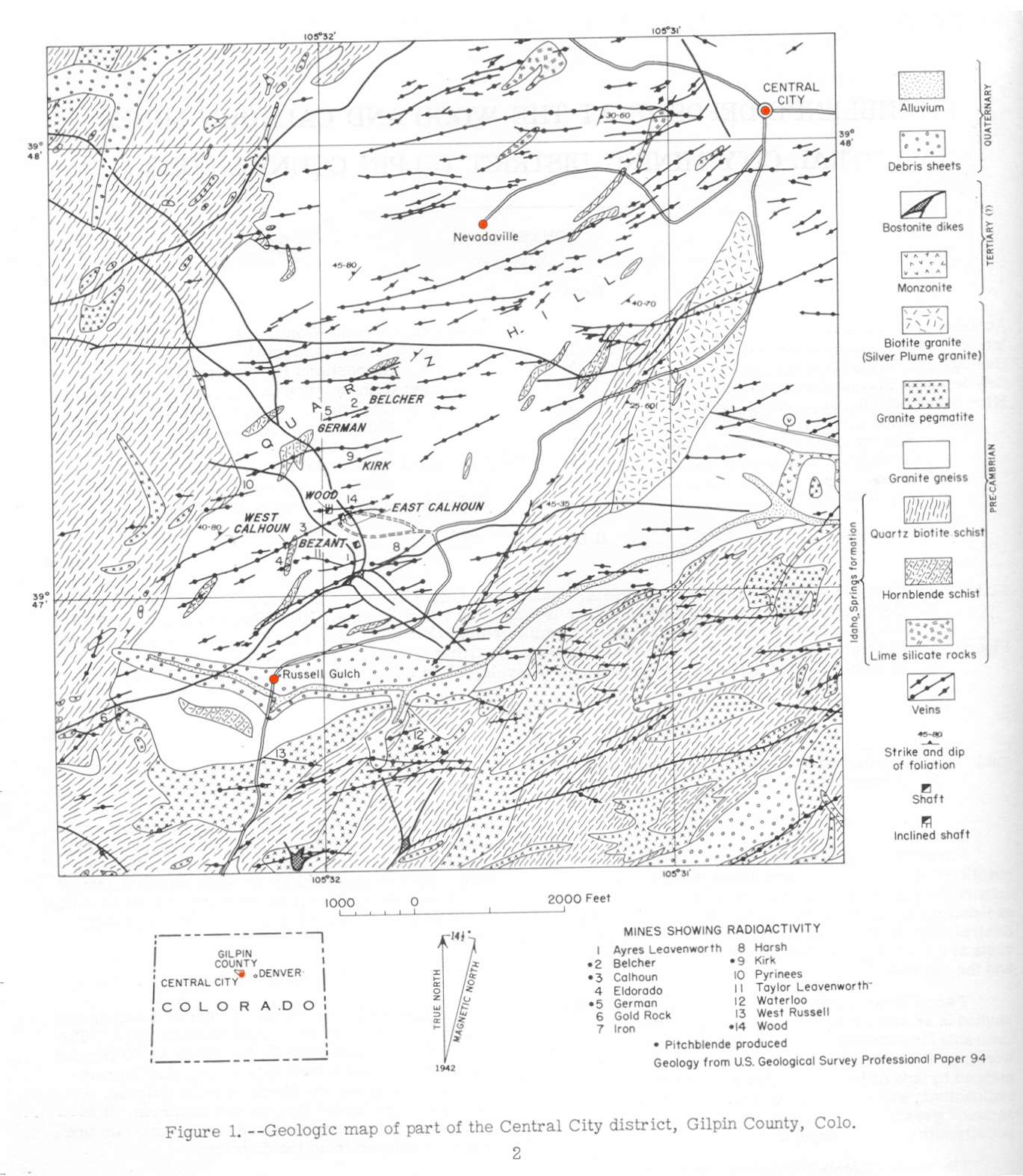
Vein Structure in the Central City District. (From Geologic Survey Circular 186, 1952.)

What is interesting about the map above is not so much the minute detail of the locations, but rather the obvious trend of the veins (solid lines with dots).  They are all east-northeast trending.  The country rock is largely precambrian granite gneiss and quartz biotite schist according to the survey. It doesn’t take long to figure out that the mine locations correlate with the veins.

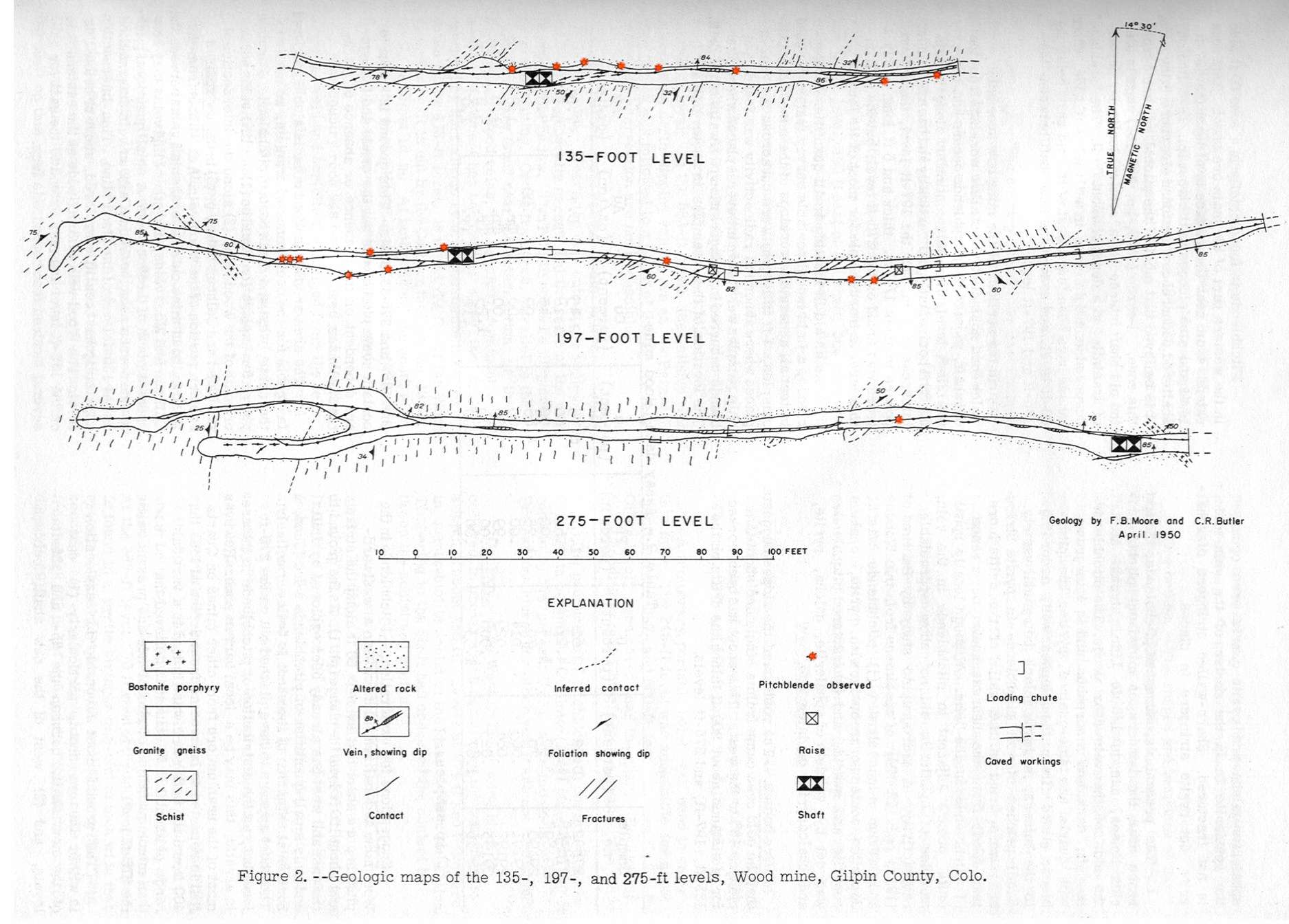
Geological Survey maps of 3 levels of the Wood Mine, Gilpin County, Colorado (Geological Survey Circular 186, 1952).

The second figure was generated by Moore and Butler in 1950 and shows the locations of pitchblende occurrences in three levels of the Wood Mine near Central City, Colorado. The red dots indicate the location of pitchblende along the three drifts at the 135, 197, and 275 foot levels of the mine.

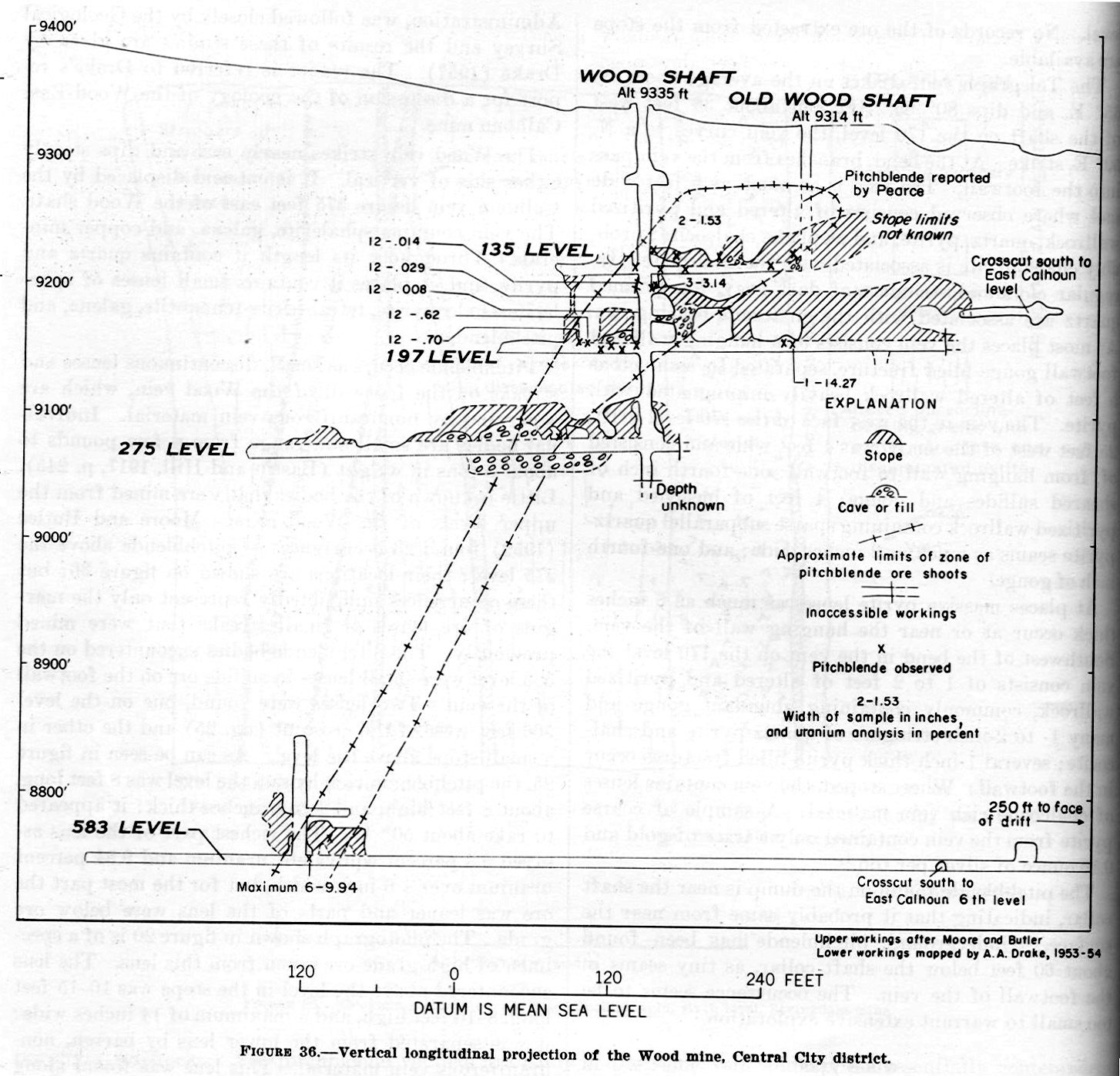
Profile of the Wood Mine, Central City District, Illustration from Geological Survey Professional Paper 371, 1963.

 The Wood Mine was an early and prolific source of pitchblende, though presumably it began as a gold /silver operation. The workings reportedly reached a depth of 600 ft.  The Wood vein is in a fault fissure that shows extensive alteration from hydrothermal action. The width of the vein varies with the type of country rock in which it is found, but ranges from from 1 to 18 inches and has been followed for a lateral distance of nearly 1000 ft.

The productivity of uranium mines is commonly expressed in terms of equivalent weight of U3O8 rather than weight of ore, given the large variety of mineral forms uranium is found to occur in. The figure above is from Geological Survey Professional Paper 371, P.K. Sims and collaborators, Geology of Uranium and associated Ore Deposits, Central Part of the Front Range Mineral Belt, Colorado. Extensive stoping has been done in an attempt to vertically intercept the vein. This was a common practice in hard rock mining- let gravity bring the muck to you.

Pitchblende was discovered on the dump of the old Wood shaft in 1871. Circular 186 reports that by the end of 1872, 6,200 lbs of ore containing 3,720 lbs of U3O8 had been removed. By 1916, 102,600 lbs of ore bearing 30,040 lbs of U3O8 equivalent had been recovered.  The high grade pitchblende was hand sorted and that below ca 10 % was discarded or lost in gold and silver processing.

In Circular 371, Sims observes that “Pitchblende occurs as small, discontinuous lenses and streaks on the footwall of the Wood Vein, which are separated by nonuraniferous vein material.”

What is intriguing is that pitchblende was apparently an item of commerce in the early 1870’s. Radium, extracted from pitchblende, was not discovered until 1898 by the Curies.  A procedure for the preparation of sodium diuranate, Na2U2O7 6H2O, was reported as early as 1849 (Patera, J. pr Chem. 1849, [i] 46, 182. Early uses of uranium yellow were in paints and stains for glass and porcelain. This pigment has also been used for the production of fluorescent uranium glass.

Fog

Sunrise in the Fog (Nov 2009, Th' Gaussling)

Okay, I’m not Ansel Adams. I’m posting this only because I’m surprised that my inexpensive camera resolved the lamp as well as it did.  It is amazing how fast the lighting can change and the moment vanishes. I suppose there is a metaphor there.

Manufacturing Consent

The Palin phenomenon is an exercise in manufacturing consent. It is happening before our eyes. The GOP media machine is tunneling under the democratic ramparts and allowing the gravity of doubt to bring the walls crashing down.

While the conservatives are beavering away underground in the muck, the eternally frenzied media is handing the conservatives exactly what they want- air time on the talking points of their choosing. Since media people view the world as an everlasting stream of dramatic sequences, they are naturally drawn to the Palin freakshow like flies to a steaming road apple.

An electorate that put GW Bush in office twice is certainly an electorate that could be moved to put Palin in office. A President Palin wouldn’t be the end of the world, 2012 allusions aside, but it would definitely be emblematic of US culture. And that’s an emblem I would rather not wear.

Flight Profile of Cactus Flight 1549

The YouTube video below is a reconstruction of the flight of US Airways Flight 1549, referred to as Cactus. It is interesting to note how the pilot acted to conserve his altitude by careful energy management. After the dual engine flameouts the pilots established an optimum glide to maximize flight time. They did not bank the aircraft anymore than they had to- banking without power consumes altitude. While one pilot was flying the airplane the other was consulting the manual for emergency restart of the engines. The captain evidently knew right away that the only option for maximum survivability was to set the plane in the river.

Near the end the pilots found themselves coming in a bit fast so they brought the nose of the aircraft up and porpoised ~250 ft or so before locking on 130 kts indicated for their glide to the surface. They were mindful of bringing the aircraft to the site of the accident as slowly as possible. KE = (1/2) mv^2. 

Note how he dips the tail in the water first while keeping the wings absolutely level. This brought the aircraft into the water along the longitudinal axis and thus averted a cartwheeling accident. The engines become powerful drag devices once they are in water.