Category Archives: Business

Necessity as the Mother of Invention

Summary: This essay addresses the important role the federal government has played in promoting the American march of progress. The old saying that “Necessity is the Mother of Invention” has a large element of truth to it. It is not enough to identify a problem or challenge. For a person, group or organization to solve a technological problem or challenge, the goal must be understood completely, resources acquired, a plan must be constructed and approved by those who control the purse strings, and skilled people must be organized and set to work on the matter at hand.

The federal government can provide the Necessity needed for attention and resources put to play in achieving a goal. For instance, NASA will set a goal and is able to open a project up for bid. The gov’t can provide seed money to the contractor for prototype equipment to present with their bid. Government grants provide the necessity to stimulate invention, hopefully on a competitive basis.

……………………

I have been a lifelong aerospace enthusiast from Project Mercury forward to the present day. What I’m realizing, however, is that I’m increasingly skeptical of the value of further manned space flight by NASA. Whatever the 6 successful manned Apollo landing missions on the moon may have found tramping around the regolith up there, evidently not enough value was found to compel the USA to go back. Obviously, the Apollo program was partially a geopolitical stunt to rival the USSR for prestige and by many measures the USA won. But what did we win? Prestige and a great many valuable technological spin-offs.

In the early 1960’s the US government financed and organized JFK’s challenge of landing a man on the moon and returning him safely to Earth by the end of the decade. Our government allocated considerable national treasure to the moon landing project and put lives on the line. Arguably, of greater importance than a round trip to the moon was the powerful boost to aerospace, computer, and other technologies. The technology-push advances funded by the government would soon become important economic drivers for industry.

In fulfilling Kennedy’s challenge there was both popular excitement about the space program and more than a little skepticism. The USA was increasingly bogged down with the Viet Nam war. Into the early 1970s, the western geopolitical argument about the advances of communism, the Domino Theory, was still cited, but it was gradually weakened by lack of popular support for the war and the loss of American blood and treasure invested in keeping communist influences out of southeast Asia. By the mid 1970’s, the US had pulled out of Viet Nam leaving behind millions of casualties and little to show for the effort. Added to Southeast Asia was the self-destructive meddling with the Cuban communist state. Castro died of old age in his communist bed.

There is an old saying that went “He’d complain if they hung him with a brand-new rope”. The suggestion was that some folks would complain about simply anything. Beyond the geopolitical and apparent military threat of the USSR beating the US into space were the much-ballyhooed technological benefits of the program. One of the oft-cited spin-offs was a Teflon coating for frying pans. It was an example that most citizens would understand and appreciate. Many incorrectly believed that NASA invented Teflon. Actually, Teflon was discovered unexpectedly in 1938 by the DuPont chemist Roy Plunkett.

NASA is very much in the technology-push world whereas many businesses are more safely oriented to market-pull. Technology-push is about invention of leading-edge vehicles, equipment, substances, instrumentation or services. Technology-push requires early adopters willing to wager that the new tech will give them a competitive edge. Government provides a ready-made early adopter.

Market-pull is where a manufacturer produces known or existing products and services. They compete by offering better availability, price and quality than their competitors.

Technology-push is the world of the tech startup. A start-up founder has a product or service that is sure to be a hit if only their products could get manufactured and pushed into the market. Tech investors will examine the startup’s business and financial plans and take a closer look at the technology or service to be offered. Is there a prototype? Is valuable intellectual property protected under patent? How stable is the supply chain or is there one? Will the company be sustained on the tech product only or will consumables be produced as well.

Importantly, is the technology-push startup looking to produce just a single product or is the technology expandible across a spectrum of applications? What if the product performs below acceptable tolerances or simply fails in the field? A startup with everything invested in a single product model is a “One-Act Pony”. Wonderful though the One-Act Pony may be, it can get sick and die in the marketplace. It can grow old and obsolete, giving way to falling sales and the mad scramble to develop a replacement product. I’ve been a part of 2 startups hoping to produce one-act ponies. The ponies died and we hit the streets.

Investors can analyze market-pull business plans by looking at the economics of demand as well as distribution of existing or similar products. Annual sales can be estimated, EBITDAs calculated, and profit margins uncovered. If the profit picture fits the general business model and timeline of the investors, they can release funding rounds to the startup with benchmarks to be met.

Necessity as the mother of invention?

In normal circumstances, industry operated by ambitious people may be motivated to advance their technology skillset to realize entry into new and promising markets. However, that said, an industry that only acts to match technological advances set by competitors is not showing the mettle required to launch a new paradigm in the technology-push manifold. Merely matching the competition does not quite describe a technology-pusher.

A technology-pusher is likely to find that they must walk the manufacturing highwire without a net and perhaps for a long time. Unless you are quite wealthy, launching a startup will likely hold personal financial risk. Commonly, external funding means that some percentage of ownership or shares will be given to the investors. By the time the product or service hits the market, the founders may find themselves as minority stockholders. Their dreams of grand wealth and influence is tempered by reality.

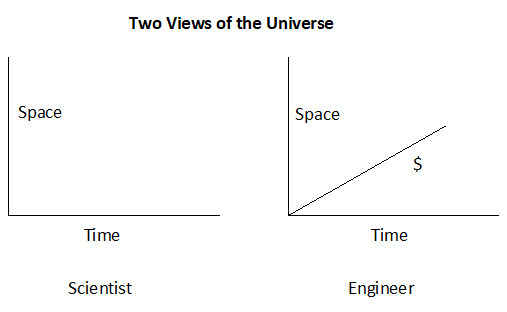
A naïve book-end view of technology pushers. Scientists are by nature more interested in phenomenology and naturally may see a two-dimensional universe of space and time. Scientists may gravitate to precision and accuracy while the engineer is also interested in not just precision and accuracy but also costs. When developing an engineering design, the engineers will constantly consider costs within the boundaries of space and time. Graphics by Arnold Ziffel.

A technology-push company is often started by engineers or scientists with experience in a particular subfield. Scientists commonly receive little or no business education as a degree requirement. Their role is the science guru. Engineers, on the other hand, fully understand the cost imperatives of a project and are able to design to remain within tight cost constraints.

In science, scientists are the main honchos. In business, engineers are the princes of the kingdom. They design projects, lead them, and come in on budget on time. A CEO with an engineering background is not at all unusual. They understand money part.

Sustainability? Can We Reinforce the House of Cards that Civilization has Become?

Ask yourself this- will your descendants in the year 2125 share in the creature comforts coming from the extravagant consumption of resources that we presently enjoy? Shouldn’t the concept of “sustainability” include the needs of 4-5 generations down the line?

The word ‘sustainability’ is used in several contexts and in contemporary use remains a fuzzy concept with few sharp edges. In this post I will refer to the sustainability of raw materials, fully recognizing that it covers numerous aspects of civilization.

There are wants and there are needs. For the lucky among us in 21st century developed nations, our needs are more than satisfied leaving surplus income to satisfy many of our wants. Will our descendants a century from now even have enough resources to meet their needs after our historical wanton and extravagant consumption of resources dating to the beginning of the industrial age? Our technology stemming from the earth’s economically attainable resources has done much to soften the jagged edges of nature’s continual attempts to kill us. After each wave of nature’s threats to life itself, survivors get back up only to face yet more natural disasters, starvation and disease. This is where someone usually offers the phrase “survival of the fittest”, though I would add ” … and the luckiest”.

What will descendants in 100 or 200 years require to fend off the harshness of nature and our fellow man? Pharmaceuticals? Medical science? Fuels for heat and transportation? Will citizens in the 22nd century have enough helium for the operation of magnetic resonance imagers or quantum computers? Will there be enough economic raw materials for batteries? Will there be operable infrastructure for electric power generation and distribution? Lots of questions that are easy to ask but hard to answer because it requires predicting the future.

Come to think about it, does anyone worry this far in advance? The tiny piece of the future called “next year” is as much as most of us can manage.

Humans would do well to remember that a great many of the articles that we rely on are manufactured goods, such as: automobiles, aerospace-anything, pharmaceuticals, oil & gas, metals, glass, synthetic polymers (i.e., polyethylene, polypropylene, PVC, polystyrene etc.), medical technology and electrical devices of all sorts. Each of these categories split off into subcategories all the way back to a farm or a mine. And let’s remember that both mining and farming are both reliant on big, expensive machinery and lots of water.

Each of the contributing technologies holding up any given apex technology were new and wondrous at one time. Think of a modern multicore microprocessor chip. Follow the chip’s raw materials back to the mines and oil & gas wells where the raw materials originated. Once you’ve done that, consider all of the people and inputs necessary in each step getting from the mine to the assembly of a working microprocessor. Each device, intermediate component or refined substance is at or near the apex of some other technology pyramid. To keep moving forward, people need to connect each apex technology input in a way to get to their own apex endpoint.

We mustn’t forget all of the machinery and components, energy to power them, transportation and trained personnel needed to manufacture any given widget. Skilled hands must be found to make everything work.

A given technology using manufactured goods is a house of cards kept upright by constant attention, maintenance, quality control and assurance, continuous improvement and hard work by sometimes educated and trained people. Then, there is a stable society with institutions, regulations and a justice system that must support the population. The technology driving our lifestyles does not derive from sole proprietor workshops in a corrugated iron Quonset building along the rail spur east of town. The highly advanced technology that is driving economic growth and the comfortable lives we enjoy comes from investors and factories and international commerce. A great many products we are dependent on like cell phones are affordable only because of the economies of large-scale production.

So, what is the point of this? Sustainability must also include some level of throttle back in consumption without upsetting the apple cart.

A plug for climate change

For a moment, let’s step away from the notion that the atmosphere is so vast that we cannot possibly budge it into a runaway warming trend. The atmosphere covers the entire surface of the planet with all of its nooks and crannies, but its depth is not correspondingly large. In fact, the earth’s atmosphere is rather thin.

At 18,000 feet the atmospheric pressure drops to half that at sea level. The 500 millibar level varies a bit but is generally near this altitude. This means that half of the molecules in the atmosphere are at or below 18,000 feet. This altitude, the 500 millibar line, isn’t so far away from the surface. From the summits if the 58 Fourteeners in Colorado, it is only 4000 ft up. That is less than a mile. The Andes and the Himalayan mountains easily pierce the 500 millibar line.

Our breathable, inhabitable atmosphere is actually quite thin. The Earth’s atmosphere tapers off into the vacuum of space over say 100 km, the Kármán line. Kármán calculated that 100 km is the altitude at which an aircraft could no longer achieve enough lift to remain flying. While this is more of an aerodynamics based altitude than a physical boundary between the atmosphere and space, the bulk of the atmosphere is well below this altitude. With the shallow depth of the atmosphere in mind, perhaps it seems more plausible that humans could adversely affect the atmosphere.

The lowest distinct layer of the atmosphere is the troposphere beginning as the planetary boundary layer. This is where most weather happens. In the lower troposphere, the atmospheric temperature begins to drop by 9.8 °C per kilometer or 5.8 oF per 1000 ft of altitude. This is called the dry adiabatic lapse rate. (With increasing altitude the temperature gradient decreases to about 2 oC per kilometer at ~30,000 ft in the mid-latitudes where the tropopause is found. The tropopause is where the lapse rate reaches a minimum then the temperature remains relatively constant with altitude. This is the stratosphere.)

Over the last 200 years in some parts of the world, advances in medicine, electrical devices, motor vehicles, aerospace, nuclear energy, agriculture and warfare have contributed to what we both enjoy and despise in contemporary civilization. The evolving mastery of energy, chemistry and machines has replaced a great deal of sudden death, suffering and drudgery that was “normal” affording a longer, healthier lives free of many of the harmful and selective pressures of nature. Let’s be clear though, continuous progress relieving people of drudgery can also mean that they may be involuntarily removed from their livelihoods.

It is quintessentially American to sing high praises to capitalism. It is even regarded as an essential element of patriotism by many. On the interwebs capitalism is defined as below-

As I began this post I was going to cynically suggest that capitalism is like a penis- has no brain. It only knows that it wants more. Well, wanting and acquiring more are brain functions, after all. Many questions stand out, but I’m asking this one today. How fully should essential resources be subject to raw capital markets? It has been said half in jest that capitalism is the worst economic system around, except for all of the others.

I begin with the assumption that it is wise that certain resources should be conserved. Should it necessarily be that a laissez faire approach be the highest and only path available? Must it necessarily be that, for the greater good, access to essential resources be controlled by those with the greatest wealth? And, who says that “the greater good” is everybody’s problem? People are naturally acquisitive- some much more than others. People naturally seek control of what they perceive as valuable. These attributes are part of what makes up greed.

Obvious stuff, right?

The narrow point I’d like to suggest is that laissez faire may not be fundamentally equipped to plan for the conservation and wise allocation of certain resources, at least as it is currently practiced in the US. Businesses can conserve scarce resources if they want by choosing and staying with high prices, thereby reducing demand and consumption. However, conservation is not in the DNA of business leaders in general. The long-held metrics of good business leadership rest on the pillars of growth in market share and margins. Profitable growth is an important indicator of successful management and a key performance indicator for management.

First, a broader adoption of resource conservation ideals is necessary. Previous generations have indeed practiced it, with the U.S. national park system serving as a notable example. However, the scarcity of elements like Helium, Neodymium, Dysprosium, Antimony and Indium, which are vital to industry and modern life, this raises concerns. The reliance of Magnetic Resonance Imaging (MRI) operations on liquid helium for their superconducting magnets poses the question of whether such critical resources should be subject to the whims of unregulated laissez-faire capitalism. While some MRI operators utilize helium recovery systems, not all do, leading to further debate on whether the use of helium for frivolity should continue, given its wasteful nature.

Ever since the European settlement of North America began, settlers have been staking off claims for all sorts of natural resources. Crop farmland, minerals, land for grazing, rights to water, oil and gas, patents, etc. Farmers in America as a rule care about conserving the viability of their topsoil and have in the past acted to stabilize it. But, agribusiness keeps making products available to maximize crop yields, forcing farmers to walk a narrower line with soil conservation. Soil amendments can be precisely formulated with micronutrients, nitrogen and phosphate fertilizers to reconstitute the soil to provide for higher yields. Herbicides and pesticides are designed to control a wide variety of weeds, insect and nematode pests. Equipment manufacturers have pitched in with efficient, though expensive, machinery to help extract the last possible dollars’ worth of yield. Still other improvements are in the form of genetically modified organism (GMO) crops that have desirable traits allowing them to withstand herbicides (e.g., Roundup), drought or a variety of insect, bacterial, or fungal blights. The wrench in the gears here is that the merits of GMO crops have not been universally accepted.

Livestock production is an advanced technology using detailed knowledge of animal biology. It includes animal husbandry, nutrition, medicines, meat production, wool, dairy, gelatin, fats and oils, and pet food production. There has been no small amount of pushback on GMO-based foods in these areas, though. I don’t follow this in detail, so I won’t comment on GMO.

The point of the above paragraphs is to highlight a particular trait of modern humans- we are demons for maximizing profits. It comes to us as naturally as falling down. And maximizing profits usually means that we maximize throughput and sales with ever greater economies of scale. Industry not only scales to meet current demand, but scales to meet projected future demand.

Essentially everyone will likely have descendants living 100 years from now. Won’t they want the rich spread of comforts and consumer goods that we enjoy today? Today we are producing consumer goods that are not made for efficient economic resource recovery. Batteries of all sorts are complex in their construction and composition. Spent batteries may have residual energy left in them and have chemically hazardous components like lithium metal. New sources of lithium are opening up in various places in the world, but it is still a nonrenewable and scarce resource. This applies to cobalt as well.

Helium is another nonrenewable and scarce resource that in the US comes from a select few enriched natural gas wells. At present we have an ever-increasing volume of liquid helium consumption in superconducting magnets across the country that need to remain topped off. This helium is used in all of the many superconducting magnetic resonance imagers (MRI) and nuclear magnetic resonance (NMR) spectrometers in operation worldwide. Quantum computing will also consume considerable liquid helium as it scales up since temperatures below the helium boiling point of 4.22 Kelvin are required.

As suggested above, today’s MR imagers can be equipped with helium boil off recovery devices that recondense helium venting out of the cryostat and direct it back into a reservoir. One company claims that their cold head condensers are so efficient that users do not even have to top off with helium for 7-10 years. That seems a bit fantastic, but that has been claimed. Helium recovery is a good thing. Hopefully it is affordable for most consumers of MRI liquid helium.

In the history of mining in the US and elsewhere, it has been the practice of mine owners to maximize the “recovery” of run-of-mill product when prices are high. Recovery always proceeds to the exhaustion of the economical ore or the exhaustion of financial backing of the mining company. Uneconomical ore will remain in the ground, possibly for recovery when prices are more favorable. It is much the same for oil and gas. As with everything, investors want to get in and get out quickly with the maximum return and minimum risk. They don’t want their investment dollars to sit in the ground waiting for the distant future in order to satisfy some pointy headed futurist and their concern for future generations.

What is needed in today’s world is the ability to conserve resources for our descendants. It requires caring for the future along with a good deal of self-control. Conservation means recycling and reduced consumption of goods. But it also means tempering expectations for extreme wealth generation, especially for those who aim for large scale production. While large scale production yields the economies of scale, it nevertheless means large scale consumption as well. In reality, this is contrary to the way most capitalism is currently practiced around the world.

Sustainability

The libertarian ideal of applying market control to everything is alleged to be sustainable because in appealing to everyone’s self-interest, future economic security is in everyone’s interest. If high consumption of scarce resources is not in our long-term self-interest, then will the market find a way to prolong it? As prices rise in response to scarcity, consumption should drop. ECON-101 right? Well, what isn’t mentioned is that it’s today’s self-interest. What about the availability of scarce resources for future generations? Will the market provide for that?

Is the goal of energy sustainability to maintain the present cost of consumption but through alternative means? Reduced consumption will occur when prices get high enough. As the cost of necessities rises, the cash available for the discretionary articles will dry up. How much of the economy is built on non-essential, discretionary goods and services? The question is, does diminished consumption have to be an economic hard landing or can it be softened a bit?

Where does technological triumphalism take us?

The generation and mastery of electric current has been one of the most consequential triumphs of human ingenuity of all time. It is hard to find manufactured goods that have not been touched by electric power somewhere in the long path from raw materials to finished article. As of the date of this writing, we are already down the timeline by many decades as far as the R&D into alternative electrification. What we are faced with is the need to continue rapid and large scaling-up of renewable electric power generation, transmission and storage for the anticipated growth in renewable electric power consumption for electric vehicles.

Our technological triumphalism has taken us to where we are today. The conveniences of contemporary life are noticed by every succeeding generation who, naturally, want it to continue. This necessitates that the whole production and transportation apparatus for goods and services already in place must continue. We have both efficient and inefficient processes in operation, so there is still room for more triumph. But eventually resources will become thin and scarcity of strategic minerals becomes rate limiting. Economies may or may not shift to bypass all scarcity of particular articles.

Perhaps a transition from technological triumphalism to minimalist triumphalism could take place. The main barrier there is to figure out how to make reduced consumption profitable. Yes, operate by a low volume, high margin business model. That already works for Rolls Royce, but what about cell phones and sofas?

Something else that stymies attempts at reduced consumption is price elasticity. This is where an increase in price fails to result in a drop in demand. Necessary or highly desirable goods and services may not drop in demand if the price increases at least to some level. As with the price of gasoline, people will grumble endlessly about gas prices as they stand there filling their tanks with expensive gasoline or diesel. Conservation of resources has to overcome the phenomenon of price elasticity in order to make a dent without shortages.

A meaningful and greater conservation of resources will require that people be satisfied with lesser quantities of many things. In history, people have faced a greatly diminished supply of many things, but not by choice. Economic depression, war and famine have imposed reduced consumption on whole populations and often for decades. When the restriction is released, people naturally return to consumption as high as they can afford.

The technological triumph reflex of civilization has allowed us to paint ourselves into a resource scarcity corner.

I’d like to believe that humanity could stave off the enviable conflict that would spark from numerous critical resource shortages, but I doubt the people and nations of the world can do it.

IEA Predicts Excess Supply in Global Oil Demand for 2025 and Beyond

The next president of the US, # 47, was heard to proclaim very recently the slogan ‘Drill Baby Drill‘. This slogan was first used by Lieutenant Governor Michael Steele of Maryland at the 2008 Republican National Convention. It was quickly picked up and made famous by Sarah Palin at the 2008 vice-presidential debate with Joe Biden. The slogan was used frequently by former president DJ Trump in his 2024 presidential campaign.

As slogans go, Drill Baby Drill successfully hit a nerve with Trump’s constituency if for no other reason than as a shout-in-your-face taunt. There was and is conservative consternation with liberal push-back on the practice of hydraulic fracturing (‘fracking’). It is not just fracking either. Opening public land to oil exploration was met with howls of dismay by Democrats over the plan to open up ANWR and other public lands to oil exploration, drilling and pipelines.

Many seem to believe, MAGAs in particular, that increased drilling and fracking will automatically decrease gas and diesel prices at the pump. From 50,000 feet up, that might seem to be true. More supply, lower prices or so the thinking goes. But economics learned in the back yard drinking beer while playing corn hole or from TikTok only takes you so far. There are many details that have their origins national and global politics as well as the many particulars of how the oil & gas supply chain actually works.

An excellent source of data on the global oil & gas situation is the International Energy Agency, IEA. They offer an excellent pdf report of the global oil picture extending to 2030. Here are the highlights from the IEA November 2024 Oil Market Report:

Consider

According to Bloomberg,

Global oil markets face a surplus of more than 1 million barrels a day next year as Chinese demand continues to falter, cushioning prices against turmoil in the Middle East and beyond, the International Energy Agency said.’

As you may know, lately China has been having a rough go of it economically with their construction and real estate crises. Bloomberg reports that-

Oil consumption in China — the powerhouse of world markets for the past two decades — has contracted for six straight months through September and will grow this year at just 10% of the rate seen in 2023, the IEA said in a monthly report on Thursday. The global glut would be even bigger if OPEC+ decides to press on with plans to revive halted production when it gathers next month, according to the agency.’

The linked Bloomberg article paints a picture of static global demand for oil and weak prices extending into 2025 and possibly longer. So, this leads us to the question- How anxious does this picture make oil executives who are always looking for a reason to increase oil & gas exploration and drilling? Obviously, their planning goes well past 2025. Lower wholesale prices of gasoline and diesel out of the refinery do not automatically translate into proportionally lower retail prices at the pump. What would be the reason that a gas station owner would lower the retail price just because his wholesale fuel costs have dropped? Why would they forfeit profit margin to offer lower pump prices when they could keep prices as high as the market allows?

Do you think that a MAGA gas station owner with a red hat would offer reduced margins and prices to MAGA customers in red hats just … because he/she is generous? I don’t think so.

The reality has always been that fuel prices are based on what the customer is willing to pay. A president or candidate promising lower fuel prices in the USA should be viewed with serious skepticism. The entire supply chain from drillers to gas station owners struggle to maximize their profit margins and sales volumes 24/7. Do we really believe that the supply chain would bend to the price promises of some politico? Perhaps in Venezuela but look at what price fuel price meddling has done to that country.

Drill-Baby-Drill is a shallow chant used to polarize voters into opposing Democrats by lumping them into a contrived basket of anti-American fools. The trouble is that it works.

An effect of the internet and social media is that it brings the entire bell curve of voters to the table where many believe that all opinions are of equal merit. On the macroscopic scale, all citizens in the broader bell curve have a right to express their opinions. But just like at the microscopic scale of business, home and institutions, arguments and opinions without merit can be cast aside. Facts and solid logic should prevail over hand waving opinions.

Whiners Going on About Increasing Oil Production

[Note: Let’s get something straight here. I’m an industrial chemist and not a pencil-necked economist. I’m going to talk about some O&G economics from my industrial perspective. MAGA people are whining about increasing oil production to ease gas prices. My view is that these buggers are idiots, but I won’t say it like that. I’ll just discuss some pragmatics of oil refining.]

In an article published 10/1/24 in The Center Square the writer reports that a survey of voters in the key swing states of Arizona, Georgia, Michigan, Nevada, North Carolina, Pennsylvania, and Wisconsin that between 80% and 86 % of voters say that the price of daily necessities has gotten painful. Between 88 % and 94 % say they are concerned about inflation. This survey was obtained by Morning Consult/American Petroleum Institute poll obtained exclusively by The Center Square. “The poll surveyed nearly 4,000 registered voters Sept. 20-22 with a margin of error of 4%.”

From the article-

Some refining basics

I think there is some misunderstanding generally about how the oil & gas (O&G) business works. First off, it is a global market and is subject to supply and demand pressures from all over the world. Second, there is O&G supply and there is refinery capacity. One might suppose that increasing O&G production domestically would automatically lead to lower fuel prices at the retail level. However, refinery throughput is limited to its particular capacity and storage. And, why would O&G producers increase output to an excess just to lower prices at the retail level? Leaving money at the table is against the instincts of every businessperson and is contrary to the fiduciary responsibilities of executives to stockholders.

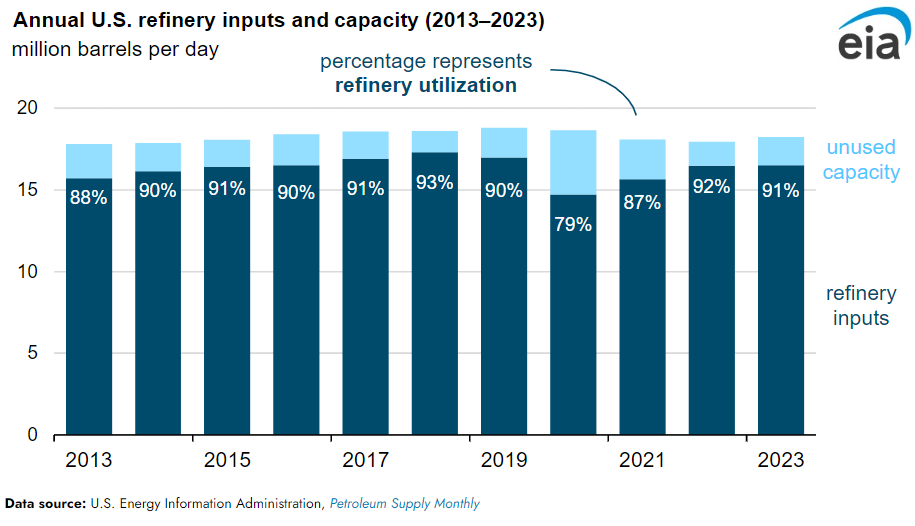
Refineries are usually operated at about 90 % capacity. Lest one think that refiners only need to tweak the throughput up a bit, it must be understood that it is unwise to operate a refinery or any other manufacturing plant at a constant 100 % capacity. Like any other factory, a refinery is subject to sudden or planned maintenance requirements, equipment failures, process upsets, variability in oil feedstock composition, hurricanes, variable demand in product spread or even infrequent operational error. A sudden unexpected shutdown can lead to a variety of complications as well as unleashing hazards at the large scale. Once a refining process line goes down, repair and restart can take one or more weeks to months to bring the process back to stable production.

A petroleum refinery is operated on a continuous throughput basis with series and parallel processing occurring simultaneously. Operating a refinery profitably is a complex job requiring a specialized skillset. As a PhD organic chemist, I am barely qualified to even set foot in a refinery, much less be of any kind of use there. Chemists may be found on site, but most likely in the quality control lab. These are the rarefied heights of the petroleum engineer.

A petroleum refinery is designed to take crude oil and gas inputs and shape them into an optimal spread of profitable products. The focus will be on maximizing the output of the most profitable products, especially motor fuels in the form of the various grades of gasoline and diesel. Your local gas station buys fuel from a wholesaler/distributor at a quoted price then sets a retail price depending on not just the wholesale price, but more importantly the local market prices and expected sales volume.

Operating a refinery is a continuous flow exercise and is a bit delicate. A refinery is a web of continuous unit operations each with an input stream from one unit operation and an output stream to another operation. Each unit operation has a specific task to perform safely and efficiently. These unit operations subject the input hydrocarbon stream to heating, fractionation by distillation, and each of the many distillate streams are then subjected to their own unique processing. Other operations include alkylation, hydrotreating, sulfur scrubbing, catalytic cracking, isomerization, catalytic reforming, heat exchange, more distillation, blending and finally transfer to storage. Each operation is designed to process throughput at high flow rates to afford the best production rate of finished goods.

Waste process heat is directed to certain operations and used for greater efficiency. Oil refining inevitably produces light hydrocarbons whose recovery produces diminishing returns for recapture or comes from pressure venting where the vented gases are not suitable for recycle. In this case these gases are sent to a flare tower and burned. The flare tower plays an important safety role as it burns away flammable hydrocarbon gases that might otherwise accumulate and spread near the ground, posing a serious fire and explosion hazard.

Naturally, this requires considerable coordination to manage the rate of output of one operation to the input rate of the next. In fact the whole plant requires coordination of rates of throughput, pressure and temperature. A refinery is constantly monitoring and adjusting individual parameters with automation and human oversight to remain in “tune”.

During the recent COVID-19 pandemic and the reduction in demand, a number of refineries were shut down for maintenance or upgrades and a few were shut down permanently. This created a bottleneck in refining capacity nationwide and there was a shortfall in overall refinery output, leading to higher retail pricing of fuels as demand eventually rose.

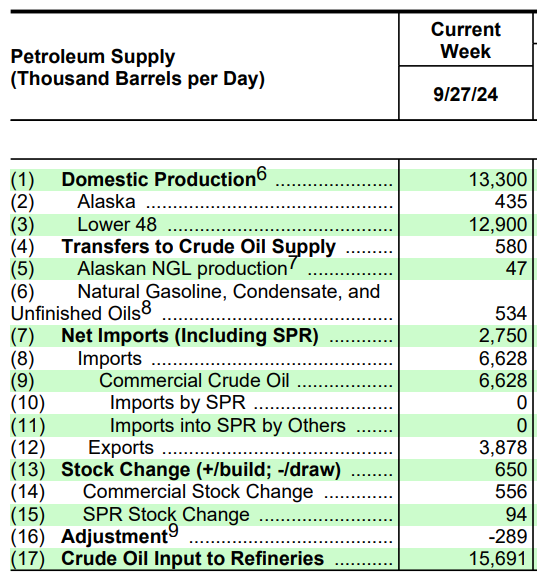
Today the USA both imports petroleum and exports it. The supply of crude oil and gas depends on contractual obligations and who is willing to pay the highest prices.

Source: US Petroleum Balance Sheet, week ending 27 Sept 2024, Energy Information Administration (EIA)

The United States in a net O&G exporter. Between imports and domestic output, the US is currently processing enough O&G for our needs with surplus to export. And what will an increase in domestic fracking really do for the US, again pricewise? It can increase the production yields at individual O&G wellheads bringing greater volume for the O&G producer over time. Done properly, fracking makes sense. However, if fracking provides a conduit for natural gas, oil or produced water into ground water, then it can be irredeemably harmful for those so affected.

Even if domestic O&G production is increased and released into the market, the near-term problem will be limited refinery capacity. The lead time for building a large oil refinery can be 4-5 years from design phase to commissioning. Permits, financing and societal pushback can add considerable time. Putting a complex refinery in the ground can cost $5-$15 billion. Startup and adjustment of a refinery is time consuming, complex and can be a bit hazardous. Accidents during startup and shutdown are not uncommon.

The politically popular opinion that what the US needs is an increase in oil production to drive down retail gas and diesel pricing rests on specious assumptions. The government provides regulatory oversight in many aspects of O&G production and refining. In my view, government oversight in regard to environmental protection and worker safety is of critical importance. Global free market control of O&G production and distribution, while often heavy handed and seemingly heartless, is the best model we have at present for production and distribution of hydrocarbon-based goods to consumers. For a historical example of government control of supply and distribution, we can look at the Soviet Union and its authoritarian centralized control of nearly everything. The Soviet model of governance and production of goods and services failed spectacularly by 1991. The leadership of the USSR dissolved the Soviet system themselves after concluding that it was no longer workable. For all of its many flaws, the overall western model of capitalism continued to thrive.

In short, it only makes sense to increase O&G production to keep retail fuel prices low if the refineries demand more crude to meet their distributor’s demand. Refined fuels could be imported for distribution here, but an uptick in storage capacity will likely be required. Refineries are fundamentally limited by their processing capacity. Refineries, like most manufacturing operations, are designed to provide an optimum output with the installed equipment. Greater throughput requires larger equipment or additional process streams

Anecdote: Every day I pass through the intersection of an east/west state highway and a north/south interstate highway. On the west side of this busy intersection there are four gas station/convenience stores competing for our gasoline and diesel business. Just a block to the west is a stoplight and at the four corners of this are three of the gas stations with direct access to the light. The fourth is not at the light so entry or exit to this station is not controlled by the light. During the early morning commute time, the four electronic signs indicate morning prices that invariably are $0.20 to $0.60 lower than mid-day prices. The tall electronic signs allow for convenient rapid response to competing prices. One station is beyond the single stoplight intersection, so both exiting eastbound vehicles and entering eastbound vehicles who need to turn left across uncontrolled heavy traffic have to wait for a break in the congested traffic. This is a competitive disadvantage for them. The other three stations have direct access to the stop light. Co-incidentally, the traffic-disadvantaged station nearly always has the lowest prices first. This tends to set the stage for a daily price war. This morning the 85-octane gasoline price was $2.719 at all four stations.

There are some plusses for the disadvantaged station mentioned above. Unlike the other three stations there is room for 18-wheelers to fill their tanks with diesel and park overnight next to a cheap motel and a Waffle House (Hey! Waffle House hash browns are the greatest). The left turn across traffic disadvantage to 4-wheelers is only a minor obstacle to the 18-wheelers using the station since they are apparently fearless in pulling into heavy traffic to execute a turn.

Econ 101 Conclusions

Like everything else, scarcity applies pressure on hydrocarbon prices up and down the supply chain- from wellhead to fuel tank. National politics can play a role in hydrocarbon pricing if it threatens to alter scarcity in some way. In chemical kinetics we are interested in finding the rate limiting step in a multistep chemical reaction. This step is the bottleneck that controls the overall reaction rate. In much the same way, a bottleneck in a supply chain will control the rate of output of a given product. The rate of delivery through the bottleneck controls the rate of wealth creation for those in the supply chain. To increase the rate of wealth creation, one must multiply the number of these bottlenecks in parallel or design a new bottle with a larger neck. Importantly, the rate of wealth creation can be a winning positive or a losing negative number. Excess capacity anywhere in the chain results from excessive money spent on unneeded production scale.

Note: There is much more to the macroeconomics of O&G production than what I have addressed. The economics of O&G production and distribution in the US depends on policy and regulatory factors as well as considerable anticipation and speculation (gambling) in the marketplace. Despite this, it is possible to make certain very broad statements in the context of general supply and demand principles. The finer, high resolution, details can be found elsewhere.

Passage Slowdown Through the Panama Canal and Some Rerouting at the Suez Canal

The year 2023 has been a bad year to be a canal user. Between a drought aggravated by El Nino and a shooting war by Houthi terrorists, transit costs and risks have risen steeply.

The two major canals for transoceanic shipping in the world are seeing events affecting their operation which are beyond their control. The Panama Canal is suffering a slowdown in transits due to a drought reducing the water level of Gatun Lake which feeds the canal lock system. The Suez Canal is being affected by hostile Iranian-backed Houthis in Yemen threatening shipping in and out of Israel moving through the Red Sea. They claim to be after ships to and from Israel, but it doesn’t appear that their target identification is very good.

The Suez Canal does not use locks so it can pass more ships per day. While the Panama Canal suffers from drought limiting its throughput, the Suez Canal has no new physical impediments. It is affected by ship operators who elect to bypass the Houthi threat by going around the Cape of Good Hope. Since 17 November, 2023, 55 ships have rerouted around the Cape of Good Hope and 2,128 ships have passed through the Suez Canal according to Reuters.

The Panama Canal auctions-off transit slots on a daily basis. During normal conditions before the drought, there were 36 transits per day. At the start of December, 2023, that rate was at 22 transits per day and the cost of a transit has risen accordingly. As of 15 December, 2023, the transit rate was increased to 24 transits per day through both the Panamax and Neopanamax locks.

The US produces more gasoline than it consumes and most of the excess is exported from the Gulf Coast. For buyers along the Atlantic basin, the US produces the cheapest gasoline. The Gulf Coast also supplies refinery products to the Pacific rim via the Panama Canal.

Within the US, gasoline prices have been low owing to excess inventories. Because of the Panama Canal slowdown, some refineries may have to reduce production to prevent further inventory buildup, potentially resulting in increased prices generally and heating oil in particular.

Panama Canal “slots are prioritized according to highest bid in auction processes, full containers, market and customer rankings,” according to Reuters.

How much CO2 reduction do we actually need?

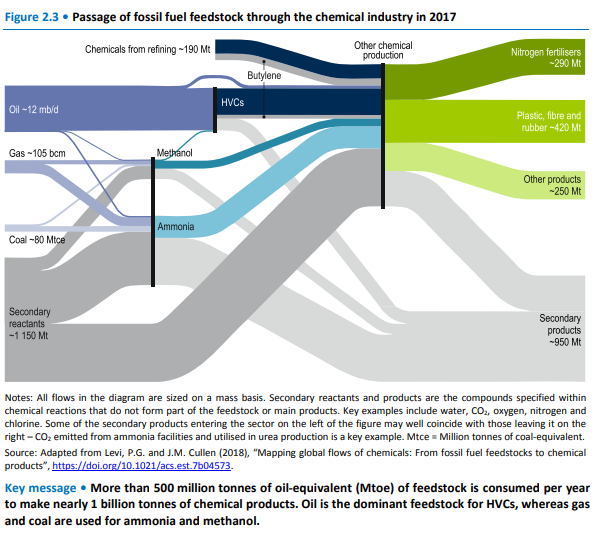
I am asking this question because the transition away from fossil fuels will have a serious knock-on effect on a very large sector of the global economy. Of the total liquid hydrocarbon production, 14 % goes to the petrochemical markets. Of natural gas production, 8 % goes to petrochemicals.

There is a serious complication connected with the idea of shutting down the combustion of hydrocarbon fuels. The elimination of oil and gas combustion activity means that crude oil production drops precipitously and therefore so would refining. Oil refineries are designed to maximize the volume of their most profitable products while minimizing their cost to manufacture. I refer to gasoline, diesel and aviation fuel. Petrochemicals come from oil and gas. Their economics ride on the coattails of fuel production to some extent in terms of scale. Refineries are physically large operations so as to operate with the maximum economy of scale. Maximum economy of manufacturing scale drives consumer prices downward.

Refineries produce much more than fuels. They produce asphalt, lubricating oil, polymer raw materials, petrochemicals for pharmaceuticals and other raw materials for thousands of products we take for granted. There are countless uses for petrochemicals beyond throw-away plastic bottles and bags. Just look around where you are sitting this very moment. Unless you are in Tierra del Fuego or Antarctica, you can’t help but see examples of hydrocarbon applications.

The Future of Petrochemicals, IEA
Flow of oil and gas streams to chemical product production. Source: The Future of Petrochemicals, IEA.

Could refineries adapt to the loss of a large fraction of their fuels production and still produce petrochemicals? Engineering-wise, I’d say yes. But as far as economics go, that is a harder question to answer. Company officers have a fiduciary responsibility to the stockholders. This is a baked-in feature of corporate business. The promise of ever-increasing margins and volumes is part of that. Switching gears towards sustaining the petrochemical sector in the face of declining fuel sales is natural in one sense, but if it involves declining EBITDA over time, it could be disastrous for the stock market. Petrochemical prices might have to climb drastically to sustain earnings. Players in the global oil & gas market are extremely twitchy. The mere suggestion of a potential problem is enough to send prices soaring or diving. Luckily, a wind-down of fuel production will take some time during which the players might be able to compensate.

Look around you. How many consumer goods come in plastic containers or plastic film-coated paper? All of our electronic devices are built into casings of some sort, most of which have plastic or fiberglass (resin impregnated glass fiber) components. The list is endless. For many or most of these things to stay on the market, a substitute material will be needed to replace the hydrocarbon-based materials. Wooden casings for computer monitors and iPhones? What about paint? Paint is loaded with hydrocarbon components.

A vast number of products we take for granted use hydrocarbon materials in some way. Perhaps renewable plastics will scale to meet certain demands. Recycling applies only to those plastics that can be melted- the thermoplastics. Thermoset plastics like melamine cannot be melted and so cannot be recycled. Recycling only works if consumers close the recycling loop. Plastics must be carefully sorted in the recycle process. When a mixture of plastics is melted, the blend can separate like oil and water producing inferior product. National Geographic has a good web page describing recycling.

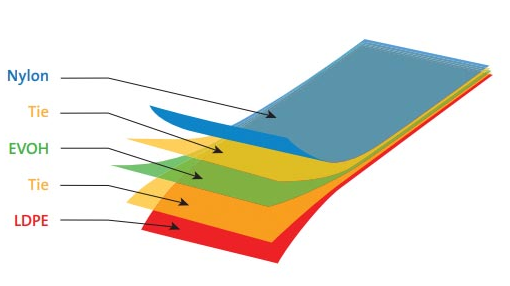
Some plastics such as clear, colorless polyethylene films are usually pure polymer. Most synthetic polymers are colorless. In general, any synthetic polymer that is colored has pigments in it. Black plastic is loaded with soot for instance. Many polymer films for packaging are multilayered with different types of polymer layered together.

Waste thermoplastic with food residues is very problematic, especially those with oil residues. Waste plastic for recycle must be clean. Multilayer plastic films are not suitable for recycling either.

Source: Technical Bulletin, Saint Gobain. Multilayer film structure with 3 different films and two tie layers between them. The Nylon layer provides toughness and tear resistance. The polyethylenevinyl alcohol (ethylene-vinyl chloride copolymer) layer (EVOH) blocks the transmission of oxygen and carbon dioxide. Low density polyethylene (LDPE) layer provides broad chemical compatibility along with biocompatibility for safe handling of biopharmaceuticals. Not all polymers are compatible with melt bonding. The tie-layer is a melt-bondable adhesive polymer film that hold the layers of polymer into a single film. The tie layer polymer is often a polyethylene film that has a surface layer of organic acid or anhydride groups that can bind to other polymers by melt bonding.

Other additives such as plasticizers are present in flexible plastics like polyvinyl chloride (PVC) or other compositions where suppleness is important. Pure PVC is rigid. Additives are an industry unto its own. The varieties and grades in the plastics business is mind boggling. The variety of plastic compositions is too diverse to allow recycling of all plastics.

Polymer manufacturing is likely to continue indefinitely. There is simply too much money at stake for the big oil & gas and petrochemical players to deconstruct themselves to a large extent. They will, however, follow the consumer, but how far?

So, the question is this- for the sake of keeping a viable petrochemical stream in place while hydrocarbon fuel consumption declines, how much hydrocarbon fuel can we burn per year without exceeding the capacity of the earth to absorb the CO2 produced? We want to lower the slope of the atmospheric CO2 curve enough to achieve a reasonable steady state. The global economy depends very much on the production and use of petrochemicals. People will generally avoid economic suicide.

Where is the balance point for a sustainable production of necessary petrochemicals and the decommissioning of hydrocarbon fuel production? I certainly don’t know.

The Refinery Crack Spread

Reuters has reported that the crack spread enjoyed by oil refiners is currently sitting around $37.50. The crack spread is the difference between the price of crude oil and the petroleum products coming from it. This number is an indicator of the profitability of refinery output.

Cracking is a major operation at oil refineries where heavy, long chain hydrocarbons are broken into shorter chain hydrocarbons. Crude oil naturally contains a limited amount of components suitable for modern engines. An important attribute is branching. The goal is to produce the most valuable products from otherwise longer chain, lower value hydrocarbons.

A Scratch in the Surface of Gas Chromatography

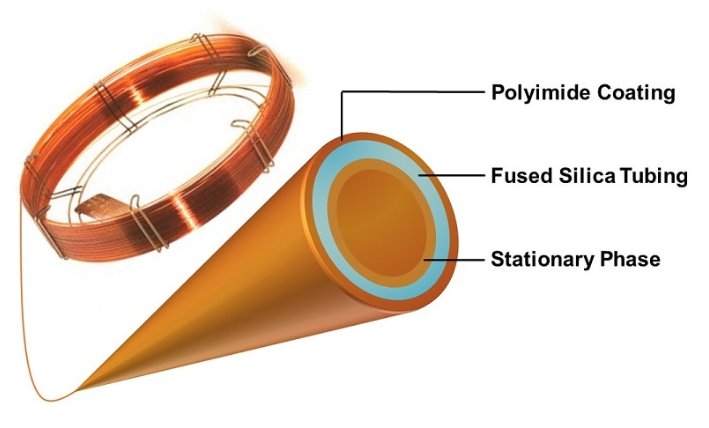
The analytical workhorse of the petroleum refinery is the gas chromatograph, or GC. The GC consists of a precisely controlled oven and within it is a coiled, small diameter hollow fiber many meters in length. It is called a capillary GC column. At one end of the column is an injection chamber with a silicone septum that samples are injected through via syringe. This chamber is hot enough to flash evaporate the sample but not so high that it decomposes. For instance, I have usually used a 250 oC injector temperature. A common volume of liquid to be injected is 1 microliter. The sample can be neat or a solution and must be scrupulously free of particles.

Inside the injector is the carrier gas input- helium is often used. A large amount of the vaporized sample is flushed out of the injector leaving only a small quantity of sample to be injected. Connected to the injector is the entrance of the capillary column. The goal is to inject a very narrow plug of sample into the capillary column all at once. After the injection, the detector is activated and the data collection begins. Progress can be followed in real time or not. Once the sample is on the column the GC run must be taken to completion. There is no reset for the column.

Capillary column. Source: Agilent.

The inside surface of the long capillary column can be just fused silica or it can have a coating. In any case, the components of the sample each have a different affinity for the inner wall of the capillary. As the carrier gas pushes the vaporized sample components along, the components with the least affinity for the inner column surface advance through the column fastest and arrive at the detector earlier. Generally, the higher the molecular weight, the lower the volatility and the longer it takes to exit the column.

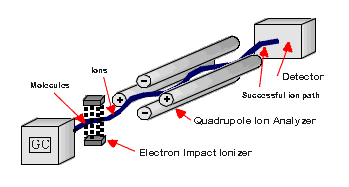
At the terminus of the capillary column is the detector. There are a variety of methods used to detect sample and send a signal to the plotter or computer. A particularly useful type of GC system uses a mass spectrometer as a detector. The flow of components enters an ionization chamber and positive ions are generated by electron impact and sent through the mass analyzer and on to the detector. This is occurring continuously as the sample components exit the column. As the components are detected, a regular chromatogram is collected and displayed. The difference with the mass spec detector is that along the timeline, mass spectra are also collected. It is possible to select any given peak in the chromatogram and display the mass spectrum.

A mass spectrum for every peak. Source: God I hope they don’t mind my using this graphic. American Chemical Society. I don’t need ACS goons banging on my door again!
Graphic from NASA showing schematic of the GC Mass Spec aboard the Huygens probe to Titan.

A mass spectrum detector offers the possibility of identifying the individual peaks from the molecular ion mass and the fragmentation pattern. That said, not all mass spectra are easily interpreted. Only cation fragments are visible. Neutral fragments must be inferred.

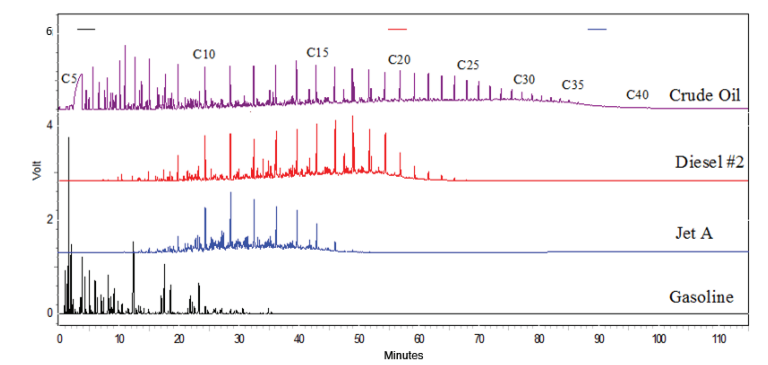
A stack of gas chromatograms showing the components of crude oil and several derived products below it. Each peak indicates a single component with the intensity along the y-axis and time in minutes along the x-axis. The area under each peak is proportional to the % composition in the sample. On the left side of the chromatogram are the components that are more volatile and exit the GC column earliest. The right side shows the components that exited the column after longer intervals. They are the longer chain molecules. Source: IRTC.

Back to the Crack

The most valuable refinery products are gasoline, fuel oil (including diesel), and aviation fuel. Within these three areas are subcategories that split into different product lines. These fuel product categories are defined by the number of carbon atoms in the blend of hydrocarbon molecules, saturation, and branching.

Refineries produce blended fuels affording certain properties according to their use. These properties include boiling point and vapor pressure specifications, octane or cetane numbers, viscosity, and pour point specifications. Between distillation, cracking, aromatization and reforming a wide variety of hydrocarbon substances are available from refining for formulation. A refinery is engineered to produce the largest volume of the most valuable hydrocarbons from continuous flow processes at the greatest profit.

Oh, I was just joking about the ACS goons. They don’t bang on your door.

Water Breaks in Tejas

Local laws mandating that 10 minute water breaks be given to construction workers every 4 hours have been eliminated by Tejas Governor Greg Abbott and the legislature under HB2127 titled “Texas Regulatory Consistency Act.” The bill was put forward by Rep. Dustin Burrows, R-Lubbock. The bill is seen as an effort to push back on progressive local laws by cities like liberal-leaning Austin and Dallas where ordinances have been put into place to protect construction workers against the oppressive heat of Texas. Abbott said the bill will “provide a new hope to Texas businesses struggling under burdensome local regulations.”

Hyperbole,  /haɪˈpɝː.bəl.i/, noun; a way of speaking or writing that makes someone or something sound bigger, better, more, etc. than they are

In Section 2 of the bill, it says the legislature finds that:  “(1) the state has historically been the exclusive regulator of many aspects of commerce and trade in this state; (2)  in recent years, several local jurisdictions have sought to establish their own regulations of commerce that are different than the state’s regulations; and (3)  the local regulations have led to a patchwork of regulations that apply inconsistently across this state.

The State claims to be the exclusive regulator of commerce and trade in the state pursuant to Section 5, Article XI, Texas Constitution. HB2127 was written to more closely define what kinds of codes local governments are free to do.

Given the state’s interest in commerce and trade, Section 6 removes any ambiguity in that regard. Labor regulations come under the heading of commerce and trade, so the state is the only lawgiver here.

HB 2127, SECTION 6.

Subchapter A, Chapter 1, Business & Commerce Code, is amended by adding Section 1.109 to read as follows:

Sec. 1.109. PREEMPTION. Unless expressly authorized by another statute, a municipality or county may not adopt, enforce, or maintain an ordinance, order, or rule regulating conduct in a field of regulation that is occupied by a provision of this code. An ordinance, order, or rule that violates this section is void, unenforceable, and inconsistent with this code.

Backers of the bill say that under OSHA, employers already have a duty to provide a safe workplace work place. A spokesman for the Associated Builders and Contractors of Texas said that “local rules impose a rigid scheme that, unlike OSHA guidelines, does not allow the flexibility needed to tailor breaks to individual job site conditions.”

However, according to David Michaels who led OSHA from 2009 to 2017, “Under OSHA law, it is employers who are responsible to make sure workers are safe,” said Michaels, now a professor at the George Washington University School of Public Health. “And we have compelling evidence that they are doing a very poor job because many workers are injured on the job, especially in Texas.”

Michaels also said that OSHA can issue a citation for a heat-related injury or death, but only after it has taken place. He also points out that OSHA has no national standard for heat related injury.

However, OSHA does have the General Duty Clause for situations where there are no specific standards applicable.

29 U.S.C. § 654, 5(a)1: Each employer shall furnish to each of his employees employment and a place of employment which are free from recognized hazards that are causing or are likely to cause death or serious physical harm to his employees.”

29 U.S.C. § 654, 5(a)2: Each employer shall comply with occupational safety and health standards promulgated under this act.

29 U.S.C. § 654, 5(b): Each employee shall comply with occupational safety and health standards and all rules, regulations, and orders issued pursuant to this Act which are applicable to his own actions and conduct.

The legislation to remove local laws regarding construction labor hazards was apparently motivated by the desire of the GOP to slap down islands of liberalism in Texas.

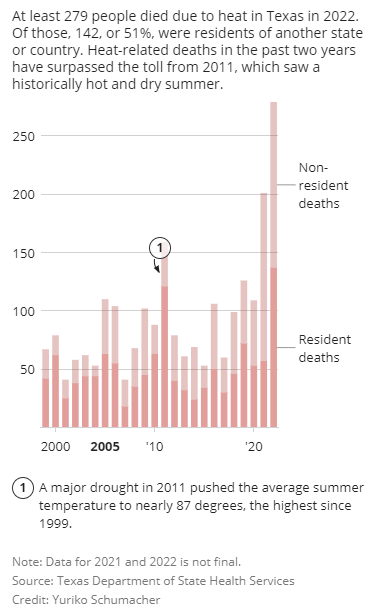
This graphic was produced by the Texas Tribune using data from Texas Department of State Health Services. Source: https://www.texastribune.org/2023/06/16/texas-heat-wave-water-break-construction-workers/

The chart above shows that known heat-related deaths in Tejas are up sharply in the last 2 years. Migrants and the homeless are hit particularly hard by hyperthermia.

I can understand the desire to smooth out the spotty nature of regulatory sovereignty across any state. It is really a matter of state vs local control and there shouldn’t be any confusing overlap of authority. Texas has chosen primacy over commerce and trade, of which labor is a part of. Somewhere in the process of this, someone noticed that regulations on water breaks mandated by municipal statute will be invalidated.

News stories came out with the shocking news that people working outdoors will not be guaranteed water breaks. The absence of statutory regulation on water breaks does not mean that workers will be denied water. Any employer who wants to retain employees will not deny water to employees. What has been invalidated are mandatory 10-minute water breaks every 4 hours. A workday is usually broken down into a break midmorning and midafternoon with lunch at around noon. These are 3 opportunities to grab a drink of water. A mandatory break after 4 hours past arrival places the break around lunch and quitting time anyway for an 8-hour day, so it is hard to imagine what advantage it gives for an 8-hour day. For longer days it would be beneficial. Employers who would deny water to employees should be punished.

Construction site managers object to rules that would interfere with things like concrete deliveries and crane work. Both are time sensitive activities. Even in the rough and tumble construction field, most companies will do the right thing and allow access to water at all times.

Texas HB2127 itself is silent on the matter of water breaks for workers. It simply reasserts authority already provided in the state constitution, namely as the, ” … exclusive regulator of many aspects of commerce and trade … ” and supersedes local statutes that overlap with what the state sees as its sovereignty. It seems a little sly, but not fundamentally corrupt.

So, the question becomes, will the State of Texas legislate mandatory water breaks for workers in hot environs? Given the rabid pro-business leanings of the state, it seems doubtful.

Am I taking the side of the Republicans on this? Goddammit, I hate to say it, but I suppose I am.

“… radical-left Democrats, Marxist, communists and fascists …”

I’m running out of words to describe the deplorable ex-president #45. Just when you think he can’t add to his steaming heap of manure called a legacy, he shovels on more. It seems like there is no limit to the falsehoods he is willing to declare in public and no limit to what his supporters are willing to accept.

In regard to his indictments, he was recorded as saying something to the effect of “They’re not after me, they’re after you … I’m just standing in their way!” He is turning his indictments into the image of him sacrificing himself on the cross for the millions of Americans. A blood sacrifice for his beloved followers. If you supposed that this vaudevillian stunt was transparently phony to everyone, you’d be wrong.

#45 has been referring to “… radical-left Democrats, Marxist, communists and fascists …” in his gimmie-all-yer-lovin’ rallies. How absurd. Leftists aren’t fascists- they are antifascists. And by the way, what is wrong with being against fascism? #45 is using his usual mirror tactic of taking accusations against him and aiming it back at his critics. He knows very well that he isn’t being held accountable for truthfulness by the people he counts on. He tells big lies and repeats them over and over. It works for him. The very boldness of his lies somehow validates them in the minds of his followers.

Marxism and socialism have been in the scrapyard of history for a decades. The Soviet experiment with using socialism to get to communism was an abject failure. Stalin’s USSR was a brutal, murderous dictatorship tarted up to appear as a people’s paradise for those outside the iron curtain.

China today is a single party communist dictatorship that practices centralized control and nationalistic state capitalism. Previously, however, under the command of Chairman Mao Zedong, it is estimated that 40 to 80 million people died as a result of starvation, persecution, prison labor and execution in order to achieve his personal dream of a communist paradise.

It is difficult to find a communist state where people have the liberties that we in the US take for granted. It seems that to compel people to hand over their belongings to the state, a good bit of muscle is needed. Stalin found this out when he tried to collectivize Ukraine in the early 1930s. He ended up causing mass starvation and sending people to the gulags. The notion that the US is under threat from communist influence is without credibility. The odd communist may pop up now and then but they are little more than a curiosity not worthy of concern.

It is hard to know what Republicans regard as radical about Democrat ideals. Could it be that anyone who disagrees with today’s GOP is a “leftist radical”? If there are actual living, breathing Marxists among liberals in the US, they are likely to be lonely. There is Richard D Wolff at UMass, Amherst. Wolff is against capitalism and makes some fair points, but the momentum of history won’t be going his way any time soon. People still remember the Soviet experiment with Marxism-Leninism which was a disaster.

So·cial·ism: noun; a political and economic theory of social organization which advocates that the means of production, distribution, and exchange should be owned or regulated by the community as a whole.

Source: Google

Will citizens of the US ever acquiesce to turning over private property to a socialist government? Clearly, there is not a chance. The accusation that US liberals harbor socialistic desires is a Republican fever dream. The same with communism. The current population of US citizens would never embrace communism. Too many past instances of communist or socialist dictatorships in the world, and besides, Americans love their private property and would defend it with the umpteen hundred million guns under their pillows.

It is a Republican fantasy that only they are the true patriots in the US. This gives them license to posture as the only “real” Americans worthy of the title. This froze out as axiomatic for them many years ago, especially since the years of Mr. “trickle-down economics” Reagan.

Having social services is not the same as having socialism. A capitalist economy that provides a social safety net through taxation is not socialism. The capitalists still own their means of production, distribution and exchange.

Ordinary citizens in the US pay taxes to support the Army, Air Force, Space Force, Marines, Navy and Coast Guard. We also pay taxes and fees for upkeep on state and national infrastructure like roads, bridges, air traffic control and many other things. All of this goes to support our capitalist means of production, distribution and exchange.

Citizens pay exorbitant tuition to educate themselves to a level where they can contribute to operating our capitalistic enterprises. Payment for the common good isn’t borne exclusively by business. Both citizens and our capitalist enterprises benefit from this arrangement.

The business side should recall that citizens contribute to their corporate existence by funding their government contracts and by purchasing products that they off-shored to China to the detriment of US workers and security.

Gaussling’s Epistle to the Bohemians 2/28/23

>>> A smattering of thoughts each too small for a post. <<<

I’ve been thinking about quantum chemistry lately, or more to the point, my graduate-level single semester experience with it. First let me say that prior to taking the qualifying exams on arrival to the graduate chemistry program, I made sure to bone up on the particle in a one-dimensional box model. And sure enough, it was on the entry p-chem exam. Whew! Dodged that bullet. However, of all 5 exams we took, I didn’t pass the statistical mechanics exam. I would have to repeat the exam and pass it by the end of the year. Instead of taking the undergrad p-chem course I decided to risk it and study on my own and as luck would have it, I managed to pass it. Another monkey off my back.

Back to the quantum chemistry course. Initially I was hoping to gain a bit of qualitative insight into the subject. As it turned out, it was really just a high level math class where the prof spent the whole term deriving all of the key equations. I think this is pretty common for this subject. There were zero interesting applications mentioned. He was either unable or unwilling to render any of it into sentences for context. The guy was a rock star in his area of solid state nuclear magnetic resonance. Once I went in for help during office hours and he told me he was busy and to come back in 2 weeks (!). I was finally convinced that putting scientists on a pedestal was a serious error and that a**holes were truly everywhere. Anyway, I made it through the experience and moved on. Haven’t had to think about Hamiltonians since.

==========

I was chatting with a toxicologist colleague recently about the big derailment and fire disaster in East Palestine, OH. I had suggested that the decision of the responders to vent and burn the remaining vinyl chloride was probably a good idea. There was some fear that there may be a runaway polymerization of the vinyl chloride. This would likely lead to an explosive rupture of the tank car and a possible BLEVE. This is from the report

On February 5, responders mitigated the fire, but five derailed DOT-105 specification tank cars (railcars 28–31 and 55) carrying 115,580 gallons of vinyl chloride continued to concern authorities because the temperature inside one tank car was still rising. This increase in temperature suggested that the vinyl chloride was undergoing a polymerization reaction, which could pose an explosion hazard. Responders scheduled a controlled venting of the five vinyl chloride tank cars to release and burn the vinyl chloride, expanded the evacuation zone to a 1-mile by 2- mile area, and dug ditches to contain released vinyl chloride liquid while it vaporized and burned. The controlled venting began about 4:40 p.m. on February 6 and continued for several hours.”

My colleague said that a fire releases aerosols that are likely to be especially deleterious to the lungs. Burning organic chlorides leads to hydrochloric acid formation with all of the joy that it brings to the dance. The smoke plume, elevated by convection, and probably carrying some amount of unburned chemicals will spread with the aerosols far and wide. This would contaminate a larger patch of environment and expose a more distant population than a simple spill at the crash site would. He wondered to what extent the chemicals shouldn’t have been removed at the site, spill or not, and the land be designated as a Brownfield.

==========

Elon Musk has been running off at the mouth again, this time seeming to take sides with the Dilbert cartoonist Scott Adams who was recently given the death penalty of abandonment by his publishers. Adams used his cartoon to go off on the Black population saying that Whites “should get the hell away from Black people” referring to them as a racist hate group.

Set aside the merits/demerits and morality of Adams’ racial views for a minute. As an adult and businessman he should have known the boundaries of acceptable content in his cartoon strips in the current social environment. He published content that appeared to have alignment with white supremacist ideas. In publishing this content, he made himself radioactive and he was dropped by his publishers who happen to have better business sense. What a dunce. He was playing with a loaded gun and it went off in his face.

So, His Excellency, Elon Musk, has stepped into the fray and condemned the excommunication of Adams from the comic strip pages. Musk said that while Adams’ comments weren’t good, there was an element of truth in them. He accused the media of providing a “false narrative” by giving more attention to Black victims of police violence than to White victims of police violence. This is on top of his general loosening on hate speech on Twitter and the reinstatement of banned accounts such as with #45. Musk is broadcasting that hate speech is as valid as any other speech on his platform. Businesses like Twitter are free to edit content or not as they please. Musk believes in a rough-and-tumble environment where most anything goes. As an owner, he is certainly free to do that. But as owner, he is also responsible for content that drives away business.

Irrespective of your beliefs in this matter or the obvious morality issues, it should be apparent that neither Adams or Musk seem to care about the effect on business of draping yourself in the flag of racism, or even just of allowing the perception of it. Savvy is a kind of vector- it has magnitude and direction. Musk has strong vectors in the technology direction, but not so much in the public relations direction. He doesn’t seem to have full control of his mouth just yet.

==========