
Category Archives: Chemical Industry

The Toxco Story – Parts 1 & 2

This is a guest post written by a good friend and colleague who retired as an executive from the specialty chemical industry. He is an author and editor of a respected book on Grignard chemistry. It is an honor for me to post his recollections on this site with his permission.

========================================

The TOXCO Story – Part I

I suppose this story begins during the Cold War. The US had developed a triad of defense capabilities to deter Soviet aggression. We had the Air Force B-52 bombers armed with atomic weapons, the submarine based Trident missiles, and the land based ICBMs–first the liquid fuel Atlas rockets and later the solid fuel Minuteman missiles hidden is silos in North Dakota and elsewhere.
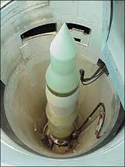
Then came 1989, the destruction of the Berlin Wall, the subsequent collapse of the Soviet Union and, suddenly, the Russians were no longer the dreaded foes whom we once feared. Maybe it was time to “stand down” our hair-trigger defense posture.

Those solid fuel Minuteman rockets were designed to be launched on short notice. Firing them required a significant amount of electricity. This was to come from the electric power grid. But our military, recognizing that this source of power could be compromised in the tense times leading up to a nuclear confrontation, needed a backup. As a result, each missile silo was equipped with a diesel powered electric generator, just in case.

But things could go wrong. The diesel fuel might be contaminated, or sabotaged by Russian saboteurs, or any of a number of other problems. So, in an overabundance of precaution, the military insisted on a “backup to the backup”. And what could be better or more reliable as a source of electricity, than a battery. To be sure, these would have to be BIG batteries, bigger and more powerful than any produced thus far, but they would be certain.
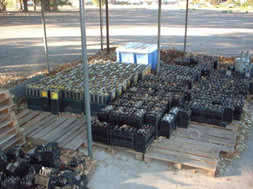
And so, the Defense Department commissioned the production of the world’s largest and most powerful batteries. These were based on lithium-thionyl chloride chemistry[1]. Each primary cell contained sheets of elemental lithium, surrounded by gallons of thionyl chloride, a reactive liquid which on contact with water produces a mixture of sulfuric acid and hydrochloric acid—really nasty stuff. These primary cells were each about the size of a coffin and it took three, ganged together to generate the power needed to initiate a missile launch. The government contracted for thousands of them and Union Carbide supplied them.

Apparently, at some point, there was a fatal incident involving a 10,000 amp Minuteman battery being drained and replaced[2] and this contributed to a decision in the early-mid 1990s to dispose of these hazardous items. The DOD issued a Request for Proposals (RFP) which caught the attention of a group of businessmen and entrepreneurs in southern California.

Operating in Orange County, California, headquartered in Anaheim, near Disneyland, were three affiliated companies. Adams Steel was in the ferrous metal recycling business-old washing machines, refrigerators, scrapped cars. Before you scrap a car, you remove the lead-acid battery and the catalytic converter. The battery, containing lead metal, lead salts and sulfuric acid is a hazardous waste and its disposal is regulated by the EPA. The catalytic converter contains precious metals such as platinum, rhodium and iridium. These two items (batteries and catalytic converters) were handled by Kinsbursky Brothers. Non-ferrous metals (common ones such as copper and aluminum and non-common ones like tantalum and gallium from electronic devices) were processed by Alpert & Alpert. The companies had worked together for a number of years.

Principals at Adams Steel and Kinsbursky decided to form a joint venture to bid on the lithium battery disposal opportunity. They created TOXCO for this purpose. It was headed by Terry Adams (the youngest sibling in the Adams family) and Steve Kinsbursky. And they won the bid. The government would pay TOXCO millions of dollars to dispose of these batteries that the government had paid millions of dollars to manufacture some years earlier. Your tax dollars at work.
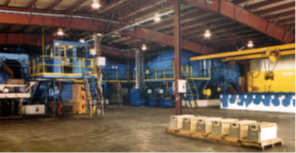
So, how do you dispose of a lithium-thionyl chloride cell weighing hundreds of pound and filled with dangerous and explosive ingredients? Well, if you are a mechanical engineer, trained at USC (as Terry Adams was), you take a mechanical engineering approach the problem. You have to neutralize the thionyl chloride and the lithium by reaction with water. And reactions take place more slowly (and more safely) at lower temperatures. So, the answer is to chill the cell in liquid nitrogen down to 77°K, put it in a large container filled with water and chop it apart with big mechanical knives (like you chop an automobile into small pieces for scrap). This actually works. Provided you’re certain that the cells have been fully discharged first. But don’t take the military’s word for it. If you do, there may be an embarrassing incident, as there was in 2000, during the disposal process.[3]

Next question. Where do you do this disposal? The TOXCO team discovered that there was an underused industrial site in Trail, British Columbia, on the Canadian side of the Idaho border. It had been part of the Cominco Smelter operations and was one of the most heavily polluted sites in North America[4]. What better place to site a hazardous battery disposal plant? If something went wrong, who would notice?

And so, TOXCO went into business, disposing of lithium batteries, successfully (except for a few incidents like the one incident alluded to above).

One of the by-products of this process was a stream of aqueous lithium salts. These had value and could be recovered and that put TOXCO into the lithium chemicals business. But that’s part II of this story.

The TOXCO Story – Part II
(the Lithchem Story)

This story also begins in the Cold War. Even as the atomic bomb (the uranium and the plutonium fission bomb) was being engineered into reality at Los Alamos in the mid 1940s, plans were being made for the next generation weapon—a fusion bomb.

The first H-bomb, based on the concept of fusing light nuclei, was tested at Eniwetok in the South Pacific in 1953. Improvements in the initial “clunky” design quickly followed. One way to boost the power of the explosion was to surround the core of the bomb with a layer of lithium deuteride, LiD. Lithium is, well, the element lithium, atomic number 3 in the Periodic Chart. And deuterium is the name for “heavy hydrogen”, an atom of hydrogen, atomic number 1, but also containing an uncharged neutron[5]. Provided that the lithium used was of atomic weight 6, the fusion of the lithium(6) and the deuterium(2) would produce two nuclei of helium(4), plus lots of energy.

This would only work if you used lithium-6. Unfortunately, the lithium available to us on this planet in mineral form, deposited around the globe, is a mixture of lithium-6 and lithium-7 (the same element, but with one extra neutron). And God, in His infinite wisdom, chose to endow the earth with mostly lithium-7. Of the naturally occurring deposits of lithium, 93% is lithium-7.
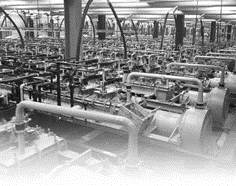
So, if you need to use just Li-6, you have to separate it out from the more abundant, naturally occurring Li-7. And the US government proceeded to do just that. Starting in the 1950s, they processed millions of pounds of lithium containing minerals to extract the less abundant isotope that was required for its military purpose. For every hundred pounds of lithium salt they processed, they got, at most, 6 pounds of lithium-6 salt[6].

And what do you do with the “leftover” 94+ pounds. Well, you can’t just turn it back into the lithium chemicals marketplace. For one thing, it’s “depleted” lithium (missing its naturally occurring share of Li-6.) This would be easily noticed by someone using the lithium for routine chemical purposes. The extent of “depletion”, that is, of extraction of the Li-6 would be measureable, and that information was a secret[7]. Moreover, if the quantity of depleted Li were ever realized, that number could be used to infer the number of LiD containing bombs, and that too was a secret.
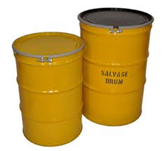
So, for more than five decades, for more than half a century, the US government simply stockpiled the “by-product” depleted lithium in a warehouse, in the form of the simple salt, lithium hydroxide monohydrate, LiOH•H2O. Millions of pounds of it. Packaged in poly lined, 55 gallon fiber drums.

In later years, the cardboard drums began to deteriorate. Some of them were damaged during handling and relocation. Sometime in the 1980s the decision was made to repack the inventory in bright yellow steel “overpack” drums.

Now comes the early 1990s. The Cold War is over. Our nuclear secrets, at least those from the 1950s, are far less precious. And the Clinton administration is looking through Fibber McGee’s closet[8] to see what can be disposed of, and maybe generate a revenue stream for the government in the process.

What they discover is 100,000,000 pounds of “depleted” lithium hydroxide monohydrate, with a potential market value approaching $1 per pound. And so, it goes out for bids.

The terms of the sealed bid auction were that the final sale would be split 70-30 between the highest bidder (who would get 70% of the inventory) and the second highest bidder (who would get 30%, but at the high bid price).

This was a perfect set up. At that time there were only two lithium companies operating in the US who could handle this quantity of inventory—Lithium Corporation of America[9] and Foote Mineral Company[10]. And both of them knew that there was no incentive for overbidding since even the loser would get 30% of the supply.

And that’s where Lithchem appeared on the scene. The TOXCO team was already in the “recovered lithium” business. All they had to do was bid one penny more per pound than the other two majors and they would be awarded the lion’s share of the inventory. They incorporated Lithchem for that purpose. I’m told that LCA and Foote each bid the same number, somewhere in the 20+ cents per pound range, and Lithchem bid one cent more. As a result, Lithchem became the proud owner of 70,000,000 pounds of depleted lithium hydroxide monohydrate.

Now what? The principal use of LiOH is in the manufacture of high performance lithium greases, used in heavy industrial applications-heavy trucks, railroads, etc. Much of the market for lithium greases is in the third world and quality is less of a concern than price.

Still, to be sold on the open market, the LiOH from the government stockpile had to meet certain specifications. Some of the yellow drums contained beautiful white crystalline powder. Others contained dead cats and cigarette butts. It was “government quality” inventory.

One condition of the bid was that the winning bidder had to remove the inventory from its location in a government warehouse (in southeast Ohio[11]) within 12 months of the successful bid. I had the occasion to visit that warehouse, before the stock was removed and it was a memorable sight.
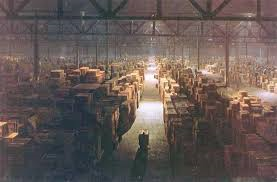
If you recall the final scene in the movie “Raiders of the Lost Ark”, the Ark of the Covenant is being stored in a gigantic government warehouse, filled floor to ceiling with identical gray boxes. A warehouse stretching far into the next county. Now replace those gray boxes with yellow overpack drums, stacked 6 or 8 high, stretching far into the next county. That’s what it was like. That’s what 70,000,000 pounds of LiOH hydrate looked like.


[1] The lithium – thionyl chloride primary cell has a high voltage (3.5 V) and a high current density.

[2] Battery Hazards and Accident Prevention,  By S.C. Levy, P. Bro

[3] In November 2009 a fire broke out at the Trail BC facility in a storage shed containing lithium batteries slated for disposal. It was their sixth fire in fifteen years. Prior to that, a major fire in 1995 destroyed 40,000 kg of batteries at the facility. Three fires occurred in 2000, including one caused by some lithium batteries. This was during the summer when negotiations were underway between Toxco and Atochem for the acquisition of the Ozark business. http://www.cbc.ca/news/canada/british-columbia/trail-battery-recycling-fire-leaves-questions-1.805780

[4] http://en.wikipedia.org/wiki/Teck_Resources

[5] Elements with the same atomic number but different weights are called isotopes. Heavy hydrogen (with an atomic weight 2) is an isotope of hydrogen (atomic number 1). Another example is carbon-14, useful for radiocarbon dating. It’s a heavier version of the more common version of carbon, C-12.

[6] Actually less than 6 pounds. The extraction process was less than perfectly efficient. The actual yield of Li-6 was a closely guarded national secret.

[7] In depleted lithium (with the Li-6 removed), the relative abundance of lithium-6 can be reduced to as little as 20 percent of its normal value, giving the measured atomic mass ranging from 6.94 Da to 7.00 Da.

[8] http://en.wikipedia.org/wiki/Fibber_McGee_and_Molly#The_Closet

[9] Acquired by FMC in 1995 and now known as FMC Lithium.

[10] Now part of the Chemetall Group, a division of Rockwood Holdings.

[11] At the time, it was stored at the DOE enrichment facility in Portsmouth, Ohio.

Lithium as a Chemical

Today we hear about lithium batteries ad nauseum. Everyone is anxious to achieve a bright battery-powered electric future for happy motoring. Mineral exploration has revealed a few new sources of lithium and mines are increasing production. Battery factories are ramping up and R&D keeps turning out tweaks in battery technology. Many are betting on or prophesying the eventual phase-out of hydrocarbon fueled motor vehicles.

Lithium is quite scarce and is the 25th most abundant element on earth with about the same crustal abundance as chlorine although this may vary with the source. For the most part, lithium is fairly widely dispersed in the earth’s crust but it is subject to concentration by hydrothermal transport, forming evaporite deposits or briny ground water. Lithium is also a component of the mineral spodumene which can be found in pegmatites within some host formation. An uncommonly rich site was at the Foote Company Mine in the Kings Mountain Mining District of North Carolina. This operation produced lithium carbonate, Li2CO3. This is a common finished product because it can be removed from a solution of lithium chloride by treatment with sodium carbonate to precipitate the poorly soluble lithium carbonate.

This light metal has many chemical uses apart from batteries. For instance, organolithium reagents are a vital part of the chemical industry clocking in at about $1 billion per year in sales. Organolithium reagents are an indispensable part of organic synthesis. Switching to a reagent with a different metal usually does not work well, giving poor results or the wrong reactivity.

Today we’re seeing organolithium prices rise dramatically with little expectation that it will ever come back and no clue of how it plays out in the future. If a few select lithium reagents, e.g., LiAlH4 or n-butyllithium, go off the market, it will be a bad day for the organic synthetic industry as well as for chemical R&D in general. It is an unexpected consequence of the switch to reduced carbon EVs.

Possible Trouble for the BASF Ludwigshafen Verbund Site

The colossal Baden Aniline and Soda Factory (BASF) verbund facility in Ludwigshafen, Germany, may have to make due with diminished energy supplies if the German state rations gas this fall. This facility is one of six BASF verbund sites and is the largest integrated chemical complex in the world. The site consists of 125 interconnected production plants on 10 square kilometers that share waste heat and generates it’s own electricity and steam. Forbes has described verbund as “… the intelligent interlinking of production plants, energy flows and infrastructure.”

There are many fascinating facts about BASF and the Ludwigshafen verbund site which can be found on the interwebs, so there in no point in duplicating it here. The point of this essay is that the global chemical industry is highly interconnected. Interruption of just one chemical complex like the BASF verbund in Ludwigshafen can lead to disruption in many supply chains in diverse markets. The chemical industry is a web of supply chains where the product of one plant is the raw material for another. Interruptions in energy or materials for one link in the chain will have knock-on effects in others all the way to the final consumer. Nothing unusual about this.

We’ve come to rely on a highly interconnected, interdependent world market that is susceptible to the consequences of political adventures from certain nations. Uncompromising nationalism, ethnic conflict, political turbulence and the current trend of fascist and violent ideology overrunning democratic freedom is threatening this house of cards we’ve built.

Technology can be quite delicate. The success of any given technology constantly depends on people practicing it, improving it and training for it. Whole technologies can be lost if interruptions in continuity from war or deep economic calamity last long enough.

Literacy in the Permian Basin Oil Field

There was an interesting article cited from the Houston Chronicle in today’s news letter from the American Petroleum Institute. Here is the link. Unfortunately there is a pay wall.

From the API news letter- “Low levels of adult literacy and limited access to higher education in the Permian Basin are compounding the skilled labor shortage already facing oil and natural gas companies as the industry’s digital transformation creates a growing need for workers with specialized skills. Ray Perryman, founder of consulting firm The Perryman Group, estimates that Permian Basin residents could lose almost $425 million in potential earnings and $292 million in economic output unless literacy skills improve, a challenge that’s being addressed by initiatives such as the Permian Strategic Partnership.”

Even in the rough and tumble world of the oil patch, folks need to be a little more educated to keep it going forward.

I could crack wise about education in the Republican Evangelical Republic of Tejas, but I’ll leave it alone this time. This problem speaks for itself.

Simple PFAS Destruction Process Disclosed

An article titled Low-temperature mineralization of perfluorocarboxylic acids, Dichtel and Houk, et al., Science, 18 August 2022, Vol 377, Issue 6608, pp. 839-845, DOI: 10.1126/science.abm8868, came out yesterday with a method for defluorination and chain scission of per- and polyfluoroalkyl substances (PFAS). Blessedly, the article is available without charge.

The article describes the mineralization of reactive perfluorocarboxylic anions with NaOH in water and dimethylsulfoxide, DMSO, at 80 to 120 C and ambient pressure.

Ok. If the prefixes “per” and “poly” are unknown to you, read below, otherwise skip ahead.

==================

First, some clarification of the name “PFAS” for you non-chemists out there. The “P” in PFAS stands for either prefix “poly” or “per”. Both prefixes appear in common use. The prefix “per” is used to abbreviate the name when some atom or fragment is attached at every possible alkyl (see below) carbon connection point in a molecule or specified fragment of the molecule. The much lengthier proper name would have a number of the position of each separate fluorine atom on the molecule. “Per” and “poly” saves everyone from having to trip over a great many tongue-twisting syllables.

Hydrocarbons consist of only hydrogen atoms on a carbon skeleton. Hydrocarbon carbon atoms can have 0 to 3 hydrogen atoms attached to each skeleton atom. The exception would be methane, CH4, which has 4 hydrogen atoms attached. “Alkyl” refers to a subclass of hydrocarbon fragments or molecules that are absent multiple bonds between atoms of a carbon skeleton. A molecule with a carbon skeleton having no multiple bonds between carbon atoms and linked to hydrogen atoms only is called an “alkane”. An alkane fragment that is connected to something else is called an “alkyl” group.

Gasp! So, a perfluoroalkyl molecule or fragment would have 2 or more of its hydrogen atoms replaced with 2 or more fluorine atoms on a given carbon atom (see definition below).

From WikipediaAccording to the Organisation for Economic Co-operation and Development (OECD): “PFASs are defined as fluorinated substances that contain at least one fully fluorinated methyl or methylene carbon atom (without any H/Cl/Br/I atom attached to it), i.e. with a few noted exceptions, any chemical with at least a perfluorinated methyl group (–CF3) or a perfluorinated methylene group (–CF2–) is a PFAS.

The prefix “poly” is much simpler. It is meant to indicate that the word it is attached to has many units of something, as in polyfluoroalkyl, which means many fluorine atoms attached to alkyl carbon atoms. Or it could refer to a string of repeating units as in a polymer.

Outside of the narrow PFAS world, the prefix per in “perfluoroalkyl” would indicate in common usage that the alkyl fragment is completely saturated with fluorine atoms.

==================

If we were at the bar during happy hour slamming well drinks after a long day of shaking separatory funnels, washing glassware and trying to vacuum distill something useful out of tar, someone might have groused that the PFAS destruction process is simply a process where you heat the piss out of a DMSO/water mixture of NaOH and PFAS to destruction. Ok, the word they used is “mineralization” rather than the more chaotic sounding words “destruction” or “digestion”. Everyone has thermally decomposed a reaction mixture in the past. We would pause for a moment, shrug our shoulders and say “well, of course that works”. DMSO is a highly polar, high-boiling solvent which supports the formation of ionic decomposition products at elevated temperature. Kendall Houk even did some snazzy DFT calculations on decomposition mechanisms. Now, that is how to develop a new approach to decomposition! Get out the big stick of quantum mechanical computing power and swing it around! The rascals Dichtel and Houk worked it out first so we’d raise our glasses and drink in their honor. Here’s to you, boys and girls!

As we stagger out to the Uber for the ride home, somebody mutters “I wonder how far along the patent application is and who will be the assignee?”

Some Pragmatics of Green Chemistry

After following a chat room discussion on process safety, I find myself mixed on the matter of what is called green chemistry. In the present example, a fellow wanted to methylate a phenol but didn’t want to use dimethylsulfate or some similar methylating agent. He wanted something that was “green”.

Suggestions were varied, including a recommendation on the use of dimethyl carbonate as methylating agent and a few other approaches through aromatic substitution. One contributor wisely reminded contributors about going into the weeds with low atom efficiency.

Green chemistry is the design of chemical products and processes that reduce or eliminate the use or generation of hazardous substances. Green chemistry applies across the life cycle of a chemical product, including its design, manufacture, use, and ultimate disposal. Green chemistry is also known as sustainable chemistry.”  -EPA

When green organic chemistry is the goal in synthesis, it pays to be sure that there is an accepted definition of green chemistry on site.  The merits and definitions are explained elsewhere. Difficult questions come up when a non-green substance is replaced with something that may be “more green” but needs 2 steps instead of 1. Or when green but more expensive reagents and solvents are needed. What is best? In this case, greater safety, lower cost, higher space yields, reduced waste generation, and fastest reaction times will be the real drivers. The business to business market will not pay more for a green product while a cheaper non-green alternative is present. If you want to get an existing customer to requalify an existing product from a new green process, be prepared to discount the price in exchange for the customer having to go through a requalification process. Customers do not like change at all.

Under what conditions would management allow a process choice that is greenish but obviously more costly? Possibly never. A greener process needs to give a cost savings somewhere. Barring draconian regulation, a successful green process will have a cost benefit. The benefit may be in lower direct cost of manufacture, satisfaction of a process requirement by a customer, or a hedge against future regulatory restrictions.

Solvents may be one of the easier opportunities for green chemistry. For a given process, there may be a bit of latitude with the solvent. Sometimes the issue of solvent residues in the product may arise. Some solvents are easier to strip away than others. No one will choose a green solvent that is hard to remove from the product. Again, the drivers will be those mentioned above.

Another green opportunity is when we automatically choose a stoichiometric reducing agent when we could have looked at a catalytic system with hydrogen. Catalyst costs per kilogram of product can range from negligible to high. One advantage of using expensive platinum group metal catalysts is that the metal is usually recyclable, which is greenish. However, any organic ligand present does get incinerated producing non-green emissions in the process of energy intensive metal refining. If catalytic hydrogenation requires the installation of new capital equipment, then the installation costs in time and money may prevent a switch.

For green oxidation, oxygen in the air is cheap and abundant but carries a big problem. Using an oxidizing gas in the presence of a flammable liquid reaction mass can give rise to an explosive atmosphere in the headspace of the reactor. This is a non-starter in industry. Catalytic oxidation using a greenish primary oxidant in solution is a good place to start. I’ve heard of hydrogen peroxide or peroxyacetic acid referred to as greenish.

The big problem with green synthetic organic chemistry is that in order to synthesize a molecule, the structural precursors must be sufficiently green, reactive and selective to run on a reasonable timescale and at acceptable cost. And they must not produce non-green side products or wastes that spoil the advantage of the target green step. A weighing of the pros and cons of any attempt to do green chemistry will always be needed and subjective decisions will be made on what constitutes green.

While we are all struggling to be greener, let’s not forget to remind ourselves and others that reduced consumption of almost everything is a green step we can all take right now.

Chaos at the EPA

It’s difficult to describe how badly the New Chemicals division in the Office of Pollution Prevention and Toxics (OPPT) at EPA is performing these days, but let me try. The commercialization of new chemicals (not on the TSCA Inventory) not otherwise regulated requires that new chemical substances (NCS) be reviewed and granted following a Pre-Manufacture Notice (PMN) or a Low Volume Exemption (LVE) submission under the Toxic Substances Control Act (TSCA), should they meet internal criteria regarding safety. Exposures and doses to workers or the environment may be measured by the applicant or modeled using EPA in-house software. R&D only chemicals are exempt from such evaluation no matter the scale.

The application process requires the disclosure of the NCS composition and structure, the manufacturing and/or use operation in considerable detail, physicochemical properties and, if available, a wide range of worker and environmental hazards. Imported chemicals not on the TSCA inventory also require TSCA approval just as though they were being manufactured in the USA. Food, drugs and pesticides are not controlled under TSCA. Under penalty of law, all submissions must have the best and most accurate available information, particularly with regard to hazard information. No fibbing allowed.

The issues I’m about to recount started sometime in early 2021. Some speculate that a particular interpretation of the law promulgated by TSCA was adopted. I can’t provide references, however.

By statute, an LVE filing for instance, must be examined and be given a grant, conditional grant, or denial within 30 days. It is currently taking much longer than that: 60 to 100 days or longer. I have some that are still pending after 7 months. PMN filings take longer to process, about 9-12 months. or worse.

Aren’t these delays just a petty annoyance? Well, no. Part of a new product development timeline is getting regulatory approval. If this approval is subject to large delays with uncertain outcomes, then the launch date can become very fuzzy. The consequence for the end user is that scheduling their production activity becomes impossibly vague. Denials of LVE and PMN filings are not uncommon. Don’t expect a lot of sympathy from customers about EPA problems.

The last thing you want is some plebe right out of school with no professional experience in commerce to be handing out the regulatory death penalty to your expensive new technology. Handling hazardous materials safely and without environmental harm is done all day every day all over the world. There is a saying in the chemical industry: If you think safety is expensive try having an accident. There is considerable financial incentive to running a chemical plant safely and within regulations.

There seems to be a troubling issue involving the assumptions that EPA makes in regard to handling the NCS. The feedback I receive suggests that the engineers and toxicologists are ruling based on the worst case exposures that they imagine are going to happen. They imagine that workers and the environment will be exposed to the NCS as if workers aren’t wearing personal protection equipment (PPE) or there was no barrier to the environment. You can plainly state that these exposures won’t happen and state why, but they want evidence evidence that they cannot define that something will not happen. In other words, they want proof of a negative.

Another problem with EPA seems to be the sophomoric view that chemical hazards can always be abated by using safer chemicals. There may be a speck of truth to this generalization. In the formulations industry, for example. Replacing hazardous ingredients in mascara or shampoo with those that are less hazardous may be quite uncomplicated. Reducing chemical hazards is part of ethical business operations and is expected with ISO 9001 registration. The catch for chemical manufacturing is that the chemical features that make chemicals reactive and hazardous are usually the same features that make them essential to synthesis. Except for solvents and filter aid, unreactive chemicals are not very useful in synthesis. Synthetic chemistry is about manipulating the reactive features of one molecule with another to yield a useful product.

The delay issue is not unknown to EPA. In fact they are painfully aware of it all the way up to the EPA administrator. The good folks at EPA are doing their best with absurdly limited resources. We’re told that the TSCA division is 50 % understaffed, and many of the staff they do have are inexperienced. They have a computer system that is obsolete by many generations. You can see this by filing on their website. They have taken to denying submissions that are flawed in a minor way rather than continuing to work with the applicant to fix the problem. This excess fastidiousness ratchets down their backlog, at least in the short term.

The problems at EPA stem from the inability of congress to buckle down and provide proper funding. Only congress can act to boost staffing or computers. Lobbyists are working on it but, unfortunately, this is not an appealing issue for a congress person to take up and run with. Maybe we can get that cancerous A-hole Tucker Carlson to howl about it on the tube. Then we might see some movement.

For Students. Thoughts on Chemical Process Scale-Up.

Chemical process scale-up is a product development activity where a chemical or physical transformation is transferred from the laboratory to another location where larger equipment is used to run the operation at a larger scale. That is, the chemistry advances to bigger pots and pans, commonly of metal construction and with non-scientists running the process. A common sequence of development for a fine chemical batch operation in a suitably equipped organization might go as follows: Lab, kilo lab, pilot plant, production scale. This is an idealized sequence that depends on the product and value.

Scale-up is where an optimized and validated chemical experimental procedure is taken out of the hands of R&D chemists and placed in the care of people who may adapt it to the specialized needs of large scale processing. There the scale-up folks may scale it up unchanged or more likely apply numerous tweaks to increase the space yield (kg product per liter of reaction mass), minimize the process time, minimize side products, and assure that the process will produce product on spec the first time with a maximum profit margin.

The path to full-scale processing depends on management policy as well. A highly risk-averse organization may make many runs at modest scale to assure quality and yield. Other organizations may allow the jump from lab bench to 50, 200, or more gallons, depending on safety and economic risk.

Process scale-up outside of the pharmaceutical industry is not a very standardized activity that is seamlessly transferable from one organization to another. Unit operations like heating, distillation, filtration, etc., are substantially the same everywhere. What differs is administration of this activity and the details of construction. Organizations have unique training programs, SOP’s, work instructions, and configurations of the physical plant. Even dead common equipment like a jacketed reactor will be plumbed into the plant and supplied with unique process controls, safety systems and heating/cooling capacity. A key element of scale-up is adjusting the process conditions to fit the constraints of the production equipment. Another element is to run just a few batches at full scale rather than many smaller scale reactions. Generally it costs only slightly more in manpower to run one large batch than a smaller batch, but will give a smaller cost per kilogram.

Every organization has a unique collection of equipment, utilities, product and process history, permits, market presence, and most critically, people. An organization is limited in a significant way by the abilities and experiences of the staff who can use the process equipment in a safe and profitable manner. Rest assured that every chemist, every R&D group, and every plant manager will have a bag of tricks they will turn to first to tackle a problem. Particular reagents, reaction parameters, solvents, or handling and analytical techniques will find favor for any group of workers. Some are fine examples of professional practice and are usually protected under trade secrecy. Other techniques may reveal themselves to be anecdotal and unfounded in reality. “It’s the way we’ve always done it” is a confounding attitude that may take firm hold of an organization. Be wary of anecdotal information. Define metrics and collect data.

Chemical plants perform particular chemical transformations or handle certain materials as the result of a business decision. A multi-purpose plant will have an equipment list that includes pots and pans of a variety of functions and sizes and be of general utility. The narrower the product list, the narrower the need for diverse equipment. A plant dedicated to just one or a few products will have a bare minimum of the most cost effective equipment for the process.

Scale-up is a challenging and very interesting activity that chemistry students rarely hear about in college. And there is little reason they should. While there is usually room in graduation requirements with the ACS standardized chemistry curriculum, industrial expertise among chemistry faculty is rare. A student’s academic years in chemistry are about the fundamentals of the 5 domains of the chemical sciences: Physical, inorganic, organic, analytical, and biochemistry. A chemistry degree is a credential stating that the holder is broadly educated in the field and is hopefully qualified to hold an entry level position in an organization. A business minor would be a good thing.

The business of running reactions at a larger scale puts the chemist in contact with the engineering profession and with the chemical supply chain universe. Scale-up activity involves the execution of reaction chemistry in larger scale equipment, greater energy inputs/outputs, and the application of engineering expertise. Working with chemical engineers is a fascinating experience. Pay close attention to them.

Who do you call if you want 5 kg or 5 metric tons of a starting material? Companies will have supply chain managers who will search for the chemicals with the specifications you define. Scale-up chemists may be involved in sourcing to some extent. Foremost, raw material specifications must be nailed down. Helpful would be some idea of the sensitivity of a process to impurities in the raw material. You can’t just wave your hand and specify 99.9 % purity. Wouldn’t that be nice. There is such a thing as excess purity and you’ll pay a premium for it. For the best price you have to determine what is the lowest purity that is tolerable. If it is only solvent residue, that may be simpler. But if there are side products or other contaminants you must decide whether or not they will be carried along in your process. Once you pick a supplier, you may be stuck with them for a very long time.

Finally, remember that the most important reaction in all of chemistry is the one where you turn chemicals into money. That is always the imperative.