Category Archives: Chemistry

Thoughts on Academia

The blog post by Terran Lane of the University of New Mexico provides a good example of the frustrations in academics today. Much of this is well plowed soil. I link to it because I think he is spot on about more than a few things.

The availability of external funding for the last 30 years has equipped American colleges and universities with a great deal of equipment and facilities. The availability of funding for grad students and post-docs has energized a vast educational complex that has come to depend on external grant money to maintain built up infrastructure. Naturally when an institution expands in good times, it finds itself top heavy in overhead when the good times end.

Ambitious people step forward when presented with the opportunity to grow programs and institutions when times are cash rich.  But when the cash influx begins to taper off, these same people find themselves in the position of having to decomission or dismantle parts of the very organization they helped to build.  It is hard for people in any circumstance to feel like they are moving forward when they have to make do with less.

One response to restricted university resources is to increase competition for teaching positions and tenure. Candidates with the best potential for winning grants are highly prized in any candidate search. The result of this is that professors today are burdened by administrative expectations in the hunt for resources in order to maintain close to what they already have.

Friends at PUI institutions are also feeling the heat, possibly due in part to the rise in undergraduate research programs that took off in the 1980’s.  Undergraduate research in chemistry, at least, has grown into an expectation rather than a plus. This brought the buzz saw of the grant machine into the grassy quads of many quiet institutions.

Certainly no untenured prof is going to throttle down their scholarly activity for the greater good of science funding.  Faculty will continue to struggle with this as long as grants are a major metric in rank and tenure.

Which brings me to my final point. Scientific knowledge as national treasure.  I am sifting through Chemical Abstracts Service data bases searching for something nearly every day. This resource of ours, scholarly and pragmatic knowledge, is one of the crown jewels of human civilization. It is the collective contribution of people and institutions going into the distant past and across the curved surface of our world.  We should cherish it for what it is- an archive of achievement, a repository of knowledge for application to future challenges, and a representation of the best of what we are capable of.

The notion that academia is the apex of the life intellectual has never been entirely true. You do not have to be in industry for very long before it becomes quite clear that there are a great many smart and creative people outside of academia. People who become professors are people who are in love with the very idea of the university and of higher education. We must find a way to allow research active faculty to throttle down the grant cycle just a bit so they may throw their energies into serving their institutions in the traditional manner. By service to  their students, to scholarship, and to the advance of civilization.

That said, it seems embarrassingly obvious to say that our academic institutions are a critical part of our civilization past, present, and future. But today our institutions are in peril of substantial decay if left to antagonistic legislators and fulminating demagogues bent on terminating programs in the name of social reconstruction.

We know how to operate our university/research complex. Absent some of the mania in the horse race for grants, perhaps we can offer a bit more student contact with professors. A BA/BS degree must be understood to mean that a graduate has absorbed knowledge, sharpened reasoning ability, accrued some judgement, and has developed a professional demeanor that can only come from the personal interaction between people. We should expect from our institutions that a professor is a professor, not a shift supervisor.

On the Merry Path of Calorimetry

I enjoy working with our RC1 reaction calorimeter. As we get more experience with thermal profiles of reactions, the utility of this instrument is made more evident. The Mettler-Toledo RC1 can be used to follow the heat evolution of a reaction for safety purposes, and/or it can be used to narrow in on optimum feed rates of reactants.

What is next on the agenda is to determine the heat transfer coefficient(s) and wetted heat transfer surface areas in selected reactors in order to gauge the upper heat load boundary that can be managed safely. There are many variables to contend with.  Inevitably, one has to pick a finite range of operating parameters to evaluate. Agitation rate, fill level, and heat transfer medium are variables to take into account.

So, down the merry path we go, learning more and more about applied thermodynamics and chemical engineering. I can dig it.

In my experience with people in different organizations in the context of training and expertise, I have come to notice that employees can be partitioned into two camps. There are those who wait to be trained and there are those who will not wait to for it.  As a rule, scientists and engineers are driven by curiosity and not a small portion of competitive spirit. This group will engage in self-study to acquire the necessary skills to push back the limits of their abilities.

An instrument like the RC1 requires that the user be familiar with the intimate details of the chemical transformation.  It is possible to alter the experiment profile on the fly, and that is not the work of a pure analyst following SOP’s. A chemist experienced in experimental synthesis with a broad background in material phenomena and descriptive chemistry is one who can steer the instrument and tease out key subtleties.

I recently had a reaction mixture in the RC1 that formed a slush at low temperature. At this temperature the heat flow trace was extremely irregular.  The reaction mass showed little visible sign of mixing.  Addition of reactant was followed by large magnitude, short coupled, exothermic swings. Apparently the heat of reaction was being released on a relatively small top portion of the reaction mass and eventually swirling towards the heat sensor strip with little dilution, giving exaggerated heat flow indications. With a Tr increase of 20 ºC and a higher mixing frequency, the mass began to thin a bit giving a vortex. The wild heat excursions disappeared.

What I take from this experience is that control problems might arise as a result of poor mixing leading to temperature or feed control inputs that are exaggerated as a result of being out of phase with the state of the reaction mass. An economic consequence might arise in the form of overly conservative metering of reactant, adding extra plant hours to the cost.

The concentration effects due to poor mixing can lead to localized enthalpic overheating and potential disturbances in the composition profile.  A reaction mixture with high viscosity or density in a solvent with low tensile strength (i.e., diethyl ether) can lead to cavitation and further exacerbation of mixing problems.

A poorly mixing slurry of reactive components in a low boiling solvent is a bad combination. Especially when the reactor is filled to afford low headspace. A temperature excursion can exceed the boiling point and cause the thick mixture to develop into a foam which can expand into the headspace or beyond.  This is the realm of heterogeneous flow and your emergency venting system may not be designed for such flows.  This is one of the many reasons that some operations define an operating temperature policy relating to the reaction temperature and the boiling point of the reaction solvent.

It is worth pointing out that process intensification is likely to lead to higher power densities (W/kg) in the reaction mass as well as solubility problems that can cause poor mixing and heat transfer. The RC1 can help the process chemist flesh out the merits of process intensification.

Why not encourage Iran and other states to develop thorium-based nuclear power?

It is a crying shame that we (the rest of the world) did not think to encourage Iran and other states to develop thorium-based nuclear power many years ago. The thorium fuel cycle provides nuclear-powered steam generation, but is largely absent the use of fissile isotopes in the cycle which may be used for nuclear proliferation.  Thorium-232 is more abundant that uranium-(235 + 238) isotopes and does not require isotopic separation as uranium does.

The great exploration boom in progress with rare earth elements would facilitate thorium supply. Thorium and uranium are commonly found in rare earth ores and, to the dismay of extractive metallurgists since the Manhattan Project, these elements tend follow along in rare earth extraction process. The isolation of thorium was developed long ago.  Point is, since so many rare earth element extraction process streams are either in operation or are pending, now is the time to accumulate thorium.

At present however, thorium is a troublesome and undesired radioactive metal whose isolation and disposal can be quite problematic. The best process schemes partition thorium away from the value stream as early in the process as possible and channel it into the raffinate stream for treatment and disposal in the evaporation pond.

The specific activity of natural thorium is 2.2 x 10^-7 curies per gram (an alpha emitter). The specific activity of natural uranium is 7.1 x 10^-7 curies per gram.  Alpha emitters pose special hazards in their handling. Dusts are a serious problem and workers must be protected especially from inhalation or ingestion. While alpha’s are not difficult to shield from, their low penetration through ordinary materials or even air makes them a bit more challenging to detect and quantitate relative to beta’s and gamma’s. In spite of the mild radioactivity of thorium, managing the occupational health of workers is known technology in practice in the nuclear industry.

Regrettably, most of the world’s nuclear power infrastructure is geared to uranium and plutonium streams. Thorium, the red-headed stepchild of the actinides, is thoughtlessly discharged to the evaporation ponds or to the rad waste repository- wherever that is- to accumulate fruitlessly. If we’re digging the stuff up anyway, why not put it to use? It is a shame and a waste to squander it.

The Chemical Entrepreneur, Part 3.

In previous posts I have written about aspects of starting and running a chemical business.  I do not pretend to cover all views on this matter. It has been my experience that entrepreneurs and inventors are a thick-headed lot who often see the world through colored and distorted optics. To such folk I can only offer this- Cash flow is life. Have something to sell right away if not sooner.

For everyone else, a chemical business can take many forms. Choose your business model carefully. Here are some examples of general business models-

  1. Distribution or catalog model.  Buy in bulk or semi-bulk and repackage for resale. This ranges from specialties to commodities. Selling samples means that you can sell under the R&D exemption under TSCA. You may have noticed that R&D quantities from supply houses are almost always labeled with “R&D Only.” This means that the sample is exempt from TSCA regulation.
  2. Formulation.  Buy raw materials and blend to produce your products. Sell your own brand or under a customer’s brand. This is often the world of commodities.
  3. Tolling business.  A toller is a processor for hire. A toller takes a customer’s raw materials and processes them in a specified manner to produce a product. In tolling, the operator agrees to produce to a specification and yield agreed to by contract.
  4. Commodity scale production.  Process raw materials to produce a product that competes with other manufacturers of the product. Commodity buying decisions are made on the basis of price and contractual terms. it is commonly a high volume, low unit margin operation. Products pricing typically very sensitive to raw material costs.
  5. Pharmaceutical manufacture. Highly specialized and capital intensive.  Specialized skill sets are required.  Cash needed for long dry spells during development. Expect to turn over control to VC’s sooner than later. This is the realm of VC/Esq/MD/PhD/MBA’s- an especially loathsome combination of buggering pencil-necks.  I would rather roll naked in broken glass wetted down with Tabasco than try starting a pharmaceutical business, but that is just my own bias.
  6. Specialty/custom synthesis.  Manufacture custom chemicals for customers who will use them in their own process. This is usually done under a secrecy agreement on a spot basis or under contract.  Specialty products may be from the public domain or may be the result of proprietary processing. They are “specialty” because they are low demand, require specialized skills, have particular specs, or are below the radar screen of other manufacturers. This kind of production may take you into the EPA TSCA regulatory realm, depending on the end use of the substances. TSCA space is a murky space where you’ll likely need a full-time regulatory staff of specialists. This kind of regulatory compliance can dramatically extend lead times for delivery.
  7. Hybrid catalog/specialty/custom.  Aldrich Chemical started in this category. They were a catalog operation that was highly opportunistic. The hoods and kilo labs that filled their catalog collection could also be used to do custom or specialty manufacture.  Alfred Bader’s great strength as an entrepreneur was his total commitment to getting the customer what they wanted.  Bader’s method was to find out what chemists wanted and make it available to them.  The secret to the catalog business is variety. Grow the collection and raise prices 5 % every year.
  8. Analytical services.  Analysis work doing water, soil, fly ash, mineral, elemental, concrete, feed, fuel samples etc.  You need to have approved methods and certifications to sign off on many analyses.  In this business, you must keep the instruments going night and day to the greatest extent possible. The good news is that advanced degrees are not often needed and fresh college grads often flock to this kind of work. Turnover may be high, though. Not everyone takes to analytical work.

I have had numerous opportunities to speak with chemists, often chemistry professors or university tech transfer folks, about their interest in commercializing an invention or exploiting an opportunity. Many of the ideas have related to reagents and catalysts. Professor X has developed a catalyst that performs some transformation in a unique manner and the prof is naturally interested in the commercial possibilities.  Prof X has filed a patent application through the university tech transfer office.

Let’s say that Prof X has a new late transition metal complex that, say, performs some transformation. The professor has a good patent attorney so the composition of matter of the catalyst is claimed bearing mono and bidentate pnictogen ligands with C1-C30 alkyl, aryl, alkylaryl, arylalkyl, fluorinated alkyl, fluorinated aryl, alkylsiloxanes, arylsiloxanes, and on and on. Multi-dimensional Markush ligand space is claimed as well as a whole universe of chiral variants. Prof X has also claimed methods of catalyst preparation as well.

Here is what Prof X controls. Nothing.  If Prof X is the inventor but not the assignee, then Prof X has turned over control of the invention to the University as is often the case.  Maybe the good Prof gets royalties personally or for the Prof’s research.  This depends entirely on what Prof X had negotiated with the university.  Some universities make a lot of royalty money from the patent portfolio. A great many do not.

Starting a business based on a transformation using patented compositions or processes can be a tough sell.  For established products, you have to convince a customer why they should take their lined-out process and change it. Even worse, and this is a common deal killer, your customer’s customer may require lengthy and expensive validation.  And, you need a good answer to the question the end user will ask- What kind of price can we expect as a result of this change?  Better to supply product or technology during the development stage when changes are not so problematic.

The other big negative to selling proprietary reagents or processes is negotiating the terms and pricing.  From the customers perspective, adopting your composition or process means that smack in the middle of their process train they have to manage a licensed technology with extra paper work and auditing.  This is a big problem with catalysts. Many of the newer catalysts you see in the Aldrich or Strem catalogs are proprietary and must be used under a license agreement.  Nothing stirs the creative juices like the desire to avoid paying royalties by finding white space in a patent or inventing a new process.

Having been involved in such license negotiations, I can say that you need to have a lawyer looking over your shoulder while you consider the terms and conditions. These agreements often entail upfront fees and a sliding scale of pricing based on usage.  Some IP owners want a piece of your gross product sales resulting from the use of their technology. An annual audit may be expected as well.  It’s like having raccoons in your picnic basket.

Instead of trying to convince the world that your reagent, catalyst, or additive is worth adopting, why not find a product that your technology enables?  When you manufacture and ship a product, you can earn profits on the mass produced.  You can use your technology to produce a portfolio of fine or custom products.  Better yet, why not just find out what customers want. You have 110 or more years of public domain chemistry available to you in Chemical Abstracts there for the taking. Maybe you can even sell some of your composition to customers for their development work.

If you have no interest or capital for starting a commodity production facility, then you have to consider the other end of the spectrum- low volume, high margin specialty or fine chemicals. But how do you find products?  Well, that is a problem. For the rank outsider, getting a clue as to what the market is about can be difficult. Commerce specifics in specialties or custom chemicals are usually confidential information.

An important consideration for the entrepreneur is to focus on your strengths and knowledge of the markets in your area of specialty.  Low volume, high value products require smaller equipment and accordingly, smaller entry costs.  I would encourage someone who wants to start up a synthesis business to avoid the one-act pony scenario.  There is strength in having a diverse collection of product offerings. Multiple products and multiple customers bring greater stability.  Your synthesis business should be a 3-ring circus of multiple simultaneous performances to a diverse audience.

In regard to products to start with, phone or visit purchasing managers to make an introduction and talk about your capabilities. Walk a trade show like Informex or ChemSpec to get an idea of what the market is doing. Many purchasing managers at chemical companies have a list of troublesome compounds they are trying to source. Keep your processes as close to earth, air, fire, and water as possible and try to keep your vessels full, even if the margins are low.  It is important to have some good history with customers.

There is more to life than pharmaceuticals. It is possible to have a productive life entirely outside of medicinal chemistry. Consider CVD or organic semiconductor chemicals.  This field is famous for stringent purity specs. But often the users do their own polishing.

Read patents from 20 years ago to see what technology is coming into the public domain. Scan recent patents in the USPTO’s Patent Gazette to see what potential customers are doing. Often, reactions in the specification are not claimed in the patent. Who knows, the procedure may actually work.

Search the USPTO for key words relating to chemistry you want to do. You’ll find assignees who represent potential customers. Maybe they’re looking for someone to take over preparation of materials related to their technology.  Just because a chemical company patents a composition or process doesn’t mean that they want to practice it. They just want to control it.   Look around.

Related Posts-

Rethinking Start-Up Opportunities

Ways to be an Entrepreneur

US Chemical Business Innovation

Start-Up Failures

A Few Hints on Starting a Chemical Business

Andy Grove on Scale-Up

The Chemical Entrepreneur, Part 1.

The Chemical Entrepreneur, Part 2.

The Chemical Entrepreneur, Part 2.5

Microscopic Printing on Aldrich Chemical Labels

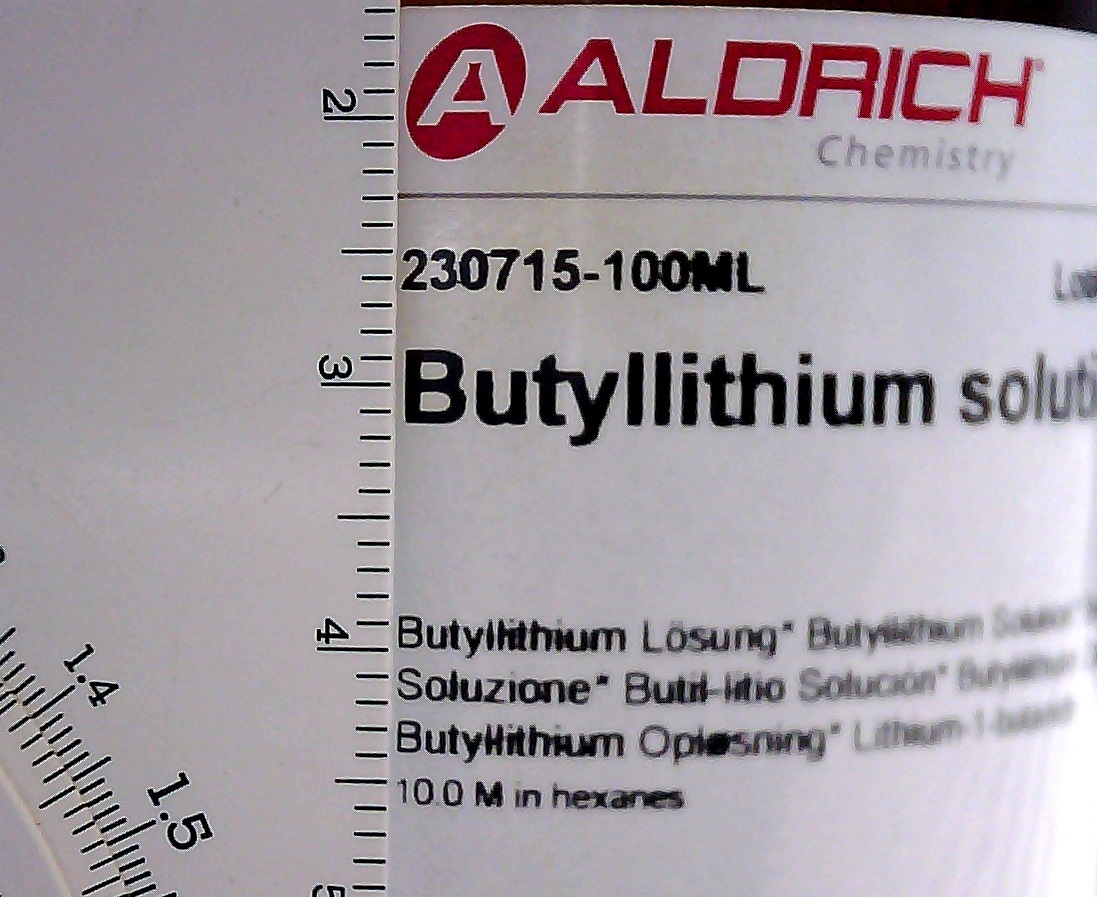
OK. I’m going to have to be the bad guy and take Aldrich (SAFC) to task on their labeling. I recently received a 100 mL bottle of 10.0 M BuLi in hexanes.  As I looked around for the concentration, I found it written in tiny print away from the name and part number which were written in larger print.  I have placed a ruler next to the label in the photo below to show the size of the print. It is the same size as the date on a penny.

Labels do not “just happen”. Someone has to design a label. This involves arranging content on a limited space while meeting internal and external requirments for safety statements and other content.  Labels do not fall from the sky in great sticky sheafs. Someone prints them. And that someone assigns font sizes and space for the information. So, someone has caused the font size to be tiny irrespective of the print content. I have numerous bottles with microscopic printing and vast expanses of white space. This smells of automation.

I’ll wager that there is an automated label generator that takes product label data and prints it onto the label irrespective of the actual need for microscopic font size. I can envisage a giant warehouse with automated shelf pickers whizzing about pulling bottles off the milti-tiered stacks and placing them into plastic tubs which course their way to shipping. Elsewhere in this voluminous interior is a widget that prints the labels and sticks them onto the bottle after they are filled.  Somewhere a human is pushing a broom.

C’mon Aldrich! Make your labels more legible. Good gravy. What would Bader say? I’m sure your accounting office has no trouble reading the print on the checks that arrive to pay for these products.  Consider that you’ve been put on notice.

Fine print on Aldrich reagent bottle. Molarity is printed in 1.0 mm font size.

ChemSpider Magic with LASSO

Of late I have been concerned with R&D information and various homebrew means of storing it and retrieving it. Institutionalizing R&D results into easily accessed knowledge can roll into a real hairball if you’re not careful. More on that another time.

My adventures with CHETAH 9.0 have caused me to look deeply into SMILES strings and what utility might be found there. This lead me to rediscover ChemSpider and the many services it provides for free to the user.

Consider the following: if you generate a SMILES structure of acetylsalicylic acid, say, from Chemdraw, O=C(O)C1=C(OC(C)=O)C=CC=C1, and use this character string as a search term in ChemSpider, it will take you to the entry for aspirin. What you get is a treasure trove of information on this substance. Go to ChemSpider, cut and paste the above SMILES string into the search box, and let her rip. I’m not your Momma. Just try it.

The breadth of references is encyclopedic.  But the truly amazing part is found when you scroll to the end of the page. There is a drop down window for SimBioSys LASSO. ChemSpider is working to provide LASSO data on its large database of compounds.  LASSO generates a structure and grinds it through a neural net processor module and produces a score between zero and one. The closer the score is to 1.00, the greater the surface conformity or compatibility of the ligand to a target receptor site.  As you would expect, there is a high score associated with aspirin and the COX-1 receptor. From what I can tell, the software is self-learning in some fashion.

The uses are many. Substances can be screened for drug-like attributes within the 40 receptor types provided.  I would like to hear from someone who might have something to say about the use of LASSO for the estimation of possible toxic effects of substances that have not been biologically tested. I fully realize the hazards of this, but perhaps LASSO scores might help flag particular substances for closer examination by testing.

Adrift in Cheminformatics Space. CHETAH 9.0 Fails with Some ChemSketch SMILES Strings.

The ASTM software Chemical Thermodynamic and Energy Release version 9.0, CHETAH 9.0, has many useful features for calculating thermodynamic values of substances.  My interest is in the (gas phase) calculation of ΔHf, limiting oxygen concentration, lower flammability level, Cp, entropy, ΔG, maximum heat of decomposition, net plosive density, ΔHc, and minimum ignition energy. The package claims to have the largest known database of Bensen group values at 965 entries.

I would have supplied links but the WordPress Editor is on the fritz. One more bloody software “issue”. – ‘th Gaussling

I recently upgraded from CHETAH 8.0 to 9.0 because 8.0 is incompatible with Windows 7.  These upgrades are a kilobuck a pop so they can be a budgetary surprise. After I upgraded I noted that 9.0 is not compatible with Windows 7 either!! Luckily I have a couple of lab computers that are still XP systems and therefore compatible with 9.0.  The folks at the University of South Alabama write and support CHETAH.

I understand from private communication that CHETAH 10.0 is in the works in anticipation of the release of Windows 8. Oh joy. I hope that some effort will be put into the user interface and general robustness. My question is this- what about those of us who will be using Windows 7 for the next few years? Will rev 10.0 be compatible? Will it have click and drag features or more of a DOS accent like the current rev?

One of the features that is nice about CHETAH is that it accepts SMILES strings as data input.  It parses the string into known Benson groups and flags unknown groups.  Previously I had been entering smiles strings from ChemDraw 7.0, an ancient but still useful version. Lately I have been evaluating ChemSketch freeware.  And lucky for me, I found another hole to stumble into.

SMILES is not inflexible in its syntax, apparently.  ChemDraw will convert a structure to a SMILES string that is different in its sequence from the identical structure drawn by ChemSketch.  I have found that CHETAH 9.0 will consistently accept SMILEs string entries from ChemDraw, but with only some ChemSketch SMILES strings.

Consider the following SMILES strings of the same structure-  5-Bromo-7-tert-butoxy-3-methyl-3H-isobenzofuran-1-one. The nomenclature is from Chemdraw. I do not use this compound- I dreamed it up as an example.

ChemDraw 7.0–  O=C2OC(C)C1=CC(Br)=CC(OC(C)(C)C)=C12

ChemSketch 12–  CC(C)(C)Oc1cc(Br)cc2c1C(=O)OC2C

The ChemDraw SMILES string is accepted by CHETAH 9.0 and parsed into Benson groups, but when you attempt to process the data it gives a “Run-time error 9” warning and then closes the program. From what I can tell, CHETAH 9.0 will only accept 9 Benson groups because when you clip off functional groups, it will accept the string for the next step. However, it still shuts down and indicates another error saying “subscript out of range”. I don’t know why this happens and the handbook does bnot seem to list errors. The programmer put the error routines in the program, but I guess was too busy to tell anyone what they mean.

The ChemSketch SMILES string above is not accepted at all.

I cannot justify switching to ChemSketch for several reasons and this is one of them.  The ChemSketch editor is generally balky compared to the smooth operation of ChemDraw. However, I must say that ChemSketch is very feature rich and has gotten much better. If I wasn’t already committed to ChemDraw (and Chem3D) I’d strongly consider it.

CHETAH seems to have limitations on the number of Benson groups it will accept for a molecule. It seems to require a particular edition of SMILES syntax. And, the user interface is is balky and antiquated.  I’ll try to uninstall CHETAH and reinstall it. That said, it still seems … brittle.

From what I can piece together by googling SMILES, the system has been evolving. Apparently, chemical graphics software out there has captured particular editions of SMILES at the time when their revision is released.  It would be nice if some international standard were in place to devise an enduring syntactical structure. Seems like something CAS could help with.

Comments on the history of oxidants

Today we know that the chemical elements are capable of showing a range of behaviors in the category of reduction and oxidation (redox). Unlike our predecessors who attempted to wrap their arms around redox phenomena without the benefit of data or atomic theory, we are able to refer to tables of information which give details on the magnitude of redox phenomena and allow us to predict outcomes of transformations.

Reduction and oxidation has always been with us and for most of human history we were blissfully unaware of it as a distinct and complementary phenomenon. Beyond the conduct of redox in biology, for most of human history the major use of redox as a tool was combustion.  I would argue that humans began to do chemistry in earnest when we learned to generate fire and use it at will.  The introduction of fire allowed humans to apply significant thermal energy to materials in contrast to mechanical energy. Thermal energy changed the composition of materials in a way that was visible to us. With fire we could boil, dry, pyrolyze, combust, sinter, fracture and melt materials.  Food once cooked was forever changed. The combustion of wood produced much heat, charcoal, and ash.

Fire could provide warmth and destruction. It could be used as a weapon of war. The Chinese would become renowned for their command of deflagrations, explosions, rocketry, as would the Greeks for their Greek fire.  Chinese adepts learned to produce deflagration and explosions with energetic redox compositions centuries before the Europeans. With the spread of gunpowder formulation around the world, the problem of finding it’s components would plague adopters of this technology.

The basic rules of controlling fire were determined very early in human history. Some things burned and other things didn’t. The effects of air might have been inferred by the simple act of lighting kindling and blowing on it. Blowing on an ember can sustain it for a time and gives rise to increased heat. Fire can be accelerated by blowing air on it but may also be extinguished by too much wind. Clues to the basic nature of fire were there all along, but we lacked vocabulary, theory, and analysis.

The color of a wood fire can range from yellow/orange to bright yellow and it can warm you from a distance. Smoke was something that issued from fire and was perhaps troublesome. Fire and smoke always seem to rise upwards. More clues to to the behavior of matter, but as before, we lacked the tools of science until only in the last few centuries.

Today we can use atomic and quantum theory, thermodynamics, and the physics of radiation and buoyancy to explain and quantify fire and its many attributes. Today we can confidently state that a fire requires an initiation (the energy source), a reductant (the fuel), and an oxidizer (air). I think early man would have had a fairly concrete understanding of heat source and fuel. But the need for an oxidizer may have been less obvious. After all, air is all around us and is invisible. Nobody knew about the fire triangle or Smokey the Bear.

The development of oxidizers as a class of substances whose participation in chemical change was held back owing to the obscurity of the concept and the lack of a good theoretical basis like atomic theory.  Humans had been perishing by suffocation forever. Everyone has experienced the effects of oxygen deprivation whether it was by running from a sabretooth tiger or holding ones breath on a dare. But without the knowledge of oxygen and its function in respiration or in combustion, oxidation was the answer waiting for the right question.

Reducing materials as fuels for combustion or for the reduction of metal ores to the metal was common knowledge for a very long time. The introduction of oxidizing materials beyond the ever present air around us was a much harder nut to crack.  If we set the oxygen in air aside and focus on strongly oxidizing substances, we can begin to see the development of oxidizers as a class of materials.

One of the earliest oxidizers to find use was nitrate, commonly called saltpeter or nitre. Nitre was found in some damp locations that were rich in decaying organic materials. Nitre beds were often observed as having a white crust that migrated to the surface of the ground.  Early references of these nitre beds come from China and India. Nitre was capable of having multiple counter-ions. The early users of nitre were unaware of this of course. Later in history, makers of gunpowder would come to prefer potassium nitrate over the sodium salt owing to it’s lower aptitude for hydration. Hydrated saltpeter will passivate gunowder.  The story of gunpowder is well documented and the reader can pursue that trail on their own.

The discovery of oxygen in 1772 by Scheele could be considered a major step in the development of oxidation technology. While chemists were misguided by the theory of phlogiston, the isolation of a substance that supported combustion was a crucial conceptual leap.  Scheele and later Priestly would show that this new “air” would support combustion. In 1774 the discovery of chlorine by Scheele was the next major oxidizer to be identified. Chlorine was produced by the action of HCl on MnO2 (pyrolusite).  The bleaching effect of Cl2 gas was soon discovered by Scheele. The discovery of Cl2 soon lead to the discovery of bleaching powders. The earliest bleaching powder composition comprised of lime and chlorine was patented in 1798 by Charles Tennant in England. By the close of the 18th century, three important oxidizing compositions were produced: oxygen, chlorine, and calcium hypochlorite.  Chlorine and lime bleaching powder went into mass production at the beginning of the 19th century.

In a real sense, the development of oxidizers is very much like the invention of the lever. A level is used to amplify mechanical force. An oxidizing agent is used to amplify the extractive force on valence electrons. A strong oxidizing agent is able to bring energy to bare on select transformations that might not be otherwise available.  With the advent of this kind of transformation, new possibilities unfolded in history. By the middle of the 19th century, molecules with pendant oxidizing groups would be capable of self reaction to produce tremendous outbursts of energy. Nitroglycerine is one such molecule containing both reducing groups and oxidizing groups in one molecule. Oxidizers and oxidizing functional groups would change how we dig tunnels, extract minerals, carve canals, wage war, and eventually, compress uranium or plutonium into a critical mass for a nuclear explosion.

Some good career advice from Bill Carroll

At our annual ACS Colorado section banquet for local high school students and their teachers, we invited Bill Carroll to be the guest speaker.  Carroll gave a good talk with pertinent advice on starting and grooming ones technical career. I won’t repeat all of it, but a few good points stand out.

Carroll began the talk by highlighting the differences between commodity and specialty products. Then he transitioned into the suggestion that careers can be partitioned into specialty and commodity categories as well. His argument was that jobs can become commoditized just like gasoline and that, like any commodity, choices as to who fills the position may be made from a crowd of indistinguishable candidates. And, like commodities, the salary paid to such workers may be beaten down by excess supply.

However you stretch analogy, the point was that it might be best to have core skills embellished with secondary and diverse abilities.

Research Squatters. When Universities and Corporate Behemoths Collaborate.

Recently I had the good fortune to get to meet for a consultation with a young and talented chemistry professor (Prof X) from a state university elsewhere in the US. Prof X has an outstanding pedigree and reached tenure rather rapidly at a young age. This young prof has won a very large number of awards already and I think could well rise to the level of a Trost or a Bergman in time.

Not long ago this prof was approached by one of the top chemical companies in the world to collaborate on some applied research. What is interesting about this is that the company has begun to explore outsourcing basic research in the labs of promising academic researchers. I am not aware that this company has done this to such an extent previously.  They do have an impressive corporate research center of their own and the gigabucks to set up shop wherever they want. Why would they want to collaborate like this?

R&D has a component of risk to it. Goals may not be met or may be much more expensive that anticipated.  Over the long term there may be a tangible payoff, but over the short term, it is just overhead.

The boards and officers of public corporations have a fiduciary obligation to maximize the return on investment of their shareholders. They are not chartered to spread their wealth to public institutions. They have a responsibility to minimize their tax liability while maximizing their profitability. Maximizing profit means increasing volume and margins. Increasing margins means getting the best prices at the lowest operating expense possible.

Corporate research is a form of overhead expense. Yes, you can look at it as an investment of resources for the production of profitable goods and services of the future. This is what organic growth is about. But that is not the only way to plan for future growth. Very often it is faster and easier to buy patent portfolios or whole corporations in order to achieve a more prompt growth and increase in market share.

The thing to realize is that this is not a pollenization exercise. The company is not looking to just fertilize research here and there and hope for advances in the field. They are a sort of research squatter that is setting up camp in existing national R&D infrastructure in order to produce return on investment. Academic faculty, students, post-docs, and university infractructure become contract workers who perform R&D for hire.

In this scheme, research groups become isolated in the intellectual environment of the university by the demands of secrecy agreements. Even within groups, there is a silo effect in that a student working on a commercial product or process must be isolated from the group to contain IP from inadvertant disclosure. The matter of inventorship is a serious matter that can get very sticky in a group situation. Confidential notebooks, reports, and theses will be required.  Surrender of IP ownership, long term silence on ones thesis work, and probably secret defense of their thesis will have to occur as well.

While a big cash infusion to Prof X may seem to be a good thing for the professor’s group, let’s consider other practical problems that will develop. The professor will have to allocate labor and time to the needs of the benefactor. The professor will not be able to publish the results of this work, nor will the university website be a place to display such research. In academia, ones progress is measured by the volume and quality of publications. In a real sense, the collaboration will result in work that will be invisible on the professors vitae.

Then there is the matter of IP contamination. If Prof X inadvertantly uses proprietary chemistry for the professor’s own publishable scholarly work, the professor may be subject to civil liability. Indeed, the prof may have to avoid a large swath of chemistry that was previously their own area.

This privatization of the academic research environment is a model contrary to what has been a very successful national R&D complex for generations. Just have a look in Chemical Abstracts. It is full of patent information, to be sure, but it is full of technology and knowledge that is in the public domain. Chemical Abstracts is a catalog and bibliography that organizes our national treasure. Our existing government-university R&D complex has been a very productive system overall and every one of us benefits from it in ways most do not perceive. We should be careful with it.