Category Archives: Chemistry

Retorting the Auriferous Spud

Gold miners of the 19th and early 20th century had a processing advantage over todays gold miners despite all of their modern diesel powered trommels, pumps, and sluices. Some early placer miners had access to mercury or quicksilver. Auriferous fines could be concentrated in a small container with water and a few ounces of mercury would be added to extract the gold as an amalgam. Or, the concentrates could be contacted with mercury-coated copper for the same effect. Mercury coated copper pans or flat plates were often used to scavenge gold and isolate it as the amalgam.

Today, the use of mercury is strictly forbidden in mining operations around the world. But there was a time when mercury was a key part of the miners toolkit.  Many extraction schemes were developed to concentrate gold into a small package.  Panning or the use of a shaker table would provide nuggets and dust as concentrate. But often there was heavy black sand comingled with the gold dust.  Isolation by amalgamation followed by distilling off the mercury (retorting) would provide moderately pure gold.

For example, a simple retort may be made from a pipe nipple with a cap on the bottom and a top connector attached to a long condenser tube that could be cooled with stream water. The retort vessel was set into a campfire and perhaps a cloth was wrapped around the condenser tube and wetted to knock down the mercury vapors so that they could be collected in a receiver.

Curiously, there is lore about the potato retort.  My source is Eldred D. Wilson, Gold Placers and Placering in Arizona, Bulletin 168 (1961), State of Arizona, Bureau of Geology and Mineral Technology, Geological Survey Branch. In the potato retort method, a potato is cut in half and one half is hollowed out enough to accomodate an ounce or so of amalgam. The auriferous spud is wired back together and placed in the ashes of the campfire for 30-60 minutes until done. The potato is then opened to reveal a gold button in the middle. Or, so the story goes.

There were variations. Analogous to the preparation of hoe cake, digging implements were put to use in retorting duty. A potato amalgam package could be placed in a frying pan or in a shovel which would then sit in the campfire.

It’s hard to say just how effective potato retorting was compared to other methods. Admittedly, I have trouble believing that the internal temperature of the potato was high enough to do the job. It’s conceivable, perhaps, that enough Hg was cooked away to leave behind a metallic mass with some gold color.  It would be interesting to try this and then get an assay.

Wilson offers this advice- don’t eat the potato.

XRF Magic

We’ve been looking at hand held XRF spectrometers.  If you have not been introduced to this, you may be in for a real treat. A variety of companies make them- Bruker, Thermo, and Innov-X to name a few. These things are in the low-end Lexus price category, but are they ever amazing.  It’s straight out of Star Trek.

Clarke’s Third Law states that any sufficiently advanced technology is indistinguishable with magic. I gotta tell ya that these hand held XRF’s are just amazing.  You point at a sample and it gives a tally of the elements present, or most of them at least.  Some even have a built-in GPS you can punch to take a waypoint of the location of the sample you just analyzed out in the field.  It is a great tool for mineral prospecting.  

What is embarrassing is that this is the first I’ve heard of it. Our geologist friends have been using these things for a while now. 

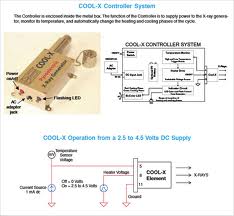
The whole thing depends on a miniature X-ray source.  I’ve been looking into this.  For the curious folks out there, lithium niobate- LiNbO3- is a very interesting material.  Crystals of LiNbO3 have the property of pyroelectric potential. A pyroelectric crystal is one that is able to generate a polarization across the crystal faces in proportion to the temperature.  A pyroelectric xtal placed on a heating/cooling block in a vacuum is able to generate a stream of electrons energetic enough that, when stopped by a copper electrode, will generate x-rays. 

One manufacturer, AmpTek, produces a miniature x-ray unit called the Cool-X that has a photon output equivalent to two milliCuries, with 75 % of the flux less than 10 KeV.  Elsewhere in the product literature, the output is described as 5 milliSieverts per hour.  So, the user has to be a little careful with this thing. But rad safety issues aside, this is quite an amazing source. The product literature doesn’t come out and say what kind of crystals are used, but they may be a tantalate salt.

AmpTek Cool-X

The unit does not operate continuously. It can only generate x-rays durig a thermal cycling period, The xtal starts out cool and as it’s heated, generates the electron flux that is de-accelerated by impacting the copper to produce the x-rays. The lit gives a cycling interval of 2-5 minutes.  It is referred to as a Kharkov X-ray generator.

It’s magic.

Materials of Construction

One of the things you have to consider when scaling up a chemical process is the composition of the wetted or exposed surfaces in the reaction vessel, associated feed piping, gaskets, and overhead vapor  spaces.  Common materials of construction subject to wetting are steel (various types), glass, Hastelloy(s), tantalum, titanium, PTFE, Viton, and various polymers found in hoses.

Metal batch reactors are subject to erosion over time. Vessel walls can be tested for thickness periodically. Glass coated reactors are very useful for their broad applicability to many kinds of reactions, but have drawbacks of their own.  Glassed vessels are sensitive to very high and very low temperatures as well as thermal gradients across the vessel wall. It is possible to crack the glass coating and have it flake away, exposing the underlying metal to corrosion.

We are all trained to do chemistry in glass reactors, but it should be pointed out that much chemistry can be performed in steel vessels. While you want to give some thought to the use of hydrogen, for the most part metal pots are well suited for reaction under neutral or reducing conditions. That is, metal hydrides, Na, carbanionic species BuLi and RMgX, alkoxides, etc., are well tolerated in wetted-metal pots.

Oxidizing or acid halide producing reaction systems are problematic for metal pots, however.  Acidic corrosive reaction mixtures can attack the wetted metal parts of the reactor system. Acidic chlorides in particular are quite corrosive to various grades of steel. It is especially problematic when you’re talking about shell and tube condensers. The tubes are often very thin for good heat transfer, leading to the possibility of the introduction of chiller fluids into the reactor if corrosion chews through the tubes.  If the chiller fluids are protic and the pot is full of MeLi, then the batch may be lost or an unplanned reactive hazard event may take place.

Condenser surfaces can be subject to more corrosion that you realize. This is the location where hot concentrated corrosive gases will condense, after all. To extend the life of the condenser, special materials of construction may be used. Tantalum and PTFE can be used when the cost is justified. With exotic materials of construction come exotic prices.

There is more to consider than corrosion.  Polymer transfer lines will generate static electric hazards via the isolation of charge on nonconductive surfaces. Tranferring hydrocarbon solvents from a drum or cylinder to a reactor through nonconductive plumbing can generate significant hazardous energy and certainly enough to be incendive. Grounded metal piping can prevent part of this problem.  However, discharging a flammable liquid into an air filled space may lead to an incendive discharge as well. It is important that all atmospheres over flammable liquids be inerted. While you may not be able to stop static discharges, you can certainly keep the fire triangle for being formed.

Operators are often alarmed by the sight of a glassed reactor with stirring toluene in it generating sparks by discharge through the glass coating.  While this may be hard on the glassing by forming pinholes, unless there is an explosive material in solution, the lack of a complete fire triangle means that the sparks cannot lead to ignition of the toluene.

Remember not to take your material to high viscosity or dryness in a large reactor. You might end up rolling your solid material into a giant bowling ball and bending your agitator shaft.  Maybe even slamming it into the reactor wall. A very expensive mistake.

Of Limited Brain Bandwidth

At some point a person has to decide that he/she is involved in enough activitites in life. This uncomfortable world of overcommitment is where I have been for a while. I’ve come to the realization that my consciousness has limited bandwidth and that intellectual stimulus can overload it in ways that are hard to recognize. 

Having been born with lots of curiosity, I find myself piqued by a great variety of things in the universe.  The sciency stuff is obvious. But there are other things that can consume much of my capacity for attention.  It is much like an addiction to a drug. One soon becomes accustomed to a high baseline level of stimulus.  As boredom sets in,  the brain seeks greater stimulus. I can’t bear to wait 5 minutes without something to read. Cable television and the internet takes full advantage of this.

Last weekend I found myself totally immersed in the Free Electron Gas theory of metals. As I was wrestling with the math my family was out shopping and having fun. I was having fun as well, but it was of a more cloistered form. Was I being selfish? I think the answer is yes.

So, this life of intellectual pursuit can spin into a solitary life.  I like to joke that some days I’m misanthropic and other days I’m very misanthropic. That’s not exactly true, but I will say that my patience for unstimulating conversation is limited.  It comes down to the fuzzy boundary between ambition and obsession.  It is very easy to slip into a condition that is referred to as eccentric.  I can see how it happens. Maybe it is too late.

Extractive Metallurgy as Inorganic Chemistry

I am involved in an extractive metallurgy project 1 day per week give or take.  So I have been trying to take apart undesirable minerals in an ore to concentrate the desired metal. It’s called beneficiation- a word introduced by Agricola in his book De Re Metallica published in 1556.  I can’t disclose what the desired metal is.  Suffice it to say that it is rather scarce though not a coinage metal. 

What really amazes me is the disconnect between what many of us think of as the field of inorganic chemistry and the field of extractive metallurgy.  In my training as an organikker, I had never been exposed to extractive metallurgy, nor did I even know what it was.  Turns out that it is a field of applied inorganic chemistry. In this field, a metallurgist is the person who figures out how to extract desired metals from ore.  Nobody seems to call them a chemist, at least to their face. They’re the metallurgist.  No doubt there are exceptions.

Well, that clears things up quite a bit. I feel better getting that off my chest.  I’m sure any wayward metallurgist who happens upon this site has already begun to laugh. Extractive metallurgists do synthetic inorganic chemistry. It’s just that they prefer to keep company with a gangue of engineers and geologists rather than those who don’t work with minerals.  I can relate.

On the Digestion of Rock

A rock consists of one or more minerals that may be held together by a cementitious binder. Or a rock may be a continuous mass of interlocking crystalline domains.

Igneous and metamorphic rocks are comprised of crystalline phases compacted into an inhomogeneous mass. Amorphous phases may be found as well.  Sedimentary rocks are often made of distinct mineral grains or pebbles held into position by cementitious matrix. There is a great deal of variety to be found.

The point is that rocks may have quite complex compositions. If the goal is to use rock for construction, then the composition may not be that important as long as some minimum structural attribute exists.  

But if the goal is to extract specific components from a rock, then the details of composition become very important.  Rock may be made of simple inorganic compounds.  Good examples would be calcium carbonate, sodium chloride, or calcium fluoride.  These substances are often found in crystalline form where the crystal consists of cations and anions which are free to solvate in the right solvent system and dissolve. These kind of minerals may be very weak structurally and subject to easy fracture.  The geological fate of such minerals is often aqueous transport and deposition to some location where a new mineral may precipitate from component ions in solution.

Some rocks may have appreciable fractions of monomers like silicate and aluminate. Monomeric components are able to form polymer networks which have a large effect on many properties of the mineral.  Glass and quartz are silicate network polymers that form rigid matrices. Silicate has 4 attachment points in a tetrahedral array that can form a variety of  linkages.  These matrices have properties like elevated melting point and rigidity that add or detract from the value of a given material. 

Quartz is a pure SiO2 network whereas soda glass contains network terminating additives that alter the connectivity and lower the glass transition temperature and melting point of the material. The additives lend workability to the glass. Chain and network termination no doubt has a major influence on the physical properties of rock.

Most metals are found in nature as an ionic compound in various oxidation states and charge balanced by simple anions like oxide, sulfide, or a halide.  Metal cations may also be associated with complex, polyatomic anions like sulfate, molybdate, tungstate, silicate, aluminate, and a few other oxidized species.  A few of these polyatomic anions, especially silicate, are held together with substantially covalent bonds. So their network polymer compositions may be very high melting and difficult to mill.

Extraction of desired metals from a rock will follow a path depending on the the type of mineral present. Rocks made of an ionic compound and not subject to network connectivity maybe susceptible to chemical attack and dissolution.  Treatment with strong acids or various fluxing agents may cause the digestion of a rock under less than drastic conditions. Such rocks maybe susceptible to weathering as well.

Rocks with substantial polysilicate or polyaluminate compositions are rather more difficult to digest. For the same reason glass resists most chemical attack, so too do silicate and aluminate minerals.  But substances that attack glass and alumina may also be useful in digesting rocks high in silicate and aluminate. In particular, hydrogen fluoride stands out. This acid is well known to attack glass by breaking the Si-O bond and making an Si-F bond due to silicons affinity for fluorine.  Digestion of silicate minerals with HF or ammonium bifluoride (NH4FHF) has been known for a long time.  The use of disulfur dichloride (S2Cl2) has been reported as well.

Silicates and aluminates are also susceptible to attack by hydroxide or carbonate.  This is often taken advantage of in the lab through the use of a muffle furnace and crucible. Digestion of a rock sample is affected at high temperature and the resulting digested material is then treated in a manner as to allow the separation of the metal as, for instance a hydroxide or carbonate that can then be ignited in the muffle furnace. This time a purified metal oxide is formed and weighed to give a yield or wt %. Metal oxides can usually be dissolved in aqueous acid and subjected to a variety of tests thereafter.

Chemistry jobs

Last fall I was invited to speak to some chemistry students at a local university. Being an industry guy, I was perceived as having some “special” insights into getting a job after college.  While I might have been a successful job hunter when I was less than 40, the odds got much longer after that transition to middle age. More on that in another post.

While I cannot outline the exact path to employment- you really can’t do that- I was able to talk about some of the lesser known jobs that  a chemistry degree will enable.  They are not sexy R&D jobs nor are they upper level executive jobs either. I’m not a pharma guy, thankfully, so my comments do not pertain to that bizarre and brutal world of pharmaceuticals.

The jobs I pointed out are critical to the conduct of manufacturing. They are jobs that one might not necessarily get at the entry level either.

So here are some of the jobs I mentioned.  Environmental health and safety- EH&S. Industry needs people who understand the regulatory situation relating to worker safety and to the environment.  EH&S is also concerned with hazardous waste management.  Expertise in this area is critical to the daily operation of any chemical plant.  This is a good place for an entry level and an experienced chemist to enter because the position typically requires a BS degree and greater than high school knowledge of chemicals and hazards.

Purchasing is an area where a chemist can play an important role in the operation of a plant.  Somebody has to source and buy the chemical raw materials. In general, there is spot buying and contract buying. Spot purchasing offers freedom on the upside but possible instability and higher pricing on the down side.  Purchasing under contract offers a better footing for negotiation and long term stability, but may lock the buyer into minimum volume and a firm price schedule. If demand for your product wavers, being locked into a supply agreement can be a problem if you have agreed to take a set volume.

There are various levels of purchasing positions.  At one end is the purchasing of non-chemical products.  Don’t need a chemist to do this.

On the other end is what is called the supply chain (or procurement) manager. Here is where you need to have a chemist.  This person is charged with assuring that there is an uninterrupted supply of feedstocks to the production facility. They are also tasked with assuring that the vendors meet some basic level of QA/QC and are able to document the whole spectrum of quality assurance. That is, does the vendor have the mechanisms in their business structure to assure not only the flow of product out the door, but also that the process is stable and produces material of the proper quality? Here,  management of change is is very important. A supply chain manager also makes site visits and conducts quality audits of vendors.

Business development and sales is an arena that makes good use of chemists and engineers. The most highly prized type of sales and business development person is the fabled “rainmaker”.  Business development is an activity where a manufacturer makes a connection with a customer who needs some particular material manufactured.  The goal in business development is, not uncommonly, to bring a new product into being.

In the chemical world (outside of pharma) there are commodity chemcials and there are custom and fine chemicals.  Commodity chemicals are those for which there are more than one manufacturer and the difference is mostly in the pricing and availability.  A chemical that is commoditized is one in which the volumes are often high and the margins are thin. Think ethylene, sulfuric acid, BTX, etc.

Commodity chemical producers need sales people too, but their job description is more related to account management and sales. If you dig being a sales rep, go for it.

A business development manager is someone who tries to match technological capability to the needs of the customer for more specialized products. This is teh person who looks at the chemistry and SWAGs a price based on paper chemistry and a spreadsheet.  This is often high pressure work. A bad quote may spell trouble for you. Too high and the customer balks. Too low and you may be faced with the wrong expectations by the customer.  Above all, a good business development person manages expectations.

Quality control/assurance is another position for a chemist. This is for someone who is highly organized and is fond of recordkeeping. This is the world of specifications and certificates of analysis, or certs. The QC person is responsible for making sure the company does what it says it will do in regard to product quality. It is a gatekeeper position and it can be a real hot seat. QA/QC can hold up a shipment or it can prevent the plant from using a raw material. It is a powerful post and those who hold it are not universally loved.

Process safety- what I presently do- is a job description wherein chemists are charged with determining whether or not a process is safe to execute. It is a hybrid job- part synthesis, analysis,and P-chem. It requires quite a bit of imagination in that you have to try to imagine possible failure modes and often obscure ways of testing materials for the potential to release hazardous energy.

Inventory management is central to the operation of any manufacturing unit. It is critical to receive raw materials both physically and in the accounting system. Materials have to be stored in designated locations and have to be staged for use according to a master schedule. While is is less common to find chemists here, I suppose it is possible. Often this position is filled by someone who is familiar with the manufacturing environment.

Related to inventory management is shipping and receiving. In order to load hazardous material onto a truck for transport, one must have training in the regulations pertaining to the transport of hazardous goods. In addition to the regs, there is training in operating in a hazardous environment and emergency response. Again, not a lot of chemists will end up here, but it is a job description in the chemical industry.

Finally, there is the possibility of working as a plant operator. You can find a large variety of people operating in a chemical plant. I know ex-firefighters, ex-military, biologists, farm boys, heavy equipment operators, construction contractors, and people who have worked in chemical plants all their adult lives. It is hard work. You have to work on the plant floor wearing PPE that is often uncomfortable, or perhaps sit at a terminal in a control room monitoring a process train.  But if you like working with your hands on machines and electronics in manufacturing, it may be job for you.

If your desire is to be a captain of industry- a CEO or President, then you should forget lab work and go into business development or sales, or even accounting. Anything related to the accumulation of sales dollars, customer service, plant startup, and deep finance is crucial to someone handing you the keys to the corporation.

Yes, I know that there are a few scientists who have ascended to the top, but they are the exception. You must be fluent with the ways of money and show a record of rainmaking.

The other possibility for a chemist is to join a startup venture. But this is hard to find since most startups are begun with a core group of people who know each other. At some point, however, they will begin to recruit skilled people to fit particular slots. I have no real advice to offer here except that startups are very risky. At some point you may be asked to invest more than just time.

Inverse Midas Touch

I seem to have contracted a case of the inverse Midas touch. Everything I touch turns to crap. I mean everything. Chemistry, friendships, a pot of chili, volunteer work, you name it.  What gets me is that it seems statistically unlikely that I would uncover so many large magnitude failure modes (??) in such a tight temporal cluster.  A flock of black swans landed in my back yard.  A monkey sat at my typewriter and typed “screw you” 500 times.  A simple reaction making a simple product  is fraught with unforseen complications. Son of a …

Okay, the monkey thing didn’t happen.

One thing I’ll get out of this is to be more reticent to volunteer for projects that seem simple in concept. Nothing is simple. Every single thing has degrees of freedom you can’t see and local minima to sink into on the way to the prize. It’s a dangerous world out there and in ways you can’t imagine.

Geysers of Enceladus

My day job requires that I can practice the art of calorimetry with some reasonable extent of expertise, so in that vein I have been cracking open some of my dusty p-chem texts and revisiting basic thermo.

The other day while on an excursion to a bricks and mortar bookstore to pick up some of my favorite periodicals (Kitplanes and Vanity Fair), I happened upon a copy Elements of Chemical Thermodynamics by Leonard K. Nash (1970, Dover, $12.95). Feeling bad for Borders and their current run of poor luck, I bought the book as though it would make some difference.

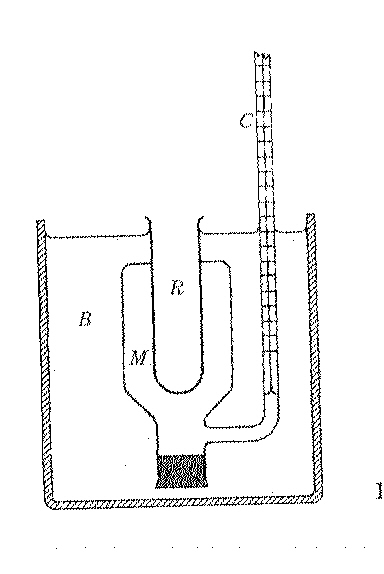
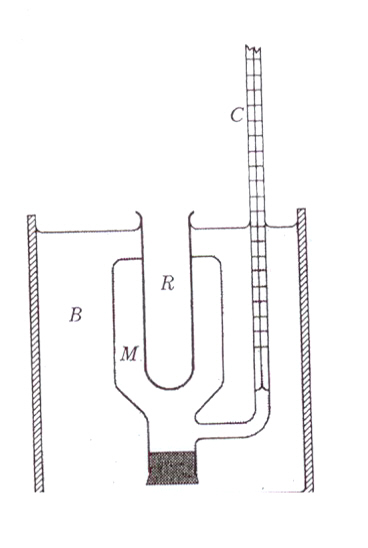
Figure 2 on p 5 (below) shows a schematic of a ice calorimeter.  An ice calorimeter uses a thermally isolated enclosed space M completely filled with liquid and solid water immersed in an insulated tank of ice and water B. The internal, thermally isolated, working volume of water has two important features- it has a small volume sample container R protruding into it and it has a calibrated small inside-diameter expansion capillary C. 

A sample in container R is in thermal contact with reservoir M.  Heat absorbed in M melts some ice and results in the loss of low density ice and the formation of higher density liquid water. The net volume of the contents then decreases and is registered as a column height change in capillary C.

Given the volume change and knowing the density and heat of fusion of water at 0 C, one can calculate the heat absorbed by the reservoir.

So, what about Saturn’s moon Enceladus? The moon is thought to be covered by water ice with liquid water underneath. It’s reasonable to assume that if some volume of water below the ice transitions to the solid phase then the collective volume for liquid water is decreased resulting in an uptick in pressure.

If this happens, it could provide a mechanism for the geyser phenomenon witnessed by the Cassini probe. The geyers could simply be a result of PV work energized by gravity and radiative cooling of the surface and subsequent thickening of the surface ice into the underlying liquid phase.

I’m sure the boys and girls at Cassini have thought of this, but since I’m not tied into the literature I have not heard anybody express it.

Sanding the Mass Spec

January 19, 2010.  We unpacked our new Agilent GCMS today. It comes with a container of fine alumina abrasive. I’ve never had to maintain one before so this has been an education. It has a triple MSD (mass selective detector) on it for what amounts to a noise cancellation feature. This increases the signal to noise ratio of the output substantially. I never realized that the MSD was off-axis relative to the quadrapole electrodes. The ion beam is steered 90 degrees into the MSD by a 10 kV post that also accelerates the beam.

Oh yes, the abrasive is for polishing the metal surface that sits against the high vacuum seal of the mass analyzer chamber. It struck me as amusing that a mass spec comes with a supply of abrasives. Now it makes sense.