Check out the images of the sulfur mine at the Kawah Ijen volcano in East Java by clicking on this link. It is just stunning. There is nothing I can add to it.
Sulfur flames
4 Replies

Check out the images of the sulfur mine at the Kawah Ijen volcano in East Java by clicking on this link. It is just stunning. There is nothing I can add to it.
In the Pnictogen Hall of Fame there is at least one p-block compound with a town named after it. The ghost town of Stibnite, Idaho, sits silently in the Yellow Pine mining district 40 or so miles NW of Cascade, Idaho. The town of Stibnite is named after the sulfide of antimony- Sb2S3. The chemical symbol, Sb, is related to this mineral name.
Idaho sits in the great North American cordillera. A cordillera is a grouping of mountain ranges at the continental scale. In the case of the North American cordillera, it begins ca 103 west longitude and extends to the Pacific ocean. The Black Hills are found somewhat east of 103 degrees, but I’m generalizing again. In the US, the Rockies, Wasatch, Cascades, and the Sierra Nevada ranges are part of the cordillera formation.
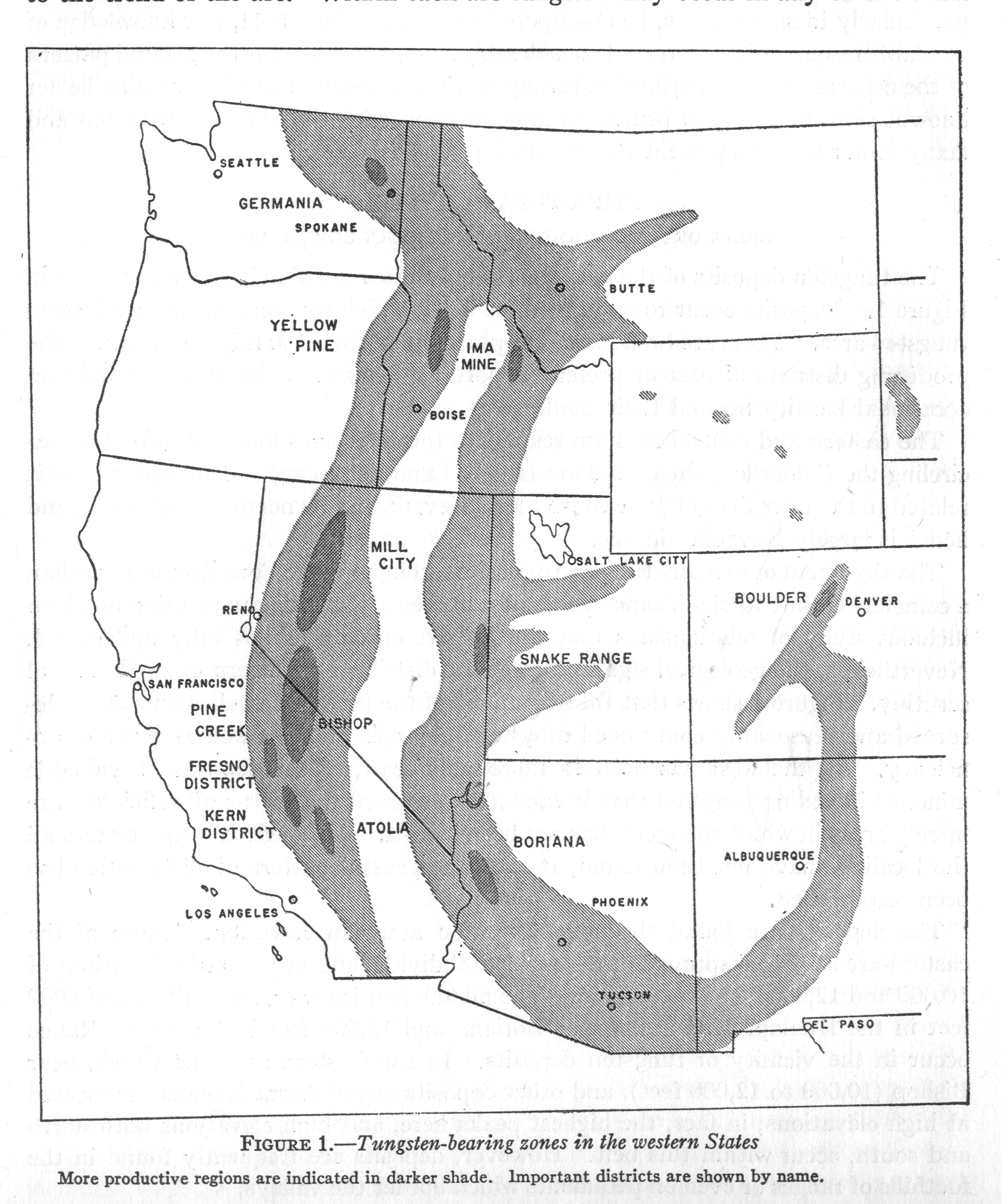
North American Tungsten Belt. From Paul F. Kerr, Tungsten Mineralization in the United States, 1946, Waverly Press.
One characteristic of the cordillera is the broad occurrence of economically important metal deposits. In the illustration above, the occurrence of tungsten is associated with the mountainous regions of the west. An important feature found in economic metal bearing districts within the cordillera are vein deposits. Metals can be disseminated in rock or concentrated in veins.
In Colorado, the Cripple Creek & Victor mine is situated in the throat of an ancient volcano. This ore body is an example of highly disseminated gold ore which is interlaced with vein structures containing higher concentrations of gold.
Rather than perform underground mining, the economics allow the large scale removal and crushing of rock to pebble size followed by extraction with cyanide to isolate the value. This mining technique was not possible until the advent of large scale mechanization. In the early days, the Cripple Creek district was limited to underground mining of vein formations that were more highly enriched in gold.
What is crucial to the placement of a metal ore body is some process that leads to concentration of valuable metals. Recall that the definition of an ore is based on economic considerations. At some level of dilution all ore becomes just gangue or country rock. Concentration of value in the ore body near the surface can arise from several mechanisms.
A common process that concentrates desirable minerals is hydrothermal deposition. This is found widely in the cordillera. A natural consequence of mountain building is the generation of stresses within the upthrusting rock. At some point stress gets relieved by fracturing which results in the formation of void spaces within the rock.
Underground water, which at depth is at high temperature and pressure, will dissolve components of rock in contact with the water. This water will naturally convect and flow towards the surface, carrying whatever solutes that were favored by higher solubility.
Deposition occurs as the water flows to the surface within whatever fracture network the waters find themselves in and may continue to deposit until the vein seals itself shut. Over the fullness of time the formations are thrust upwards and erosion wears down the rock to expose outcroppings of the desired mineral at the surface.
Such processes have put vein lodes in place all over the world, including the American west. Deposits of gold, silver, antimony, iron, mercury, and tungsten are examples of metals that are concentrated in this manner. Ostensibly, this is happening in geothermal hotspots like Yellowstone or Iceland today.
These exposed outcroppings weather and oxidize, generating new mineral compositions. In the case of gold, its relative inertness leads it to form the native metal in these weathered formations and, under the influence of gravity and the hydraulic forces of snowmelt, gold will work its way downhill and into the alluvium.
Other elements besides gold are also mobilized, particularly the sulfides. In the deep crust, well below the depth to which oxygenated meteoric water can flow, is an environment rich in the anionic subunits oxide, sulfide, silicate, and aluminate. Metals and metalloids like Cu, Sb, Ag, As, Pb, Hg, etc., form complexes with the various anions and correspondingly, 3 dimensional networks of inorganic polymeric species. To the extent that a 3-D network of shared atoms, edges, and faces of tetrahedral crystalline subunits can be formed, the resulting bulk material may have a high melting point and high strength.
However, when connectivity is lowered by chain or network terminating constituents, the melting temperature and hardness of the material may be lowered. An example is soda glass. When silica is diluted with chain or network terminating components like soda or lime, the high strength and high melting point of quartz, which is just pure polysilicate, is lost. The same thing can happen naturally in mineral formation processes.
Other kinds of ore are put in place by fractional melt crystallization and layer deposition by density within a magma chamber. The major ocurrences of platinum group metal (PGM) deposits are an example of such a process. Eventually, tectonic processes raise the frozen and extinct magma chambers to the surface where erosion exposes a narrow banded horizons referred to as a reef. The Bushveld Igneous Complex in South Africa and the Stillwater Complex in Montana are examples of this mechanism.
The deposits found near Stibnite, Idaho, are comprised of antimony and tungsten as well as lesser amounts of gold and silver. In about 1900 gold, silver, and antimony were discovered in the area, leading to a gold boom at Thunder Mountain. During the years from 1938 to 1944, the Yellow Pine (W, Sb) and Meadow Creek (Au, Ag, Sb) mines in this part of Idaho were the largest producers of tungsten and antimony in the United States.
The details of this mining district can be found in:
John R. Cooper, Geology of the Tungsten, Antimony, and Gold Deposits Near Stibnite, Idaho; 1951, Geological Survey Bulletin 969-F. Stibnite Idaho USGS
In the abstract, Cooper describes the W, Sb, Au, Ag deposits as being confined to an area about 1 mile by 3.5 miles in scope (as of 1951). The principal rock of the area is quartz monzonite which is extensively fractured and has been penetrated by dikes of basalt, quartz latite porphyry, trachyte, and rhyolite.
Cooper describes a deposit whose metallization has taken place in three stages with intervening episodes of fracturing. The first stage is described as extensive replacements by gold-bearing pyrite and arsenopyrite. The second phase of deposition or replacement is less extensive and is by scheelite (CaWO4) within the gold ore bodies.
The third stage of growth or deposition is of stibnite and silver, largely within the same fracture systems as the scheelite. The ore bodies occur with the Meadow Creek fault and associated subsidiary faults in the quartz monzonite. The tungsten-antimony ore body within the formation took the shape of a
“flat upright funnel flaring to its widest diameter at the surface and tapering to a narrow neck, which extends below the bottom of the minable tungsten ore. The underside of the ore body is very irregular in detail. The highest grade of tungsten ore was concentrated toward the center of the mass and was surrounded by an envelope of antimony ore containing only a little tungsten.” – John R. Cooper
The Meadow Creek ore contained 0.23 oz gold per ton and 1.6 percent of antimony. The Yellow Pine ore contained little gold but 4 percent of antimony and 2 percent of WO3. The Yellow Pine deposit was exhausted of tungsten in 1945, producing 831,829 units of WO3 equivalents in the concentrate. One unit of WO3 is 20 lbs of tungsten trioxide.
Much of the scheelite was found disseminated in brecciated gold ore. Some scheelite was found in branching stringers and veinlets within the groundmass.
The stibnite occured as “disseminations, microveinlets, stockworks, massive lenses, small fssure-filling quartz stibnite veins, and euhedral crystals coating late fractures. ” Oxidized antimony minerals such as kermesite (Sb2S2O) were reported as being very scarce.
I used to work with a sales consultant who would say smart things now and then. As sales manager, consultants were usually the bane of my existance. Not because they were no good- often they were quite competent- but because they were problematic. Management brought them in because, with its all seeing eye, it believed that we foot soldiers were unable to make certain changes.
So when a consultant arrived we had to bring them up to speed and then watch them slowly fail to make the changes. They nearly always failed. Management was looking for change in the lower eschelons but never considered that change at the top was necessary. Ever. One day we’d hear that so-and-so had moved on to other things.
Working for a corporation is very one-sided unless you are at the very top. Employees are expected to be loyal and hard working no matter how outrageous the working environment and no matter how incompetent the management. Fail to impress management and you’ll face the prospect of job hunting without good references.
But I’ve gotten off track. The Great Gondini (I’ve scrambled the letters in his name) used to say this-
Never work for a company as a chemist if chemistry is not their main activity.
He spent much of his career with IBM and later, Lexmark, involved in magnetic coatings for disk drives, charge transfer agents and other xerography chemicals, and toners. IBM and Lexmark are not chemical companies.
The point my friend was trying to make was that professional isolation within a company has consequences. One consequence is that promotion to upper management is difficult owing to the lack of participation in the management of core projects. It is understood that there are exceptions.
There are benefits to isolation. You get to be the company wizard. Often management is loath to mess with you because, while they know that you do something important, they aren’t really sure what it is. I experienced this phenomenon when I was a chemist in a dairy lab. It can be quite amusing.
The isolation issue exists even for chemists in chemical companies. Your ascendency to upper level positions is stunted if you have not been involved in the major company projects in a significant way. If you’re running an small lab somewhere in the organization, especially if you’re in a service role, it is hard for management to promote you to VP of Chemistry over that project manager whose successful project went to market on time and on budget.
If you’re not interested in this kind of advancement, then it is a moot point.
Some chemist friends have mentioned to me that I make sweeping generalizations and this is surely true. There are exceptions to all but the most specific statements, eg., x = 3 (wait a minute, doesn’t x = 4 as well !!??). Generalizing is a rhetorical technique. The view from 50,000 feet is meant to show the overall topography.
Chemists love details and, like a pig in shit, we love to roll around in the data. And for some, no detail is too small to bring the show to a complete halt while they wrestle with details. I’ve seen this many times. This makes it difficult for some chemists to make the transition to other job descriptions. It is a simple fact that we sometimes have to move forward with an incomplete picture.
Having interviewed numerous bachelors degree job candidates recently, I’m beginning to question some fundamental assumptions about the value of a BA/BS chemistry degree to industry. Let me say from the outset that I wasn’t interested in hiring an analyst. There are plenty of analysts out there in the market, especially in the temp agencies. I’d been looking for someone to do synthesis. Both organic and inorganic.
Just to be clear, the slot has been filled, so don’t send your resume to me. Sorry.
I had the experience of interviewing a fresh BS chemist from a good- dare I say “elite”- school this week. He had fulfilled the requirements for graduation and was sitting there at the table beaming at me with great confidence. This fellow fared poorly on our application chemistry test, but was undeterred.
When asked as to the length and breadth of his organic synthetic experience in school, he admitted that it was limited to that obtained in sophomore organic chemistry. He did have a trifle of inorganic synthesis experience- he made ferrocene once. That being said, his interpretation of the NMR spectrum on the test was wrong, his understanding of carbocation stability trends was wrong, and he couldn’t calculate his way out of a paper bag.
This is not so unsual.
So here is what I have observed in the past 6 or 7 years interviewing BS chemists. Precious few of them had any demonstrable interest in organic chemistry or synthesis. It is not because they were lacking ability- they had not had the opportunity to practice the art. They might have been involved in some kind of research in their senior year, but very often it is involved in some highly specialized work with a very narrow scope. OK. That is the nature of research. It’s specialized. I believe the college chemistry curriculum and the shifting interests of faculty to ultra specialized research are failing students.
I’m glad to hear that students at the local university have experience in operating a tunneling microscope or picosecond laser equipment. But what about experience in basic synthetic transformations in actual glassware? How about a reduction of an ester or an amide with LAH? What about a catalytic hydrogenation or running a reaction with a Grignard reagent? Are students limited to the microscale experience? Do chem majors get to handle greater than 100 mg of reagents? Do they learn to handle hazardous materials in a smart way, other than just learning tofear them?
This graduate that I interviewed had experience in some kind of nanoscience, but couldn’t say much at all about basic synthesis. When asked about Grignard reagents, he could not recall having heard of it. What the hell good did the professor do for this kid?? The kid burned up his senior year doing deep-niche chemistry with skills of questionable transferability. He should have been doing distillations and crystallizations until he could coax pure subtsances out of a mixture that he/she made. That is what an undergrad should be doing. An undergrad should be refining basic manipulation skills and accumulation experience in running diverse reactions. Experience is proportional to the number of experiments run.
I have no reason to believe other than undergraduate chemistry education is failing to prepare bachelors students for the practice of the synthetic arts. It has been my experience- perhaps yours is different- that students with an interest in synthesis go to grad school. The problem with that is that it immediately doubles the cost of doing synthetic chemistry per unit chemist in society at large.
So, who is best served today in undergraduate education? The students or the institutions? Chemistry departments are faced with rising costs and diminishing funding, especially in public institutions. Faculty do what they know how to do. They promulgate scholarship. That is the comfort zone. And they develop strong opinions about who should join their ranks- people of like mind for the most part.
The pressure to minimize waste streams in undergraduate labs enabled the transition to microscale lab equipment. The development of computer technology has enabled the accumulation and treatment of data by semi-automated data collection tools and spreadsheets. Some of this is good- drudgery for its own sake is dumb. But we are removing students from contact with the very materials they study. This is not how to accumulate expertise. This is expertise in automation and not automatically in chemistry.
These graduates move into important roles in industry. Industry, contrary to a popular academic sentiment, isn’t merely a big sack of tedious details. It is a colossal part of our culture. We’re tool users and chemistry is one of the things that tool-using citizens do to improve our lot in life. The synthetic arts in the USA are somewhat in decline as industry continues to outsource manufacturing and R&D (!!?) to India and China. The USA needs affordable labor to do synthetic chemistry. Continuing to stamp out PhD’s is not the answer. PhD’s are very expensive to have around, and while perhaps they do most of the critical discovery work, the costs are prohibitive. Just look around.
The USA needs a new cultural paradigm. We need a chemistry labor pool that consists of workers of high and medium skill to bring affordable and competitive products to market. Unless we figure this out we are headed for that realm of self-satisfied mediocrity that some of our neighbors across the Atlantic find themselves in. There are many examples of fallen empire around the world and the US is slouching in that direction.
A company called Active Spectrum is marketing a benchtop ESR unit called the Micro-ESR that performs electron spin resonance measurements. The site says that the system operates at 3.4 and 9.6 GHz and has sub-micromolar sensitivity. It’s pretty amazing, really.
I don’t know for a fact but the easy guess is that this ESR instrument and the picoSpin NMR spectrometer are based on some kind of rare earth magnet technology. Both instruments use very small cross section sample space, presumably to accomodate a design scheme to bring magnetic field lines together as closely as possible in the probe giving a useful field strength without a big electromagnet.
A quick patent search fails to turn up patents based on some obvious key words. I’ll have to spend some time looking more intently.
Now that I’ve got you hanging on to the rotating frame, lets tip you over with this. China’s new policy of restricting rare earth element (REE) export as well as the recent announcement that it would be inposing fairly stiff tariffs means that wonders like these two magnet-based technologies are going to feel a pinch in raw material supply and competition real soon. The aggregate demand picture for REE’s will exceed supply by 2014 or so. Market purists will nod knowingly and chant their homily on the rational allocation of goods by the market.
But to what extent is China part of a rational market? China, Inc., really consists of a highly nationalized array of business fronts that are backed to the hilt by the Chinese government by internally favorable regulations on ownership and local sourcing. Don’t forget that Chinese currency is shielded from valuation excursions.
To a large extent, China is leveraging technology developed in Japan and the west with metal resources highly concentrated within its borders to apply a pincer attack on the market place. China has industrial policy that it is steadfastly acting to strengthen its manufacturing base while the USA has an emphasis on aligning its citizens to be more receptive to consumption.
Wouldn’t it be nice to live in a country that tried harder to make its manufacturing industry more robust rather than the present fascination with finance and the well being of financiers? Wouldn’t it be nice if westerners transferred a bit less of our magic to countries who will turn it into a stick to beat us over the head with?
It is going to take a lot more than glib talk about the free market to deal with China and the growing influence of nationalized companies around the world.
Check out the picoSpin website. This company is coming out with a 45 MHz permanent magnet NMR in 1Q2011 that produces FID’s so the user may collect FT spectra. The instrument is somewhat larger than a toaster and is sensitive enough for many undergraduate and industrial applications. The customer must provide the computer and data workup software.
The other company out there offering non-superconducting FT systems is Anasazi Instruments. They have been refurbishing the fleet of 60 & 90 MHz CW systems sitting in storage rooms throughout academia into FT instruments.
I am jazzed. I think we might get one. OK. It is low field and low sensitivity. But that is often enough. For an in-process check very often you’re just looking for one or two diagnostic peaks to collapse or grow to indicate reaction progress. This instrument could fit the bill.
I think many people will agree that the big supercon systems on the market, while well endowed with capability, often provide wildly more capacity than is actually used. A sort of creeping featurism. This instrument is utterly utilitarian in conception and priced at $20,000.
I think this is a welcome addition to the selection of NMR instruments for the chemical field and I wish them well in their endeavors.
So I’ve been working out a process for the last few days. Among other things the compound is a ketal and it’s synthesis is pretty simple. Ketone and diol brew in a pot of refluxing hydrocarbon and through the magic of equilibration, the water and hydrocarbon vapors condense and phase separate in a Dean-Stark apparatus. The water phase drops to the bottom of a graduated collector and the progress of the reaction is monitored by watching the water volume accumulate.
This reaction is straight forward enough that I can easily make up the procedure myself. So I calculated a favorite weight percentage for concentration and pitched in the reagents. I chose a few of my favorite acid catalysts as well for a series of trial runs. Everybody knows that these reactions run faster with an acid catalyst. Such mechanisms are used to torment sophomore organic students everywhere.
After satisfactory completion with a few catalysts, I decided to round out my table of data with a run without catalyst. What better way to show the critical nature of the catalyst than to run a blank?
As luck would have it, the reaction ran splendidly without added catalyst. In fact, there was precious little increase in yield over the test interval with added catalyst. Even better, without the catalyst the color of the reaction mixture was lighter (the substrate is a little sensitive).
So I took the carbonyl reagent and shook it up with some water and plunged a pH probe into it. What I had assumed to be a neutral organic material was quite acidic on contact with water. Hmmm.
A dive into the literature (patents, actually) revealed that the history of the compound most likely involves exposure to HCl from a continuous acid hydrolysis and steam distillation. And the Aldrich bottle did say that ca 1 % water is present. A fact that I neglected in my haste to set up the reaction.
The upshot is that I didn’t anticipate that there was residual acid catalyst in the reagent itself.
This is good to know from the scale-up perspective. An acid catalyst probably won’t be needed and loading procedures and sourcing do not have to be done to use a separate catalyst.
Now the trick is to determine if it is safe to combine all of the reagents in the reactor or if one needs to be fed in as the reaction proceeds. A run where all of the reagents are in the pot from the start is called a batch run. A run where one or more reagents are fed into the vessel over the course of the reaction is called a semi-batch run. The reaction rate is greatest if all of the reagents are present from the start, but it does represent an accumulation of energy in a low phi-factor vessel that could be a runaway hazard. I’ll have to noodle through this issue if this reaction gets scaled up.
Taking into account the phi factor, or the thermal inertia of the system, is one of the crucial details in scale-up. Eventually, you have to make a decision on whether to configure the run as a batch or a semi-batch process. The precautionary principle usually leads to semi-batch unless you can prove that a batch configuration is safe.
Running a process at reflux with a heated jacket relies on the overhead condenser to be the primary thermal safety device. This usually is very effective in knocking down condensable components in the gas phase. A good condenser has a huge effect on the heat balance of a reactor system.
Knocking down condensable components helps to regulate the pressure and temperature of the pot. The transition from liquid to gas phase carries heat away from the reaction mass quite effectively under ordinary conditions.
However, it is possible for a reaction to accelerate to a point where the condenser capacity is inadequate. At such a point the jacket may be filled with heating fluid and a switchover to chiller fluid may take a relatively long time.
A reactor can behave as an adiabatic system if you pick a time interval that is short enough. So, a reaction mass that exotherms rapidly enough may find itself in an approximately adiabatic containment. In this condition, the reaction mass can accelerate with gusto as pressure and temperature ramp skyward, multiplying the reaction rate. Decomposition reactions kick in and non-condensable gases are evolved that further pressure the system. Hopefully, the rupture disk and vent were properly sized because there is going to be an administrative mess to clean up afterwards.
This scenario is one to be avoided. Reaction calorimetry and ARC testing give results that help tremendously with engineering around a runaway scenario. A parameter of particular interest in the adiabatic Time to Maximum Rate (TMRad). TMR is extracted from the slope of a linear portion of an Antoine curve determined by ARC. A formula for the line can be substituted with a desired time and a temperature can be calculated.
A particularly useful value to come from this is the temperature affording a 24 hour TMR. Many companies will determine the 24 hr TMR and set a policy to operate at a set temperature margin below the 24 hr TMR temp: a 60 C margin is not uncommon.
The news of a bacterial life form that not only resists the toxic effects of arsenate but has been reported to use arsenate in place of phosphate has reverberated around the scientific world. If the reported results are to be believed, then plainly this is a very significant find. (I haven’t been to the local library to read the Science article myself and I’m too cheap to pay for a download!)
From the reviews I have read, the paper reports the presence of the Group V oxoanion arsenate in the organism. But the presence of an arsenate as a functional group in a biomolecule apparently has not been substantiated. I think this has to happen before we break out the champagne. Arsenate linkages have to be made in vivo by enzymes in order to qualify this as a new kind of life form. It would be nice to hear about a successful enzymatic emplacement of arsenate in a controlled experiment. So far, all we know is that the organism is extremely tolerant of arsenate.
12/10/10. UPDATE. My my my. Now we’re starting to hear doubters chiming in on the news of arsenious life forms at Mono Lake. What is that flushing sound?? Could it be the sound of careers circling ’round the porcelain bowl on the way to pergatory? Remember Pons and Fleischman.
Extraordinary claims require extraordinary evidence. C. Sagan
Got an email from a friend who is a patent examiner. I thought I’d pass the rumor that the US Patent and Trademark Office is planning to hire 1000 more examiners in the coming months, 100 of which will be in the chemical field. The USPTO website seems rather perky as well. I can’t verify the accuracy of the number of hires planned- it’s just what my examiner friend said.
The good news is that it is a job with benefits. The bad news is that you have to live in the DC area, study patent applications all day, and haggle with endothermic patent attorneys. For an interesting view of life as an examiner, read the blog Just a Patent Examiner. Remember, Einstein was a patent examiner. Hmmm …. I wonder if he understood novelty?
My friend said that the goal is to fill the slots before the hoard of angry Tea Party Pissants take over the house next year. (Well, ok. He said republicans. I made up the part about Tea Party Pissants)
I can’t bring myself to apply.
I wonder if an examiner must have more than ordinary skill in the art? An Über-Phosita.
I’ve spent some of my time cheerleading for the profession of chemistry and offering some insights into non-academic career paths that are perhaps less well known. I’ve tried to offer a positive view on the field, despite the name of the blog, and advance some arguments for why a practitioner of chemistry should be optimistic about the future.
There are some practical difficulties with chemistry as a lifelong field of endeavor relating to the matter of career growth and limitations therein.
Imagine that you are a brightly feathered bird with a very strict diet. Let’s say that you are an exotic bird who feeds on the fruit of a rare tree that grows only on the south facing bank along the headwaters of a minor tributary of a tributary of the Amazon river. This is the condition many if not most PhD scientists find themselves in. A company has to limit the number of PhD’s in the organization because they are expensive and can be a little particular about what they do. They are the generators of company technology and IP. It’s hard for a CEO who has come up the ranks through sales and marketing to win an argument with a scientist on matters of technology. That is why you have VP’s of Technology.
Scientists are problem solvers. Some scientists are well suited to industrial activity with a knack for rapid solution of applied science problems. Their work has a beginning, a middle, and an end. Others are, well, eggheads. Some PhD’s couldn’t close the loop on a project if both ends were tied with red yarn to their wrists. They are more interested in the elegance and texture of the system than the punctilious adherence to schedules and timelines. There is a place for eggheads in industry as well.
I love the science of chemistry. It wraps around the peculiar topography of my consciousness nicely. It satisfies my need to understand the fine material mechanisms of the universe. I crave the next insight into the nuances and subtleties of the material world. And I’m referring to the fraction of the universe that we can observe- Bright Matter. Dark matter leaves me cold and unmoved. I just don’t care about it at this point.
Realistically, to be in chemistry you need to be in an organization. A chemist without an organization is like a diplomat without a country. The act of obtaining raw materials, processing, and disposing of waste is a tangled mass of regulatory webbing requiring D&B numbers, permits, and money- lots of money. A chemist requires a place to work. At least experimentalists do.
But these issues still do not get to the heart of the question of alternatives to the laboratory. At the heart of the matter, is the question of the dreaded glass ceiling. Chemists have some omissions in their professional education that limit their access to the rarified hights of of industry. I’ve written about this before.
A BA/BS degree in chemistry is a course in science, not industry. The bachelors degree in chemistry is very much oriented to the Three Pillars of Chemistry- Theory, Synthesis, and Analysis. Graduate studies in chemistry are the same. Chemistry graduates are versed in chemical problem solving because that is what the ACS curriculum demands and what the faculty are able to produce. This is perfectly reasonable.
However, the commercial practice of the chemical arts and sciences requires much more than what the ACS curriculum provides. Industrial chemistry requires managment of material and human resources. It requires the ability to lay out a timeline for multiple, parallel activities and meet deadlines. It requires knowledge of generally accepted business practices in the form of sales, accounting, shipping & receiving.
What are the duties that academia might have to the world outside the cloister? Is the role of academia limited to the continuation and purity of the profession or does it have any obligation to the pragmatics of the outside world? Faculty are always glad (or relieved?) to see their graduates find careers.
Go to the website of any chemistry department and look at the research interests of the faculty. Aside from the faculty who are not research active any longer, it is easy to see in every listing a snapshot of what was considered hot research at the time of hire. Research is a lifelong activity and we all have to pick a specialty to hope to retain some kind of comprehensive expertise.
What you will never (?!) see in a listing of chemistry faculty interests are topics related to industrial issues. Chemistry faculty hires are often chosen for their connection to what are considered cutting edge research topics of the time. The rationale is that this kind of hiring brings vitality and modernity to the department. It’s perfectly reasonable as long as the hireling can teach the core classes as well. Chemistry faculty hires in the area of industrial science don’t seem to happen. Whether it is because of ignorance of industry or that industrial chemistry is seen as derivative and therefore not cutting edge science I do not know.
How to help students going into industry? Take some business coursework. A minor in business is an easy place to start.
Intro to business Accounting Finance Management Business LawWhat about more industrially related chemistry topics, say, for grad students? Well, that only works if their advisors are of like mind. I do not see that happening in my lifetime.
Geology has a subdiscipline called economic geology. It is concerned with the discovery and analysis of economically viable ore bodies as well as the extractive processes involved in the recovery of value.
Perhaps chemistry needs a subdiscipline in the area of operations management. Process economics and engineering are certainly covered in the Chemical Engineering course of study. Why have we partitioned chemists away from this? Again, it is the academic culture that is the driver. If they do not conceive of curricula and hire industrial faculty members, then the thing never begins.
Economic chemistry (Chemeconomics)- covers the economics of chemical manufacturing and the global chemicals market. It is a subdivision of industrial engineering.
There are some books out there that attempt to address aspects of this. One on my bookshelf is by Derek Walker, The Management of Chemical Process Development in the Pharmaceutical Industry. While Walker’s book does not delve into economics, it does try to bridge the gap from lab to business issues.
 Lamentations on Chemistry