
Category Archives: CounterCurrent

On the mysteries of show business. Th’ Gausslings 14th Epistle to the Bohemians.

Last night, our production of The ODD COUPLE had its biggest audience to date. The audience enjoyed the show. They laughed at our delivery of Neil Simon‘s lines and were engaged in the story.  The suspension of disbelief actually happens.
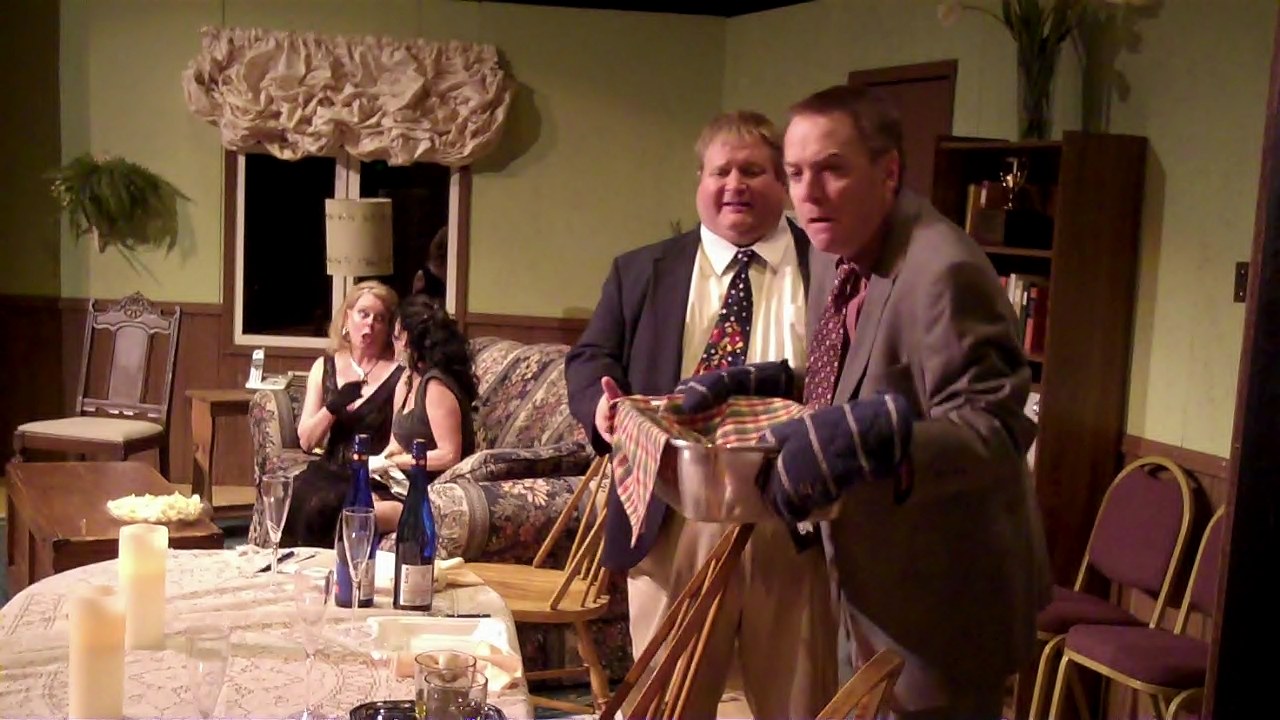
The ODD COUPLE, Felix with burned London broil (1/21/11, Moon Theatre Company)


What is clear to one who is involved in this sort of thing is that once you have the show cast and directed properly, the play takes on a life of its own.  But not all aspects jump to life and run around.

Show business has two sides- the art side and the business side.  As I said above, the art aspect is taken care of by the director.  The business side, the haunting space of the producer, is perhaps more difficult in my experience.

The business side comprises the nuts and bolts of funding cast & crew, props, the venue, set design and construction, etc.  This is very concrete and relatively easy to understand and manage.  What is less than easy to understand is the publicity function. 

Publicity today must be done in the schizophrenic world of print and internet media.  The center of the community theatre-going demographic are the retired people and those over, say, 60 years of age. Go to most any production and you’ll see the Q-tips and Blue Hairs in the seats.

In order to put butts in seats, this group must receive the message and thence be wrenched from the recliner in front of the DirecTV and compelled to go out into the evening traffic, find a parking spot, and buy a ticket. 

After rehearsal the other night, a few of my fellows and I repaired to the local establishment for some beverages. This public house featured an open mike performance by local musicians who were actually quite good. The tables were filled with an entirely different demographic group than we had set our sights upon and the air was full of expectant optimism.

After the waitress delivered my cold glass of liquid bread I put  to her a sincere query.  I asked her what it is that would compel her and her fellows to attend community theatre?  This fine specimen of a 20-something stood there flummoxed. She was accustomed to fending off the unwanted advancements of inebriated customers, but this sort of question was completely unexpected. She left to tend another table, promising an answer on her next visit. 

On her next visit, the waitress, a former theatre major, said that she would be attracted to a production that was … edgy.  That was it.  I acknowledged her comment and asked her if she ever goes to live theatre performances. She said “no”. I asked her how would such a message find its way to her and her compatriots. She thought about it and replied that she didn’t know. There was no single information outlet that percolated up.

I suspect that this interchange represents the situation in miniature. We have so many channels with densely packed data streams pouring into our consciousness that we are overwhelmed with it. Information is cheap and abundant. The value of any given notice of a public event is diluted to an infinitesmal level by the sheer volume of similar such notifications across the multidimensional space of media.

We do suspect that the Blue Hair demographic still reads newspapers and in the future we’ll throw a handful of money at print advertising. But like everyone else, we’ll be uneasy with the expenditure.  It is very difficult to predict the effect of low intensity advertising in any given medium.

High intensity advertising, on the other hand, is a good way to get the message out. But high intensity advertising is high intensity spending and that isn’t an option yet.

Frequently wrong, but never in doubt

At some point, self-confidence more resembles a learning disorder. This is one of the great truths of history, I believe. The unwise advancement into adverse conditions with little more than the loincloth of bravado has lead to the demise of many. In that group of the many are military and political leaders, businessmen, frontiersmen, ponzi scammers, technocrats, and adventurers of all sorts.

We all like to be around people who are self-assured and cool. The air of self-confidence is a necessary attribute for those entrusted with the authority to commit resources on the large scale. But often the authority is not backed with a durable feedback loop for checks and balances. This is a fatal weakness in any system that focuses the authority on a few to delegate resources.  Sweet enthusiasm may quickly ferment into the delerious elixor of greed. Beware those who are frequently wrong, but never in doubt.

This is the Darwinistic force that lead to the evolution of that curious species, the auditor. The auditor is an omnivore with slender and dextrous fingers for prying under the bark to tease out burrowing pests. The large ears of the auditor and cavernous nasal passages evolved to detect burrowing vibrations and the unusual odors of malfeasance.  The bulbous eye stalks have special neural GAAP networks for the detection of tell-tale body language and with laser-like focus, can pierce the corporate veil and lock onto fraudulent transactions.  Woe is he to whom the auditor has taken special interest.

China’s Stealth Fighter Revealed

It is interesting that China’s new J20 stealth aircraft has been revealed before deployment. US stealth aircraft were long a source of UFO reports before they were officially acknowledged.  The Chinese J20 aircraft, called a “fighter” by some, bears a striking resemblance to the US F22 Raptor, though larger and perhaps capable of a fighter-bomber role.

China's J20 Aircraft

While some discount the real maturity of Chinese stealth technology, it is clear that they are on track for parity with the US in this regard.  Stealth technology has as much to do with the shape and angle of surfaces and edges as it does radar absoptive coatings. The Chinese already know what it takes. They just have to come up with flight control systems and manufacturing processes to build the aircraft.

Stealth aircraft and nuclear powered aircraft carriers are a potent combination for the projection of power. Will the sun rise on a Chinese nuclear carrier group patrolling the Atlantic by 2020?  Where will their authoritarian marketplace take them, and us?

Back to reality.

The holidays are over. The christmas lights are now obsolete. The first big snow storm of the season has come and gone. The cryosphere is unceasing in its wicked attempt to thermally equilibrate my house to a ΔT = 0 across the walls. Only high thermal inertia and a near constant stream of methane into the burners will hold it off.

That jolly elf brought Th’ Gaussling a 1 terabyte external hard drive. Years of pdf downloads and treasured jpeg’s streamed silently onto the drive via the fabulous USB port.  Papers on mining & metallurgy, LiBeB cosmochemistry (on the Lithium dip, one of my fascinations), and thousands of photos.

While picking at the guitar the other day it dawned on me why some people choose to play the base guitar.  Four strings are mechanically easier to play than six. Maybe there are other and better reasons, but this seems like a good one. Then, as you advance, there is playing notes from the fifth fret and above.  My brain plasticity turns vitreous at this level. It comes down to repetition of the basics.

Remember the basics: Task at a time- correction in the right direction;  attitude, altitude, cross check;  and, runway behind you is useless!  Dave Benton, Th’ Gausslings flight instructor, ca 1978.

For me and my day job, 2011 will be very much about thermokinetic issues in process safety. We’re going to install a reaction calorimeter and much time and effort will be needed not only in operating the device, but in folding its use into the development cycle. It is one thing to collect thermochemical data. It is quite another to use it to make decisions concerning engineering and process safety.  Considerable effort in my industrial career has been spent in building structure for information archival rather than just bench chemistry.  I didn’t anticipate that.

Our upcoming production of The ODD COUPLE opens in 2 weeks. I’m still rough with my lines, so there is no shortage of stress there. The thought of opening night and sitting on stage in the lights in front of a darkened audience wonderfully concentrates the mind. Neil Simon wrote some great lines in this play.

A Collection of Links

Some interesting links on Th’ Gaussling’s Favorites List-

Many moons ago, as a 9th grader, I built an atomic cloud chamber. I fabricated a galvanized sheet metal reservoir for dry ice and methanol and attached a chamber on the top made from the top of a metal Folgers coffee can. The can had a plexiglass viewing window and three curved plexiglass windows on the side for illumination. The plans were from C.L. Stong’s column “The Amateur Scientist” in Scientific American.

Going into 10th grade I managed to borrow a Polonium-210 source from the physics teacher. It was just a needle with a small spot of radioisotope on one side and a cork on the other. I never did see any activity from the source, but I did see a few stray vapor trails from background radiation. Turns out that the source had a short half life and was long dead.

One of the more interesting websites is United Nuclear.  They sell various nuclear related items, ball mills, as well as NdFeB super magnets. Most notably, they sell a cloud chamber that looks quite well designed. They also sell sources.

The best place to buy electronic cables is MonoPrice.  A USB cord selling for $30 at Best Buy will go for just a  few dollars at MonoPrice.  Same story with HDMI cables.

If you love to listen to speakers talk about exciting ideas and technology, then TED is the place to go.

The MetaFilter community weblog is a treasure trove of unusual links dredged up by many contributors. The site is updated continuously.

Patently-O is a consistently well produced weblog on patent law and worth visiting now and then. 

An excellent aggregator of earth science related news is Geology.com. They are reasonably good at finding rare earth element related news.

Benchtop ESR Spectrometer, Rare Earths, and Global Politics

A company called Active Spectrum is marketing a benchtop ESR unit called the Micro-ESR that performs electron spin resonance measurements. The site says that the system operates at 3.4 and 9.6 GHz and has sub-micromolar sensitivity.  It’s pretty amazing, really.

I don’t know for a fact but the easy guess is that this ESR instrument and the picoSpin NMR spectrometer are based on some kind of rare earth magnet technology. Both instruments use very small cross section sample space, presumably to accomodate a design scheme to bring magnetic field lines together as closely as possible in the probe giving a useful field strength without a big electromagnet.

A quick patent search fails to turn up patents based on some obvious key words. I’ll have to spend some time looking more intently.

Now that I’ve got you hanging on to the rotating frame, lets tip you over with this.  China’s new policy of restricting rare earth element (REE) export as well as the recent announcement that it would be inposing fairly stiff tariffs means that wonders like these two magnet-based technologies are going to feel a pinch in raw material supply and competition real soon. The aggregate demand picture for REE’s will exceed supply by 2014 or so.  Market purists will nod knowingly and chant their homily on the rational allocation of goods by the market. 

But to what extent is China part of a rational market? China, Inc., really consists of a highly nationalized array of business fronts that are backed to the hilt by the Chinese government by internally favorable regulations on ownership and local sourcing. Don’t forget that Chinese currency is shielded from valuation excursions. 

To a large extent, China is leveraging technology developed in Japan and the west with metal resources highly concentrated within its borders to apply a pincer attack on the market place. China has industrial policy that it is steadfastly acting to strengthen its manufacturing base while the USA has an emphasis on aligning its citizens to be more receptive to consumption.

Wouldn’t it be nice to live in a country that tried harder to make its manufacturing industry more robust rather than the present fascination with finance and the well being of financiers?  Wouldn’t it be nice if westerners transferred a bit less of our magic to countries who will turn it into a stick to beat us over the head with? 

It is going to take a lot more than glib talk about the free market to deal with China and the growing influence of nationalized companies around the world.

A willing suspension of belief. Anatomy of a liberal.

I keep getting emails from conservative friends and acquaintances who are obsessed by what they call political correctness. In these emails, some kind of sarcastic parody is made regarding an alleged trend to ban the use of the phrase “Merry Christmas”.  Neoconservatives latch onto this like barnacles on the bottom of a tramp steamer. Inside their pointy heads they imagine that a cabal of liberals are scheming to take their guns and their religion from them.

If other liberals are like me (an admitted dissident), then not only do we not want to deprive them of  their damned firearms and bibles, but we want to put as many miles between us as possible. At least out of shooting range.

Christmas has a secular component and practice that even a bitter, crusty, non-religious liberal like myself can feel comfortable with. But as far as possible insensitivity to Jews and Muslims, well the decendents of Abraham will have to work that out amongst themselves.

In my limited sphere I don’t know of a single liberal who is trying to replace “Merry Christmas” with “Happy Holidays”. Only conservatives carp about this.  It’s a red herring promulgated by that famous yapping vaudevillian cur himself, Rush whatshisname, in the name of ratings.

——————

I’m moved to comment on what makes some people liberal.  A recent article in Slate was written by a conservative, Daniel Sarewitz, who seems to be genuinely perplexed at the apparent trend of scientists, or at least academics, to be liberal. It is though he is talking about a smallpox epidemic.  While I have no idea as to the C/L ratio of scientists and academics, I can say that from my perch on a small and obscure branch of the tree of science, liberals like myself are rather scarce.

Indeed, most of the industrial chemists I am in contact with are libertarians or evangelical conservatives or plain vanilla orthodox conservatives. So, from my limited data set,  Sarewitz’s complaint appears specious.

He probably refers to the life and eco-sciences, earth science, astronomy, big-time-physics, etc. I suspect that the balance is different in these fields.

But why would scientists trend towards a liberal viewpoint?  I have some ideas. First, the scientific approach to the world relies heavily on study and measurement.  Scientists tend to study analytically or, to use another term, critically. Critical study of the physical world requires a willing suspension of belief.  A scientist must keep a loose grip on beliefs because experimental results frequently force one to re-examine fundamental assumptions.  Fame and glory in science goes to those who tip over the apple cart of concepts with contrary results.  All scientists are excited at the prospect of looking at something in a new way.

I would offer that one attribute of a liberal person is the ability and willingness to reexamine ones fundamental assumptions. A corollary to this is that liberals are eager to acquire a new perspective on things in general. It is simply an artifact of curiosity.

Conservatives whom I know also appreciate study and measurement. But I think there is more of a trend towards devotional study rather than critical study. It’s about a greater knowledge of doctrine or greater fidelity with a catechism of policies.

Religionists upset with the notion of the separation of church and state often assert their right to be heard and to express their religiosity in public spaces.  Some liberals might take this as a simple matter of freedom of speech. And if that is all the religionists want, that would be fine. But if you look closely, they don’t want simple speech, they want to hold services in public spaces. They want to bring the civil sphere into alignment with their doctrine.

Religious services are about the veneration of the sacred. But “sacred” means that which is beyond question or understanding.  In a real sense, holding something sacred is to set apart a concept or doctrine from critical analysis. Religionists are not interested in a public critical analysis of their precepts. They are only interested in broader devotional covereage.

A liberal person is compelled to do critical analysis.  The very notion of sacredness is antithetical to one who seeks analytical truth. The policy that some concepts are beyond analysis is simply a form of thought control and is more suited to the Iron Age than the present.

For a good many people, college is a time and a place for intellectual experimentation and openness.  The university is an institution where critical analysis of the great world systems takes place.  The active examination of our world is the realm of the progressive.  Progressives push the boundaries of knowledge irrespective of where it might lead. Sometimes our analyses reflect well on our human or national institutions and sometimes it does not. But knowledge hidden is knowledge abused. That universities are loaded with liberals is a natural outcome of the shared intellectual adventure students are taking.

Merry Christmas from your liberal friend,

Th’ Gaussling

American Plutocrats and Commoners

It is really interesting how American commoners can support a political party that obviously serves interests of the top money earners and wealthy elites in this country. Perhaps they are waiting for some scraps to fall off the table? Or some of that lucre to dribble down their way in the form of a fabulous $9.00/hr retail job?   But, “commoners”?  What does that mean?

I figure that since the country seems bent on heading in the direction of a 19th Century-style society of stratified income classes, we may as well dust off the Victorian terminology and talk about how life is going to be. 

Power is the ability to allocate resources. As more and more resources come under the control of a wealthy minority, government seems to align itself increasingly to a small pool of influential and wealthy elite.  With the election of the upcoming congressional class, it is very clear that wealthy corporations and individuals are getting what they paid for-  statutory favors and influence in the deconstruction of the federal system of government. It is no coincidence that politicians from southern states, where an upswing in antebellum sentiment is afoot, are especially keen on the topic of states rights and other confederate sympathies.  Old antipathy is being dusted off and tried on for size.

Since SCOTUS has affirmed that money equals speech in Citizens United v Federal Election Commission, and that corporate funding of broadcasts cannot be limited under the First Amendment, anonymous streams of cash from conservative donors have flooded the 2010 election.  Such is the power of persuasion made by big money that a class of deconstructionists has been elected to the next session of congress.

Americans commoners have a fetish about the ways of the megawealthy.  Dial up CNBC sometime when Warren Buffett and Bill Gates are interviewed at one of the Ivy League B-Schools. Watch all of the gaga-eyed MBA students as they hang on every utterance proffered by these two American Plutocrats. It is a form of rapture. The students and faculty are under a kind of enchantment. But this is no different from the country at large. Watch how commoners behave around Donald Trump, or Oprah for that matter.

One of the things that will have to change in the near future is a rewrite of the local zoning codes pertaining to shanty towns and squatting.  As the population grows, as raw material scarcity increases, and as wealth continues to shift toward the wealthy side of the bell curve, more and more people will find themselves unable to house themselves. Increasingly we see a housing system heavily relying on credit and background checks, high rents, and the need to commute in America’s now balky system of suburbs.  The suburb system places a great distance between work centers and living centers, making transportation problematic for our up-and-coming dirt poor class.

As the population of dirt poor and destitute rises due to deindustrialization and dissolution of social safety nets (say, by 2030), all flexibility in the system will begin to play out and people will find themselves living in shanties and refrigerator boxes. They’ll become squatters. The local constables will have to deal with them because municipalities will refuse to compromise property values and will shun the homeless.

Let’s see.  What will the growing class of homeless do with their time? Write poems about the joys of laissez faire orthodoxy? I think that somebody will put together an appealing manifesto on insurrection.

Maybe our own village idiot, Glenn Beck, is right. Maybe there is a revolution underway. But I don’t think it is the one he is expecting.

Patent holiday

It’s been days since I’ve shaved. I’ve spent 3 solid days over the Thanksgiving holiday hunkered down in my office studying patents and following threads through the IP swamps of Mordor.  A friend has engaged me to do some consulting and needs an IP map of a particular realm of industrial chemistry. I have no confidentiality overlap with this area of technology so I agreed. It sounded so easy when I said yes and estimated my fee. Now that I have blown well past anything I could ever hope to recover in terms of billable hours, I’m still blasting and hand shoveling muck from the pit of my own making.

His company is currently putting a plant in the ground to produce a well known commodity and the question foremost in their minds is- what added value beyond [—] does the product have?

I’m reasonably good at diving down the rabbit hole in the patent world and finding what I need to know. But the current project has forced me to press into use more USPTO resources since I don’t have a personal SciFinder account for this work. Especially useful has been the classification system.  Patent lawyers will scoff at my swoon over this and flash their Esquire stinkeye since they are all too familiar with it. But chances are they don’t use SciFinder like chemists do.

SciFinder’s ability to find patent families from a structure or CASRN input is phenomenal. Even from within Markush claims.   I’ve had one search with combined SciFinder/USPTO resources compared with legal specialists using their own search tools. My search was just as exhaustive as theirs. Yes, SciFinder has flaws. And not finding claims is like a negative experiment.  But it is a very good tool for combing the ground.

Part of my approach stems from my natural inclination to browse. I drive people nuts when I go to a store with them because I will thoroughly examine the contents of the store for interesting items.  I drive the merchants nuts because my browsing rarely results in a sale.  (Notice that the theme is that I drive people nuts.)

Once you find a lead patent it is important to search the classification as well as cited patents. It is a simple matter to do a search by classification and dredge up hits. Once the fish are on board, it is about sorting the results and casting the trash fish back in the water. 

Google Patents is an excellent resource and I heartily recommend it. It retrieves pdf’s of the entire patent document as well as providing links to patents cited and those patents citing the patent of interest. It also links to the the classification site at the USPTO. A simple click of the mouse in the USPTO site pulls up a search of all of the patents under that classification.

On occasion, Google patents will not retrieve a particular patent or application. This seems to happen with very newly issued patents and applications in general. For this circumstance I use pat2pdf.org.  You might have to monkey with the formatting of the application number string, but it almost always returns the document eventually.

OK. It’s fine to be able to retrieve a bunch of patent numbers and pdf’s. But soon one becomes overwhelmed by the large amount of highly dense data that has been recovered.  In my surveys, I use a form meant to collect key information, but sized in a manner so as to limit the amount of detail I can write down. Feel free to use this form or modify it as you please.

Patent Summary Blank Form

At some point it becomes useful to use Excel to develop a matrix of patent information. In particular, one can retrieve a list of patents from the PTO and cut and paste them into Excel. They’ll paste as hotlinks, so all you have to do is to right click on the cell and select the unlink option. Tedious but effective.

I have developed an Access database to store patent information and other IP office actions and produce reports for due diligence studies. This is very handy, but eventually you become enslaved by upkeep as is true with all database tools.

Am I suggesting that one does his own lawyering? Not at all.  But if you’re in high tech manufacturing, one must be very careful to avoid infringement. It it crucial that a few technical people in the organization be familiar with the patent picture.  It is far better to avoid infringement in the first place than to have to find a way out of it.

The best way to use a patent attorney is to be informed in all interactions with them.  While they can often noodle through a problem presented to them by napkin scribblings and hand waving, it is best for the client to be knowledgeable about the patent landscape and to help the attorney to focus on the key legal issues. Good lawyering happens when the attorney clearly understands the nuances of the problem and can act accordingly. Having a list of prior art or other IP facts will save you billable hours in the form of research and needless office actions.

Your attorney is an officer of the court and has a legal obligation to honesty and fidelity to the system.  Being well informed in advance and working cooperatively with a patent attorney will go a long way to staying out of litigation.

The other good reason for closely studying the patent literature is to find what some call the “white space”.  This is the negative space around the claimed art that is not claimed and is likely to be free to practice or fertile enough to file a application on. If you Google “patent white space” you’ll find that this is a cottage industry.  A study of white space may provide insight into maneuvering room around a patent.