Category Archives: Economics

There Be Dragons!

There is a theory brewing that the ignorant wielding of statistics-based risk management is deep at the heart of the current financial panic. Nassim Nicholas Taleb is quite outspoken in this matter. He goes on at length about the inadequacies of statistical methods for financial risk management.

NY Times writer Joe Nocera [link may require free subscription] echoes this sentiment- but in greater breadth- in a recent article in the NYT. Nocera focuses on Value at Risk- VaR.  Since my statistics training is limited, the reader will have to draw their own conclusions on the merits of this methodology.

Taleb warned about “Black Swans” a while back in a book by that title.  A man not overly burdened with modesty, Taleb has transcended to the status of an Illuminati due to his prescience on the blindness of statistics-based financial risk management in predicting low frequency catastrophic events, or Black Swans.

Perhaps the old cartographic flourish “There Be Dragons!” should be updated to “There Be Black Swans!”

Kar Tsar? Car Czar?

A Car Czar?  What?  Are they kidding? Pfffttt!! Industry people barely know how to run the car business. How is a civil servant or political appointee going to direct a bunch of cocky rust belt stiffs in pinstripe suits to drive us into a clean and happy motorized future? Is this a joke? HEY!!  Who’s idea is this?

The big three automotive companies need a blood purge. The executives who lead these venerable organizations onto this jeep trail to perdition need to have their heads skewered on a row of pikes planted outside corporate HQ for all to see. There must be a big show of public firings and some tearful, sobbing contrition by the survivors. People who become automobile executives captains of industry should be terrified every day they show up to work, fearing for their careers. If you get too relaxed, You’re Out!  Damn’d skippy.

Receding Tide Strands All Boats

Wow. Major dose of reality. For Th’ Gaussling, this economy fiasco just went from made-for-TV to in-your-face reality. Big chemical producers are pitching 10 % chunks of resourceful humanity overboard. They are burning down inventory levels, pushing back raw material purchases, and stopping capital projects. The reciprocal of the old saw about “a rising tide lifting all boats” is in effect.

Well, everywhere except government. Government seems to continue to build up debt obligations into the tens of terabucks range. Now is a good time to have defense related products- things that have MIL SPEC on them.

But now is when it really sucks to be in advertising, RV sales, and office supplies.  Advertising budgets are among the easiest to cut when the flancing of blubber begins. 

This is a great time to hire. Lots of job candidates out there with degrees. I’ve been getting Hail Mary resumes from people wildly disconnected from chemistry.

If you are a well paid 50-something, golly, you might as well put a target on your back. This is one of the ways companies can re-jigger their staff to be rid of those expensive, middle aged folk who burden the health insurance pool with those costly diseases. In a recession, a company can use the situation to reset the payroll and have a chance to restaff with cheaper worker bees when things pick back up. That is, if there is anybody left.

Failing to Ask Better Questions

We may be entering a time of greater economic hardship than many have known in their lives. The great age of mass consumption, non-returnables, and disposable goods may have peaked.  Boarding the Hummer or the Escalade to drive 5 miles to buy cigarettes and a Big Gulp may be a thing of the past for a greater number of citizens. Americans will have to adopt a lifestyle much more akin to Europe or Japan- reduced living space and reduced (kg of crap)/(person year), reduced portion sizes, more walking, local shopping, and increased use of rail transportation.

The Oil Shock of Summer 2008 snagged the suspenders of this nation of hydrocarbon addicts, sending us reeling into the election/market crash machinery like a drunken farmer pulled into the thresher. Out the back end of this nightmare comes the bloody oat chaff to hint that something horrific happened. Reality strikes, then … silence.

In spite of the plurality of media outlet channels into our collective consciousness, few infotainers are drilling into the core of the problem. The pace and timing of commercial media sets the rhythm of infotainment metered to the masses. Photogenic talking heads selected for their appeal read predigested content for broadcast to attention deficit channel surfers. People dulled by the sheer magnitude of content-dilute information streams and dazzled by the production value of infotainment are compelled to switch on HBO and hide from the world.

Here is what we must do. We must see to it that better questions are being investigated. Instead of asking about the replacement for gasoline, we must ask for a frank disclosure on the sustainability of high consumption. Instead of asking for better or hybrid automobiles, we must frame questions around the concept of a mass transportation network. How can we get intercity rail up and running? How can the Detroit automobile manufactures be cajoled into entering the rail infrastructure business? Where is the hydrogen going to come from to fuel the hydrogen economy? Does it make sense to consume energy to generate hydrogen and then turn around and burn it for propulsion?

The best answers come from the best questions.

The Cost of Scientific Information. Who Pays and Who Gets Paid?

For anyone outside of academia who has not actually received an invoice from Chemical Abstracts for literature retrieval services, let me assure you that literature searches will cost you real money.

CAS has weighted the basic search operations and defined them in a menu of task equivalents. When you subscribe, you purchase a bundle of tasks. Tasks can be used like a chit- they can be applied for a variety of search operations. Some search operations are assigned a higher value than others. Obviously, a group of big wheels at CAS sat down in a room and hammered out what they perceive the value of a given operation to be.

At this point, it is useful to remind folks that price is not properly based on cost, it is based on what the customer is willing to pay. CAS has an army of clerks punching abstracts into the database, so they do have some real overhead. While CAS honchos are mindful of paying the overhead, they are also trying to find a pricepoint for their information services. On this I do sympathize with them.

However, where I part ways with this organization relates to the monopolistic arrangement they have with information paid for by citizens of this country. The major pipelines of chemical research information seem to plumb directly into CAS and the ACS.  Research that does not get published by the ACS goes to a variety of private publishing houses. The common thread is the transfer of copyright to the publishing house. By turning over the copyright of publically funded research to these organizations, the public relenquishes the right to free access to results it has paid for.

In a very real way, the published results of our university research complex represents national treasure. What do we do with it? We hand it over to publishing organizations who print it in exchange for the copyright. In this way, we can keep paying for access indefinitely.

In fact, lets highlight some of the features of this transfer of wealth and the cost to society of scientific literature-

  1. Citizens and corporations pay taxes to support the various funding agencies like NSF, NIH, DoE, DoT, DoD, etc., as well as provide private grants.
  2. Funding agencies award grants to institutions and researchers to pay for the conduct of research.
  3. Researchers take a combination of funds and pay for stipends, fellowships, materials, and overhead to support the people who do research.
  4. Research is performed and results are communicated as publications.
  5. Researchers sign over the copyright to their work in exchange for publication.
  6. Publishers such as the ACS, Wiley, Elsevier, etc., then hold a copyright on the content in perpetuity.
  7. For the rest of time, the citizenry who paid for the results have to pay a fee to get a copy of the paper, or travel to the nearest University library and hope that the publication isn’t in deep archival storage and unavailable that day.
  8. Thanks to the Bayh-Dole Act, institutions can patent the results of federally funded work. This means that the hopeful citizens of the USA are barred from the practice of the art they paid for. In fact, they have to work out a license agreement which will include a royalty (with audit trail) and probably a hefty upfront, non-refundable, fee to get the ball rolling.
  9. Despite this royalties cash stream that universities have access to, tuition and fees continue to rise well above inflation.
  10. If you are a chemical scholar out of the cover of academic discounting, you face the full brunt of literature search costs yourself. A monograph or book on any given chemistry topic could easily cost $10,000 in non-academic SciFinder charges (ie., $68 per reaction search). A typical technical book may provide an author $3,000 to $10,000 in royalties over 5 years.

Well, you say, the benefit is to society as a whole. The science we pay for goes into society where, like an incoming tide, lifts all boats.

Nonesense! This tide lifts the good ship Elsevier and the USS Chemical Abstracts. It helps large universities get larger. The generation of information has become a cash cow for a handful of organizations who are subject to precious little scrutiny by those who freely supply the scientific content that keeps the system going.

GM, Ford, and Lonely Chrysler

With all of the pious talk of the importance of the big 3 auto makers, it is hard to dissociate ones feelings with the subject. American car culture and our affinity for happy motoring is woven into the Stars and Stripes. But our automotive manufacturers have come to the end of the road. Their myopic practice of pure market-pull business operations, as opposed to the technology push of industrial leadership, has left them stranded on a slender spit of sand surrounded by the rising tide of change. The very immensity and gravitas that allowed these corporate creatures to dominate the market now threatens to sink them as our unsustainable mania for consumption and wretched excess comes to a squealing halt.

Three ailing patients show up in the congressional emergency room and plead for help. But the market and the government must do triage on this group of patients lying on cots before us and throw resources at those who may live and wheel the living dead to expire in the dark hallways of the corporate morgue.

The delegation of big wheels from Detroit were apparently unsuccesful in their reconnoiter to DC looking for national treasure. Their bizjet faux pas was the finishing dab of paint on this silly cartoon. It was a signature blunder marking arrogance and an artless attempt to exploit the transient alignment of stars motivating congress to fund business institutions “too large to fail”.

These business dinosaurs need to become extinct so as to allow other more competitive creatures a chance at survival. I urge the Congress to stand back and allow these companies to enter into Chapter 11 and reorganize. Their cost structures are simply too bloated with overhead to go forward. If a company is willing to reorganize, then it may be worth advancing a loan of public funds to aid their survival. But as they are presently configured, they should not be encouraged to live on to produce more of the same.

PGM Prices Continue to Weaken

20 November, 2008. EIB Rhodium bullion prices continue to haunt the cold, murky pricing depths of the metals market. Today, Rhodium opened at US$1250/toz. That’s just 12 % of the June ’08 highpoint of US$10,100/toz. 

Rhodium demand is heavily dependent on automotive and industrial catalyst applications. While chemical plants may still be chugging out hydroformylation products at reasonable levels, automobile manufacturers are having a hard time getting citizens to buy new automobiles. And strapped to the undercarriage of each automobile is a metal cannister packed with PGM-laced ceramic material. It is no coincidence that Rhodium prices and automotive sales have collapsed together.

Platinum pricing has fallen considerably as well, from the Feb ’08 high of US$2275/toz to todays opening price of US$780/toz.  While Platinum does have considerable automotive and industrial catalyst application, it is also subject to demand from the global jewelry market, which acts to dampen the price collapse.

Two bits of Platinum news may be strengthening Pt prices. An incident at the Angloplats Polokwane smelter will lead to a shortfall in Pt output by an estimated 200,000 toz.  Johnson Matthey predicted a 240,000 toz Pt shortfall for 2008. It was unclear whether that estimate takes into account the production stoppage at Polokwane. Matthey cited general safety stoppages and skilled labor shortages as being behind the anticipated Platinum shortfall.

Microsoft Telescope Effect

As I plod along in my daily swim upstream, I have the occasional epiphany that makes me pull over into an eddy behind a rock and contemplate my situation. Gradually, I have been making better use of the Microsoft Office suite of products generously provided to me. Among those tools is MS Access. I have been devising database tools to help me keep various kinds of data available for quick retrieval as well as access to the source documents. For some of us, it helps for retrieval tools to be as visual as possible.

As I put the finishing touches on my latest creation, it dawned on me what a rube I was. Again I had fallen into the technology trap. Instead of making a case for administrative help, I had merely taken another step along the path of telescoping increasing job responsibilities into my work week.

It suddenly became crystal clear. Microsoft products have facilitated the near complete extinction of whole job descriptions. In times past, highly trained employees were given assistants to leverage or multiply their activity. Assistants would attend to organization of information and limit access to their boss. In this way, employees could focus on performing the expensive skills they were hired for.  To a very large extent, personal computers have rendered obsolete what used to be an ordinary working duo- a manager/specialist and an administrative assistant.

This working pair has been replaced with “personal productivity tools” that allow- require, really- that the specialist take care of all of the correspondence, filing, categorization, phone-tag, drop-in visitors, requisitions, expense reports, etc., required for the job. In most organizations I am familiar with, expensive specialists are expected to be their own office managers, file clerks, and receptionists.

Th’ Gaussling can be a bit slow on the uptake, so I’m sure others have already noted this effect long ago.

In a similar vein, James Kunstler writes about another consequence of technology. Here, he is making reference to electronic voting machines, but the notion applies well to another marketing scam: compulsory excess capacity or capability. Another way to say it is, a high tech “solution” to a low tech problem.  

  What many people are nervous about, of course, is the chance of shenanigans with the voting tally. Just one minor feature of the general paralysis gripping this society has been our inability to get rid of those mischievous Diebold computerized voting machines that leave no paper trail. By the way, these touchscreen voting units are an example of the diminishing returns of technology. There was nothing wrong with the old mechanical units, but by making over-investments in complexity we’ve just created more problems for ourselves. This ought to be a warning to those in the thrall of techno-triumphalism.

How many people make full use of most of the features of, well, any of their software? When you are a hammer, everything looks like a nail. When you are the largest software company in the Milky Way Galaxy, everything looks like a software solution opportunity.

America’s Cold Civil War.

Note: The following has been determined to be a diatribe and not a screed. A screed would be several times longer.

This period in US history contains enough meat on the bone to keep both scholars and crackpots gnawing for decades. Collectively, we are in the overlap space of a sociological Venn diagram. The overlapping domains of economic calamity, political paranoia, shrinking international stature, and withering military expense combine like cyan, magenta, and yellow to form a white hot zone of malcontent.

It is no overstatement to say that many if not most Americans have chosen a part of the political pool they want to swim in. Listen to the voices at McCain/Palin rallys. Listen to people being interviewed upon leaving a McCain/Palin rally. They’re invariably angry and fearful. They distrust the “Liberal Media”. Do they mean to include Rupert Murdoch’s media empire? Do they also include most of the AM band talk radio programs? Is this the deep end of the pool or the shallow end?

I cannot help but conclude that conservatives are a fearful bunch. Study the McCain/Palin campaign advertising. Go back to any recent presidential campaign and recall Willie Horton or the Swift Boat attack on the democrats. Fear is the unifying ingredient in conservatism and the people who run the GOP machine know how to swing this stick.  Democrats do the Fear theme poorly and as a result, cannot summon the same kind of existential panic that the GOP can pull from their bag of tricks.

McCain is starting to see some of the visceral response to the possibility of Obama as president from underneath all of the rocks and behind all of the tarpaper shacks in the political back-40 acres. He has been openly challenged by angry citizens about the viability of his campaign.

That cartoon figurehead of the GOP, Rush Limbaugh, was practically apoplectic in his frustration with McCain. Strangely, this political freakshow impressario is now towing the line on McCain and has focused his leagions of ditto-zombies on bringing down the reputation of Obama with a mezmerising whisper campaign of slander.

I’m beginning to think that McCain wouldn’t be the worst kind of GOP president to have, especially if the conservatives of the land are this uncertain of him. But Palin as runner-up to the Whitehouse leaves me speechless. A country so brain-addled as to put Palin in national office is perhaps a country that needs to have its nose rubbed in it for a taste of its own collective stupidity. McCain/Palin in Washington may be what it takes for the complete implosion of the GOP.

Having watched the rise of Bush II and the conduct of the 2008 campaign, I have begun to understand what it might have been like to have lived in the period leading up to the American Civil War. This was a period intense division between citizens regarding deeply held beliefs. Civil and religous laws were invoked by both sides to justify their actions. Both Lee and Sherman believed that they marched in righteousness. It was brother fighting brother with a kind of hostility that is startling to people even today.

I sense a widespread and internal hostility along with a rigid adherence to doctrine that marks a divided country. I believe that America is in a type of cold civil war. There is a fulmination of anger and frustration out there that is beginning to partition the meaning of America into distinct translations that suit the adherents. 

Countries that experience economic and political upset are prone to the surfacing of latent fascism. Fascism is a kind of fever that spreads through the vectors of blame and jingoism. Anti-intellectualism and ethnic hatred are common manifestations of a country having a bout of fascism fever.

Witness the accusations of “elitism”  and the whisper campaign questioning the citizenship and religious affiliation of Obama. We have elite military forces, elite police forces, and elite athletes- why not elite chief executives? Why would we demand that politicians be just like the down-home folks like you see, say, running the Tilt-O-Whirl at the carnival? Don’t we want the chief executive to be someone who has honed his skills for public life? The Army has its War College. Why can’t the executive branch have its Administration school?

I think we have a civil cold war brewing in the USA right now and if 20-25 % of the workforce loses its paycheck because of the banking fiasco, I think there’ll be trouble. But no doubt, the DHS has thought of this and has soldiers and Darkwater contractors ready to deal with the sh**storm.

US Mint Suspends Sales of Gold Coins

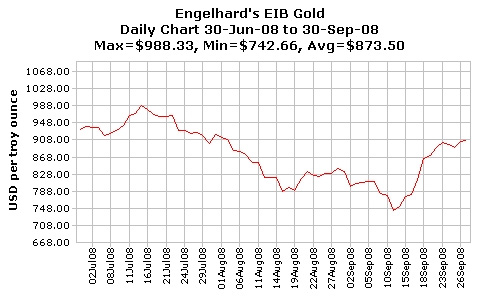
Reports have been circulating that the US Mint has suspended the sales of gold coins. The mint has been experiencing unprecedented demand for gold and silver coins. A short list of favored dealers has been drawn up for distribution of the limited supply.

What is curious about this is that the US Mint has “suspended” sales rather than simply announcing that it has a backlog. Only the govenrment would respond to demand in this way. I understand that minting gold coins is not nearly as automated and fast as base metal coins. But by their manner of responding to the demand, they can only accelerate the rise in price for these coins.

I have captured a snapshot of PGM pricing from the BASF EIB website. I hope BASF isn’t too hacked off.

The Canadian Maple and South African Krugerrand gold coins are available, as far as I can tell from internet sources.

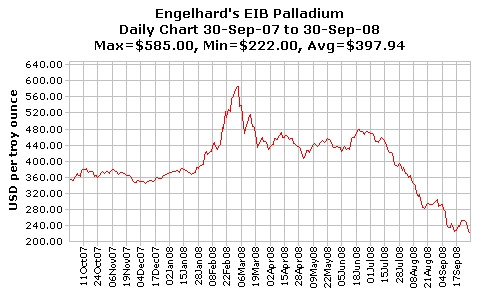
Of interest to the catalyst world is the falling price of Palladium. The chart below is scaled to show the price of bullion for the last 12 months. This is surely a kind of economic indicator affording a clue as to the vitality of some particular and narrow market sector.

I wonder where the opportunities are in this difficult time? Now is a good time to keep your head on a swivel for unique opportunity.