Wow. There is a whole lot of pissin’ and moanin’ out there about Biden’s student loan payment program. A lot of it is bubbling to the surface like rotten egg gas in the mud pots of Facebook and Twitter. That wriggling libertarian tapeworm is deeply and firmly attached to the innards of a great many people.
I’m not going to waste precious heart beats trying to explain why a civilization should aid and encourage higher education. It should be obvious.
In an earlier chapter of American history, I graduated with a BA in chemistry owing $265 back in 1984. The whole time I had at least 2 jobs simultaneously and in two cities for part of that time. It is what I had to do to graduate without accumulating a lot of student loan debt. Later, in grad school, I received tuition remission and a stipend to study for a PhD. This is/was common for chemistry graduate students. The only cost for the ordeal was time, a divorce and my sanity.
Since that time tuition, student housing/rent, fees and other expenses have grown astronomically while wages and grants have not. State funding of colleges and universities has shifted from grants in favor of guaranteed student loans. The reprobates in congress have also passed laws that make escape from student loan payments through bankruptcy impossible.
As it has turned out, my generation of Baby Boomers has benefitted immensely from lower tuition in our time. Today, the picture for students is quite different. Student loan debts are drowning a great many people. We lived in a time that funded student aid with grants and scholarships that are either not available now or they didn’t grow with tuition increases. Today’s students are unable to save for house down payments or otherwise spend on other goods and services. It might even affect who you marry. Why marry into enormous long-term debt?
For many students, not signing the loan papers was equivalent to giving up on their dream of a better life. There are indeed plenty of jobs not requiring a college degree that can lead to a comfortable life. Starting your own business is not for everyone. We can’t all be a Bill Gates because ground fertile enough for a paradigm shift is fairly scarce.
Now, there is a chorus of indignant voices hissing that “I paid my debts- why shouldn’t you? Why should I pay for your debt?” I can’t argue with that except to say that canceling some fraction of student loan debt is reimbursement of what should have been tuition assistance in the first place. The situation shouldn’t have arisen to trigger people. The sum of $10,000 amounts to $2500 per year for 4 years. This is a reimbursement for a modest yearly tuition grant.
With the appearance of COVID and polio the USA, the news has revealed that it is possible to detect and monitor certain viruses in municipal sewage. As a chemist I marvel at this. Sewage is a frightfully complex mixture of biological waste products along with many chemical cleaning products, detergents, grime and pharmaceuticals that go down the drain. How is it that one can collect enough intact virus particles from this fecal hell broth with enough purity to make a positive identification of genetic material?
A recent methodology is given in an article titled Detection of Pathogenic Viruses in Sewage Provided Early Warnings of Hepatitis A Virus and Norovirus Outbreaks and published in Appl Environ Microbiol. 2014 Nov; 80(21): 6771–6781, DOI: 10.1128/AEM.01981-14 by Maria Hellmér,aNicklas Paxéus,bLars Magnius,cLucica Enache,bBirgitta Arnholm,dAnnette Johansson,bTomas Bergström,a and Heléne Nordera,c. As you can see the work is from 2014 so this is not brand-spanking-new technology. It is interesting to note that the material used to sediment the viruses in this article was acidified powdered skim milk proteins. The article was found by a Google search and located at the NIH National Library of Medicine.
Why powdered skim milk? It could be that milk fat interferes with the process or the workers are just removing variables. More likely, it is because the widely available powdered milk that you buy at the grocery store is from skim milk. Dairy fat is too valuable for a business to squander and is used to make more profitable products like ice cream or whipping cream.
In the 2014 article above, the virus particles are extracted from the raw sewage onto acidified powdered skim milk proteins and amplified with quantitative polymerase chain reaction, qPCR. Powdered milk may seem strange but realize that virus particles can be removed by coagulation with metal ions, lime or with other polyelectrolytes, including proteins. The charge distribution on milk proteins will vary with acidity so these methods are very pH dependent. The viruses are naturally coated in proteins and thus will acquire surface charges varying with pH. The coagulation of proteins occurs when dissolved or suspended proteins irreversibly change their secondary structure by unfolding and condense to form a thicker solution or a solid form. The formation of cheese by acidification or solidifying a runny egg with heat are common examples of coagulation.
A 1973 review article by Gerald Berg in Bull World Health Organ. 1973; 49(5): 451–460, reviews methods for the removal of viruses from effluents, so knowledge of the sedimentation, or coagulation, of viruses in sewage has been around for a long while.
These articles are written by specialists in the field and may present considerable difficulty for a few readers. I would urge those so inclined to try to plow through the articles and pick up what you can. This holds true for all scientific papers. See what you can learn.
There was an interesting article cited from the Houston Chronicle in today’s news letter from the American Petroleum Institute. Here is the link. Unfortunately there is a pay wall.
From the API news letter- “Low levels of adult literacy and limited access to higher education in the Permian Basin are compounding the skilled labor shortage already facing oil and natural gas companies as the industry’s digital transformation creates a growing need for workers with specialized skills. Ray Perryman, founder of consulting firm The Perryman Group, estimates that Permian Basin residents could lose almost $425 million in potential earnings and $292 million in economic output unless literacy skills improve, a challenge that’s being addressed by initiatives such as the Permian Strategic Partnership.”
Even in the rough and tumble world of the oil patch, folks need to be a little more educated to keep it going forward.
I could crack wise about education in the Republican Evangelical Republic of Tejas, but I’ll leave it alone this time. This problem speaks for itself.
So, it turns out that I did time in Texas- 22 months to be exact. As a postdoc in a large central Texas city with the initials S.A. The natives were friendly, if not a little obsessed with the daily level of the Edwards Aquafer. If you absolutely have to live in Texas, SA is a decent choice. I do have to fault them on their choice of US Rep. Louie Gomert. An actual gibbering dunce if there ever was one. Imagine what kind of people were passed over in making that choice? But I digress.
On to the point. The Texas State Board of Educators recently made the news regarding their decision NOT to replace the word “slavery” with “involuntary relocation”. Evidently this antiseptic language was floated by a curriculum study group. The board, to their credit, unanimously directed the work group to revisit the language. Astute choice, folks.
According to the article in the San Antonio Current, GOP lawmakers (are there any other kind in Tejas?) are trying to shield students from discomfort in the classroom as with the mercurial issue of Critical Race Theory. Previously, in 2015, headlines were made when it was discovered that enslaved Africans brought to the US by the slave trade were described as “workers” in a social studies textbook. Sanitizing language on slavery is the first step to eliminating its tragic history altogether.
With the birth of every child, civilization must start anew. Parents and other adults are the major actors in rebuilding civilization and their first duties are to teach the child how care and fend for themselves in an often hostile world. Wariness is critical to surviving potential threats out in the open or those that lurk in the shadows. Adults must encourage wariness but not to the point of freezing solid in fear. Nuance is required in order to balance the threat/benefit relationship with the main goal of living as long as possible. In more precise terms, children must be educated and given examples of how to use that gained knowledge to not only live longer, but better as well. Seems obvious.
Today we see a movement in US civilization towards the disassembly of K-12 public education in favor of throwing those resources to conservative private and parochial education. Here in Colorado there is a silent group with out-of-state funding methodically getting far right, like-minded school board members elected. And it’s working. These groups wrap themselves in the flag playing Yankee Doodle, while often carrying a cross, and blow popular rightwing dog whistles as loud and often as they can. Currently, Critical Race Theory (CRT) is the most popular generator of dread fear among a great many in the population.
The fear that the CRT “threat” seems to be aimed at is the American liberal arts education taught in the public schools and in universities. First, some clarity. A liberal arts education is not about indoctrinating kids to be a democrat. The word “liberal” has come to be an epithet in common usage by many. A liberal education is actually meant to learn about a variety of topics and ways of thinking- to be less dogmatic and narrow. It encourages open minds. It tries to be neutral on the religiosity scale as well. And it has been quite successful for generations. Look around and you’ll see an endless assortment of objects and systems whose invention was by people educated under the liberal arts education.
Definition from Wikipedia: “Usually global and pluralistic in scope, it can include a general education curriculum which provides broad exposure to multiple disciplines and learning strategies in addition to in-depth study in at least one academic area.”
It seems that encouraging open mindedness or broad knowledge is exactly what they don’t want. What they want is actually indoctrination into “their” knowledge and thinking using their narrow definitions. It is about a narrow form of mind control, not objective facts and analysis. There is a fear that an accurate study of actual US and world history or science leads kids astray, away from God and country, to a world of anti-Americanism and to eventual eternal damnation. But, an accurate accounting of US history must eventually come to grips with the moral issues of slavery and the origins of the Civil War or the long, unfinished story of racism. To paint it over with heroic tales of settlers on the Oregon Trail while ignoring details of the slaughter and confinement of Native American to the reservation is an affront to reality and in all likelihood will eventually be made known to students anyway. Hiding the truth is a fools errand.
In my estimation, the American liberal arts education in the public schools, while flawed, has been a success. It has helped to provide a vast store of knowledge and skill that has lead to inventions and systems that have extended and improved our lives. Yes, the story is not perfect, but it is not over yet. To place the education of our young in the hands of politically partisan actors peddling extreme conservative views and possibly into corporate control is to steer our civilization into a less democratic, darker future.
See the comments section for more elaboration on this topic.
As an undergrad back in the early 1980s I took a year of Russian language as part of a planned minor in Soviet studies with Air Force ROTC. Let me first admit that a single year of a foreign language is not entirely useless, but it is close. When I eventually traveled to Russia on business in 2000, my miniscule Russian language skills were practically of no use. I could still read and pronounce the words, though. The problem with knowing just a few sentences is that the person you are speaking with assumes that you are fluent and starts talking. That’s where you shrug and they get the idea with noticeable disappointment.
The professor teaching the Russian language course was a Ukranian by birth. He was near retirement at the time and had a thick accent. It took only a short time for me to prove to him that I had little talent for foreign languages generally and Russian in particular. But, I did have the best accent in the class. My high school German classes were an early indication of the slippery Teflon coated language region of my brain where nothing sticks.
The professor’s name was Ivan <redacted> (pronounced ee-VAUGHN) and he had a average frame topped with a big shock of white hair. He was always in suit and tie and had a gregarious personality. He was an accomplished and inspiring teacher and would even teach Russian off-campus at night when asked. He sponsored the campus Russian club whose members were especially fond of the art of pysanky, or Ukrainian Easter eggs.
The professor had an interesting past. As a child growing up in Ukraine, as he tells it, his family’s village was overrun by the Nazis in WWII on their way east. Figuring that the Nazis couldn’t be any worse than Stalin, they stayed put in their village and survived the invasion. But later in the war when the Red Army pushed back the Nazis to the west, they were reported to kill villagers who did not fight to the death or flee to the east. Anticipating this, the whole family packed up and fled west. He said that their group was fired upon by aircraft as they left. Eventually they ended up in some kind of camp in western Europe. After a year post-war in the camp, the family moved to Brazil where he completed his education and acquired teaching credentials. He eventually made his way north to the USA and became a university professor.
Who knows, maybe the story is embellished a bit. Doesn’t matter. I feel lucky to have made his acquaintance and to have picked up just a tiny bit of his language.
Public outreach in science is a important element for the maintenance of our present technology-affected (or afflicted) civilization. Science and engineering (Sci & Eng) activity is continually expanding the scope of the known. The global business sector, without relent, puts new technologies to work and retires others as obsolete. It is as though civilization is in a constant state of catch-up with the tools and materials being made newly available. And the quality of news is quite variable.
When it comes to the electronic and print mass media’s government reporting, the emphasis seems to me to focus on the current budgeting process and political conflict therein. These two subjects are in the “eternal now” in the flow of events. The word “news” is just the plural form of “new” so it is natural that news media focus on present budgeting and in-fighting. Media directors and executives know that reporting must be as concrete as possible and what could be more so than large dollar values and pithy news of political hijinks? Both raise our ire because cost and anger are emotional triggers for people. And emotional triggers bring lingering eyeballs to media.
The public not affiliated with Sci & Eng are quite often unaware of what their tax dollars are actually producing, perhaps many years down the timeline. The eventual outcome of government spending on Sci & Eng may be quite specialized and seem only remotely related to non-Sci & Eng life.
It has been my observation that media equates boring content with failure and compelling content with broadcasting success. The word “compelling” is used to describe something that attracts lingering eyeballs. Modern news broadcasting is the process of jumping from one compelling piece to another. I suppose we cannot blame them for this emphasis on superficiality because apparently it is what “we” want. The big We that draws advertisers and thus cash flow to broadcasters. It keeps the lights on and families fed. Basic stuff that can’t be dismissed with a utopian wave of the hand.
If there is going to be any fundamental change in the tenor and quality of content in media, it will have to come from citizen viewers. This leads me to the thrust of this essay: Those knowledgeable in Sci & Eng must bring the value proposition of current efforts in technological civilization to the citizenry, because broadcast media certainly can’t. By “broadcast media” I mean to include everything right down to what appears on your smart phone. Unfortunately, tech content typically emphasizes consumer goods like automobiles, electronic widgets, space, or miraculous medicine.
Those knowledgeable in Sci & Eng must bring the value proposition of current efforts in technological civilization to the citizenry, because broadcast media certainly can’t in any depth. They’re in showbiz.
Arguments in favor of rational stewardship of our little world won’t influence elected politicians. But informed and persuasive citizens can influence those who are less so and if they apply some leadership. Carefully. Those who may be less educated and less up to date on the sciency subjects do not take kindly to speech that talks down to them. The hand that reaches from above is still above and off-putting. Learn to communicate on even ground.
What works for me in reaching out to all levels of education is to use humor and a bit of showmanship. Reaching out to the public in a way that keeps their attention is hard to do and not everyone is prepared to do it. Lest you think I am describing putting on a show, not entirely. I am saying that by the deft use of knowledge, public speaking skill, and the strength of personality, it is possible to persuade even the scientifically reluctant to perk up and follow your efforts at making a point. But the point must be accessible. Deep detail and meandering monologue will lose your group. Keep your outreach succinct and limit the breadth to a few pearls of wisdom. Get feedback on your presentation. With any luck, they’ll go home and jump on Google for more.
If you need help with public speaking, join Toastmasters to improve. Try acting lessons. Join a theatre group. Learn to relax, pace yourself, and enjoy speaking. The better you get at the mechanics of public speaking, the more effective you’ll become.
[Note: The crummy WordPress text editor used to write this post is just abysmal. Why it was changed to the current revision is a mystery to me. -Th’ Gaussling]
As I look back on the chemistry coursework I took as an undergrad, a few classes stand out as especially useful over my career. First some qualifications: I became an organic chemist because I found it to be a good “fit” for my brain. So, organically oriented courses were obviously useful. The chemistry department at my alma mater followed guidelines for the ACS Certified curriculum. Thus required coursework was prescribed and completed.
Chemistry coursework of enduring value.
Sophomore Organic Chemistry: Fortuitously, I took 2/3 of my general chemistry in the preceding summer, so I was able to take organic chemistry in my freshman fall term. This was the great awakening. It was crystal clear that this was what I was meant to do. The benefits from a course on organic chemistry are many. Foremost on the list is that it is structurally and mechanistically oriented. The cognitive benefit is that a structural and mechanistic approach can render the subject a bit less abstract. At least to highly visual people like myself.
Molecules are tiny objects with even tinier places on them where certain things can happen. Reaction chemistry is revealed as a graphic sequence of specific events on specific objects. This allows the mind to put together patterns of functional groups and reaction motifs. In my view, a year of organic chemistry is the reward for slogging through a year of general chemistry. Gen Chem doesn’t make you a chemist. A tech perhaps. But gen chem is to the chemistry curriculum as The Hobbit is to The Lord of the Rings- a necessary prelude. That is what I used to tell students, anyway.
Qualitative Analysis: This was the third quarter of a 3-quarter sequence of freshman chemistry. It was heavily lab oriented with a focus on the separation and identification of inorganic cations and anions. It was substantially descriptive chemistry where clever schemes were used to isolate ionic species.
Analytical Chemistry: This is where you really begin to feel like a chemist. We all learn skills in this class that last. It is measurement science and error analysis. Every chemical scientist should have a solid foundation in wet chemistry.
Instrumental Analysis: This class was taken after Analytical Chemistry and built upon learnings from it. I’d offer that time spent on learning how your detectors work and their limitations is invaluable.
Organic Qualitative Analysis: I’ve come to learn that this class was an unusual experience. We learned to identify organic substances using fundamental means for 1982. Melting points, melting points of derivatives, NMR (60 MHz!!) & IR spectra, solubility, sodium fusion, Lucas Test, 2,4-DNP-hydrazones etc. We were required to get three data points per unknown to conclude that we had identified the substance. An indispensable resource was a compendium of derivative properties. A challenging but good experience.
Undergraduate Research: Two years of this experience was invaluable as a prelude to grad school. The asymmetric reduction of ketones (1982-84) work here lead to my doing a doctorate in asymmetric C-C bond forming chemistry and a postdoc in catalyzed C-H insertion chemistry. This activity is a must for those who want to pursue post-graduate work.
Advanced Organic Chemistry: What can I say?
Advanced Inorganic Lab: Good experience. Did some glass blowing. Worked on a vac line, tube furnace, and in a glove box. Good intro to airless work which would be important in grad school.
Chemistry coursework that was inadequate.
Inorganic Chemistry: I took this class in a time when symmetry and spectroscopy topics were an emphasis in the textbooks. Maybe it is still like that. But I wish we could’ve spent more time on descriptive and preparative inorganic chemistry.
Physical Chemistry: At the time it seemed as though the mathematical manipulations were more important than what the relationships actually meant. Statistical mechanics was played down in favor of more time on quantum mechanics. On entrance to grad school of the 5 qualifier exams taken, stat mech was the only one I failed.
Coursework outside of chemistry that has been of enduring value.
Microbiology: My only college bio class. I swear that this class has saved me from food self-poisoning more than I realize. That is a lifelong benefit, but so was the insight into a fascinating world. The course included an intro to immunology which also has been useful.
Communications: I made great strides in learning how to do public speaking.
Russian Language: Took only 1 year- just enough to be dangerous. It was of nearly zero help when I eventually visited Russia years later on a business trip. I was interested in the history and politics of Soviet Russia in that slice of time during the cold war.
Computer Programming: Should have taken more classes. In the early eighties we had to use either punch cards or the DEC terminal. Oh, I hear that FORTRAN still sucks.
Air Force ROTC: The biggest benefit was that I learned I am not military material in any sense. But, the communication skills and the history of air power were useful. I couldn’t march to save my life. I was Gomer Pyle.
One of my work duties is to give safety training on the principles of electrostatic safety: ESD training we call it. The group of people who go through my training are new employees. These folks come from all walks of life with education ranging from high school/GED to BS chemists & engineers to PhD chemists & engineers. In order to be compliant with OSHA and with what we understand to be best practices, we give personnel who will be working with chemicals extensive training in all of the customary environmental, health and safety areas.
I have instructed perhaps 80 to 100 people in the last 6 years. At the beginning of each session I query the group for their backgrounds and ask if it includes any electricity or electronics study or hobbies. With the exception of two electricians in the group, this survey has turned up a resounding zero positive responses.
Admittedly, there could be some selection bias here. It could be that people with electrical knowledge generally do not end up in the chemical industry. My informal observations support this. But I’m not referring to experts in the electrical field. I refer to people who recall ever having heard of Ohm’s law. One might have guessed that the science requirements for high school graduation may have included rudimentary electrical concepts. One might have further suspected that hobby electronics could have occupied the earlier years of a few attendees. Evidently not. And it does not appear that parents have been very influential in this matter either.
I’m struggling to be circumspect rather than righteous. It is not necessary for any given individual to have learned any particular field of study. It is not even necessary for most people to have studied electricity. But it is important for a core of individuals to have done so. So, where are they? And why aren’t more people curious enough to strike out on their own in the acquisition of electrical knowledge?
Back to electrostatics. In order to have a working grasp of electrostatic principles, the concept of the Coulomb has to be conveyed. Why the Coulomb? Because it is the missing piece that renders electrostatic concepts as mechanistic. It is my contention that a mechanistic grasp of anything can help a person to reason their way through a question. The alternative is rote memorization. The mechanistic approach is what drives learning in the natural sciences.
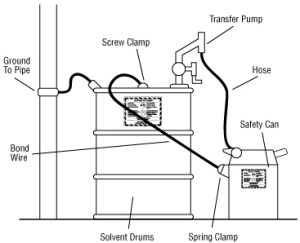
To be safe but still effective as an employee, a person needs to be able to discriminate what will and what will not generate and hold static charge to at least some degree in a novel circumstance. By that I mean how accumulated or stranded charge can form and what kind of materials can be effectively grounded. If you are working with bulk flammables, your reflexes need to be primed continuously to recognize a faulty ground path in the equipment around you. At the point of operation, somebody’s head has to be on a swivel looking for off-normal conditions.
It is possible to cause people to freeze in fear and over-react to unseen hazards like static electricity. But mindless spooking is a disservice to everyone. To work around flammable materials safely requires that a person understand and respect the operating boundaries of flammable material handling. Those boundaries are grounding and bonding (see NFPA 77), avoiding all ignition sources, good housekeeping, and maintaining an inert atmosphere over the flammable material.
Much of electrostatic safety in practice rests on awareness of the fire triangle and how to avoid constructing it.
Back to electrical education. There are numerous elements of a basic understanding of electricity that will aid in a person’s life, including safely working around flammable materials. One element is the concept of conduction and what kinds of materials conduct electric current. Another is the concept of a circuit and continuity. Voltage and its relationship to current follows from the previous concepts.
I would offer that the ability to operate software or computers is secondary to basic knowledge of how things work.
Connecting these ideas to electrostatics are the Coulomb and the Joule. One volt of potential will add one Joule of energy to one Coulomb of charges. One Ampere of current is one Coulomb of charges passing a point over one second. Finally, one Ohm is that resistance which will allow one Ampere of charge to move by the application of one volt.
For a given substance- dust or vapor- a minimum amount of spark energy (Joules) must be rapidly released in order to cause an ignition. This is referred to as MIE, Minimum Ignition Energy, and is commonly measured in milliJoules, mJ.
A discussion on sparking leads naturally into the concept of power as the rate of energy transfer in Watts (Joules per second), connecting to both the Joule and Ohm’s Law. Rapid energy transfer is better able to be incendive owing to the finite time needed for energy to disperse. Slow energy transfer may not be incendive simply because the energy needed to initiate and sustain combustion promptly disperses into the surroundings.
A discussion of energy and power is useful for a side discussion on how the electric company charges for energy in units of kilowatt hours (kWh). This is a connection of physics to money.
The overall point is that a rudimentary knowledge of electrical phenomena is of general use, even in the world of chemical manufacturing. I often hear people talk about the importance of “tech” in regard to K-12 education. By that they seem to say that using software is the critical skill. I would offer that the ability to operate software or computers is secondary to basic knowledge of how things work. Anyone with a well rounded education should be able to learn to use software as they need it.
Addendum 8/16/18. Since I wrote this essay, I’ve taught another 2 groups of trainees and not a single one of the 12 individuals could say that they had heard of Ohm’s law. All were high school grads over an age range of 22 to ~50. One had fresh BS Chem. E. degree. Evidently none had enough inclination in their travels to noodle their way through a rudimentary grasp of volts, ohms, amperes and basic electronic components. I find this incredible given the penetration of electrical contrivances in our lives.
This feeds into a pet theory of mine that true expertise is being replaced with software skills. I know this because it seems to be happening to me as well. Is this an aspect of the Dunning-Kruger effect?

 Lamentations on Chemistry