Category Archives: Politics

Some Sunny Day

This link shows the closing scene of Dr. Strangelove.  Why are atomic bomb blasts so fascinating to watch? Of course, the movie was a satire.

But when you see the next one, it becomes much more sobering.  It is a clip from a BBC documentary with CGI enhancement on Hiroshima. Part of the responsibility of having civilian control over military forces in the USA entails that at least some fraction of the civilian population retain a bit of knowledge of topics like this.

I think that when queried, most people will think of an atomic bomb blast as primarily a nuclear radiation calamity. To be sure, there is a healthy gamma pulse and the dispersal of a large variety of troublesome radionuclides, with long lasting contamination issues.  But much of the prompt destructive effect is from the immense heat pulse followed by the blast wave. 

Mutual assured destruction (MAD) as a nuclear strategy was arguably successful because parties on both the NATO and Soviet blocks were more desirous of long life than of the need for the delivery of nuclear hellfire at any cost.  The cold war was a time of opposing political and economic doctrines. MAD was essentially a secular concept.

In the present era of religious theatre, movements citing supernatural endorsement of earthly doctrines are in ascendancy.  The calculus of MAD fails when parties practice nuclear policy under the influence of supernatural euphoria.

Space MAD

The astronomer who taught my intro astronomy class years ago once joked that the shortest meaningful time was the “jiffy”; the time it took a photon to pass the diameter of a proton. He was also fond of referring to the “erg” as approximately equal to the energy required by a ladybug to crawl up on a piece of cardboard: thus 1 erg = 1 bug cardboard. [Hey, take it easy. It was a class for non-physics majors.] That astronomers name is John McKim Malville. He wrote a book called “A Feather for Daedalus: Explorations in Science and Myth in the New Physics”. Here is a quotation from Malville-

 SCIENCE – this precocious child we do not exactly know how to live with – can be used for more than the construction of warheads, the design of rockets, or the invention of technological marvels. As we shall attempt to demonstrate, the insights of science can be used in the same manner that we use our religious and artistic symbols – as evocative devices to lead us beyond that which is merely said. We have to a certain extent been guilty of misusing our SCIENCE in the production of unholstered gadgets [italics by Gaussling] and computerized wonders, thus neglecting it as an aid for mankind’s larger journey. It is as though after hacking our way through the forest we have reached the shore of a great river which prevents us from proceeding further. The water’s edge contains many beautiful and fascinating pebbles. Their colors and shapes are extraordinary! Never before on our journey have we seen such marvellous pebbles. They are, in fact, so captivating that we have completely forgotten about our journey. Instead we spend all our time gathering these brightly colored rocks – the facts with which we have become so infatuated of late. Into higher and higher piles we gather these facts, never wanting to stray too far from them for fear that someone might take them from us. And so we remain, trapped by our pebbles, unable to EXPLORE THE REST OF THE WORLD. We could, it is true, use our rocks to continue on our journey by tossing them into the stream ahead of us and using them as stepping stones. Shall we?

I like his term “unholstered gadgets”.  The 20th century was a period when many unholstered gadgets were developed and used with more technical skill than wisdom.

I picked up a book called “Edward Teller: The Real Dr. Strangelove” by Peter Goodchild.  It is an unauthorized biography of a brilliant, though irrascible character who participated in nuclear weapons design in the Manhattan project.  After WWII, Teller went on to solve the problem of how to configure a fission explosive to achieve a thermonuclear detonation. He was an influential supporter of many nuclear programs well into the Reagan years. As a student, Teller studied under Werner Heisenberg and went on to spend a year working with Bohr. Teller was one of the very earliest theorists to work on what chemists now refer to as quantum chemistry.  He and Jahn published a paper in 1937 predicting what is now called Jahn-Teller distortion, a phenomenon found in degenerate octahedral metal complexes.   Teller also helped produce many unholstered gadgets.

So, in this vein, it is interesting to note that the Chinese have just “fired a shot heard round the world”.  They were successful in hitting a retired satellite in what is reported as a ~600 mile orbit with a ballistic missile.  This event has twittered many governments in a jiffy or two, including the US gov’t. It has been reported that the US recently had a chance to sign a treaty that would ban aggressive action against satellites, but refused to do so. I don’t have a primary source for this assertion as yet. And for the first time in a long while, news outlets are referring to “Red China”.

I wonder how many young Tellers are out there, urging their government to develop offensive weapons under the guise of defense?  Perhaps this is Chinese arm twisting, or maybe it is the first step in a new type of Mutual Assured Destruction in space- Space MAD? There is a catchy name.

Watts and Watts of Ice

Many years ago I had the chance to visit the National Maritime Museum in London. It is a fantastic museum and if you’re ever in London, try to take a day to visit.  The Royal Greenwich Observatory is nearby as well, so you can see the prime meridian and the transit telescope. I seem to recall that Christopher Wren was the architect of the Observatory. Anyway, I remember a visit to the cafeteria there and an observation that I made while buying lunch. 

As an American in Europe, your presence is obvious to everyone. Well, to everyone but a few who may suspect you’re a Canadian.  And a more awkward bunch of preening land lubbers you’ll never find than American tourists abroad. So, standing there at the food counter with fish & chips and waiting for my aliquot of Coca Cola, the matron behind the counter noted that I was an American and asked if I required ice. Yes indeed, says I. She nods and hobbles over to a small ice bucket, not unlike the kind you see in a motel room. She brings the bucket and using a pair of tongs, reaches in and fetches a single ice cube for my 300 mL portion of the blessed nectar. 

At first I was struck with their miserly approach to dispensing ice. They didn’t invest in a commercial high output ice machine like even the most modest American mom & pop cafe had. But sitting there munching on my deep fried cod, I started to think about the vast resources Americans consume in order to have a ready supply of ice.

Just think of it. How many restaurants are there in the USA? According to Datanetwork there are 516,326 restaurants in their database for the USA. If you assume that each restaurant has 1 ice machine, and the ice machine draws, say, 12 amps at 120 VAC, and using the rms value for AC voltage (0.707 * 120 V = 84.84 Vrms) we can use Ohms law to calculate the wattage: power = EI = (84.84 Vrms * 12 Amps) = 1018 watts while in operation. Obviously, there are wide variations in parameters out there in the field. This is just a SWAG- Scientific Wild Assed Guess.

So, multiplying the number of restaurants times the wattage: 516,326 * 1018 watts = 525,619,868 watts, or ~ 526 megawatts of demand.  Assuming that the power distribution losses  in the grid are ~20 % (just a guess!), that means that the utilities have to generate 657 megawatts at the plant so that 526 megawatts get to the consumers.  But it gets better.

The thermodynamic efficiency of a power plant is approximately 33 %, so 657 megawatts/0.33 = 1991 megawatts thermal have to be consumed to to generate the 657 megawatts electrical.  Let’s assume a typical ice maching runs 25 % 0f the time, or 6 hrs per day: Energy consumption for one day is 1991 megawatts * 6 hours = 11,946 megawatt hrs thermal per day. So, lets get down to coal and oil consumption-

(11,946 MWHr * 3,412,000 BTU/MWHr) = 40.76 E9 BTU ==> (40.76E9 BTU/13,000 BTU per lb bituminous coal) = 3,135,000 lbs of bituminous coal per day, or 1568 tons per day, or 572,000 tons per year. The metric conversion is 1.1025 tons per metric ton. So, 572,000 tons/1.1025 = 518,821 metric tons per year.  For conversion to equivalent barrels of crude oil, use 4.879 barrels equivalent crude oil per metric ton of coal.  Thus, 518,821 MT coal * 4.879 bbl crude oil/MT of coal = 2.53 million barrels of oil per year to energize ice machines for our cokes and Slurpies. 

So, 2.53 million barrels of oil * 60$/barrel= $151.8 million. A drop in the bucket in a $10 trillion economy. But it is just a tiny sliver of the whole spectrum of profligate uses of energy.  What we need is to summon some sensibility and reduce our individual consumption of energy.  Think of all of the devices the typical home now has that are always on- anything with a clock, DVD  players and televisions that can be activated by remote, plug in cell phone chargers, etc.- all consume a trickle current.

So forgive me for asking the following question. If we are more than happy to commit the brightest minds in our country to find new energy souces, develop more potent weaponry, teach urban combat in our war colleges, invade savage and squalid middle eastern “countries”, resurrect the nuclear power industry, invent hybrid automobiles, etc., then why can’t we commit a small portion of that effort to reducing demand for resources whose scarcity can trigger a war?

Oh yea, reducing consumption means buying fewer goods and services. How do you reduce consumption while maintaining growth? There is the fly in the ointment.

[Note: this posting makes a lot of assumptions. It is meant to be an order of magnitude estimate of the consequences of our fetish for ice cold drinks.  I value and welcome corrections, comments, and dialog. Th’ Gaussling]

Marriage, Non-Overlapping Magisteria, and Deconvolution

I recently picked up a book called “Excel for Chemists” by E. Joseph Billo.  The book is written for simpletons like myself who use MS Excel but, for one reason or another, haven’t invested the time to become “Power Users”. The book has a chapter on the deconvolution of data.  For those who may not know what this is, it is a technique of extracting individual signals from coincident signals that are overlapped and therefore summed in the detected signal. 

Thinking about this concept of apparent signals as actually consisting of summed components got me to consider how the concept shows up in nonscientific aspects of our lives as well.  In particular, the controversial matters of the evolution of life and the definition of marriage come to mind as separate examples of convoluted “signals”.

One of the more strident voices out there on the topic of marriage is Rep. (R-CO) Marilyn Musgrave.  Musgrave is doggedly pursuing a Marriage Amendment for the US Constitution.  She and her party are concerned that the granting of marriage rights to same sex partners somehow threatens the sanctity and stability of marriage. This issue of same sex marriage is a sure-fire initiator of moral outrage and blowtorch sermonizing by the evangelical Visigoths of the airwaves.

I have heard no public discourse taking into account the fact that in the US, marriage is typically sanctioned under two spheres of influence. Parenthetically, it is along the lines of what Stephen Jay Gould has called “non-overlapping magisteria“. 

(Note: try to ignore for a moment the fact that divorce is the biggest threat to marriage and instead focus on what marriage actually is so we can move forward with this argument.)

Here is the deconvolution part. There are really two domains of marriage- 1) Marriage under the state, and 2) Marriage under the church.  In domain 1) , the state has a compelling interest in regulating marriage in part because it will likely be called on to intervene in the dissolution of the marriage agreement.  The interest of the state is in the disposition of minor children, property, debt, and other aspects of settlement. It is called divorce. Marriage is a type of partnership that almost always entangles others in a community, so the state has imposed its presence in the matter.

In domain 2), the realm of the supernatural interface, women and men are married by exchanging vows in the presence of the community and in plain view of the diety. In the end, as the doctrine goes, persons are accountable only to their creator in regard to their marital conduct on earth. Rules of conduct have been rendered liturgical and passed down through this formalism we call religion.  The dominant religion in the US is obviously Christianity and it is widely interpreted that marriage specifies the union of a woman and a man to be united in a bonding under the all-seeing, unblinking eye of the creator. 

The taxonomy that has shaken out over the millenia is that the term “marriage” has been widely accepted to mean the union of male & female. It conveniently aligns with the biological imperative for reproduction.  Centuries of precedent have made a strong case for a fixed definition of “marriage”.

However, in modern times there is growing interest in sanctioned same-sex pairings. Proponents argue that same sex partners should be accorded the same rights that are taken for granted with partners in conventional marriage. The more politically astute have advanced the term”civil union” and have argued that the state should construct a statutory or constitutional safe harbor. 

In the domain of the state, marriage is a type of partnership not unlike business partnerships.  A civil union can be thought of as a type of partnership, but with spousal rights that might be a bit more far reaching than that found in business.

Use of the term “marriage” when applied to same sex pairing will drive some religious citizens barking mad. Conversely, use of the term “civil union” is cynically dismissed as a transparent ruse to demolish the meaning of marriage by application of a sly semantic subterfuge.

By deconvoluting the problem, we’re left with two domains that historically have input on the issue of same-sex marriage- The state and the church. The states authority is backed by the courts and the penal code for enforcement and punishment.  The church can offer excommunication or other forms of dis-affiliation as earthly punishment and threats of punishment by searing hellfire in the afterlife.  

Conclusion.  At the very best, this is an issue that affects only a small fraction of the population of citizens. I have seen nothing that serves as a tangible threat to married citizens.  While I think that reserving the term “marriage” for opposite sex pairings is justified on the basis of precedent, I do think it is reasonable to codify similar rights and priviledges into an analogous partnership between same sex partners. It would be interesting to see if the Equal Protection clause applies. 

Note: This essay is a work in progress. Like a block of marble where the figure is inside waiting to be found by the artist, the rhetorical form of the point I’m trying to make is still partially buried in the marble. It takes me a while to find the form.  -Th’ Gaussling

Polylactic Acid (PLA)- A polydisperse trail of tears.

Many hearts have been broken in the attempt to get PLA on the market. In my case, I bailed from a tenure track asst prof slot to join a startup planning to scale up PLA production. It was quite exciting for a year and then it went belly up. These days, I’m a bit more cautious. I’m not bitter about it. It was a good introduction to polymer science and the marvels of chemical engineering.

In response to a question about PLA, I thought I’d elaborate on it a bit.

I’d be curious to find out more about the PLA experience, particularly the timing.  PLA is certainly a big hit right now.  Natureworks is sold out, and it has also found some niche applications – surgical staples for instance.   

The problem seems to be that if you develop the polymer first and the application second, then you will have a difficult sell.  If you go the other direction, it is an easy sell but you are left with lots of little applications.

Whereas we failed with PLA, Dow Cargill LLC has apparently turned it into an ongoing product called NatureWorks.

In case you haven’t heard, PLA is polylactic acid.  In its most common manifestation, it is the homopolymer of what is designated as the L enantiomer, which is produced from fermentation. Out of respect for my colleagues I won’t name the now defunct startup company.

Most everyone agrees that the marketing appeal of PLA is that it will biodegrade in the environment all the way to carbon dioxide and water, at least in principle. I qualify this assertion because it has been found that this biodegradation requires a fair amount of moisture to progress in a reasonable time. Landfills can be dry, fetid heaps that are not automatically conducive to rapid breakdown of organic materials. At least on the timescale of a few decades.  

In the microbial world, many microorganisms have the enzymatic machinery to biodegrade PLA to lactic acid (LA) and beyond.  LA is a natural compound that is judged to have a benign fate in the environment because it is such a common metabolite. In principle LA could be fully metabolized to CO2 and water once it is depolymerized from the PLA. So went the sales pitch.

In the 1990’s, people were concerned that landfills were rapidly filling to the brim with smelly disposable diapers and plastic junk.  There seems to be less public debate on this today, but I assume that the landfill issue remains largely unresolved.

PLA is made by an esterification reaction called ROP- ring opening polymerization. PLA is not made directly from LA. It is made from the ring opening polymerization of lactide, the cyclodimer of LA. This way there is no evolved water to add reversability to the polymerization.  And lactide is quite reactive.  Initiation of this highly strained monomer can be started with an initiator like an alcohol or an HO-terminated polyether in the presence of a Lewis acid catalyst (tin (II) octoate) in the lactide melt phase.

Lactide can be made by the direct cyclodimerization of lactic acid or by a back-biting reaction of oligomeric PLA made by heating LA.  I don’t know for sure, but I think that the back-biting reaction may be the major route to lactide today.

There is a lot of IP out there covering specialized applications of PLA. Medical and dental implants, sutures, timed released chemotherapy, etc.  PLA will slowly come apart in vivo over time, so it can serve as a kind of scaffold for bone or tissue regrowth or for metered drug release.  But this is a small and specialized market.

The big money is in packaging materials- blown films in particular. However, there are technical challenges here owing to a few of the properties of PLA homopolymer.  PLA has a relatively high Tg, so films will rattle and sharp package corners will crack.  PLA’s crystallinity can be good or bad depending on the application.  PLA also has a tendency to have an amber color and it’s films can block. 

Commodity polymer films have to be dirt cheap. The premium films  are colorless and low haze, have a high gloss, and have a low Tg.  There is a whole industry already producing such premium material from inexpensive feedstocks- the polyolefin industry. Sometimes people parse polystyrene and polyvinyl chloride as industries distinct from polyethylene and polypropylene. Polyethylene, polypropylene, polystyrene, and polyvinyl chloride are the predominant synthetic polymer feedstocks used by the packaging industry. They are well dug into the market with established feedstock supply lines and a global presence. 

Enter PLA.  PLA is ultimately a fermentation product. To get the right tacticity, you need enantiomerically pure LA. The best way to get it is to ferment sugars. LA must be fermented from a carbohydrate source, isolated from the broth (!!), converted to lactide, and polymerized.  Fermentation is a low space yield process. The microbes must be kept alive- excessive LA will kill them owing to low pH. You’ll need a cheap source of carbohydrates.

One of the best sources is corn starch, so a big corn wet mill will be required to produce it. The economics of PLA requires that a producer be vertically integrated from starch to fermentation to monomer production to polymerization. Energy and corn prices will have a large impact on your economics.

I’ll spare you the details going forward. Suffice it to say that PLA can’t compete with polyolefins on a price per pound basis at the present time.   PLA is boutique polymer at best for the forseeable future. My former company, the defunct PLA startup, felt that the best market segment for PLA was the market occupied by nylon films, due to the comparable cost and food contact and barrier properties. I have no idea what the economics look like now, 10 years later.

I wish all of the players well in the PLA business. It is a worthwhile endeavor and I wish that my experience had turned out differently. So it goes.

For an updated post on PLA, follow this link.



Litvinenko

The story of Alexander Litvinenko, the Russian who recently died of apparent acute radiation poisoning in London, is fast becoming the most bizarre and compelling story in recent memory.  Litvinenko was an ex-patriot former KGB Colonel who was especially critical of the Putin regime. 

A website called Frontline contains a video of a meeting wherein Litvinenko flatly accuses Putin of being behind the murder of Anna Politkovskaya.  Politkovskaya was a journalist writing for Novaya Gazeta and was bitterly critical of Putin and his policies surrounding Chechnya. She was found murdered on October 7, 2006, in the elevator of her apartment complex in central Moscow.

Interestingly, according to a reference in Wikipedia, none other than Mikhail Gorbachev spoke out morning the loss of Politkovskaya-

Gorbachev told the Russian news agency Interfax about this assassination: “It is a savage crime against a professional and serious journalist and a courageous woman”, “It is a blow to the entire democratic, independent press. It is a grave crime against the country, against all of us.”

The whole thing is turning into one of those ponderous Russian sagas written deep in the snowy birch forests of eastern Russia. 

Already the radiological evidence is accumulating tying together the players in this startling tale of assassination.  Several BA jets have yielded clues as to the presence of radioactive materials on passengers. 

I’m guessing that the Brits will do a first class job sorting this one out.  Hopefully, the details will be made public.

Ninnies

If you don’t read The Atlantic magazine, you should.  The writing is good and the content seems to be reasonably researched.  James Fallows is especially amusing to read.  A while back he wrote an essay called a “Nation of Ninnies“.  Perhaps my fondness derives from the fact that this essay expresses my own sentiments on risk and how we respond to threats.  Fallows observes that whereas at one time our national character might have been exemplified by the Gary Cooper persona, we now resemble Mr. Bean or Pee Wee Herman. 

When uncertain, when in doubt, run in circles, scream and shout

There has been another outbreak of good news.  Dr. Senator Bill Frist, M.D., is returning to the healing arts and away from a run in the 2008 presidential campaign.  Somehow the prospect of being up to his elbows in smelly bowel resections or skewering goiters was preferable to running for president.  It’s just my opinion, a shameless personal bias really, but I’d like to see someone from north of the Mason Dixon line live in the White House for a term or two. We could all use a breather.

Finally, the US has banned the sale of iPods to North Korea.  Darned tootin’.  That’ll fix their wagons.  Makin’ nuculer weapons … we’ll show ’em.  According to the AP, this was designed to personally aggravate that tufted Stalinist weasel, Kim Jung Il. OK, I’m for that.

An ionizing death

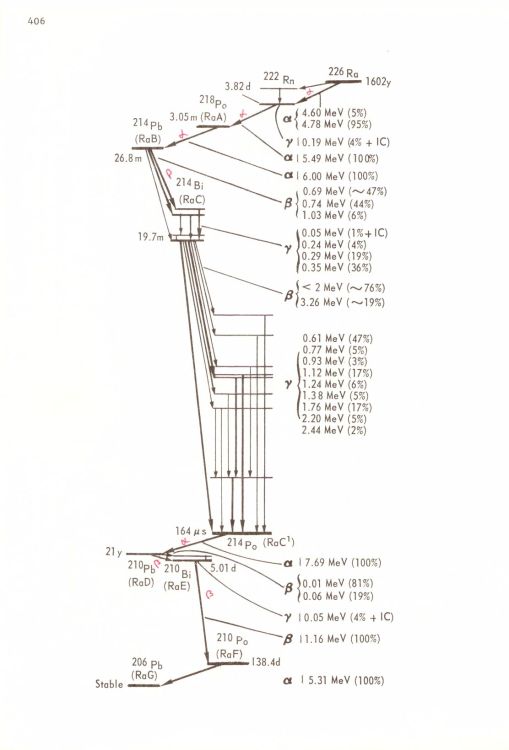
The mind boggles at the recent passing of Alexander Litvinenko in London.  This poor sod was evidently dosed with some radiological hellbroth, possibly at a sushi bar. Crimony. Authorities found the radionuclide Polonium-210 in his urine.  According to the Radiological Health Handbook, US Department of Health, Education, & Welfare, January 1970, Po-210 is an alpha emitter (5.31 MeV) with a half-life of 138.4 days. It decays to Lead-206 which is stable. The specific activity of Po-210 is about 4,500 Curies per gram. 

This bad actor has a half-life long enough to handle, but short enough to be intensely radioactive.  Like the proverbial ice dagger, the evidence rapidly decays to the asymptote of the background.  And, alpha particles are more problematic in their detection, given their low penetration ability.  Not all survey counters will pick up alpha’s, so samples must be taken and prepared for analysis.  And, someone must first have cause to suspect radiological mischief. 

Obviously, this is the work of some fiendish mind. 

 Decay Table from Radium to Lead

The decay table shows the decay events from Radium-226 to Lead-206.  The decay of Polonium-210 is the last decay in the series.  This graphic is from the Radiation Health Handbook.  Unfortunately, the 1970 edition of the Handbook does not give a target organ.  I have no clue as to common chemical forms of polonium compounds.  However, given it’s high specific activity, chemical toxicity may be negligable relative to the radiological insult. 

I show the decay table only because some might find it interesting to see where Po-210 comes from.  Hopefully, the health physics people who investigate this might find other nuclides that could give a hint as to the production source of the Po-210.

This reprehensible action reminds us that civilization is a veneer that is only a millimeter in thickness.  A radiological assault of this sort is especially sneaky in its execution and savage in its effects.

(*Weasel words- I am not a health physics person. My experience is limited to a semester course in radioisotope techniques and safety in grad school given by a radiation biology department.*)

The Calculus of Power

What an amazing thing it is to see, the great ship of state shifts its mighty rudder and the bow turns a few degrees in another direction. With the US House of Representatives under a Democratic majority, the whole calculus of power changes sign. The house that Gingrich built has found unruly new tenants.  Congressional oversight of the executive branch will begin in earnest.  The revolution will be televised.  Subpoena’s will swarm up Pennsylvania Avenue like the swallows of San Juan Capistrano.  

Verily, pity not the wretched and rejected Republicans, for they still own the Executive branch, the Senate, and the supreme court.  And Lo! Malleable though the Senate may be, the smirking majority voting bloc of SCOTUS- Scalia, Roberts, Alito, and Thomas- are tenured unto their last breath. 

Thus spake Zarathustra.

(*End Dream Sequence*)

Wingnuts

Another far right-wing character bites the dust.  Seems that Colorado Springs preacher-man Ted Haggard, mullah of the New Life Church, commander of the “Spiritual NORAD”, weekly advisor to George Bush II, and PT Barnum of the New Testament, has been leading a double life.  Seems he has a private taste for what he publically condemns.  Holy revelations, Batman. 

This is a tragic comedy.  There is some smug satisfaction in seeing a prominent theocrat get tangled in a web of his own construction. A most humiliating experience it must be, to be caught indulging in the most forbidden pleasures of the flesh.  But the fall of Ted Haggard is only the tragic part. 

The comedy part relates to the mechanics of operating theocracy.  Theocracy is governance by revelation.  Self-appointed persons claiming to have received special instructions by, or have special sensitivity to, a supernatural being are the governors of a theocracy.  There are no checks and balances. There can be only unblinking obedience.  This event forces us to pause and think about the pragmatics of operating a theocratic state. How divine is the leaders inspiration? How can you discern the direction from God vs the directions from people? This mode of governance is fundamentally flawed because people are forced to interpret nuance and testamonials as opposed to objective, measurable, reality.

Ted Haggard is (was) a prominent leader of a nascent conservative theocratic movement in America.  See for yourself. Look it up.

Soon we’ll see the obligatory sobbing plea for forgiveness and the posturing.  In 5 years he’ll be back preaching from Arkansas or Indiana on the DayStar network. His fall from grace will be the basis of a book and a CD set.  Maybe this is part of the cycle that the Hindu’s talk about.