
Category Archives: Science Education

For Students. Thoughts on Chemical Process Scale-Up.

Chemical process scale-up is a product development activity where a chemical or physical transformation is transferred from the laboratory to another location where larger equipment is used to run the operation at a larger scale. That is, the chemistry advances to bigger pots and pans, commonly of metal construction and with non-scientists running the process. A common sequence of development for a fine chemical batch operation in a suitably equipped organization might go as follows: Lab, kilo lab, pilot plant, production scale. This is an idealized sequence that depends on the product and value.

Scale-up is where an optimized and validated chemical experimental procedure is taken out of the hands of R&D chemists and placed in the care of people who may adapt it to the specialized needs of large scale processing. There the scale-up folks may scale it up unchanged or more likely apply numerous tweaks to increase the space yield (kg product per liter of reaction mass), minimize the process time, minimize side products, and assure that the process will produce product on spec the first time with a maximum profit margin.

The path to full-scale processing depends on management policy as well. A highly risk-averse organization may make many runs at modest scale to assure quality and yield. Other organizations may allow the jump from lab bench to 50, 200, or more gallons, depending on safety and economic risk.

Process scale-up outside of the pharmaceutical industry is not a very standardized activity that is seamlessly transferable from one organization to another. Unit operations like heating, distillation, filtration, etc., are substantially the same everywhere. What differs is administration of this activity and the details of construction. Organizations have unique training programs, SOP’s, work instructions, and configurations of the physical plant. Even dead common equipment like a jacketed reactor will be plumbed into the plant and supplied with unique process controls, safety systems and heating/cooling capacity. A key element of scale-up is adjusting the process conditions to fit the constraints of the production equipment. Another element is to run just a few batches at full scale rather than many smaller scale reactions. Generally it costs only slightly more in manpower to run one large batch than a smaller batch, but will give a smaller cost per kilogram.

Every organization has a unique collection of equipment, utilities, product and process history, permits, market presence, and most critically, people. An organization is limited in a significant way by the abilities and experiences of the staff who can use the process equipment in a safe and profitable manner. Rest assured that every chemist, every R&D group, and every plant manager will have a bag of tricks they will turn to first to tackle a problem. Particular reagents, reaction parameters, solvents, or handling and analytical techniques will find favor for any group of workers. Some are fine examples of professional practice and are usually protected under trade secrecy. Other techniques may reveal themselves to be anecdotal and unfounded in reality. “It’s the way we’ve always done it” is a confounding attitude that may take firm hold of an organization. Be wary of anecdotal information. Define metrics and collect data.

Chemical plants perform particular chemical transformations or handle certain materials as the result of a business decision. A multi-purpose plant will have an equipment list that includes pots and pans of a variety of functions and sizes and be of general utility. The narrower the product list, the narrower the need for diverse equipment. A plant dedicated to just one or a few products will have a bare minimum of the most cost effective equipment for the process.

Scale-up is a challenging and very interesting activity that chemistry students rarely hear about in college. And there is little reason they should. While there is usually room in graduation requirements with the ACS standardized chemistry curriculum, industrial expertise among chemistry faculty is rare. A student’s academic years in chemistry are about the fundamentals of the 5 domains of the chemical sciences: Physical, inorganic, organic, analytical, and biochemistry. A chemistry degree is a credential stating that the holder is broadly educated in the field and is hopefully qualified to hold an entry level position in an organization. A business minor would be a good thing.

The business of running reactions at a larger scale puts the chemist in contact with the engineering profession and with the chemical supply chain universe. Scale-up activity involves the execution of reaction chemistry in larger scale equipment, greater energy inputs/outputs, and the application of engineering expertise. Working with chemical engineers is a fascinating experience. Pay close attention to them.

Who do you call if you want 5 kg or 5 metric tons of a starting material? Companies will have supply chain managers who will search for the chemicals with the specifications you define. Scale-up chemists may be involved in sourcing to some extent. Foremost, raw material specifications must be nailed down. Helpful would be some idea of the sensitivity of a process to impurities in the raw material. You can’t just wave your hand and specify 99.9 % purity. Wouldn’t that be nice. There is such a thing as excess purity and you’ll pay a premium for it. For the best price you have to determine what is the lowest purity that is tolerable. If it is only solvent residue, that may be simpler. But if there are side products or other contaminants you must decide whether or not they will be carried along in your process. Once you pick a supplier, you may be stuck with them for a very long time.

Finally, remember that the most important reaction in all of chemistry is the one where you turn chemicals into money. That is always the imperative.
Reactive Hazards Seminar

One of the safety seminars I teach is on the general topic of reactive hazards. There is a bit of a challenge to this because the idea is to cultivate informed caution rather than allow broadband fear to rule. It is challenging because my class is generally populated with non-chemist plant operators or other support staff. Out in the world the word “chemical” is generally taken to be an epithet and indicative of some malign influence. We who work with chemicals are in a position to bear witness to the reality of chemistry in our lives and to speak calmly and reasonably about it, without crass cheerleading.

Here is how I look at this. There are hazards and there are dangers. A hazard is something that can cause harm if it was to be fully expressed by way of physical contact with people or certain objects, unbounded access to an ignition source, exposure to air, etc. A critical feature of the hazard definition is that there are layers of protection preventing undesired contact. Hazards can be contained. A contained hazard is safer to be around than an uncontained hazard.

An uncontained hazard is that which can cause harm without the interference of effective layers of protection. A hungry tiger in a cage is hazardous in that there is the potential for trouble if the cage is breached. Being openly exposed to that tiger is what I’ll call dangerous.

Likewise, a stable chemical in a bottle has a physical layer of protection around it. A policy on the use of that bottled chemical constitutes a concentric administrative layer of protection. The bottle sitting in a proper cabinet within a room with limited access has more layers of protection. The policy of selling that chemical only to qualified buyers is a further layer of protection.

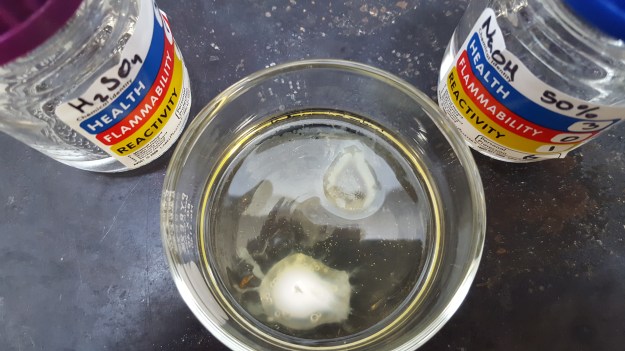
Egg white to which has been added several drops of conc H2SO4 (bottom) and 50 % caustic (top). Two minutes have elapsed. The point of this demo is to show what might happed to a cornea on contact with these reagents. The clouding is irreversible. People remember demonstrations.

It is possible to work around contained hazards safely and most of us do this outside of work without giving it much thought. Hazardous energy is exploited by most of us in the form of moving automobiles, spinning jet turbines, rotating machinery of all kinds, compressed gases and springs, and flammable liquids. Safe operation around these hazards is crucial to the conduct of civilization right down to our daily lives.

It is very easy for experts to frighten the daylights out of people by an unfortunate choice of words or simply dwelling on the hazardous downside too much. Users of technology should always be versed in the good and bad elements as a matter of course.

Risk can be defined as probability times consequence. So, to reduce risk one can reduce probability, diminish undesired consequences, or both.ย  This is the purpose of LOPA, or Layers of Protection Analysis. LOPA can provide a quantitative basis for safety policy. The video below will explain.

https://youtu.be/L3kQ9DKHS5A

Designing for tolerable risk is something that all of us in industry must come to grips with.


Pragmatics of effective science outreach

Public outreach in science is a important element for the maintenance of our present technology-affected (or afflicted) civilization. Science and engineering (Sci & Eng) activity is continually expanding the scope of the known. The global business sector, without relent, puts new technologies to work and retires others as obsolete. It is as though civilization is in a constant state of catch-up with the tools and materials being made newly available. And the quality of news is quite variable.

When it comes to the electronic and print mass media’s government reporting, the emphasis seems to me to focus on the current budgeting process and political conflict therein. These two subjects are in the “eternal now” in the flow of events. The word “news” is just the plural form of “new” so it is natural that news media focus on present budgeting and in-fighting. Media directors and executives know that reporting must be as concrete as possible and what could be more so than large dollar values and pithy news of political hijinks? Both raise our ire because cost and anger are emotional triggers for people. And emotional triggers bring lingering eyeballs to media.

The public not affiliated with Sci & Eng are quite often unaware of what their tax dollars are actually producing, perhaps many years down the timeline. The eventual outcome of government spending on Sci & Eng may be quite specialized and seem only remotely related to non-Sci & Eng life.

It has been my observation that media equates boring content with failure and compelling content with broadcasting success. The word “compelling” is used to describe something that attracts lingering eyeballs. Modern news broadcasting is the process of jumping from one compelling piece to another. I suppose we cannot blame them for this emphasis on superficiality because apparently it is what “we” want. The big We that draws advertisers and thus cash flow to broadcasters. It keeps the lights on and families fed. Basic stuff that can’t be dismissed with a utopian wave of the hand.

If there is going to be any fundamental change in the tenor and quality of content in media, it will have to come from citizen viewers. This leads me to the thrust of this essay: Those knowledgeable in Sci & Eng must bring the value proposition of current efforts in technological civilization to the citizenry, because broadcast media certainly can’t. By “broadcast media” I mean to include everything right down to what appears on your smart phone. Unfortunately, tech content typically emphasizes consumer goods like automobiles, electronic widgets, space, or miraculous medicine.

Those knowledgeable in Sci & Eng must bring the value proposition of current efforts in technological civilization to the citizenry, because broadcast media certainly can’t in any depth. They’re in showbiz.ย 

Arguments in favor of rational stewardship of our little world won’t influence elected politicians. But informed and persuasive citizens can influence those who are less so and if they apply some leadership. Carefully. Those who may be less educated and less up to date on the sciency subjects do not take kindly to speech that talks down to them. The hand that reaches from above is still above and off-putting. Learn to communicate on even ground.

What works for me in reaching out to all levels of education is to use humor and a bit of showmanship. Reaching out to the public in a way that keeps their attention is hard to do and not everyone is prepared to do it. Lest you think I am describing putting on a show, not entirely. I am saying that by the deft use of knowledge, public speaking skill, and the strength of personality, it is possible to persuade even the scientifically reluctant to perk up and follow your efforts at making a point. But the point must be accessible. Deep detail and meandering monologue will lose your group. Keep your outreach succinct and limit the breadth to a few pearls of wisdom. Get feedback on your presentation.ย  With any luck, they’ll go home and jump on Google for more.

If you need help with public speaking, join Toastmasters to improve. Try acting lessons. Join a theatre group. Learn to relax, pace yourself, and enjoy speaking. The better you get at the mechanics of public speaking, the more effective you’ll become.

[Note: The crummy WordPress text editor used to write this post is just abysmal. Why it was changed to the current revision is a mystery to me.ย  -Th’ Gaussling]

Electrostatic Discharge Safety and Basic Electricity Principles

One of my work duties is to give safety training on the principles of electrostatic safety: ESD training we call it. The group of people who go through my training are new employees. These folks come from all walks of life with education ranging from high school/GED to BS chemists & engineers to PhD chemists & engineers. In order to be compliant with OSHA and with what we understand to be best practices, we give personnel who will be working with chemicals extensive training in all of the customary environmental, health and safety areas.

I have instructed perhaps 80 to 100 people in the last 6 years. At the beginning of each session I query the group for their backgrounds and ask if it includes any electricity or electronics study or hobbies. With the exception of two electricians in the group, this survey has turned up a resounding zero positive responses.

Admittedly, there could be some selection bias here. It could be that people with electrical knowledge generally do not end up in the chemical industry. My informal observations support this. But I’m not referring to experts in the electrical field. I refer to people who recall ever having heard of Ohm’s law. One might have guessed that the science requirements for high school graduation may have included rudimentary electrical concepts. One might have further suspected that hobby electronics could have occupied the earlier years of a few attendees. Evidently not. And it does not appear that parents have been very influential in this matter either.

I’m struggling to be circumspect rather than righteous. It is not necessary for any given individual to have learned any particular field of study. It is not even necessary for most people to have studied electricity. But it is important for a core of individuals to have done so. So, where are they? And why aren’t more people curious enough to strike out on their own in the acquisition of electrical knowledge?

Back to electrostatics. In order to have a working grasp of electrostatic principles, the concept of the Coulomb has to be conveyed. Why the Coulomb? Because it is the missing piece that renders electrostatic concepts as mechanistic. It is my contention that a mechanistic grasp of anything can help a person to reason their way through a question. The alternative is rote memorization. The mechanistic approach is what drives learning in the natural sciences.

To be safe but still effective as an employee, a person needs to be able to discriminate what will and what will not generate and hold static charge to at least some degree in a novel circumstance. By that I mean how accumulated or stranded charge can form and what kind of materials can be effectively grounded. If you are working with bulk flammables, your reflexes need to be primed continuously to recognize a faulty ground path in the equipment around you. At the point of operation, somebody’s head has to be on a swivel looking for off-normal conditions.

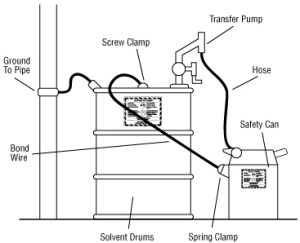
It is possible to cause people to freeze in fear and over-react to unseen hazards like static electricity. But mindless spooking is a disservice to everyone. To work around flammable materials safely requires that a person understand and respect the operating boundaries of flammable material handling. Those boundaries are grounding and bonding (see NFPA 77), avoiding all ignition sources, good housekeeping, and maintaining an inert atmosphere over the flammable material.

Much of electrostatic safety in practice rests on awareness of the fire triangle and how to avoid constructing it.

Back to electrical education. There are numerous elements of a basic understanding of electricity that will aid in a person’s life, including safely working around flammable materials. One element is the concept of conduction and what kinds of materials conduct electric current. Another is the concept of a circuit and continuity. Voltage and its relationship to current follows from the previous concepts.

I would offer that the ability to operate software or computers is secondary to basic knowledge of how things work.

Connecting these ideas to electrostatics are the Coulomb and the Joule. One volt of potential will add one Joule of energy to one Coulomb of charges. One Ampere of current is one Coulomb of charges passing a point over one second. Finally, one Ohm is that resistance which will allow one Ampere of charge to move by the application of one volt.

For a given substance- dust or vapor- a minimum amount of spark energy (Joules) must be rapidly released in order to cause an ignition. This is referred to as MIE, Minimum Ignition Energy, and is commonly measured in milliJoules, mJ.

A discussion on sparking leads naturally into the concept of power as the rate of energy transfer in Watts (Joules per second), connecting to both the Joule and Ohm’s Law. Rapid energy transfer is better able to be incendive owing to the finite time needed for energy to disperse. Slow energy transfer may not be incendive simply because the energy needed to initiate and sustain combustion promptly disperses into the surroundings.

A discussion of energy and power is useful for a side discussion on how the electric company charges for energy in units of kilowatt hours (kWh). This is a connection of physics to money.

The overall point is that a rudimentary knowledge of electrical phenomena is of general use, even in the world of chemical manufacturing. I often hear people talk about the importance of “tech” in regard to K-12 education. By that they seem to say that using software is the critical skill.  I would offer that the ability to operate software or computers is secondary to basic knowledge of how things work. Anyone with a well rounded education should be able to learn to use software as they need it.


Addendum 8/16/18.  Since I wrote this essay, I’ve taught another 2 groups of trainees and not a single one of the 12 individuals could say that they had heard of Ohm’s law. All were high school grads over an age range of 22 to ~50. One had fresh BS Chem. E. degree.  Evidently none had enough inclination in their travels to noodle their way through a rudimentary grasp of volts, ohms, amperes and basic electronic components. I find this incredible given the penetration of electrical contrivances in our lives.

This feeds into a pet theory of mine that true expertise is being replaced with software skills. I know this because it seems to be happening to me as well. Is this an aspect of the Dunning-Kruger effect?

Comments on Adult Education/Training on the Job

One of my job responsibilities is to educate new hires on reactive hazards and the basics of electrostatic discharge safety in the chemical manufacturing environment. The attendees are usually new plant operators with the occasional analytical chemist also in attendance. The educational background for the operators is nearly always a high school diplomaย with work experience of widely varying durationย in non-chemical industries. Since we are far from the regional chemical manufacturing centers in the USA, we rarely encounter applicants from our industrial sector.ย Commonly the analysts arrive withย a BA/BS in chemistry, biochemistry, or even biology sometime in the past.

In their 1 to 2 weeks of introductoryย training I’m given 1 hour for each of the 2 topics- barely enough time to wedge in important vocabulary let alone develop a command of, well, anything. My approach is to first talk about the difference between hazard and danger with some folksy examples. Then I introduce the general concept of stability using examples boxes on a rising incline. From there, we talk about stability as related to variously truncated inverted conical objects. The notion of instability, meta-stability, and stability are teased out of examples of the tipsiness of inverted cones leading to a change of stateย under the influence of external forces. This is very concrete and primes the mind to begin to grapple with the abstract notion ofย substances undergoing change depending on the precariousness of their initial state or the intensity of external influence.

Synthetic chemistry is very much about the careful manipulation of instability in order to produce the sort of change that is desired. Highly stable materials, i.e. sand,ย are not desirable in a chemical synthesis minimally because they are resistant to alteration. Many reaction stepsย may be performed and much cost incurredย in order to produce features (functional groups)ย thatย are sufficiently unstable to undergoย the series ofย desired connections.

After all of the above, the remainder of the hour is spent talking about chemical hazards and how some of them may be passivated by paying attention to the fire triangle. Also the matter of chemical compatibility is introduced as well as the existence of various categories of substances with examples. Of course, this means nothing to them. It’s just a bunch of new words arranged in unfamiliar ways. I’m quite well aware of this, but the purpose is to prime the pump so that when they hear these solvent names and words like acidic, caustic, basic, pH, quench, etc., then can begin the long process of connecting the dots to produce a better picture of their workspace.

The topic of ESD – electrostatic discharge – has its own peculiar challenges. First of all, static charge is invisible, pervasive, and unless you have direct measurements, provides hazards of an unknown risk. To understand ESD hazards, the learner should be exposed to theย units describing static charge. These include the Coulomb (C), the volt (Joules/C), theย Joule (J), area charge densityย (ยตC/m^2), power (Wattsย = J/sec), the Ohm (ฮฉ = V/A)ย and the Siemens (S = 1/ฮฉ), and theย Ampere (A = C/sec).

Herein lies the real point of this essay. In teaching ESD safety for 4-5 years, I have met perhaps 2 attendees (engineers)ย out of many dozensย who recall having taken coursework relating to basicย electricity. I always begin the seminar by taking a poll on who has heard of Ohm’s Law. In reality, I don’t expect electrical proficiency from folks who have not worked in an electrical field. What surprises me is that so few can recall havingย heard of Ohm’s Law. How is it that we are letting so many people graduate from high school without some course work introducing the very basics of electricity?? This related to one of the most pervasive and influential technologies in our time.ย I think this is a stunning oversight.

“A’hem, cough cough,” you sputter, “but surelyย …” –short pause for effect- “… students who have taken high school physics have had instruction in electricity,” you reply with obviousย incredulity.

If you had said this you’d be correct. But the educational profile of many factory workers doesn’t seem to include many people who have, in our experience,ย taken physics in high school. Those from the electrical trades tend not to show up from the temp agency for screening.

So let me end this by asking the mandarins of our school districts why we let students not college boundย  graduate without some background in the basics ofย electricity or electronics? To repeat, this is a stunning oversight, given the extensive use of electrical functions and objects in our lives.


Well, it depends …

Getting technical people to offer insight and advice can range from simple to vexing. Following a recent purchase of an unusual type of spectrometerย we found ourselves inย need ofย advice regarding consumables and sample preparation. Going into this installationย I believed, naively, that our set up to operateย the new instrument would be eased by patient advice from the seller.ย  I was mistaken.

I could whine on about deficiencies in this or that, but instead I’ll get to my point. Consider the following exchange-

Q:ย  What sort of electrode should we use to run this mineral sample?

A:ย  Well, that depends.

Q:ย  It depends upon what?

A:ย  Well, it depends on the type of matrix you have and the concentration of the desired metals.

Q:ย  How do we decide on what kind of electrode to use?

A:ย  We do not have experience with that element or that matrix. And there are many kinds of graphite widgets, many for specific uses. The widget company did not return your email because they are small and would prefer to talk to their customers.

Q:ย  So, how do we get started?

A:ย  You’ll have to prepare bracketing calibration standards that match your matrix as closely as possible.

Q:ย  What can you tell us about buying or the preparation of calibration standards? Are there any special materials we can use as diluents or any preferred methods?

A:ย  There are no manufacturers of these solid calibration standards anymore. We bought out the inventory of the last one.

Q:ย  So we can compound our own standards at concentrations close to the spec of the inventory you hoarded bought out?

A:ย  Well, yes, I suppose. It depends on your capabilities ….

And on it went.ย  Eventually we extracted the information we needed and are moving forward.

Here is my point. Everything “depends”.ย  A little louder. ย EVERYTHING DEPENDS. For crying out loud!ย  This is one of the fundamental theorems of life. We technical people have to get past this barrier when a questioner asks for help.

A few sentences of advice-

On the assumption that everything depends, offer a hint to the questionerย in the form of a range of possibilities. Open with insightful examples or a recitation of common practices. Do not sit there, Sphinx-like, while the questioner sputters and struggles with finding the best questions. Offer some guidance by way of general performance boundaries.

The technical service folks we spoke with were very much in the quandary of Buridan’s Ass. In this fable, a donkey was in between two identically appealing piles of hay. In the endย he starved to death because there was no good reason to pick one over the other.

In the case of the tech service folks, one pile of hay was to offer zero advice and make no errors. The other pile of hay was to offer frank advice and satisfy the customer. Having been in this position, I know that offering advice has it’s appeal, but it may be fraught with liability. Telling people how to run their equipment can have negative consequences- thus the reluctance to speak. But sellers are there to service their customers. They should use words and pictures to help their customers get started.

Thoughts on Academia

The blog post by Terran Lane of the University of New Mexico provides a good example of the frustrations in academics today. Much of this is well plowed soil. I link to it because I think he is spot on about more than a few things.

The availability of external funding for the lastย 30 yearsย has equipped American colleges and universities with a great deal of equipment and facilities. The availability of funding for grad students and post-docs has energized a vast educational complex that has come to depend on external grant money to maintain built up infrastructure. Naturally when an institution expands in good times, it finds itself top heavy in overhead when the good times end.

Ambitious people step forward when presented with the opportunity to grow programs and institutions when times are cash rich.ย  But when the cash influx begins to taper off, these same people find themselves in the position of having to decomission or dismantle parts of the very organization they helped to build.ย  It is hard for people in any circumstance to feel like they are moving forward when they have to make do with less.

One response to restricted university resources is to increase competition for teaching positions and tenure. Candidates with the best potential for winning grants are highly prized in any candidate search. The result of this is that professors today are burdened by administrative expectationsย in the hunt for resources in order to maintain close to what they already have.

Friends at PUI institutions are also feeling the heat, possibly due in part to the rise in undergraduate research programs that took off in the 1980’s. ย Undergraduate research in chemistry, at least, has grown into an expectation rather than a plus. This brought the buzz saw of the grant machine into the grassy quads of many quiet institutions.

Certainly no untenured prof is going to throttle down their scholarly activity for the greater good of science funding.ย  Faculty will continue to struggle with this as long as grants are a major metric in rank and tenure.

Which brings me to my final point. Scientific knowledge as national treasure.ย  I am sifting through Chemical Abstracts Service data bases searching for something nearly every day. This resource of ours, scholarly and pragmatic knowledge,ย is one of the crown jewels of human civilization. It is the collective contribution of people and institutions going into the distant past and across the curved surface of our world.ย  We should cherish it for what it is- an archive of achievement, a repository of knowledge for application to future challenges, and a representation of the best of what we are capable of.

The notion that academia is the apex of the life intellectual has never been entirely true. You do not have to be in industry for very long before it becomes quite clear that there are a great many smart and creative people outside of academia. People who become professors are people who are in love with the very idea of the university and of higher education. We must find a way to allow research activeย faculty to throttle down the grant cycle just a bit so they may throw their energies into serving their institutions in the traditional manner. By service to ย their students, to scholarship, and to the advance of civilization.

That said, it seems embarrassingly obvious to say that our academic institutions are a critical part of our civilization past, present, and future. But todayย our institutions are in peril of substantial decay if left to antagonistic legislators and fulminating demagoguesย bent on terminating programs in the name of socialย reconstruction.

We know how to operate our university/research complex. Absent some of the mania in theย horse race for grants, perhaps we can offer a bit more student contact with professors.ย A BA/BS degree must be understood toย mean that a graduate has absorbed knowledge, sharpened reasoning ability, accrued some judgement,ย and has developed a professional demeanor that can only come from the personal interaction between people. We should expect from our institutions that a professor is a professor, not a shift supervisor.

Comments on the history of oxidants

Today we know that the chemical elements are capable of showing a range of behaviors in the category of reduction and oxidation (redox). Unlike our predecessors who attempted to wrap their arms around redox phenomenaย without the benefit of data orย atomic theory, we are able to refer to tables of information which give details on the magnitude of redox phenomena and allow us to predict outcomes of transformations.

Reduction and oxidation has always been withย us and for most of human history we were blissfully unaware of it as a distinct and complementaryย phenomenon. Beyond the conduct of redox in biology, for most of human history the major use of redox as a tool was combustion.ย  I would argue that humans began to do chemistry in earnest when we learned to generate fire and use it at will.ย  The introduction of fire allowed humans to apply significantย thermal energy to materials in contrast to mechanical energy. Thermal energy changed the composition of materials in a way that wasย visible to us.ย With fire we could boil, dry, pyrolyze, combust, sinter, fracture and melt materials.ย ย Food once cooked was forever changed.ย The combustion of wood produced much heat, charcoal, and ash.

Fire could provide warmth and destruction. It could be used as a weapon of war. The Chinese would become renowned for their command of deflagrations, explosions, rocketry, as would the Greeks for their Greek fire.ย  Chinese adepts learned to produce deflagration and explosions with energetic redox compositions centuries before the Europeans. With the spread of gunpowder formulation around the world, the problem of finding it’s components would plague adopters of this technology.

The basic rules of controlling fire were determined very early in human history. Some things burned and other things didn’t. The effects of air might have been inferred by the simple act of lighting kindling and blowing on it. Blowing on an ember can sustain it for a timeย and gives rise to increased heat. Fire can be accelerated by blowing air on it but may also be extinguished by too much wind. Clues to the basic nature of fire were there all along, but we lacked vocabulary, theory, and analysis.

The color of a wood fire can range fromย yellow/orange to bright yellow and it can warm you from a distance. Smoke was something that issued from fire and was perhapsย troublesome. Fire and smoke always seem to rise upwards. More clues to to the behavior of matter, but as before, we lacked the tools of science until only in the last few centuries.

Today we can use atomic and quantum theory, thermodynamics, and the physics of radiation and buoyancy to explain and quantifyย fire and its many attributes.ย Today we can confidently state thatย a fire requires an initiation (the energy source), a reductant (the fuel), and an oxidizer (air). I think early man would have had a fairly concrete understanding of heat source and fuel. But the need for an oxidizer may have been less obvious. After all, air is all around us and is invisible. Nobody knew about the fire triangle or Smokey the Bear.

The development of oxidizers as a class of substances whose participation in chemical change was held back owing to the obscurity of the concept and the lack of a good theoretical basis like atomic theory.ย ย Humans had been perishingย byย suffocation forever. Everyone has experienced the effects of oxygen deprivation whether it was by running from a sabretooth tiger or holding ones breath on a dare. But without the knowledge of oxygen and its function in respiration or in combustion,ย oxidation wasย the answer waiting for the right question.

Reducing materials as fuels for combustion or for the reduction of metal ores to the metal was common knowledge for a very long time. The introduction of oxidizing materials beyond the ever present air around us was a much harder nut to crack.ย  If we set the oxygen in air aside and focus on strongly oxidizing substances, we can begin to see theย development of oxidizers as a class of materials.

One of the earliest oxidizers to find use was nitrate, commonly called saltpeter or nitre. Nitre was found in some damp locations that were rich in decaying organic materials. Nitre beds were often observed as having a white crust that migrated to the surface of the ground.ย  Early references of these nitre beds come from China and India. Nitre was capable of having multiple counter-ions. The early users of nitre were unaware of this of course. Later in history, makers of gunpowder would come to prefer potassium nitrate over the sodium salt owing to it’s lower aptitude for hydration. Hydrated saltpeter will passivate gunowder.ย  The story of gunpowder is well documented and the reader can pursue that trail on their own.

The discovery of oxygen in 1772 by Scheele could be considered a major step in the development of oxidation technology. While chemists wereย misguided by the theory of phlogiston, the isolation of a substance that supported combustion was a crucial conceptual leap. ย Scheele and later Priestly would show that this new “air” would support combustion. In 1774 the discovery of chlorine by Scheele was the next major oxidizer to be identified. Chlorine was produced by the action of HCl on MnO2 (pyrolusite).ย  The bleaching effect of Cl2 gasย was soon discovered by Scheele. The discovery of Cl2 soon lead to the discovery of bleaching powders. The earliest bleaching powder composition comprised of lime and chlorineย was patented in 1798 by Charles Tennant in England. By the close of the 18th century,ย three important oxidizingย compositionsย were produced: oxygen, chlorine, and calcium hypochlorite.ย  Chlorine and lime bleaching powder went into mass production at the beginning of the 19th century.

In a real sense, the development of oxidizers is very much like the invention of the lever. A level is used to amplify mechanical force. An oxidizing agent is used to amplify the extractive force on valence electrons. A strong oxidizing agent is able to bring energy to bare on selectย transformations that might not be otherwise available.ย  With the advent of this kind of transformation, new possibilities unfolded in history.ย By the middle of the 19th century, molecules with pendant oxidizing groups would be capable of self reaction to produce tremendous outbursts of energy. Nitroglycerine is one such molecule containing both reducing groups and oxidizing groups in one molecule. Oxidizers and oxidizing functional groups would change how we dig tunnels, extract minerals, carve canals, wage war, and eventually,ย compress uranium or plutonium into a critical mass for a nuclear explosion.

Research Squatters. When Universities and Corporate Behemoths Collaborate.

Recently I had the good fortune to get to meet for a consultationย with a young and talented chemistry professor (Prof X)ย from a state university elsewhere in the US.ย Profย X has an outstanding pedigree and reached tenure ratherย rapidly at a young age.ย This young prof has won a very large number of awards already and I think could well rise to the level of a Trost or a Bergman in time.

Not long ago this prof was approached by one of the top chemical companies in the world to collaborate on some applied research.ย What is interesting about this is that the companyย has begun to exploreย outsourcing basic research in the labs of promising academic researchers. I am not aware that this company has done this to such an extent previously.ย  They do have an impressive corporate research center of their own and the gigabucks to set up shop wherever they want. Why would they want to collaborate like this?

R&D has a component of risk to it. Goals mayย not be met or may be muchย more expensive that anticipated. ย Over the long term there may be a tangible payoff, but over the short term, it is just overhead.

The boards and officersย of public corporations have a fiduciary obligation to maximize the return on investment of their shareholders. They are not chartered to spread their wealth to public institutions. They have a responsibility to minimize their tax liability while maximizing their profitability. Maximizing profit means increasing volume and margins. Increasing margins means getting the best pricesย at the lowest operating expense possible.

Corporate research is a form of overhead expense. Yes, you can look at it as an investment of resources for the production of profitable goods and services of the future. This is what organic growth is about. But that is not the only way to plan for future growth. Very often it is faster and easier to buy patent portfolios or whole corporations in order to achieve a more prompt growth and increase in market share.

The thing to realize is that this is not a pollenization exercise.ย The company isย not looking to just fertilize research here and there and hope for advances in the field. They are a sort of research squatter that is setting up camp in existing national R&D infrastructure in order to produce return on investment. Academic faculty, students, post-docs, and university infractructure become contract workers who perform R&D for hire.

In this scheme, research groups become isolated in the intellectual environment of the university by the demands of secrecy agreements. Even within groups, there is a silo effect in that a student working on a commercial product or process must be isolated from the group to contain IP from inadvertant disclosure. The matter of inventorship is a serious matter that can get very sticky in a group situation. Confidential notebooks, reports, and theses will be required.ย  Surrender of IP ownership, long term silence on ones thesis work,ย and probably secret defense of their thesis will have to occur as well.

While a big cash infusion to Prof X may seem to be a good thing for the professor’s group, let’s consider other practical problems that will develop. The professor will have to allocate labor and time to the needs of the benefactor. The professor will not be able to publish the results of this work, nor will the university website be a place to display such research. In academia, ones progress is measured by the volume and quality ofย publications. In a real sense, the collaboration will resultย in work that willย be invisible on the professors vitae.

Then there is the matter of IP contamination. If Prof X inadvertantly uses proprietary chemistry for the professor’s own publishable scholarly work, the professor may be subject to civil liability. Indeed, the prof may have to avoid a large swath of chemistry that was previously their own area.

This privatization of the academic research environment is a model contrary to what has been a very successful national R&D complex for generations. Just have a look in Chemical Abstracts. It is full of patent information, to be sure, but it is full of technology and knowledge that is in the public domain. Chemical Abstracts is a catalog and bibliography that organizes our national treasure. Our existing government-university R&D complex has been a very productive system overall and every one of us benefits from it in ways most do not perceive. We should be careful with it.