
Category Archives: Science Education

Transformative Research in Many Ways

A friend who is presently on sabbatical has started a blog about his academic experiences in primarily undergraduate institutions (PUI). It is called Sabbatical Epistles. He mentions a key phrase that is being batted around; it is Transformative Research. According to the NSF, transformative research is-

research that has the capacity to revolutionize existing fields, create new subfields, cause paradigm shifts, support discovery, and lead to radically new technologies.

The context of the use of this phrase was that research funding at PUI’s will increasingly be put to the merit test of transformative research. As such, research into chemical synthesis at PUI’s is especially at risk of not qualifying for funding. I suppose the concern is that multistep synthesis projects for undergrads requires lots of time and skills that undergrads do not have.

Who is against transformative research? It is like motherhood and apple pie. Everybody wants to fund or be part of this kind of effort. We should always ask that research funds be put towards this end. But there is more to it than just an affirmation of meritocracy.

What I sense is that the golden age of undergraduate research programs may be fading into some darker period of scant interest.  The scientific establishment continues to grow larger with each passing year. And in parallel, major research universities continue to add programs, courses, grad students, faculty, bricks and mortar, and administration based on the allocation of grant money. Big institutions depend on grant money to a large extent. 

As grant money gets tighter, program requirements will increasingly filter the small fish from the big fish. Large institutions have many alumni in influential positions and in the end, the programmatic mind-set of large research institutions in conjunction with the definition of success as understood by administrators of first tier schools will win the day. 

There is a pecking order to this. A kind of snobismus. And undergraduate research is not too high in the pecking order.  In relation to undergraduate research in the area of synthesis, in most schools this is the only opportunity for an undergrad to get some advanced experience in the synthetic arts. If you have tried to hire a synthetic savvy BA/BS, you know they are hard to find. In my experience, most synthetikkers want to go to grad school. They want more.

Just in case anybody is listening, I want to make a pitch for continued and stronger funding of undergraduate research. As a student, it changed the course of my life in terms of growth and development. As a former mentor of undergraduate researchers as a post doc and prof, I can say that nearly all of my students are now either PhD’s or MD’s. They are all contibuting greatly to the benefit of our society in industry, teaching hospitals, and academia. I am proud of them and I’d do it over in a heartbeat.  The pedagogy isn’t in dispute, I suppose. But the method of funding is.
Lipid Rafts

This morning I found out what a “lipid raft” is. All of these years I’ve been in the dark about order and disorder in cell membranes. I didn’t learn about this through any sort of noble quest; I was merely curious about a movie.

Molecular Movies is a website containing links to a marvelous set of animations about cells and molecules. I enthusiastically recommend that the reader visit this site. The movie mentioning lipid rafts is in “The Inner Life of the Cell“.

Reactivity and Risk. Gaussling’s 10th Epistle to the Bohemians.

A chemical plant performing synthesis is a place where the materials in use are purposely selected for certain attributes of instability. Chemical stability refers to the tendancy of a substance to remain unchanged when exposed to some kind of stimulus. That stimulus may be exposure to heat energy, mechanical shock, or a more precise chemical attack on particular functional groups. Unstable substances have a low threshold to change. Stable substances require more stimulus to cause a change in composition.

Substances that are extremely stable are often not very useful in near-ambient temperature chemical synthesis, i.e., saturated hydrocarbons, metal sulfates, silica, etc.  The lack of lower temperature reactivity (say, up to 200 C) can be compensated for by application of high temperatures. Petroleum refineries take full advantage of high temperature reaction chemistry to alter the composition of otherwise stable hydrocarbons.

We choose stable substances for duty as solvents, diluents, carriers, etc., precisely because of their non-changeability or stability. “Inert” solvents allow chemists to bring molecules into solution for selective transformations. Of course, we all know that most solvents have some influence on the course of a transformation, the point is that we can transform solute materials without the fuss of altering the solvent too.

Chemical synthesis requires the manipulation of reactivity (and therefore stability) to perform useful transformations. Without well placed instability on a molecule, there cannot be efficient, directed synthesis. It is the job of the synthesis chemist to apply the knowledge of reactivity.

Because of the inherent instability of reactive and flammable materials, chemical plants must require that certain behaviors, procedures, and knowledge be set into a formal structure. Actions and conditions must give predictable consequences. This structure is comprised of a set of standard- operating procedures, equipment, test methods, and safety requirements.

It seems silly to go to the trouble of detailing the merits of running a safe plant, but it is worth pointing out the layers of requirements on an operating plant. 

  1. Preservation of life, health, and the environment
  2. Compliance with federal, state, and local regulations
  3. To provide for the uninterrupted flow of goods and services in the conduct of business
  4. To qualify for affordable business insurance
  5. To be a good neighbor and stable source of gainful employment for all concerned

A company in the business of manufacture is exposed to many kinds of liability. A chemical manufacturing plant is subject to modes of failure and liability that set it apart somewhat. 

One result of chemical manufacture that sets it apart from other forms of industry is the combination of unknown risk and dread fear. For communities in the vicinity of chemical operations, fear comes from the combination of the unknown as new risks, unknown effects, or delayed effects with the dreaded possibility of catastrophic or fatal consequences, inequitable consequences, involuntary effects, and high risk to future generations (see: Perilous Progress: Managing the Hazards of Technology, Edited by Kates, Hohenemser, and Kasperson, 1985, Westview Press, Boulder, Colorado, p 108. ISBN 0-8133-7025-6).

While the neighbors of a furniture factory may be annoyed by the presence of a nearby woodworking shop, it is unlikely that the neighbors will be stirred into existential dread by its presence. The hazards of a woodworking plant are easy to imagine and therefore, easier to rank into the grand list of life’s dangers.

Chemical and nuclear risk perception score at the extreme ranges of risk perception. Both domains involve an agent of potential harm that is poorly understood by most people. Ionizing radiation is inherently destructive to tissues, but the exact relationship between quality and dose to risk is fuzzy at low level exposure. And because it cannot be sensed directly, fear of it’s presence can induce disturbing excursions of imagination and dread.

Fear of chemicals is widespread in the industrialized world. The downside to chemical operations has been immortalized by numerous well known industrial calamities like Love Canal (Hooker Chemical), Bhopal, numerous dioxin fiascos, PCB’s, or occupational exposure to asbestos or chromium (VI). There are a great many chemical items of commerce that are unavoidably hazardous to health.

Because of the risks associated with toxicity or exposure to hazardous energy from machines, chemicals, radiation, heat, noise, gravity, sharp implements, etc., the many layers of government have established agencies and a regulatory structure to diminish risk exposure to workers specifically and citizens generally.

The purpose of the chemical industry is to produce goods and services for people who want or need the value of it’s output. Like the ad says- “We don’t make the surfboard, we make it better”. Well, making the surfboard better inevitably requires that certain kinds of hazards be unleashed and managed. The expectation that hazardous materials can be eliminated in manufacturing is a fantasy. The manipulation of instability is inherent to chemical transformation. Zeroing out hazards has to come from the demand side of the market.

Chemist Alert! NFPA 400 to be posted in May 2009.

The National Fire Protection Association (NFPA) is an international nonprofit organization dedicated to the prevention of fire related incidents. The have recently pitched a set of regulations as NFPA 400 pertaining to the storage of hazardous materials. The comment period is long over and soon the rules will be issued as a published document.  While the NFPA is not a regulating body, their rules are widely adopted by government organizations and promulgated.

If you have not taken the chance to review some of these documents, it is well worth your time as a chemical professional to do so. Why? Because the practice of chemistry is being dramatically necked-down in terms of the kinds of chemistry that can be practiced and the manner in which materials are stored. Not only is your local fire marshal packing a stack of NFPA based fire codes, but a whole host of federal regulators are armed with regulations from Homeland Security, EPA (i.e., TSCA), DOT, REACH, and an alphabet soup of regulatory coverage aimed at every conceivable substance.

Organizations that oversee chemical operations include the chemical industry, hospitals, agriculture, mining, and academia. All organizations are under the obligation to provide a safe workplace for the employees. It makes sense to minimize employee exposure to risk. But the web of applicable regulations for any given chemical operation is expanding by the day.

Not only is an organization obliged to conduct business in compliance, but quite often there is the requirement of self-reporting of noncompliance. An organization finding itself out of compliance is an organization in need of legal representation. The nuances relating to most any kind of regulation are such that your average company president will generally be unwilling to settle the malfeasance with the regulatory agency without the help of an attorney. This is the point where a jet of cash starts flying out of the company coffers.

So, the question of the effect on academic chemistry arises.  Academic chemistry departments are seeing increased coverage under the regulatory umbrella as well. Should academic research labs have some sort of dispensation given the nature of the activity? Given that OSHA regulations may not be applicable to students, academic labs are already under somewhat less scrutiny. More to the point, how much government intrusion should researchers accept in relation to the kinds of chemicals they work with and store and the kinds of risks that are taken during research?

This is important for a very good reason. The issuance of proposed rules by organizations like NFPA results in regulatory pressures that eventually find their way to individual researchers. But the researchers don’t hear about it directly from NFPA. The University Health and Safety department hears about the regulations (or guidelines) and they apply requirements on chemistry departments. Faculty being faculty, they’ll perform a gritching ritual and eventually comply.

Generally, the arrival of new regulations results in new constraints. The end result is that the department has to spend more to operate the labs and students receive less experience with interesting chemistry. This whole unfortunate trend of increasing government oversight of all things chemical will eventually neuter US chemical education and industry leaving a bland and uncompetitive culture averse to risk.

I hate to be critical of fire safety people. But I also hate to see chemical education and research hamstrung by well intended parties who have devised highly detailed and extensive rules that will seep into every aspect of the chemical sciences. I am aware of absolutely no pushback of any kind when it comes to this matter.

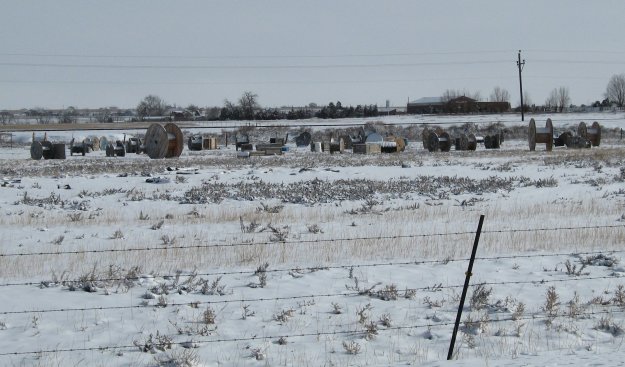
Spoolhenge

Unlike many of my colleagues in the Chemical Industry, say in New Jersey for instance, Th’ Gaussling is able to enjoy a pleasant country drive to and from work every day. Among the many sights to enjoy is Spoolhenge. This curious archeological artifact is thought to have been constructed by ancient electricians in the early Cupracene Age of the Sparkezoic Era.

Who were these people? What strange rituals did they perform in this maze of paleospools? Only a few crude wirenuts fashioned out of elk antler remain in the soil surrounding these ruins.

Writer and amateur paleophrenologist Anders van der Klopp suggests the ruins may have been part of a temple built by ancient astronauts who crash landed on earth in the distant past. Van der Klopp’s panspermia theory is not taken seriously by mainstream paleophrenologists who balk at the idea of electricians in space. Perhaps one day we will solve the mystery.

Spoolhenge

Spoolhenge

The Cost of Scientific Information. Who Pays and Who Gets Paid?

For anyone outside of academia who has not actually received an invoice from Chemical Abstracts for literature retrieval services, let me assure you that literature searches will cost you real money.

CAS has weighted the basic search operations and defined them in a menu of task equivalents. When you subscribe, you purchase a bundle of tasks. Tasks can be used like a chit- they can be applied for a variety of search operations. Some search operations are assigned a higher value than others. Obviously, a group of big wheels at CAS sat down in a room and hammered out what they perceive the value of a given operation to be.

At this point, it is useful to remind folks that price is not properly based on cost, it is based on what the customer is willing to pay. CAS has an army of clerks punching abstracts into the database, so they do have some real overhead. While CAS honchos are mindful of paying the overhead, they are also trying to find a pricepoint for their information services. On this I do sympathize with them.

However, where I part ways with this organization relates to the monopolistic arrangement they have with information paid for by citizens of this country. The major pipelines of chemical research information seem to plumb directly into CAS and the ACS.  Research that does not get published by the ACS goes to a variety of private publishing houses. The common thread is the transfer of copyright to the publishing house. By turning over the copyright of publically funded research to these organizations, the public relenquishes the right to free access to results it has paid for.

In a very real way, the published results of our university research complex represents national treasure. What do we do with it? We hand it over to publishing organizations who print it in exchange for the copyright. In this way, we can keep paying for access indefinitely.

In fact, lets highlight some of the features of this transfer of wealth and the cost to society of scientific literature-

  1. Citizens and corporations pay taxes to support the various funding agencies like NSF, NIH, DoE, DoT, DoD, etc., as well as provide private grants.
  2. Funding agencies award grants to institutions and researchers to pay for the conduct of research.
  3. Researchers take a combination of funds and pay for stipends, fellowships, materials, and overhead to support the people who do research.
  4. Research is performed and results are communicated as publications.
  5. Researchers sign over the copyright to their work in exchange for publication.
  6. Publishers such as the ACS, Wiley, Elsevier, etc., then hold a copyright on the content in perpetuity.
  7. For the rest of time, the citizenry who paid for the results have to pay a fee to get a copy of the paper, or travel to the nearest University library and hope that the publication isn’t in deep archival storage and unavailable that day.
  8. Thanks to the Bayh-Dole Act, institutions can patent the results of federally funded work. This means that the hopeful citizens of the USA are barred from the practice of the art they paid for. In fact, they have to work out a license agreement which will include a royalty (with audit trail) and probably a hefty upfront, non-refundable, fee to get the ball rolling.
  9. Despite this royalties cash stream that universities have access to, tuition and fees continue to rise well above inflation.
  10. If you are a chemical scholar out of the cover of academic discounting, you face the full brunt of literature search costs yourself. A monograph or book on any given chemistry topic could easily cost $10,000 in non-academic SciFinder charges (ie., $68 per reaction search). A typical technical book may provide an author $3,000 to $10,000 in royalties over 5 years.

Well, you say, the benefit is to society as a whole. The science we pay for goes into society where, like an incoming tide, lifts all boats.

Nonesense! This tide lifts the good ship Elsevier and the USS Chemical Abstracts. It helps large universities get larger. The generation of information has become a cash cow for a handful of organizations who are subject to precious little scrutiny by those who freely supply the scientific content that keeps the system going.

Atomic Testing Museum

Th’ Gaussling took a quick trip to the Atomic Testing Museum this week. It is located on Flamingo Rd a few blocks east of the Las Vegas strip. Before entering I was dubious, wrongly thinking that it would be a thin gruel of well worn nuke photos and a few trinkets. I was wrong.

The museum is meant to chronicle the activity of the Nevada Test Site just a few miles to the north. There are numerous video units showing various shots.

They have a substantial collection of diverse equipment used in nuclear weapons testing as well as models of a few actual nuclear weapons, notably the Davy Crockett miniature nuclear bomb. There is very little in the way of bomb design detail, but there is considerable detail in regard to radiation sampling from the burst, drilling equipment, dosimeters, GM counters, a mushroom-cloud sampling rocket, slide rules, nuclear rocket motors, down-hole test rigs, etc.

The museum has a modest theater with special sound and wind effects to simulate being in close proximity of a test shot. They do a decent job. If the wind was hot, though, it would be more realistic. But in general, the application of museum science is well done.

If you are in the Las Vegas area, I would recommend a visit. The nuclear legacy is a part of our national history.  The Nuclear Genie is out of the bottle, but the people who write policies and devise programs need pushback from an educated populace in regard to the stewardship of the nuclear inventory and its expanded use.

Aldrichimica Acta, Vol. 42, No. 2, 2008.

The latest Aldrichimica Acta is out- No. 2 of volume 41. This publication was started by a friend, teaching colleague, mentor, and former boss who spent some of his best years working for Alfred Bader. He eventually retired as a VP of something or other at Aldrich. A truly great guy. For a while, the task of catalog publishing was his job. He bought paper by the rail car. Their job was to increase the size of the collection by 15 % per year.

He also invented the coffee pot kugelrohr system that Aldrich sold for a long time. It has now morphed out of recognition. But he showed me the prototype motor assembly. It consisted of a reciprocating air motor built for automotive windshield wipers wired onto some pegboard. The air motor used either air pressure or vacuum and had a metal tube that connected the vac line from one side of the motor axially to the other.  The reciprocating motor got around the need for a sealed vacuum bearing. To one side of the reciprocating tube was connected a vacuum line via flexible rubber hose, and to the other via hose and barbed connector, a series of bulb tubes and pot. 

The coffee pot came from a West Bend coffee pot plant down the road in Milwaukee. Aldrich bought the reject pots and paid a guy to refit them for kugelrohr duty in his garage. It was a very successful product. When I went to grad school we had a Buchi kugelrohr for bulb-to-bulb short path distillation. But I still remember with some fondness having to sit at the bench twiddling the Aldrich kugelrohr by hand while feeding dry ice onto the receiver. Sometimes we would drip dichloromethane in the receiver and let the evaporative cooling do the trick. We’d use the air motor for lengthy distillations.

Organic and Inorganic Carbon??

Thanks to a friend in Grand Rapids, I was linked to a blog hosted by the NY Times called Tierneylab.com.  The writer of the post was sounding off about a pet peeve relating to the use of the term “Organic”.  It seems that there is some confusion as to the use of the adjective organic in relation to certain carbon-containing substances. Tempest in a teapot, you ask? Let the chemistry community decide.

The problem begins to show itself when astronomers and planetary scientists start describing carbon containing materials found in planetary exploration as organic.  Back on earth, the word organic is burdened with both common and scientific usage. So, when descriptions of organic materials found on other worlds begin to arise in discourse, the intent of the usage becomes unclear.

For instance, it could suggest to people that such discovered materials were put in place by some kind of life form. It could suggest to nondiscriminating audiences that the presence of carbon implies life, past, present, or future. Or it might well suggest to higher level audiences that biology-ready raw materials are in place.

The scientists working with the Phoenix Lander have an interesting analytical chore in front of them. Using a robotic platform on Mars, they want to distinguish the presence of organic vs inorganic carbon. What is meant by organic and inorganic is less than clear. But it seems that organic refers to something other than CO2 and carbonate.

In the relatively few journal articles I’ve seen relating to this, the authors are not always precise about the kinds of molecules they are referring to as organic. Irrespective of what is said in the articles, when this work gets to a public forum, the meaning behind the word organic becomes even less clear.   

The TierneyLab post does bring up an interesting question about what is necessary for a substance to be considered organic.  Do graphite, diamond, Buckyball, or soot forms of carbon qualify as organic? What about CO2, CS2, carbonates, CO, HCN, or calcium carbide? Does it make more sense to refer to organic and inorganic carbon, where inorganic carbon is defined as … well, what? 

Seriously, what would it be? CO2? Carbon dioxide is incorporated into glucose by plants and this seems quite organic.  Carbonate? This anion is used to balance our blood pH. Our own metabolic CO2 helps to provide carbonate. This product of metabolism should qualify as organic. CO? Well, Carbon monoxide undergoes Fischer-Tropsch reactions to produce aldehydes. This seems very organic as well. Perhaps the target is a substance with C-H bonds?

There is nothing inherently biological about the C-H bond. The Saturnian moon Titan is blanketed with a thick layer of CH4 (methane) and it seems unlikely that it is of biological origin. Indeed, hydrogen is the most abundant element in the universe and carbon the 4th. That hydrogen and carbon atoms could find each other to form trace methane in a proto solar system isn’t too much of a stretch.

Organic and Inorganic Carbon.  How about we just leave it all as organic? 

Here is what I think. It does matter if a scientist or writer is using language in an imprecise way. If writing or speech implies, for instance, that Mars is rich in life giving organic nutrients when in fact Martian organic matter is really carbonate and CO2, then I believe the language must be altered to reflect that condition. A writer should not leave an impression of past or incipient planetary fecundity when in fact the planet may be an inert ball of metal silicates dusted with a bit of carbonate when the 6 torr CO2 atmosphere kicks up a breeze.