Category Archives: Science

A Massive Au/AuTe Deposit

Th’ Gaussling attended a geology seminar thursday evening at the Colorado School of Mines. It was given by the chief geologist at the Cripple Creek & Victor gold mine (now AngloGold Ashanti) and was concerned with 3-D modeling of the volcanic formation that forms the center of the deposit.

What is unusual about the CC&V mine is the extent to which tellurium is present. There are a dozen or more tellurium minerals and many of them are present in the ore body. The CC&V load was discovered relatively late- about 1891. Due to the extensive fraction of AuTe and AuAgTe minerals, the presence of the ore body was not detected by placer prospecting. 

Prospectors panning for gold in local streams had no way of knowing that extensive gold was present because AuTe(Ag) minerals do not have a gold-like appearance.  Legend has it that it was discovered by a drunken cowboy who noticed some native gold in an outcropping in the area and took a sample down for assay. As I have mentioned before, the Cripple Creek district has produced about half of all the g0ld to come out of Colorado.

What is key to the formation is the fact that it has zones of extensively altered volcanic rock disturbed both mechanically in the form of fractures and faulting, and chemically in the form of its potassic-alkali nature. The formation has strongly brecciated zones and is desribed as “vuggy”, meaning that there are extensive voids. Native gold and gold telluride mineralization can be found on the surfaces of the vugs. The mineralization was deposited by hydrothermal streams extracting Au and Te from unknown source rock.

Presently the operation is surface mining which feeds to a cyanide leach field for gold extraction. The surface pit mine is working downward, digging through the extensive network of mineshafts. In the early days at Cripple Creek the mining was limited to underground activity. Miners would follow the extensive subsurface network of gold-rich veins in whatever direction they might go. The result is a very complex and extensive matrix of tunnels and shafts that extend downward to as low as 3000 ft. In the early days, the economics of subsurface vein mining were attractive enough to sustain the operation. Today, the economy of scale dominates and pit mining with heap leaching of the lower grade ore is what sustains the operation.

The gold is recovered by a cyanide leach field that is 800 ft thick in places. This method produces ca 300,000 toz/yr. The process does not recover Au from AuTe. It is left untouched in the leach heap and constitutes ca 1/3 of the total gold present.

Curiously, during the many eruption cycles in the distant past (~32 ma), debris from the surface has washed back deep into the formation. Bits of woody debris have been recovered within cementitious rock hundreds of feet below the surface. The CC&V geologist showed a core sample with a wood fragment imbedded within it. For a time reference, the current episode of Rocky Mountains (the Laramide Orogeny) began ~65 ma.

Chemist Gaussling will blend in with a group of geologists tomorrow morning and take an extensive geology tour of the mine site. Hopefully, there will be pictures to share. We’ll be going up to ~10,000 ft, so it will be chilly.
LC Dreamin’

When I get to work this morning I’ll be greeted with a brand spankin’ new Agilent 1200 HPLC sitting on the bench in my lab. It has a diode array detector (no flippin’ MS this time). Pretty sweet.  Gosh, early 1990’s LC capability- already!

It is interesting how the installer assumed I’d be doing reverse phase work. Must be what most of the weenies in pharma are using. Carbon-heteroatom-carbon-heteroatom-carbon-heteroatom-carbon=heteroatom-carbon-heteroatom- … maleate.

A hot little number

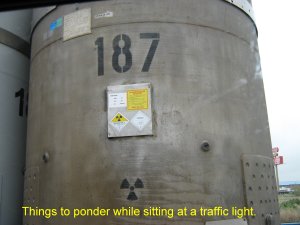
hot-load-on-the-interstate1

I see these shipping casks on the highway at least once a month.  This time I had a Canon with me (Powershot A470, you know, a camera). While sitting at the off-ramp stop light next to this container I began to wonder how much activity shines through the shielding. I began to daydream … if I could see in the gamma spectrum, would this thing be bright or dim?

Then, in the blink of an eye the spell was broken. The light turned green and I parted company with this hot little number.

Green Propellants

Notes from the Field-

There appears to be a movement in the gun and rocket propellant field away from perchlorates.  Propellants that are comprised of substances that pose minimal potential for the dispersal of adverse and environmentally persistant substances are referred to as “green propellants”.  Substances that qualify as adverse include arylamines, perchlorates, and certain rheology modifiers. Substances that are thought to be endocrine disrupters have been specially targeted for replacement.

While it may seem absurd to attempt to produce a weapon system having a reduced toxic signature, the  fact is that between practice projectiles and warshots, a good deal of hazardous residues are released in the use of these devices. Reducing the chemical environmental insult is a step in the direction of reduced collateral damage.

One expert in the area of perchlorates said that people with adequate iodine intake shouldn’t worry about perchlorate contamination of water. Hmmm. While that may be true, it sounds like a poor basis for policy.

Mea Culpa

Today I found myself attending a talk on mortar propellants. It was delivered by a shy young woman who looked to be no older than a high school senior- she looked like a babysitter you’d hire to stay at home with the kid while you treated the wife unit to a night out on the town. Yet she was an expert in mortar shell propellants.

Next, I attended a talk on flare compositions delivered by a tiny woman who could barely see above the podium.

I rounded the day off by attending a talk by a woman who presented her results on igniter design and in developing a new explosive propellant manufacturing process. During the Q&A, my questions on ignition mechanisms were answered by yet another woman who was exceedingly knowlegeable in this field.

What I have noticed is that the gun and rocket propellant R&D field is populated with women to a much greater degree than the industrial organic or organometallic chemistry waters in which I normally swim.

Before you fire a rude comment alleging some sexist malfeasance, please understand that I was raised by a single mother as the eldest of 5 kids. That, and having witnessed the birth of my child, I have no doubt whatsoever about the robustness and Ability of women.

That women do this isn’t news. What is noteworthy is the extent to which my ignorance remains so great at age 51. My caveman misconception was that explosives chemistry would not appeal to women. I had mistakenly and foolishly assumed that a career with explosives was largely a male domain and driven by male fascination with power. Holy cats. I was quite mistaken.

I seem to be wrong about  a lot of things these days.

A Nevada Cinder Cone

Whilst doing a survey of Lithium mining in North America, I blundered into a small cinder cone. It is found in the Clayton Valley of western Nevada south and west of Tonopah.

A link from the University of Nevada, Reno, gives some details on this cone as well as some interesting photographs.

Just to the south of this cinder cone is the Chemetall Foote Corporation Silver Peak brine facility. Lithium rich brines are pumped into evaporation ponds for concentration of the lithium salts. US 7390466 says that the Silver Peak brines contain 0.02 wt % Li.  The richest Li brine can be found in the Salar de Atacama brines in Chile. The Atacama brines contain from 0.15 to 0.193 wt % Li.

Research and Playfulness

As a kid I noticed that many cats seemed to lose their playfulness as they matured. What were once playful kittens would mature into rather less playful adult animals with irritability issues. Many humans I know seem to have “matured” away from a general disposition to playfulness in a similar way. It is a shame. Playfulness is an important expression of brain vitality.

Play can be manifested in many ways. One form is where one teases out a response from a stimulus. It can be done for simple joy, as in the case of teasing your sister. Or it can be directed to somewhat more useful and enduring outcomes as in the case of research.

As I look back on my meager list of useful developments in the laboratory, I can see that most were the result of play. I was just curious as to a particular outcome. If I had simply paid more attention to my boss and focused on getting expected results (a production activity), it is unlikely that I would have fallen into some interesting and useful insights. No doubt almost every scientist can make the same claim.

On the other hand, if I had paid more attention to my boss, perhaps I’d be  a tenured prof at a decent university or a mid-career manager at Pfizer. Hmmm.

What happens to many people when they age is the same thing that happens to cats. They settle into comfortable patterns and try to exclude surprises from their lives. Just like it takes discipline to get regular exercise, it also takes some discipline to keep imagination and playfulness a central part of your consciousness.  Go out there and try something that has been on your mind all these many months! See if it works.

Redoubt Volcano Continues to Show Activity

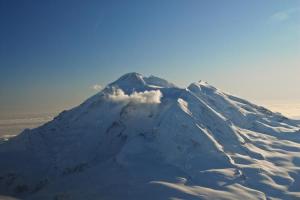
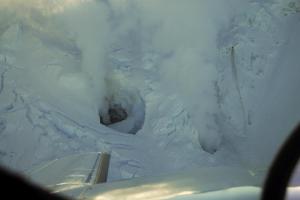
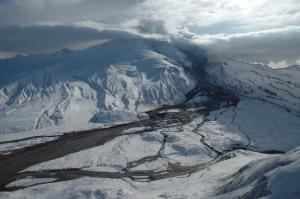
The Redoubt volcano is making its presence known. It has played havoc with some petroleum infrastructure (Drift River Oil Terminal) and has begun to dump ash. Lahar activity has flooded a runway and generally made a mess. The photos below do not show the volcano in a major eruption. Most of the AVO/USGS close up shots seem to be taken when the mountain is quiet.

Mud & debris flows from Redoubt (Photo AVO/USGS)

Mud & debris flows from Redoubt (Photo AVO/USGS)

North Flank of Redoubt 1-31-09 (Photo AVO/USGS)

North Flank of Redoubt 1-31-09 (Photo AVO/USGS)

Redoubt Eruption Plume from MTSAT (photo National Weather Service)

Redoubt Eruption Plume from MTSAT (photo National Weather Service)

Redoubt Fumaroles 1-31-09 (Photo AVO/USGS)

For detailed information on the Redoubt Volcano and it’s ashfalls and other activity, click to the Alaska Volcano Observatory (AVO).

The lab as a shop

Just sent multiple kgs of a rare earth reagent out the door. It may have been one of the larger scaleups of this stuff. I hope it does the job for the customer. Meeting certain specs turned out to be more difficult and time consuming that I had anticipated. But getting it certed and shipped is quite satisfying.

Lots of new projects in the shop for examination and custom synthesis. Some process safety tests, some analytical development, and some synthesis. It’s a good mix and quite diverse in chemical elements.

Carlsbad Caverns

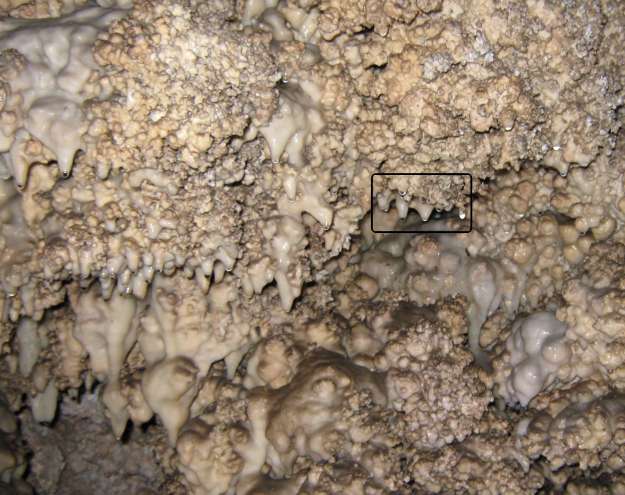
Carlsbad Cave Popcorn

Carlsbad Cave Popcorn

The problem with Carlsbad Caverns today is the same problem that plagued it from the very beginning- it is very isolated and is not even on the way to many other places of major interest (except El Paso, of course). For the first 20 years or so, the cavern was primarily a source of bat guano fertilizer for the California citrus orchards. Slowly, and with the persistance of a few key individuals, word of this wondrous underground cathedral spread.

Today, Carlsbad Caverns is visited by approximately 500,000 people per year. The cavern is in remarkably good shape considering the large number of people who walk the several miles of underground trails 364 days per year.  Curiously, one of the big pollution concerns is lint from the clothing of shuffling visitors which settles on the formations.

The above photo is a snapshot of a common evaporite formation referred to as cave popcorn. The box in the photo encloses an area about the size of the palm of your hand and if you look closely, you can see water droplets clinging to the small mineral protuberances.  The colors in the photo are a good representation of most of the cavern.

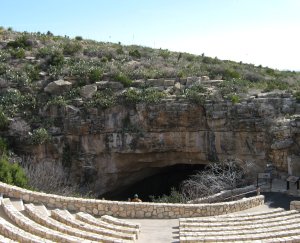
Entrance to Carlsbad Caverns

Entrance to Carlsbad Caverns

The decorated caverns are the result of several kinds of chemical processes. The internal spaces were dissolved out of the regional limestone formation. This formation is thought to be the remnant of an ancient reef. It is believed that aqueous hydrogen sulfide migrated up from the anaerobic permian formations below and was subsequently (air) oxidized to more corrosive species.

The park people point out that H2S was oxidized to sulfuric acid which is responsible for the chemical digestion of the limestone. Sounds reasonable to me, though the chemistry of sulfur oxidation is full of many kinds of intermediary species on the way from sulfide to sulfate. The presence of gypsum (calcium sulfate) inside the cavern supports the claim that sulfuric acid was the corrosive agent. What was not mentioned was whether or not sulfate is found in the surrounding formations. [Note: a commenter made a good point about the bio-oxidation of sulfide]

Stalactites festooned with cave popcorn, Kings Palace caves, Carlsbad Caverns

Stalactites festooned with cave popcorn, Kings Palace caves, Carlsbad Caverns

The decoration of the interior spaces left by digestion of the limestone happened by the action of seepage of rainwater and carbonic acid though the upper layers of sedimentary rock. The water dissolves many mineral components including calcium. The calcium carbonate rich liquors seeping in from the roof of the caverns wetted the surfaces below and deposited calcite and other mineral species by way of intermittant accretion.

If you examine the few smaller and broken mineralizations along the trail, you can clearly see that the accretion results in substantially crystalline material. So, while the formations are not large calcite or aragonite crystals, the small scale structure is crystalline.

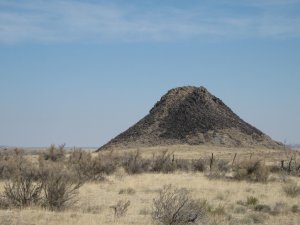
There is much to see in the world if you just bother to look. Along I-25 in southern Colorado is a modest looking feature. It is called Huerfano Butte and sits along the highway near Walsenburg. This igneous intrusion is more resilient to weathering than the surrounding sedimentary formations.  Radiating from the nearby Spanish Peaks are an array of dikes indicating the presence of past magma intrusion.

Huerfano Butte- a weathered igneous intrusion.

An synthetic chemist is in a great position to absorb some geochemistry. Once one is keyed into a bit of geology, the mechanisms of mineral formation begin to become apparent, with a little study of course. For myself, this is a great motivation to kick around in the weeds and explore the world. Gotta watch out for rattle snakes, though.