Here is a link to a cute little nuclear reactor applet. And here is reactor simulator demo download. The demo is free but the actual product is $10.
Nuclear Reactor Demonstrator Applet
2 Replies

Here is a link to a cute little nuclear reactor applet. And here is reactor simulator demo download. The demo is free but the actual product is $10.
A symposium in honor of the late Professor Albert I. Meyers is being held at Colorado State University in Ft. Collins on Friday, 24 October, 2008, in the late afternoon and all day Saturday, 25 October, 2008. The symposium speakers are Clayton Heathcock, Peter Beak, Daniel Comins, Kyoshi Tomioka, Daniel Romo, Victor Snieckus, Jeff Seeman, and Paul Reider. I look forward to attending.
Two reader/commenters who contribute sage commentary to this blog have predicted the 2008 Nobel Prize in Chemistry– Jordan and Hap. Both predicted that Roger Tsien should or would win. Well done!
Naturally, Th’ Gaussling allowed his clairvoyance to be fogged over by sappy sentimentality for the (n+1)th time. My hat is off to these two savants and their predictve powers.
Oh yes, congratulations are in order for the 3 prize winners as well- Osamu Shimomura, Martin Chalfie, and Roger Tsien. Golly, we can’t forget them.
One of my great enthusiasms is the topic of small scale continuous synthesis. There has been some new thinking in this area recently. I don’t mean the use of robots to move material around- I mean continuous flow reactions. Our refinery friends have been doing this for a long time. It’s the reason gasoline isn’t $25/gallon.
Many, if not most, supplies of bulk raw materials come from continuous process equipment. The economies of large scale may require custom reaction equipment dedicated to a given product. The problem for small scale production is the cost of custom designed equipmet is often large compared to the value of the production run. It is usually best to develop processes to operate in conventional, off-the-shelf pots & pans.
The availability of stirred tank reactors and their ease of use for small scale production has dominated the mode of specialty chemical process technology to the present day. Generations of chemists and engineers in fine and specialty chemicals know nothing other than batch reactor chemistry.
Easy, inexpensive continuous processing isn’t automaticaly suitable for every process. Transformations that are suitable for continuous flow processing may still be disqualitied by virtue of upstream or downstream processes that feed from or into transformations that must be done batchwise. There is the question of feed rates to and from the continuous transformative step and the extent to which non-continuous operations are compatible.
But back to basics. Why have continuous synthesizers at all in the small scale? Why not just run the semi-batch process as may times as you need at the largest scale possible? Well, there is no reason not to. This is a tried and true business plan. But what small scale continuous processing allows is the possibility of multiple parallel operations run by fewer staff. At the small scale, batch chemical production typically has a larger labor component than bulk or commodity scale production. Improvements to small scale process economics rests to a large extent on reducing the labor cost contribution.
By it’s nature, continuous processing is an intensified activity. The idea is to construct a minimum reactive volume and flow materials through the reaction or processing zone under intensified conditions for as short of a residence time as possible. At any given moment, there is a minimum mass of hazardous materials undergoing a potentially hazardous transformation. Or, intensification may mean the use of smaller ancillary equipment continuously, as in the case of continuous filtration vs batch filtration.
There are those who are making progress in this field. Recently I ran into a number of websites and files of Ashe Morris in the UK. These folks are operating a productive engine of development in regard to reactor design and innovative process chemistry improvemets. They have focused on process efficency and intensification. The question is, what shape will the IP take? Will users pay a royalty on their production or will it be limited to the purchase cost ofthe equipmet. How they do this will make all of the difference to the extent and rate of acceptance in the market.
It’s that time again. Time for the buzz to start about who gets a trip to Stockholm. My favorites, in no particular order, are- Bergman, Grey, Whitesides, Kagan, and Mislow. It is a pity that Al Cotton passed on before taking his ride to Sweden.
Naturally, my guess will be wildly off-base owing to my complete ignorance of some seminal work on nano, bio, metalloenzymatic, mRNA, photolabile, surface active, quantum tunneling, neutron activated, antiviral, ionic liquid, quasi-xtal work that has been thrumming along in the basement of Princeton university since Ike was president and known only to 8 people.
Below is a thermogravimetric (TG) scan of commercial grade sucrose. Over the course of the experiment, the compound is quite stable to decomposition to the gas phase under N2 up to the onset temperature of ~226 C. This is indicated by the constant temperature line leading up to the onset. Above 226 C it begins to evolve gas or aerosols.
The furnace temperature ramp is 10 C/minute, the purge gas is nitrogen, and the crucible is platinum. The software that presents the data determines an onset and offset temperature by intersecting lines extending from the slopes of the lines at points chosen by the operator. In this way, the computer “squares” the broad curves and reports a temperature at that point.
Not shown is the % mass loss; from ambient to 500 C the sample lost 78.55 %. The slope of the curve from the onset to offset temperature is 0.69 %/deg C. Multiplying by 10 deg C/min, the cook off rate is 6.9 wt % per minute in the temperature ramp. An isothermal run could be performed to look at behaviour under constant temperature.

The value of information presented by this analysis is somewhat limited to the relevance of conditions in the crucible. TGA can be a big help in determining the onset and extent of dehydration or other decomposition transformations. It can easily detect the ability of a material to sublime as well. And, it can provide information to process chemists and engineers regarding certain aspects of temperature stability and thermal safety.
Everyone should have a chance to use a fire extinguisher on a real fire. The trouble with this idea is that the annual discharge of fire extinguishers is expensive, training fires can be problematic, and the discharge from the extinguishers can leave a big mess.
I had the chance recently to undergo annual training with a new controlled fire training system made by BullEx. I’ll admit to being skeptical at first. It seemed awfully contrived and … safe. But watching the tenderfoot office staff line up with their backup buddies to use pressurized water to put down a controlled and “adjustable” fire, I finally came around and had to agree that the system has considerable merit. For us, the system pays for itself in 1 year of training in terms of retiring dry chemical recharge costs.
Most would agree that a fire extinguisher is fairly simple to use. What seems to be the hard part for many is overcoming the uncertainty about whether they should use the extinguisher and under what circumstances. While the simulator does not produce smoke, obnoxious fumes, and there is no dust cloud from a dry chemical extinguisher discharge, the system does a good job of building confidence in people who may be a bit timid.
There are many ways to live a scientific life in chemistry. The obvious examples are the lives of chemistry faculty. A chemistry prof’s time is split between teaching, managing a research group, grant writing, committees, giving seminars, academic advising and, oh yes, a home life.
In industry, the life of a scientist can be split between several layers of applied research, management of a budget and directly reporting staff, occasional patent work, meetings, writing reports, and if there is a spare minute, leafing through a journal.
I could have never anticipated the job description that I now hold. The specifics aren’t important for the purpose of this essay. What I want to describe is the extent to which I am constantly juggling numerous diverse, often intractable, open-ended tasks. It dawned on me recently that my job description sets me up for a career of dealing with thorny problems that few want and could or would handle.
Is this shameless self-admiration? No, it’s really a kind of lamentation. It would be nice to do something straightforward now and then. I used to do the advertising. Then we got back the C&EN survey results. I don’t do the advertising anymore. I’d like to meet a few of those rotten commenters … \;-)
Because I share office space with the accounting group, I have the chance to lunch and banter with the bean counters. It doesn’t take long to realize that theirs is a life of well defined tasks with built in cross-checks and monthly cycles. These accountants have their work cut to size and funneled to them by highly formalized and structured norms. Their job is to enforce consistency and eliminate surprises. They express discomfort and fear near the boundaries of their knowledge.
In contrast, scientists are people who seek out the boundary waters of knowledge and actually set up camp there. A scientist is someone who finds a way to acclimate to a life of uncertainty. A scientist knows that ignorance and uncertainty can be ground down with hard work and a bit of luck. Luckily for me, dogged persistance can partially make up for the lack of genius.
But despite the high minded platitudes about the endeavor of science, I’ve come to appreciate washing glassware and cobbling together a plumbing solution to a problem with an apparatus exactly because it is so concrete. Unlike molecules, I can actually see the results of my plumbing handiwork of compression fittings, steel tubes, and rubber hose. Sometimes it is nice to leave the abstract behind and make something simple but sturdy.
This is the Atomic Testing Site in Nevada. These craters were dug through the use of cold war neutrons.
Meteor Crater is an example of what a large collision with reality looks like.
Somewhere within the glass and stone canyons of Manhattan, a financial crater smolders while dazed onlookers wonder how deep it is …
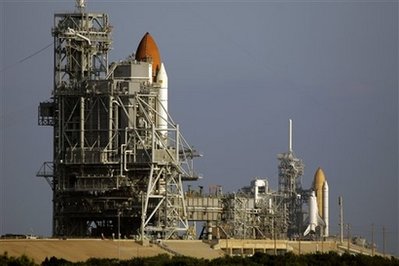
(Credit: AP Photo)
Here is something you don’t see every day. Two Shuttles are now sitting locked and loaded for the upcoming Hubble repair mission. Think of all of the contained energy waiting to spring out.

