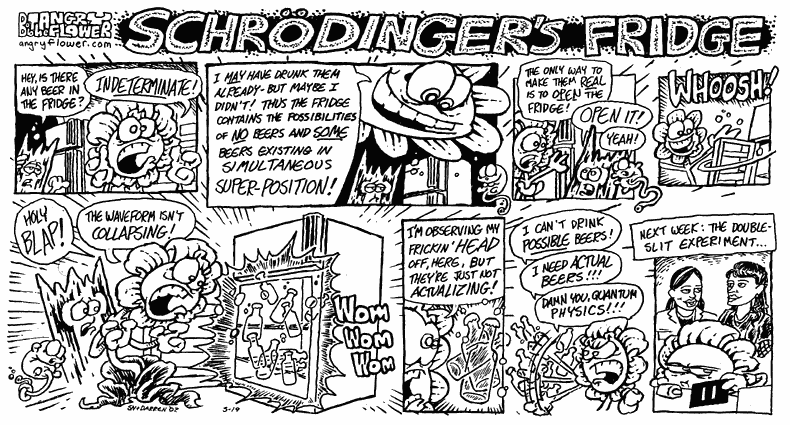
Here is a link to the cartoon strip Bob the Angry Flower. I like the one about Schrodingers Fridge. I was tempted to post a copy, but I didn’t want to rile the Copyright Gods.
Friday Fun- Bob the Angry Flower.
Leave a reply

Here is a link to the cartoon strip Bob the Angry Flower. I like the one about Schrodingers Fridge. I was tempted to post a copy, but I didn’t want to rile the Copyright Gods.
There is an interesting debate happening in the weather and climate modeling wing of the blogosphere. Seems that over at Wattsupwiththat someone has pointed out the significant part water vapor may play as an absorber of solar energy. All you have to do is look at the absorbance spectrum of water vs CO2 and you’ll see that the game is suddenly more complex than the incessant drum beating about CO2 would suggest.
There are a number of good websites on weather and climate out there. Rabett Run seems well centered in terms of the science. If you are interested in the level of play happening in the real, behind the scenes debate, check out the references to Kirchoff’s law. Physical meteorology is at the center of the whole debate. Assumptions about the applicability of certain laws, assumptions about the value of key variables, and other details of equation building can drive the nature of the conclusions. Planetary atmospheres are really quite complex!
I think it will be several more solar cycles before the right modeling assumptions shake out.
University of Leicester, UK. John Bond, a reseacher at the University of Leicester and consultant to the Northamptonshire Police, suggests that criminals who consume fast foods leave fingerprints that are corrosive. Dr. Bond says that enhanced levels of salt in processed foods can lead to sweaty fingerprints that are more corrosive to metals.
Dr Bond said: “On the basis that processed foods tend to be high in salt as a preservative, the body needs to excrete excess salt which comes out as sweat through the pores in our fingers.
“So the sweaty fingerprint impression you leave when you touch a surface will be high in salt if you eat a lot of processed foods -the higher the salt, the better the corrosion of the metal.”
Dr. Bond went on to say that there was an “indirect link” to obesity and the chances of being caught in a crime. Bond says that corrosion due to fingerprints may be helpful in the tracking of terrorists whose bombs are fragmented from the explosion.
Blundering through the patent literature I took a wrong turn and tripped over a patent that claims an interesting use of ammonia solutions of electrons. The patent, US 6080907, is assigned to Teledyne Commodore and teaches a method that uses ammonia as a fluid metal cutting medium for the safe destruction of bombs and the explosives inside. The inventor claims that ammonia is superior to water as a cutting fluid. Apparently Teledyne employs a few chemists because it dawned on someone that ammonia will also dissolve certain metals and provide a means of conveyance for a reducing agent to enter the bomb casing and reduce the nitro groups on the explosives. It is a clever idea. A new use for the Birch reduction.
I wonder if it is in operation?
There are many reasons not to start a business. It’s risky. It inevitably requires many long hours sweating all of the ten thousand details. Building a company from scratch requires wildly diverse skills that are not commonly possessed by a single person. And it usually requires more resources than a typical wage earner can easily muster.
A chemical entrepreneur with an eye on manufacturing faces some unique challenges that, say, a fledgling purveyor of roasted coffee beans could avoid. Most obvious it the issue of a physical plant. Not only must the chemist or engineer have a workable chemical process, but also have a highly specialized facility in which to do the processing. This requires suitably zoned land, local review boards, environmental permits, a local work force, process equipment, a minimum of raw material inventory, and buildings to contain it all.
Then the entrepreneur must provide an infrastructure of chillers, boilers, electrical distribution, liquid nitrogen for inert gas, an analytical facility, an R&D facility, quality control, as well as administration, sales, and technical staff. There must be a steady stream of cash flow to provide a steady payroll. Taxes must be estimated and paid in advance.
There are many sobering reasons not to go forward with a chemical business plan if one is risk averse or, shall we say, comfortable. Indeed, one of the common character traits of people who are analytically-minded is the tendancy to rattle off all of the reasons why something won’t work. We’ve all experienced this in meetings. A problem arises and meetings are called. After the problem is identified, much of the remaining time is spent in a recital of the additional problems that are expected. Soon, the problem mushrooms into a phantasm with imaginary components of awesome magnitude.
We’re all good at digging up reasons why something won’t work. And chemists suffer no lack of ability here.
But this is where the true entrepreneur stands out from the herd. One mark of a successful entrepreneur is the ability to ignore, or filter out, pessimistic predictions of an outcome. There is a spark within the some people that compels them to go forward. Sometimes it is a special insight. But just as likely the entrepreneur has an inner drive- some might unflatteringly call it “narcissism”- that moves them forward because they are certain of the outcome. It is not uncommon for an entrepreneur to consider him or herself the smartest person in the room.
In Part 3 we’ll look at examples of what kinds of businesses chemical entrepreneurs have started.
It appears as though CERN’s atom smasher didn’t destroy the world yesterday. That, or earth’s destruction is a slower process than we imagined.
CERN has announced that the first injection of particles into the Large Hadron Collider (LHC) will occur between 9:00 and 10:00 Wednesday, September 10th, 2008. Fears of spurious black hole formation have been discounted. The final synchronization was a success. Safety has been reiterated.
This is big time science, man. While in Geneva you won’t be able to spit without hitting a particle physicist.
How do they keep the superconducting magnets chilled? Air Liquide was selected to provide the liquid helium supply to maintain the 1.8 K operating temperature of the magnets over the 27 km length of the LHC.
According to CERN, the cool down phase of LHC preparation required 10,000 tonnes of liquid nitrogen and 130 tonnes of liquid helium to fill the 8 magnet sectors.
The peak beam parameters are quite interesting. Check out this link to PhD Comics.
I was going to write about something that bored me even more than this ridiculous debate over the taxonomic status of Pluto. Then it dawned on me that nothing bored me more than this topic. So … nevermind.
Way off topic- Check out this link for a recipe for Weapons Grade Salsa.
The latest Aldrichimica Acta is out- No. 2 of volume 41. This publication was started by a friend, teaching colleague, mentor, and former boss who spent some of his best years working for Alfred Bader. He eventually retired as a VP of something or other at Aldrich. A truly great guy. For a while, the task of catalog publishing was his job. He bought paper by the rail car. Their job was to increase the size of the collection by 15 % per year.
He also invented the coffee pot kugelrohr system that Aldrich sold for a long time. It has now morphed out of recognition. But he showed me the prototype motor assembly. It consisted of a reciprocating air motor built for automotive windshield wipers wired onto some pegboard. The air motor used either air pressure or vacuum and had a metal tube that connected the vac line from one side of the motor axially to the other. The reciprocating motor got around the need for a sealed vacuum bearing. To one side of the reciprocating tube was connected a vacuum line via flexible rubber hose, and to the other via hose and barbed connector, a series of bulb tubes and pot.
The coffee pot came from a West Bend coffee pot plant down the road in Milwaukee. Aldrich bought the reject pots and paid a guy to refit them for kugelrohr duty in his garage. It was a very successful product. When I went to grad school we had a Buchi kugelrohr for bulb-to-bulb short path distillation. But I still remember with some fondness having to sit at the bench twiddling the Aldrich kugelrohr by hand while feeding dry ice onto the receiver. Sometimes we would drip dichloromethane in the receiver and let the evaporative cooling do the trick. We’d use the air motor for lengthy distillations.
Being over the hump and into the 2nd half of my chemistry career, I find that more and more of my time is spent dealing with systems issues. Not fighting existing systems. Synthesizing new ones. One of the things I have come to appreciate is the value and necessity of at least some level of bureaucratic structure as an organization grows. Really, it has been an awakening.
My current project involves receiving and organizing a massive stream of diverse information. It is a taxonomic nightmare. How does one organize critical and confidential information in such a manner that it can be accessed for future reference? It is more than a matter of profligate use of file folders. I have drawers and drawers of file folders with commercial and scientific information in them, but I have lost track of what I already have. What has to shake out of my current task is a bureaucratic mechanism.
I have come to be viewed as a “resource”. This is a euphamism for “keeper of obscure information”, or more to the point, “he who knows where the bodies are buried”.
Getting back to the matter of systems generation, a problem organizations may develop is one in which valuable, painful, and expensive lessons get lost over a relatively short interval. People naturally like to get on with things. Problems in the past are just that- in the past. We overcame a challenge and now we are on to bigger things. But what folks underestimate is that past problems are often the result of habits of thought and poor adaptation to change.
It is easy to get bewildered in a conceptual space where there are no sharp edges or crisp boundaries. In the chemical business world, you find that the crowd naturally divides into science/technical people and business people. There are always a few cross-over people (freaks like myself) who defy tidy categorization. But for the most part, when the tray stops shaking, the people settle into particular positions.
Business-types like to deal in the binary world of yes and no. Science-types accept that this is possible only from a great distance from the problem. Business-types use the tool and toss it when done. Science-types can become enchanted with the tool and will try to make it better.
One of the tricks to system development in an organization is to define what constitutes a normal condition. Once this is defined, an off-normal condition can be recognized and SOP’s can be written to deal with it. As a psycholgical precaution, this is where you begin to get insights into the deep-seated insecurities of your colleages. Many long-time acquaintances can reveal control-freak behaviour or authority issues. The generation and implementation of systems in an organization always involves greater control and loss of degrees of freedom for individuals. People will see this coming and things may get contentious.
As more people become involved in any endeavor, complexity inevitably arises as failure modes are uncovered and people learn to game the system. Good leadership can go a long way towards helping people keep perspective as things become more complex.