Category Archives: Science

A Bunch of Blarney

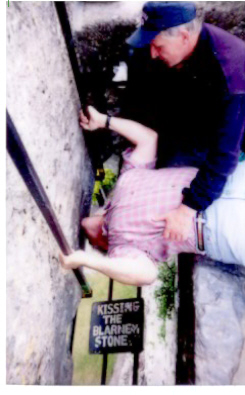
I thought I’d disclose a picture of Th’ Gaussling for the one or two miscreants who might actually be interested.  I had the opportunity to visit Blarney Castle in Ireland a few years back. The Blarney stone is said to be part of the Stone of Scone given to Cormac McCarthy by Robert the Bruce of Scotland in 1314 as a reward for support in the Battle of Bannockburn. Yada yada. It is supposed to confer the power of eloquence.

I try not to think of all of the thousands of sweaty tourists that have hung backwards high in the air to kiss that clammy, dank stone. Yeah, I kissed it. Didn’t do a damned bit of good, though.

Blarney Stone

Cheers!

On Extracting Abstractions from the Abstracts

One of the chores that must be done when developing a new technology is “Due Diligence” as applied to intellectual property.  In the fabulous world of industrial chemistry, there is an overlapping of the three great magisteria- Business, Chemical Science, and Law.  In order to get a new product or process on stream, we must find a line of sight through the many hoops and past the many gatekeepers of those magisteria that can obstruct our path the fame and fortune. 

First, allow me to pay homage to two great and wondrous database services- the United States Patent and Trademark Office (USPTO) and Chemical Abstracts Service (CAS).  They are the custodians of data generated by some of the most cantankerous and unruly people on earth- lawyers and chemists.  Their task is complex and effectively endless. 

In actually trying to do a reliable due diligence analysis, a searcher must ascertain that a proposed bit of IP does not conflict with claims in valid patents owned by others.  In a chemical IP search, one can divide the claim universe into 2 domains- composition of matter claims and process claims.  In the patent, the first sentence will state whether a composition is being claimed or that a process is being claimed. Some patents have both composition claims and process claims.

So here is the problem.  Let’s say that you are trying to determine whether or not you have the right to manufacture a particular molecule. This apparently simple question actually deconvolutes to two fundamental questions: 1) Is the composition of matter in the public domain? And, 2) are there claimed processes for it’s manufacture? 

There is a third domain and that relates to the use of the composition.  However, this does not impinge on the right to manufacture the material, just it’s use.

If the material is claimed as a 1) composition of matter in a valid patent, then you cannot lawfully make it or possess it (for commercial use, though precendence is being set for a bar on R&D use as well) without the permission of the assignee of the patent. Note that the owner of the patent is the assignee, not the inventor(s). If the composition of matter is not claimed, then it is in the public domain, assuming that you did not learn of it under trade secrecy. 

So, let’s say then that your target material is in the public domain. Now the question is 2); does your proposed method for its manufacture infringe on claimed methods? This may be a hard or expensive question to answer, and the reason is plain.  When you execute a search for IP issues related to a substance, you search path is limited to fields, key words, structures, CASRN’s, etc. that are flagged in the major databases. 

A CAS search on a given compound will lead to patent families that mention the compound, its preparation, or its use. But you have no way of knowing whether the patent reference claims the composition, its preparation, or its use.  It could very well be that there are no claims pertaining to the compound of interest- it was just cited as an example of some sort.

A CAS search is highly accurate in terms of the focus on a particular compound.  However, a USPTO search is not. A chemical search of the USPTO public database (USPTO.gov) is pretty much limited to a search for specific character strings.  It is possible to narrow down the scope of a search by concentrating on classification numbers, but I have never been convinced of its thoroughness.

After all of this set up, here is my point.  The problem we all face in doing our IP due diligence is that there is no direct means for determining from an indication in a database search report whether or not a composition is in the public domain. A CAS search will not yield a clear yes or no, and the USPTO database search only retrieves hits that have the requested strings.  Despite the advances in database technology, the user still has to collect all of the patent citations pertaining to the material and sift through them and interpret the claim language. 

Wouldn’t it be useful to the public if an applicant for a US patent were required to collate the claimed compositions for uplink into a database?  With such a “field” in a CAS or Beilstein search, you could tell in an instant if the composition was claimed. The same argument holds true for processes.  At present, the “retrievability” of claimed art is poor.

Patent attorneys are likely to object along the following arguments: not all patents that you retrieve from a search on CAS or USPTO will be valid.  Some patents will have expired naturally, others will have expired for non-payment of fees, and still others will have serious weaknesses that will only be apparent from an examination of the prosecution history as revealed in the file wrapper.  Abandonment may be difficult to detect for abstracting services, as would flaws in the prosecution as documented by the wrapper.

Another objection that is unlikely to be openly identified is the matter of clarity.  There is may be advantage conferred to assignees when a claim is a bit fuzzy.  This may afford some manuevering room during an infringement action, though it might be hard to say who the beneficiary would really be. I would estimate that whomever had the most persuasive attorneys would prevail.

It would be interesting to hear from others about this matter.

The Veneer of Civilization

It is easy to be lulled into the notion that the USA has reached a transcendent state of modernism; a place where people have come to adopt pluralism and tolerance. When you drive along the highways and fly the skyways of the USA, when you navigate the streets lined with familiar businesses and institutions there is this comforting though superficial vibe that you are in an advanced culture that is fairly progressive and forward thinking.

American culture has produced some of the most stunning changes in the history of life on earth.  Electricity, drug design, advanced materials, aerospace, computers, semiconductors, and on and on. Yet, there is this underlying ache, a subterranean twinge out there that is disturbing in it’s potential.

While I cannot accept the cosmology of supernatural beings or the physics of miracles, I have been known to attend a meeting of the Religious Society of Friends (Quakers) on a social basis. It is soothing to sit in silence and meditate in a group setting with highly civilized people like the Quakers. I remember some years ago at a Friends Meeting in Boulder, CO, listening to Kenneth Boulding (now deceased) make a comment during the meeting.  It was in another context, but the thrust of it is relevant nonetheless.  He pointed out that a few miles below the serenity of the nearby mountains there exists magma that, if given the chance, will flow to the surface and erupt. He observed that below the surface people also have raw and violent forces that sometimes escape. His point was more of a lyrical acceptance of this human frailty than one of condemnation. Examples of this condition are too numerous to count.

I was reminded of this comment of Boulding when I encountered some commentary on a recent editorial from the Wall Street Journal.  I can’t afford to subscribe to the WJS- I found it in the popular blog Pharyngula. The author of this exceptional blog has added commentary and I won’t spoil it for the reader. It is worth linking over there to read it.  Beneath the surface of consciousness of many, many people is the need to strike out at those have a different view of things.

Few points of view will evoke as vigorous a negative response as atheism does from believers in the Big 3 religions that originated in the middle east.  To these people, atheism is a kind of poke in the eye. The very presence of atheism seems to be a kind of pestilence or a corrosive influence on society itself. Believers in a supernatural being are convinced that without a diety, there can be no moral frame of reference.

It is much like the number line with its positive numbers, it’s negative numbers, and, importantly, zero.  To theists, God is the zero of the moral number line. It represents the demarcation of the positive and the negative realms.  As the theists would assert, without a frame of reference anchored from a higher plane, man is hopelessly absent a moral compass.

One thing is certain. I’m not going to solve this matter tonight.  I do know that civilization is one millimeter thick and there are plenty of places on earth where it has worn off to reveal the troubled underlayment of our species. This week, in the land of Nebuchadnezzar and the gardens of Babylon, many good people have died for no good reason.

Gaussling’s First Epistle to the Bohemians

Like nearly all chemists practicing today, I was hatched from a university chemistry department and tossed into the big, big world.  Like most Ph.D. hatchlings, I had developed a bit of a swagger. I somehow managed to get into and survive a good research group with more than a third of my sanity and ego intact. Part of the real value of an advanced degree is the fact that you have survived a very elaborate ordeal and gotten across the finish line. Yes, I was able to drag my battered remains across the finish line with my remaining good arm. 

University training doesn’t exactly prepare you for all of the outrages challenges that lie in waiting for you.  And, it really can’t do that.  University training does give a basic skill set from which you can build upon.  Which brings me to the point of this little epistle.  What you’ll find when you get into the world is that there are many more really smart people walking around that you might have considered.  Not all of the smart people actually matriculated and studied chemistry.

One of the smartest people I know is an electrician friend.  I worked for him for a while during some hard times and he actually tolerated my presence with grace, useless though I might have been at bending pipe and pulling wire. He has this uncanny ability to get things done.  This is an attribute that is absolutely golden.  Crimony, I nearly killed him one day when the backhoe I was operating swung out of control when some frozen ground gave way suddenly, causing an unplanned control input.  The bucket swung over and stopped short right at his chest.  He didn’t bat an eye.

He once pointed out that you have to expect to take a lot of hits. The goal was to minimize the number of hits you take below the waterline. 

It’s good advice and I’ve never forgotten it.

Some Sunny Day

This link shows the closing scene of Dr. Strangelove.  Why are atomic bomb blasts so fascinating to watch? Of course, the movie was a satire.

But when you see the next one, it becomes much more sobering.  It is a clip from a BBC documentary with CGI enhancement on Hiroshima. Part of the responsibility of having civilian control over military forces in the USA entails that at least some fraction of the civilian population retain a bit of knowledge of topics like this.

I think that when queried, most people will think of an atomic bomb blast as primarily a nuclear radiation calamity. To be sure, there is a healthy gamma pulse and the dispersal of a large variety of troublesome radionuclides, with long lasting contamination issues.  But much of the prompt destructive effect is from the immense heat pulse followed by the blast wave. 

Mutual assured destruction (MAD) as a nuclear strategy was arguably successful because parties on both the NATO and Soviet blocks were more desirous of long life than of the need for the delivery of nuclear hellfire at any cost.  The cold war was a time of opposing political and economic doctrines. MAD was essentially a secular concept.

In the present era of religious theatre, movements citing supernatural endorsement of earthly doctrines are in ascendancy.  The calculus of MAD fails when parties practice nuclear policy under the influence of supernatural euphoria.

Space MAD

The astronomer who taught my intro astronomy class years ago once joked that the shortest meaningful time was the “jiffy”; the time it took a photon to pass the diameter of a proton. He was also fond of referring to the “erg” as approximately equal to the energy required by a ladybug to crawl up on a piece of cardboard: thus 1 erg = 1 bug cardboard. [Hey, take it easy. It was a class for non-physics majors.] That astronomers name is John McKim Malville. He wrote a book called “A Feather for Daedalus: Explorations in Science and Myth in the New Physics”. Here is a quotation from Malville-

 SCIENCE – this precocious child we do not exactly know how to live with – can be used for more than the construction of warheads, the design of rockets, or the invention of technological marvels. As we shall attempt to demonstrate, the insights of science can be used in the same manner that we use our religious and artistic symbols – as evocative devices to lead us beyond that which is merely said. We have to a certain extent been guilty of misusing our SCIENCE in the production of unholstered gadgets [italics by Gaussling] and computerized wonders, thus neglecting it as an aid for mankind’s larger journey. It is as though after hacking our way through the forest we have reached the shore of a great river which prevents us from proceeding further. The water’s edge contains many beautiful and fascinating pebbles. Their colors and shapes are extraordinary! Never before on our journey have we seen such marvellous pebbles. They are, in fact, so captivating that we have completely forgotten about our journey. Instead we spend all our time gathering these brightly colored rocks – the facts with which we have become so infatuated of late. Into higher and higher piles we gather these facts, never wanting to stray too far from them for fear that someone might take them from us. And so we remain, trapped by our pebbles, unable to EXPLORE THE REST OF THE WORLD. We could, it is true, use our rocks to continue on our journey by tossing them into the stream ahead of us and using them as stepping stones. Shall we?

I like his term “unholstered gadgets”.  The 20th century was a period when many unholstered gadgets were developed and used with more technical skill than wisdom.

I picked up a book called “Edward Teller: The Real Dr. Strangelove” by Peter Goodchild.  It is an unauthorized biography of a brilliant, though irrascible character who participated in nuclear weapons design in the Manhattan project.  After WWII, Teller went on to solve the problem of how to configure a fission explosive to achieve a thermonuclear detonation. He was an influential supporter of many nuclear programs well into the Reagan years. As a student, Teller studied under Werner Heisenberg and went on to spend a year working with Bohr. Teller was one of the very earliest theorists to work on what chemists now refer to as quantum chemistry.  He and Jahn published a paper in 1937 predicting what is now called Jahn-Teller distortion, a phenomenon found in degenerate octahedral metal complexes.   Teller also helped produce many unholstered gadgets.

So, in this vein, it is interesting to note that the Chinese have just “fired a shot heard round the world”.  They were successful in hitting a retired satellite in what is reported as a ~600 mile orbit with a ballistic missile.  This event has twittered many governments in a jiffy or two, including the US gov’t. It has been reported that the US recently had a chance to sign a treaty that would ban aggressive action against satellites, but refused to do so. I don’t have a primary source for this assertion as yet. And for the first time in a long while, news outlets are referring to “Red China”.

I wonder how many young Tellers are out there, urging their government to develop offensive weapons under the guise of defense?  Perhaps this is Chinese arm twisting, or maybe it is the first step in a new type of Mutual Assured Destruction in space- Space MAD? There is a catchy name.

Watts and Watts of Ice

Many years ago I had the chance to visit the National Maritime Museum in London. It is a fantastic museum and if you’re ever in London, try to take a day to visit.  The Royal Greenwich Observatory is nearby as well, so you can see the prime meridian and the transit telescope. I seem to recall that Christopher Wren was the architect of the Observatory. Anyway, I remember a visit to the cafeteria there and an observation that I made while buying lunch. 

As an American in Europe, your presence is obvious to everyone. Well, to everyone but a few who may suspect you’re a Canadian.  And a more awkward bunch of preening land lubbers you’ll never find than American tourists abroad. So, standing there at the food counter with fish & chips and waiting for my aliquot of Coca Cola, the matron behind the counter noted that I was an American and asked if I required ice. Yes indeed, says I. She nods and hobbles over to a small ice bucket, not unlike the kind you see in a motel room. She brings the bucket and using a pair of tongs, reaches in and fetches a single ice cube for my 300 mL portion of the blessed nectar. 

At first I was struck with their miserly approach to dispensing ice. They didn’t invest in a commercial high output ice machine like even the most modest American mom & pop cafe had. But sitting there munching on my deep fried cod, I started to think about the vast resources Americans consume in order to have a ready supply of ice.

Just think of it. How many restaurants are there in the USA? According to Datanetwork there are 516,326 restaurants in their database for the USA. If you assume that each restaurant has 1 ice machine, and the ice machine draws, say, 12 amps at 120 VAC, and using the rms value for AC voltage (0.707 * 120 V = 84.84 Vrms) we can use Ohms law to calculate the wattage: power = EI = (84.84 Vrms * 12 Amps) = 1018 watts while in operation. Obviously, there are wide variations in parameters out there in the field. This is just a SWAG- Scientific Wild Assed Guess.

So, multiplying the number of restaurants times the wattage: 516,326 * 1018 watts = 525,619,868 watts, or ~ 526 megawatts of demand.  Assuming that the power distribution losses  in the grid are ~20 % (just a guess!), that means that the utilities have to generate 657 megawatts at the plant so that 526 megawatts get to the consumers.  But it gets better.

The thermodynamic efficiency of a power plant is approximately 33 %, so 657 megawatts/0.33 = 1991 megawatts thermal have to be consumed to to generate the 657 megawatts electrical.  Let’s assume a typical ice maching runs 25 % 0f the time, or 6 hrs per day: Energy consumption for one day is 1991 megawatts * 6 hours = 11,946 megawatt hrs thermal per day. So, lets get down to coal and oil consumption-

(11,946 MWHr * 3,412,000 BTU/MWHr) = 40.76 E9 BTU ==> (40.76E9 BTU/13,000 BTU per lb bituminous coal) = 3,135,000 lbs of bituminous coal per day, or 1568 tons per day, or 572,000 tons per year. The metric conversion is 1.1025 tons per metric ton. So, 572,000 tons/1.1025 = 518,821 metric tons per year.  For conversion to equivalent barrels of crude oil, use 4.879 barrels equivalent crude oil per metric ton of coal.  Thus, 518,821 MT coal * 4.879 bbl crude oil/MT of coal = 2.53 million barrels of oil per year to energize ice machines for our cokes and Slurpies. 

So, 2.53 million barrels of oil * 60$/barrel= $151.8 million. A drop in the bucket in a $10 trillion economy. But it is just a tiny sliver of the whole spectrum of profligate uses of energy.  What we need is to summon some sensibility and reduce our individual consumption of energy.  Think of all of the devices the typical home now has that are always on- anything with a clock, DVD  players and televisions that can be activated by remote, plug in cell phone chargers, etc.- all consume a trickle current.

So forgive me for asking the following question. If we are more than happy to commit the brightest minds in our country to find new energy souces, develop more potent weaponry, teach urban combat in our war colleges, invade savage and squalid middle eastern “countries”, resurrect the nuclear power industry, invent hybrid automobiles, etc., then why can’t we commit a small portion of that effort to reducing demand for resources whose scarcity can trigger a war?

Oh yea, reducing consumption means buying fewer goods and services. How do you reduce consumption while maintaining growth? There is the fly in the ointment.

[Note: this posting makes a lot of assumptions. It is meant to be an order of magnitude estimate of the consequences of our fetish for ice cold drinks.  I value and welcome corrections, comments, and dialog. Th’ Gaussling]

Into the Bezosphere, Gradatim Ferociter

The founder of Amazon.com, Jeff Bezos, is certainly an enterprising fellow. He has started his own space program and is making actual progress.  He bought 165,000 acres of Texas, started a company called Blue Origin, and has hired the best rocket and propulsion people he can find.  The first space race began post-WWII, when there was a frenzied dash by the US and the Soviets to nab the best German rocket scientists their armies could round up.  In the present commercial Space Race, Bezos and other billionaires can pick and choose their staff from the best and brightest space cadets that money can buy.

The link above contains some footage of the spacecraft lifting to a modest altitude and returning gently to the ground.  It lifts off vertically and uses a powered reverse decent to touch down.  The footage shows a launch where the exhaust gasses are not obviously incandescent and there is little or no “smoke”. This suggests to me that there is little in the way of carbonaceous components in the propellant. I wonder if it uses hydrogen peroxide as the propellant, like the famed jet packs use. Anyway, it’s all very hush-hush.

The slogan of the Bezonauts will be Gradatim Ferociter- step by step, fiercely.

Sign me up, boys. I’ll take a window seat.

[Revised 1/10/06]