Category Archives: Science

Pomegranate Juice UV-Vis Spectrum

Odwalla Pomegranate Juice

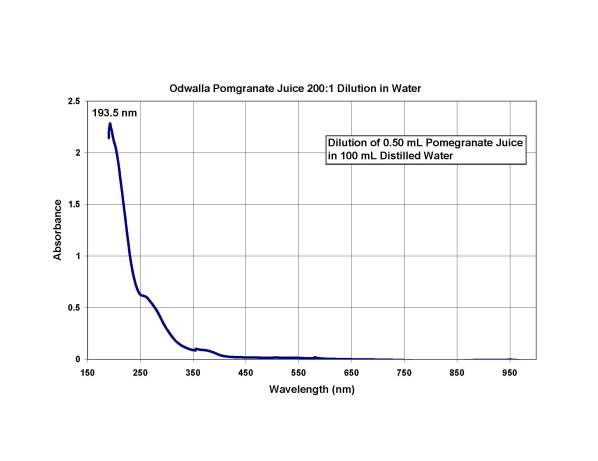
I’ve been really curious about the UV/Vis Spectrum of Pomegranate juice, so I finally broke down and ran the spectrum.  I bought commercially available Odwalla Pomegranate Juice from Safeway and diluted 0.50 mL of this juice in 100 mL (+/- 1 mL) of distilled H2O.  It is approximately 200 to 1 dilution. This commercial juice is also mixed with Chokecherry, Elderberry, Blueberry, Black Currant, and Apple juices, as well as a bit of citric acid. I’m going to try to get plain pomegranate juice for comparison.

I took a bit of the diluted soln and added some metals to it to see if there were any shifts in peak wavelength.  The two shoulders (~250 and ~350 nm) were unchanged in wavelength and extinction, but the extinction of the peak at 193 nm was increased. The metals were SnCl2, ZnCl2, FeCl3, and MnOAc2.  The Mn(II) Acetate has a fair extinction at ~195 nm but drops sharply at ca 200 nm. In all cases the shoulders remained. I would have to run a control to see if the consistent uptick in extinction at 193 nm is due to the metal ions.

When the dilute juice soln was treated with a few grains of NaIO4, the shoulders disappeared and the soln promptly took a clear yellow color. So it should be possible to follow the oxidative degradation of these solutions by UV/Vis.  Since the juice is a complex mix of chromaphores, there is no telling what species are involved and what exactly is being oxidized.  I’m sure that someone has sorted out what is in pomegranate juice. 

This is what I did with a saturday afternoon.

Market Pull and Technology Push

The chemical business is, after all, a business.  You have to make something that somebody wants. Brilliant ideas are a dime a dozen. Getting a new product to market is harder than you might expect, even if you have a purchase order in hand. The transition from bench to 1000 gallon reactor is often full of unanticipated problems.  The process of forcing a new product or technology on a market that didn’t exactly ask for might be called “Technology Push”.  The process of responding directly to a clear market demand is called “Market Pull”.

Market pull is a force that business types, especially the MBA’s, feel best about.  It is easy to justify the allocation of resources to launch into a product development cycle that addresses a clear and quantifiable demand.  Duh. It’s a no-brainer. That is, if there are no bottlenecks to get through. The merits of market pull are only valid if the proposed technology has been shown to work to specifications. Beware of the inventor who cannot produce a prototype to back his/her patent.

Technology push is a circumstance wherein a company has a product or technology that might stimulate demand if it were marketed properly.  Now, an economist might say that there is no such thing as stimulating demand. They’ll patiently explain that this only stimulates an underlying demand that may not have been articulated. Whatever formalism you prefer, it is possible to dazzle potential customers with a new capability.  Clever people can dream up applications that the original inventors could have never anticipated. Look at Symyx with their fantastic technology package for high throughput experimentation.

It is a bit easier to write a business plan based on market pull because the job of forecasting revenue flows should be based on measurable market conditions. Again, the assumption is that the proposed response to the market pull is a technology that works.

A business plan based on technology push has to incorporate estimates of acceptance of change. You see, technology push is the realm of the paradigm shift.  Predicting outcomes from the early side of the timeline is very tricky.  Customers for paradigm shift technologies may be scarce.  Not all companies are interested in being an early adopter or a buyer of first generation technology. 

Market pull is the domain of orthodoxy, of the rightous and proper company president who is also a CPA and who worked his way up the ladder from the accounts receivable department. Technology push is the domain of the engineers and scientists.  These are the dreamers who know in their hearts that if you build it, they will come.

Successful technology companies are somehow able to give a voice to the technology people in the allocation of resources.  Very often, these companies are managed by chemical engineers. While ChemE’s may not be trained in advanced synthesis R&D, they are involved in the scale up and economics of new processes.  Chemists live in a 2-dimensional world of space and time.  Chemical engineers live in the 3-dimensional world of space, time, and money.  Their knowledge of economics is what causes them to rise to the top of the corporate ladder more frequently than chemists.

It seems to me that companies that thrive today are those who do both market pull and technology push. Market pull is the cash cow.  Technology push is the seed corn for next years crop.

Exponential Ignorance and the Rule of 70

For many of us, there have been a few characters in our past who have have made a deep and lasting impact. For me as a chemist, I have to report that one of those people was a physicist at a school I only went to part time.

Many years ago I was lucky to have taken a class at CU Boulder by Professor Albert A. Bartlett, or “A-squared” as he was affectionately known by a few. I recall that in true Boulder fashion, he was fond of wearing flannel shirts with a Bolo tie and heavy boots.  It was an elective class in the Physics & Society vein. Professor Bartlett was (and is) skilled in the art of back-of-the-envelope calculations to help people think about problems, even when you are lacking exact numbers- what science folk call “order of magnitude” estimates. He was good at looking at a problem, estimating key quantities, and sketching approximate trends and consequences.  This is a mark of a skilled scientist- peeling away the unnecessary details and deriving estimates from core phenomena or just F=ma.  

Professor Bartlett had written a paper called “The Forgotten Fundamentals of the Energy Crsis“.  Recently I happened to find it on the web while following another vein.  

Bartlett was fond of saying that one of our biggest downfalls as a society was the failure to appreciate the exponential function.  He reminded people that Malthus had already shown that the use of arithmetic was crucial to the understanding of population growth and by extension, the consumption of natural resources. 

To scientists, this is quite obvious.  But his audience was the general public. During his talks he would give the audience a small take-home gift. The ability to calculate doubling times by the “rule of 70” as some call it. By simply dividing the number 70 (approximately 100 x ln2) by a constant growth rate, say 5 % population growth in a municipality, you would easily compute a doubling time of 70/5=14 years to double the population.

This handly little calculation helps one think critically about the consequences of growth when you hear a town council member state that some particular growth rate is desirable. In the above example, a 5 % annual growth rate will require the doubling of many city services in 14 years- a fact that often goes unnoticed by the council and public.

Professor Bartlett is a true crusader in the campaign against innumeracy.  His personal example of the use of basic math to reason his way through the consequences of unchecked consumption of natural resources and to make persuasive arguments to local government was an inspiration to many of us. 

In Praise of Reverse Polish Notation

I have been a devotee of calculator RPN notation since the mid 70’s. My first HP calculator was an HP 25C. For those who aren’t sure what it means, RPN stands for “Reverse Polish Notation”. For an eternity, in electronic industry years anyway, Hewlett Packard offered a variety of advanced calculators that used the RPN data entry format. Over the last 10 years or so, this blessed notation has been going the way of the Dodo.  Gradual extinction. 

As they explain it on the HP Museum of Calculators web site, RPN was named after a Polish mathematician named Jan Lukasiewicz who developed a logic in the 1920’s that allowed for the removal of parentheses in calculations.   Years later, computer scientists were able to apply the unique juxatposition of operators to the operands in first in last out (FILO) recursive stack manipulations. 

HP maintains that the term RPN is a type of homage to Lukasiewisz, and it may very well be. But, why isn’t it just “Polish Notation”? Here is my guess.  Up through the early 1970’s, the Archie Bunker years, Polish jokes were quite popular. In those days it wasn’t unusual for oddly configured devices to be referred to disparagingly with the adjective “Polish” and an especially strange contrivance might be further described as “reverse Polish”. My guess is that the word “Reverse” in RPN was from this vein of English usage.

I write to lament the decline of this intuitive and useful mode of computation. My guess is that onslaught of Japanese calculators (Sharp, etc) into the US market from the 1970’s onward with their algebraic entry format was an easier sell to the mathphobic masses.  Death by faint marketing.

College bookstores still offer a few versions of the RPN calculator and OfficeMax does offer the HP12 business calculators. But sadly, there does not appear to be any kind of revival anytime soon. There may be pockets of users out there, but we seem to be getting fewer in number.  It’s fun to watch people borrow your RPN calculator only to find that there is no “=” key. They quickly hand it back, grumbling as they look for another.

Chemistry Blogs

There has been a significant uptick in the number and quality of chemistry related blogs during the fall of 2006.  In my case, I was motivated to start by following the blog “Tenderbutton” maintained by Dylan Stiles, a Trost grad student. This genuine and charming blog was abruptly discontinued earlier in the fall.  The blog was somewhat revealing- though never negative- with regard to the lab culture and the chemical supplies of this world-class research group.  In all likelihood, the advisor called a “come to Jesus” type of meeting where he was reminded of his pending thesis defense. I could be completely wrong, but it is the kind of thing a research advisor would do.

Some blogs are operated as a node- that is, the blogger will collect and comment on interesting links elsewhere on the web.  Other blogs are more pedagogical in nature. The blogger will write on various topics with the intent of carrying on a kind of blog lecture series.  There are more than a few blogs that follow the chemical literature, publishing analyses of chemical transformations.  I think that these in particular are great blogs, but they do seem to be a lot of work for the blogger. The blog “Totally Synthetic” is a good example of a solid meat and potatoes style of synthesis blog. You leave this satisfying blog feeling like you’ve been in the literature that day.

Some blogs seem to be platforms for broadcasting various kinds of outrage. I have even done this myself. Sometimes a person just has to vent. But you also need to know when to stop. It is easy to step across the line from amusing to pathetic.

Some bloggers are prodigous writers, shoveling out great steaming heaps of output on whatever topic catches their fancy. Obviously, this is where “Lamentations on Chemistry” is parked.  My interest is in writing essays on science and politics.  Others are more talented at reviewing the chemical literature than I.  I view the human enterprise as a kind of tragic comedy and I take no small delight in reducing slices of it to words.

The 80/20 Rule

Having done my tour of duty in chemical sales and having travelled over a good bit of the northern hemisphere buying & selling, I’ve picked up a few insights into the B2B and “retail” chemical business.   Everyone has the major chemical catalogs on their desk. You know, the thick tomes from Aldrich, Spectrum, TCI, Matrix, Strem, GFS, Gelest, Fisher, etc.  There is considerable overlap in content, though some specialize in their chosen niches. While Aldrich makes no bones about total world domination, others are pleased just to dominate certain cul de sacs of chemistry. 

SAF is clearly the colossus of international catalog companies.  The Aldrich wing was started by Alfred Bader, now a retired art collector. To hear him tell it, Bader was frustrated by the limited availability of reagent chemicals and spotty service (by Eastman Chemical, if I am not mistaken).   Anyway, Bader was the right character at the right time.  He had a single-minded drive to give chemists what they needed and make a few bucks doing so. The slogan “Chemists Helping Chemists” was a the result of a sincere calling.  Bader visited university chemistry departments and asked professors what they needed.  Over time the Aldrich catalog collection grew and so did the company. Eventually, Bader was quietly forced out of the organization.  Founders can become “problematic” evidently.

Today SAF offers a vast collection of products and makes a sizeable fraction of what they offer.  Most professors don’t know it, but interesting materials from the lab might be saleable to a catalog company. If a prof has developed a new reagent or some useful fragment or pharmacophore, for instance, it might be worth contacting a catalog company to see if they want to stock it. You never know until you ask.

But we business types know that dealing with professors can be sticky, so Herr Doktor Professor, don’t get too high handed or greedy!  Academics are often missing the merchant gene and as a result badly price their wares.  The typical mistake is to over-estimate the demand and hike the price up to the astronomical numbers that you see in the catalogs. 

Here are the problems. Catalog companies do not pay the prices that you see in the catalogs. Buying material for inventory is equivalent to putting a stack of money on the shelf.  They have to pay lots of money up front before the first purchase order for your wonder product is faxed in. They have to pay for those damned fat catalogs, the inventory, salaries, the facility, regulatory compliance, certification, labeling, packaging, the time value of money, taxes, and they have to make a profit for the shareholders. So if the catalog price of something is $10 per gram, figure that they’re likely to keep their costs to $2 to $3 per gram for it, tops.  Obviously, this is subject to variation due the type of material or special negotiated deals.  But a 3x to 5x markup is not uncommon and is necessary to stay in business.

Then, after you ship the product to the catalog house and they put it into the collection, it might not sell.  It could be a dog.  The rule of thumb is that 20 % of your inventory will do 80 % of the business.  So, one of the ways to grow is to increase the number of products. Their interest in your product may be of a statistical nature rather than a firm belief in it’s viability.

I’ve heard many people go off about high catalog prices. I don’t like to pay the high prices either. But it is the cost of convenience.  If you need some obscure material, chances are that you can order it and have it in a few days. That is worth something and the catalog companies know it.  Hell, I’d do the same thing.

UV/Vis Spectrum of Bromine in Water

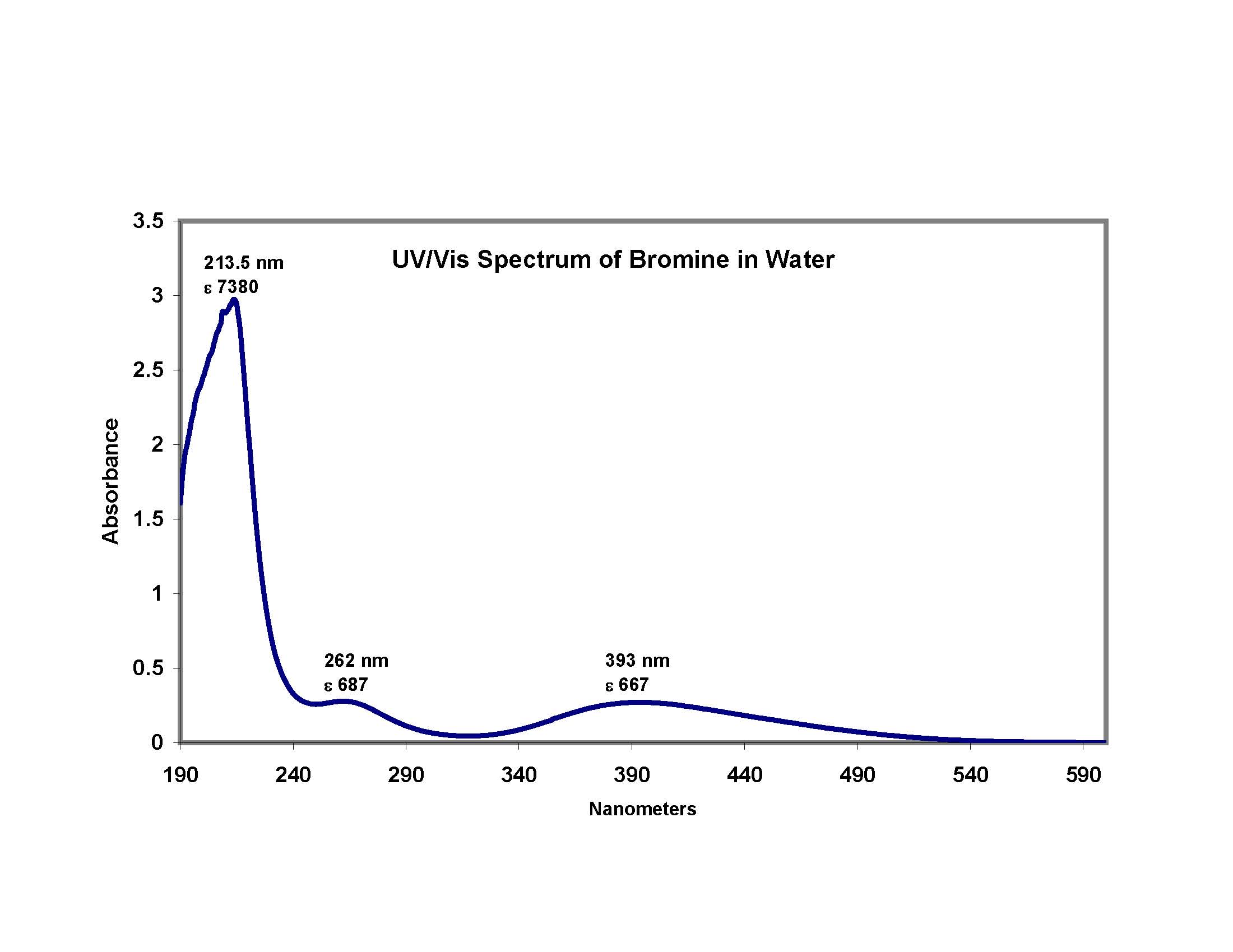
We have a Cecil CE 2041 UV/Vis spectrometer.  Data is collected by the DataStream CE2000 software package. The instrument has 4 nm of resolution, not the best, but still quite usable. To quote the famous British philosopher- “You can’t always get what you want!” (M. Jagger).

This posting is an experiment on how to upload data to the web. The graphic below is a jpeg conversion of a pdf conversion of an Excel chart. Seems like an awkward way to do this. Undoubtedly someone out there can offer a suggestion of how to upload an Excel graphic to the blogosphere.

 uv-vis-of-br2-in-water-rev-2.jpg

It looks like prior to an upload the graphic has to be beefed up a bit.   I’m gonna have to monkey with it some more. Maybe someone has a suggestion.

Organic Qualitative Analysis. RIP.

One of the chemistry classes I took as an undergrad continues to assist me in my synthetic endeavors mid-career.  The class was organic qual.  It was designed to take the student through the determination of an unknown organic compound , or mixture, with the aid of qualitative tests and derivitization to figure out the compound. We did small visual tests to guage acidity, basicity, water solubility, etc. We did sodium fusions to look for halides, 2,4-DNP hydrazones for carbonyls, picrates of amines, and flame tests to make a guess at saturation. We were given just so many grams of unknown and we had to perform several tests to support a claim of identity. It was an excellent experience because an organic prof taught the actual lab section.  We had access to the lab during the week to work on the unknowns. 

We used derivitization to determine some of the more difficult unknowns. CRC Press had a book of physical properties of a large range of known compounds that were derivatized, so you’d compare mp’s, color, bp, solubility, etc., to make a case for identity.

I would be interested to hear if this is still in the curriculum out there. I fear that it has passed along into history in the face of the hyphenated cryptozoology of todays analytical instruments.  That’s a pity.  Organic qual gave me the chance to handle chemicals, perform reactions, deal with ambiguity,  and do tests that might be hard to work into the rest of the curriculum.   Part of being a good organic chemist is racking up lots of time in the lab doing stuff, polishing up the physical intuition and mechanical skills.

I am embarrassed to admit that at one time I embraced the idea that the organic microlab experience was good pedagogy.  I now see it as more of a phenomenon meant to stretch department budgets. The idea of giving students barely enough reagents to make 100 mg of something is pretty dubious.  If the student goofs and spills something or makes a mismeasure, they might end up with 25 mg of product. The isolation of this amount of mass is problematic for fresh learners.  I miss the days when the organic lab kit had 25, 50, 100, and 250 mL flasks in it (19/22 ST joints, of course). 

The argument goes something like this: Our conversion to microlab equipment is justified because of the cost saving gained by going to a lower scale. We buy fewer grams of expensive reagents and we lower waste generation for the department. Well, this is a bunch of self-serving crap. I can just see the department chair’s pointed head nodding in agreement as some tenured Poindexter drones on about minimizing the negative impact on the environment.  

For Christ’s sake, we’re talking about chemistry, not church camp.  Minimally, chem majors should not be cheated by limiting them to the microscale experiments.

If you want to save the environment, stop driving your SUV down to 7-11 to get cigarettes.  Or, don’t bring home so much cheap plastic crap from Big Box Mart.

Colleges should be giving their chemistry majors more synthesis experience, not less.  In industry it can be a real problem finding fresh BS/BA graduates that have lab experience beyond sophomore organic lab.  Schools that promote lab-based synthesis research for undergrads (as opposed to computation) are doing their students a bigger favor than they may realize. 

A mote in the eye of Schrodingers Cat

I have made some adjustments to the blogroll. It turns out that physicists, to a greater extent than chemists, have taken up the craft of blogging.  Why chemists seem less inclined to blog remains unclear.  This tendency is seen on the shelves of book stores as well.  Whereas, bookstore science shelves are clogged with treatises on Quantum _____ (fill in the blank), works on chemistry are often limited to chemical dictionaries or Schaums Outlines.  Here in Colorado, where the per capita college education is reasonably high, in certain counties at least, urban bookstores may have chemistry titles that go ever so slightly beyond the study guides and dictionaries. 

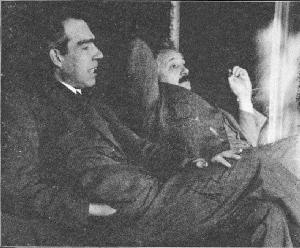
It seems to me that many of the popular quantum mechanics books on the market are peddling to people looking for a mystical experience.  Fred Alan Wolf and a few others have made a career of feeding this need.  I recall the quote by Niels Bohr-

‘There is only an abstract quantum physical description. It is wrong to think that the task of physics is to find out how nature is. Physics concerns what we can say about nature.“. 

 Bohr and Einstein

But I’ve ventured out on a limb. I am but a lowly synthetic organic chemist, a plebian scribbler in the scientific pecking order, who has not used a Hamiltonian operator or a Kroniker delta since grad school. My fragmented knowledge of quantum mechanical formalism is but a mote in the eye of Schrodingers cat.

Note: I’ve deleted The Volokh Conspiracy from the blogroll. They have developed an unfortunate neocon twitch that I find distasteful. 

Now, I am become Death, the destroyer of worlds

The news of North Korea’s announcement of the detonation of their first nuclear weapon is reverberating around the world.  It is certainly an unwelcome development if true.  Now the question is, can that junior varsity Stalinist Kim Jong Il resist the temptation to use it in a warshot? Or, sell copies to a growing list of unwholesome groups bent on the delivery of radioactive hellfire to the infidel crusaders?  What may actually be worse than having one go off in the US is our possible response and the cascade of events that follow.  What would we actually do? Whose home soil would we vitrify in our wrath? Whom would we smite? I fear that our reply would have an Old Testament ring to it. 

 I’m reminded of the famous quote by J. Robert Oppenheimer-

We knew the world would not be the same. A few people laughed, a few people cried, most people were silent. I remembered the line from the Hindu scripture, the Bhagavad-Gita. Vishnu is trying to persuade the Prince that he should do his duty and to impress him takes on his multi-armed form and says, “Now, I am become Death, the destroyer of worlds.” I suppose we all thought that one way or another.

I vaguely remember talk of the nuclear genie when I was a skinny Iowa farm boy in the 1960’s.  Knowledgeable people assured that once the nuclear genie was out of the bottle there was no putting him back in.  North Korea and Iran remind us that the nuclear genie is still out of the bottle.  And while we worry less about a barrage of ICBMs flying over the north polar cap towards us, or Warsaw Pact forces storming into western Europe, we are stirred out of our slumber by third or fourth tier states cobbling together a fission apparatus. 

An hour and a half drive from where I am typing this can be found missile silo’s.  Deep underground in undisclosed locations Air Force Missileers monitor the status of their squadron of missiles while maintaining readiness.  Kim Jong Il’s shenanigans have brought back an immediacy to the matter.

 Mushroom Cloud

Kim is aware that the fact of power is the act of power. And swinging around a nuclear bomb is definitely an act of power.  The real danger of a North Korean Bomb isn’t just in the immediate threat to possible victims. The larger threat lies in how the existying nuclear powers respond.  Once a North Korean nuclear bomb is triggered in anger, restraint will fly out the window. It would be a difficult time for the North Koreans and whomever bought their bomb.