Category Archives: Science

Oxybenzone and Coral Reefs in the Light of Day

In a recent issue of ChemistryWorld, an online publication of the Royal Society of Chemistry, a revealing article on work first published in Science describing how the combination of the UV sunscreen active ingredient oxybenzone and UV light together produce something that is toxic to corals reefs.

Researchers (paywall) at Stanford University found in their sea anemone model studies that in the presence of UV light, oxybenzone is modified by the attachment of glucose, forming a water soluble glycoside conjugate. This is a not an uncommon event in metabolism. The oxybenzone-glycoside conjugate was found to be a potent photo-oxidant and quite toxic to the algal symbionts of coral. A methoxy analog proved to be much more potent.

Benzophenones, of which oxybenzone is a variety, are well known photosensitizers and photoinitiators.

Locations like Hawaii and Palau have banned the sale of oxybenzone-containing sunscreens due to the harm they cause to coral reefs.

Black Hole Imagery

An image of Sagittarius A*, the black hole in the center of the Milky Way galaxy, has just been published. This is only the second such feat. The first image was of the central black hole of the galaxy M87. The images were captured through the collaboration of 8 synchronized radio telescopes around the world called The Event Horizon Telescope. It is an impressive technical problem to solve. Seeing something the apparent size of the M87 black hole as viewed from earth is said to be like trying to see a bagel on the surface of the moon. And they did it with sub-millimeter radio waves.

The color of the objects is interesting. I wonder how many folks out there think that radio telescopes can record the visual color of an object?

Earth Day on the Pale Blue Dot

This Earth Day of April 22, 2022, is a good time to stop and reflect a moment on our home in the universe. We live on a gleaming blue and white wet rock hurtling around a yellow star in a cosmos so vast that it is well beyond our ability to comprehend. On February 14, 1990, a photo looking back at Earth was taken from a distance of 4 billion miles by the space probe Voyager 1 on its way out of the solar system. This photo features a tiny, pixel-sized, blue dot. Our lonely home world.

So far, this decade of the 2020’s has begun with global contagion and a growing standoff by nuclear powers over culture and real estate. Many are saying that the conflict will lead to famine in Africa and economic chaos elsewhere. How it unfolds is the question on everyone’s mind. If there was ever a time for us to take a pause to look at the big picture, that time is now. We could all use a bit of humility from time to time.

Someone once joked that the international unit of humility should be called the “Sagan.” Carl Sagan the astronomer was a gifted and popular spokesman for astronomy and space science in a time of great discovery and space exploration in the latter 1900’s. Carl Sagan the writer is said to have published more than 600 scientific papers and 20 books for lay audiences. What’s more, in addition to co-writing and narrating a popular TV series, he wrote a piece of science fiction, Contact, that was turned into a popular movie.

Sagan wrote the following-

“Look again at that dot. That’s here. That’s home. That’s us. On it everyone you love, everyone you know, everyone you ever heard of, every human being who ever was, lived out their lives. The aggregate of our joy and suffering, thousands of confident religions, ideologies, and economic doctrines, every hunter and forager, every hero and coward, every creator and destroyer of civilization, every king and peasant, every young couple in love, every mother and father, hopeful child, inventor and explorer, every teacher of morals, every corrupt politician, every “superstar,” every “supreme leader,” every saint and sinner in the history of our species lived there–on a mote of dust suspended in a sunbeam.

The Earth is a very small stage in a vast cosmic arena. Think of the rivers of blood spilled by all those generals and emperors so that, in glory and triumph, they could become the momentary masters of a fraction of a dot. Think of the endless cruelties visited by the inhabitants of one corner of this pixel on the scarcely distinguishable inhabitants of some other corner, how frequent their misunderstandings, how eager they are to kill one another, how fervent their hatreds.

Our posturings, our imagined self-importance, the delusion that we have some privileged position in the Universe, are challenged by this point of pale light. Our planet is a lonely speck in the great enveloping cosmic dark. In our obscurity, in all this vastness, there is no hint that help will come from elsewhere to save us from ourselves.

The Earth is the only world known so far to harbor life. There is nowhere else, at least in the near future, to which our species could migrate. Visit, yes. Settle, not yet. Like it or not, for the moment the Earth is where we make our stand.

It has been said that astronomy is a humbling and character-building experience. There is perhaps no better demonstration of the folly of human conceits than this distant image of our tiny world. To me, it underscores our responsibility to deal more kindly with one another, and to preserve and cherish the pale blue dot, the only home we’ve ever known.”

— Carl Sagan, Pale Blue Dot, 1994

Copyright © 1994 by Carl Sagan, Copyright © 2006 by Democritus Properties, LLC.

For Students. Thoughts on Chemical Process Scale-Up.

Chemical process scale-up is a product development activity where a chemical or physical transformation is transferred from the laboratory to another location where larger equipment is used to run the operation at a larger scale. That is, the chemistry advances to bigger pots and pans, commonly of metal construction and with non-scientists running the process. A common sequence of development for a fine chemical batch operation in a suitably equipped organization might go as follows: Lab, kilo lab, pilot plant, production scale. This is an idealized sequence that depends on the product and value.

Scale-up is where an optimized and validated chemical experimental procedure is taken out of the hands of R&D chemists and placed in the care of people who may adapt it to the specialized needs of large scale processing. There the scale-up folks may scale it up unchanged or more likely apply numerous tweaks to increase the space yield (kg product per liter of reaction mass), minimize the process time, minimize side products, and assure that the process will produce product on spec the first time with a maximum profit margin.

The path to full-scale processing depends on management policy as well. A highly risk-averse organization may make many runs at modest scale to assure quality and yield. Other organizations may allow the jump from lab bench to 50, 200, or more gallons, depending on safety and economic risk.

Process scale-up outside of the pharmaceutical industry is not a very standardized activity that is seamlessly transferable from one organization to another. Unit operations like heating, distillation, filtration, etc., are substantially the same everywhere. What differs is administration of this activity and the details of construction. Organizations have unique training programs, SOP’s, work instructions, and configurations of the physical plant. Even dead common equipment like a jacketed reactor will be plumbed into the plant and supplied with unique process controls, safety systems and heating/cooling capacity. A key element of scale-up is adjusting the process conditions to fit the constraints of the production equipment. Another element is to run just a few batches at full scale rather than many smaller scale reactions. Generally it costs only slightly more in manpower to run one large batch than a smaller batch, but will give a smaller cost per kilogram.

Every organization has a unique collection of equipment, utilities, product and process history, permits, market presence, and most critically, people. An organization is limited in a significant way by the abilities and experiences of the staff who can use the process equipment in a safe and profitable manner. Rest assured that every chemist, every R&D group, and every plant manager will have a bag of tricks they will turn to first to tackle a problem. Particular reagents, reaction parameters, solvents, or handling and analytical techniques will find favor for any group of workers. Some are fine examples of professional practice and are usually protected under trade secrecy. Other techniques may reveal themselves to be anecdotal and unfounded in reality. “It’s the way we’ve always done it” is a confounding attitude that may take firm hold of an organization. Be wary of anecdotal information. Define metrics and collect data.

Chemical plants perform particular chemical transformations or handle certain materials as the result of a business decision. A multi-purpose plant will have an equipment list that includes pots and pans of a variety of functions and sizes and be of general utility. The narrower the product list, the narrower the need for diverse equipment. A plant dedicated to just one or a few products will have a bare minimum of the most cost effective equipment for the process.

Scale-up is a challenging and very interesting activity that chemistry students rarely hear about in college. And there is little reason they should. While there is usually room in graduation requirements with the ACS standardized chemistry curriculum, industrial expertise among chemistry faculty is rare. A student’s academic years in chemistry are about the fundamentals of the 5 domains of the chemical sciences: Physical, inorganic, organic, analytical, and biochemistry. A chemistry degree is a credential stating that the holder is broadly educated in the field and is hopefully qualified to hold an entry level position in an organization. A business minor would be a good thing.

The business of running reactions at a larger scale puts the chemist in contact with the engineering profession and with the chemical supply chain universe. Scale-up activity involves the execution of reaction chemistry in larger scale equipment, greater energy inputs/outputs, and the application of engineering expertise. Working with chemical engineers is a fascinating experience. Pay close attention to them.

Who do you call if you want 5 kg or 5 metric tons of a starting material? Companies will have supply chain managers who will search for the chemicals with the specifications you define. Scale-up chemists may be involved in sourcing to some extent. Foremost, raw material specifications must be nailed down. Helpful would be some idea of the sensitivity of a process to impurities in the raw material. You can’t just wave your hand and specify 99.9 % purity. Wouldn’t that be nice. There is such a thing as excess purity and you’ll pay a premium for it. For the best price you have to determine what is the lowest purity that is tolerable. If it is only solvent residue, that may be simpler. But if there are side products or other contaminants you must decide whether or not they will be carried along in your process. Once you pick a supplier, you may be stuck with them for a very long time.

Finally, remember that the most important reaction in all of chemistry is the one where you turn chemicals into money. That is always the imperative.

Pragmatics of effective science outreach

Public outreach in science is a important element for the maintenance of our present technology-affected (or afflicted) civilization. Science and engineering (Sci & Eng) activity is continually expanding the scope of the known. The global business sector, without relent, puts new technologies to work and retires others as obsolete. It is as though civilization is in a constant state of catch-up with the tools and materials being made newly available. And the quality of news is quite variable.

When it comes to the electronic and print mass media’s government reporting, the emphasis seems to me to focus on the current budgeting process and political conflict therein. These two subjects are in the “eternal now” in the flow of events. The word “news” is just the plural form of “new” so it is natural that news media focus on present budgeting and in-fighting. Media directors and executives know that reporting must be as concrete as possible and what could be more so than large dollar values and pithy news of political hijinks? Both raise our ire because cost and anger are emotional triggers for people. And emotional triggers bring lingering eyeballs to media.

The public not affiliated with Sci & Eng are quite often unaware of what their tax dollars are actually producing, perhaps many years down the timeline. The eventual outcome of government spending on Sci & Eng may be quite specialized and seem only remotely related to non-Sci & Eng life.

It has been my observation that media equates boring content with failure and compelling content with broadcasting success. The word “compelling” is used to describe something that attracts lingering eyeballs. Modern news broadcasting is the process of jumping from one compelling piece to another. I suppose we cannot blame them for this emphasis on superficiality because apparently it is what “we” want. The big We that draws advertisers and thus cash flow to broadcasters. It keeps the lights on and families fed. Basic stuff that can’t be dismissed with a utopian wave of the hand.

If there is going to be any fundamental change in the tenor and quality of content in media, it will have to come from citizen viewers. This leads me to the thrust of this essay: Those knowledgeable in Sci & Eng must bring the value proposition of current efforts in technological civilization to the citizenry, because broadcast media certainly can’t. By “broadcast media” I mean to include everything right down to what appears on your smart phone. Unfortunately, tech content typically emphasizes consumer goods like automobiles, electronic widgets, space, or miraculous medicine.

Those knowledgeable in Sci & Eng must bring the value proposition of current efforts in technological civilization to the citizenry, because broadcast media certainly can’t in any depth. They’re in showbiz. 

Arguments in favor of rational stewardship of our little world won’t influence elected politicians. But informed and persuasive citizens can influence those who are less so and if they apply some leadership. Carefully. Those who may be less educated and less up to date on the sciency subjects do not take kindly to speech that talks down to them. The hand that reaches from above is still above and off-putting. Learn to communicate on even ground.

What works for me in reaching out to all levels of education is to use humor and a bit of showmanship. Reaching out to the public in a way that keeps their attention is hard to do and not everyone is prepared to do it. Lest you think I am describing putting on a show, not entirely. I am saying that by the deft use of knowledge, public speaking skill, and the strength of personality, it is possible to persuade even the scientifically reluctant to perk up and follow your efforts at making a point. But the point must be accessible. Deep detail and meandering monologue will lose your group. Keep your outreach succinct and limit the breadth to a few pearls of wisdom. Get feedback on your presentation.  With any luck, they’ll go home and jump on Google for more.

If you need help with public speaking, join Toastmasters to improve. Try acting lessons. Join a theatre group. Learn to relax, pace yourself, and enjoy speaking. The better you get at the mechanics of public speaking, the more effective you’ll become.

[Note: The crummy WordPress text editor used to write this post is just abysmal. Why it was changed to the current revision is a mystery to me.  -Th’ Gaussling]

Electrostatic Discharge Safety and Basic Electricity Principles

One of my work duties is to give safety training on the principles of electrostatic safety: ESD training we call it. The group of people who go through my training are new employees. These folks come from all walks of life with education ranging from high school/GED to BS chemists & engineers to PhD chemists & engineers. In order to be compliant with OSHA and with what we understand to be best practices, we give personnel who will be working with chemicals extensive training in all of the customary environmental, health and safety areas.

I have instructed perhaps 80 to 100 people in the last 6 years. At the beginning of each session I query the group for their backgrounds and ask if it includes any electricity or electronics study or hobbies. With the exception of two electricians in the group, this survey has turned up a resounding zero positive responses.

Admittedly, there could be some selection bias here. It could be that people with electrical knowledge generally do not end up in the chemical industry. My informal observations support this. But I’m not referring to experts in the electrical field. I refer to people who recall ever having heard of Ohm’s law. One might have guessed that the science requirements for high school graduation may have included rudimentary electrical concepts. One might have further suspected that hobby electronics could have occupied the earlier years of a few attendees. Evidently not. And it does not appear that parents have been very influential in this matter either.

I’m struggling to be circumspect rather than righteous. It is not necessary for any given individual to have learned any particular field of study. It is not even necessary for most people to have studied electricity. But it is important for a core of individuals to have done so. So, where are they? And why aren’t more people curious enough to strike out on their own in the acquisition of electrical knowledge?

Back to electrostatics. In order to have a working grasp of electrostatic principles, the concept of the Coulomb has to be conveyed. Why the Coulomb? Because it is the missing piece that renders electrostatic concepts as mechanistic. It is my contention that a mechanistic grasp of anything can help a person to reason their way through a question. The alternative is rote memorization. The mechanistic approach is what drives learning in the natural sciences.

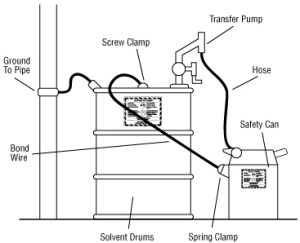
To be safe but still effective as an employee, a person needs to be able to discriminate what will and what will not generate and hold static charge to at least some degree in a novel circumstance. By that I mean how accumulated or stranded charge can form and what kind of materials can be effectively grounded. If you are working with bulk flammables, your reflexes need to be primed continuously to recognize a faulty ground path in the equipment around you. At the point of operation, somebody’s head has to be on a swivel looking for off-normal conditions.

It is possible to cause people to freeze in fear and over-react to unseen hazards like static electricity. But mindless spooking is a disservice to everyone. To work around flammable materials safely requires that a person understand and respect the operating boundaries of flammable material handling. Those boundaries are grounding and bonding (see NFPA 77), avoiding all ignition sources, good housekeeping, and maintaining an inert atmosphere over the flammable material.

Much of electrostatic safety in practice rests on awareness of the fire triangle and how to avoid constructing it.

Back to electrical education. There are numerous elements of a basic understanding of electricity that will aid in a person’s life, including safely working around flammable materials. One element is the concept of conduction and what kinds of materials conduct electric current. Another is the concept of a circuit and continuity. Voltage and its relationship to current follows from the previous concepts.

I would offer that the ability to operate software or computers is secondary to basic knowledge of how things work.

Connecting these ideas to electrostatics are the Coulomb and the Joule. One volt of potential will add one Joule of energy to one Coulomb of charges. One Ampere of current is one Coulomb of charges passing a point over one second. Finally, one Ohm is that resistance which will allow one Ampere of charge to move by the application of one volt.

For a given substance- dust or vapor- a minimum amount of spark energy (Joules) must be rapidly released in order to cause an ignition. This is referred to as MIE, Minimum Ignition Energy, and is commonly measured in milliJoules, mJ.

A discussion on sparking leads naturally into the concept of power as the rate of energy transfer in Watts (Joules per second), connecting to both the Joule and Ohm’s Law. Rapid energy transfer is better able to be incendive owing to the finite time needed for energy to disperse. Slow energy transfer may not be incendive simply because the energy needed to initiate and sustain combustion promptly disperses into the surroundings.

A discussion of energy and power is useful for a side discussion on how the electric company charges for energy in units of kilowatt hours (kWh). This is a connection of physics to money.

The overall point is that a rudimentary knowledge of electrical phenomena is of general use, even in the world of chemical manufacturing. I often hear people talk about the importance of “tech” in regard to K-12 education. By that they seem to say that using software is the critical skill.  I would offer that the ability to operate software or computers is secondary to basic knowledge of how things work. Anyone with a well rounded education should be able to learn to use software as they need it.


Addendum 8/16/18.  Since I wrote this essay, I’ve taught another 2 groups of trainees and not a single one of the 12 individuals could say that they had heard of Ohm’s law. All were high school grads over an age range of 22 to ~50. One had fresh BS Chem. E. degree.  Evidently none had enough inclination in their travels to noodle their way through a rudimentary grasp of volts, ohms, amperes and basic electronic components. I find this incredible given the penetration of electrical contrivances in our lives.

This feeds into a pet theory of mine that true expertise is being replaced with software skills. I know this because it seems to be happening to me as well. Is this an aspect of the Dunning-Kruger effect?

Ionospheric Bow Waves Caused by August, 2017, Eclipse

A recent paper (free) in Geophysical Research Letters reports the discovery of long anticipated ionospheric disturbances caused by the passing of the moon’s shadow over the earth during an eclipse. The paper, submitted by the MIT’s Haystack Observatory, reports the occurrence of ionospheric bow waves associated with the shadow ground-track of the August, 2017, North American eclipse.  The online source, MIT News, summarized the discovery.


Life With an RC1

I’ve been using a Mettler-Toledo (MT) RC1e reaction calorimeter for about 6 years. Our system came with MT’s iControl software, RTCal, and 2 feed pumps with balances. Overall it has proven its worth for chemical process safety and has helped us understand and adjust the thermal profile of diverse reactions. Like everything else, MT’s RC1e has many strengths and a few weaknesses.

The RC1e’s mechanical side seems reasonably robust. Our instrument sits in a walk-in fume hood resting on a low lab benchtop supported by an excess of cinder blocks- it is a heavy beast. During installation we discovered that the unit would not achieve stable calibration with the hood sash closed. The control box mounted on the instrument didn’t work properly on installation. After a trip to the repair shop, the box was returned as functional but without finding the fault.

Recently we had a mixing valve fail in the heat transfer plumbing, resulting in down time. Diagnosis of this was unsuccessful over the email and phone, necessitating a service call. Parts may not be inventoried in the US and consequently must come from Switzerland. Expect Swiss prices and less than snappy delivery. Hey, it’s been my experience.

Addendum, 5/4/22:  After a nearly 1 year period of down time the RC1 was reinstalled at another location. Due to temperature regulation problems after the move, a technician from MT visited and repaired the instrument. It turns out that swapping one of the hot legs on the  208 3 phase feed for another can cause the stir motor to reverse direction. A relief valve related to the heat transfer system had failed in the partially open condition. It was fixed and the instrument now performs as expected.

Addendum 2, 6/10/22: The RC1 has failed again. The “fix” didn’t work. Same problem as before. Maybe in the next repair they’ll replace the bloody valve rather than just “unstick” it. Unrelated gripe- Getting parts from Mettler-Toledo in Switzerland has been frustrating. They have always been very slow. So much for Swiss efficiency.

A chiller unit is required for RC1 operation and can add 15-30 k$ to the setup cost. Users will have to contend with the loss of floor/hood space in the lab for the chiller and RC1. The chiller must be powerful enough to contend with the exotherms that may be generated in the instrument. Chillers can take many hours to get down to the set temperature. Given that RC1 experiments can also be lengthy, plan accordingly. Our (brand new Neslab 80) chiller requires nearly 2 and 1/2 hours to get from +20 C to -20 C, which is the lower chiller temperature we use, depending on the reaction chemistry. For reactions that are on the sporty side, we’ll drop the chiller to – 50 C.  This is near the  minimum temperature for the water-based chilling fluid we use. Early on I opted for an aqueous potassium formate solution with a very low freezing point. The instrument comes with a panic button that switches to full cooling in an emergency.

The chiller required the wiring-in of a dedicated single-phase 208 VAC circuit. With the chiller using single-phase and the RC1e using 3-phase 208 VAC, it is important to assure that one cannot inadvertently connect into the wrong power circuit (idiot proofing). The chiller plug design should already prevent this. It is critical that the electrician is alert to this and does NOT jury-rig the plugs to use the same style of connectors because he has only one style in the parts bin.

Some comments on the collection and interpretation of RC1 thermograms.

  • It is critical that those who request RC1 experiments understand the limitations of the instrument. For instance, we use a 2 Liter reaction vessel with a 400 mL minimum fill volume. Refluxing is not allowed owing to the huge thermal noise input from the reflux return stream. Special equipment is said to be available for reflux.
  • Experiments must be carefully designed to elicit results that can answer questions about feed rates and energy accumulation.
  • Like many instruments, the RC1 needs a dedicated keeper and contact person for inside and outside communication. A maintenance logbook should be kept next to the instrument if for no other reason than to pass along learnings from previous issues.
  • If thermokinetic measurement is part of your organization’s development SOP, someone on staff should be reasonably familiar with some chemical thermodynamics. That can be a chemical engineer, as may often be the case.
  • The users of thermal data are likely to need help with interpretation of the results. Be prepared to offer advice on interpreting the data, taking care not to over-interpret. If you don’t know, say so. It is easier to claw back “I don’t know” than “yeah, go ahead and do that …”.
  • Do not be anxious to singlehandedly bear the weight of responsibility for safety. Safety is a group responsibility.
  • Be curious. How do the insights and learnings from the data translate into best practices? What changes, if any, can the process chemists make to nudge the process for better safety and yields? A credible specialist in RC can make comments or ask questions that lead to better discussions on thermal hazards. Be a fly in the ointment.
  • Never forget that a reaction calorimeter is a blunt instrument for the understanding of a reaction. An RC1 thermogram is a composite of overlapping solution-phase phenomena. Interpretation of results can be greatly refined by pulling timely aliquots for NMR, GC/MS, or HPLC analysis.
  • A database should be constructed to collect and immortalize learnings from all safety work and RC1 learnings fall into that group.

There is the question of who collects and presents the data. An engineer or a chemist? Engineering thermodynamics is a big part of a chemical engineer’s education and skill set. As a plus, an engineer can take thermal data and apply it to scale-up design for safety and sizing of equipment and utilities. You know, the engineering part. On the down side, there may not be many chemical engineers who are comfortable with doing reaction chemistry.

Do not be anxious to singlehandedly bear the weight of responsibility for safety. Alpha males- are you listening??  Safety is a group responsibility that should originate from a healthy group dynamic.

There’s a good argument for a chemist to conduct RC experiments as well. A trained synthesis chemist is qualified to conduct chemical reactions within their organization. That includes sourcing raw materials, handling them, running the reaction, and safely cleaning up the equipment afterwards. But interpreting RC1 data has a physical chemistry component. In my experience, run of the mill inorganic/organic synthesis people may have seen PChem as an obstacle rather than a focus in their college education. Their skill set is in instrumental analysis like NMR and chromatography, mechanisms, and reaction chemistry. I would recommend having a PhD chemist in a leadership role when calorimetry is a key part of a busy process safety environment.

Safety data can be collected and archived all day long. The crucial and often tricky part is how to develop best practices from the data. I would offer that this is inherently a cross-disciplinary problem. Calorimetric data from reaction chemistry can be collected readily, especially with the diverse and excellent instrumentation available today. Adiabatic temperature rise, ΔTad, is a key measurement. A lab group may be interested in the maximum (adiabatic) heat rise for a given reaction. A smooth and efficient technology transfer from lab to plant happens when good communication skills are used. Yes, SOP’s must be in place for consistency and safety. But the positive effect of individuals who have good social skills and are prone to volunteering information cannot be underestimated.

A Pox on the House of Microsoft

An automated Windows update disrupted my life today. It swooped in overnight like a winged wraith, did its dark deeds, and flapped quietly back to the dank hole from whence it came. My RC1 data may yet reside unscrambled on the disk drive, but it lies orphaned from the mother iControl application which mockingly professes no recollection of 18 hours of sweet data lovingly produced. The curs in IT can only “tsk, tsk” in their antiseptic way while bobbing pointed heads in faux dismay. Another first-world difficulty uncovered for all to see.