In this post I’ll feature a particularly well-done group of videos on precious metals prospecting, milling and smelting. The producer of this content is Jason Gaber at Mount Baker Mining and Metals, MBMM. The website says that Jason is a geophysicist. His company manufactures small-scale industrial grade equipment for the processing of ore. He produces videos that show how things are done in prospecting, mining, and even smelting. His videos give long, lingering views of the milling and smelting processes in operation. I was interested in particular in the process of cupellation, which has always been a bit of a mystery.
Gold ore is dropped into a crusher then pulverized to millimeter-size with a hammer mill. The finely divided ore is then fed onto a shaker table for separation by density with flowing water. The shaker table is a mechanical separation method that allows the isolation of metal fines without chemical processing methods. No cyanide or mercury here. The only waste materials are the pulverized ore tailings.
Editorial comment: To be sure, there is nothing innocent about ore tailings. The large surface area along with the presence of sulfides and water allow air to oxidize the sulfur to strong mineral acid and accelerate the leaching of hazardous metals into streams over the long term. It is very damaging to wildlife and municipalities that draw water from the stream and rivers. Water pollution is a problem all around the American West. Metals are forever.
The smelting videos are interesting for a chemist to watch. Jason uses his knowledge of pyrometallurgy to extract the values and partition impurities away from the target metal. Of course, chemists will recognize this as high temperature inorganic chemistry. Before watching this, I had a poor understanding of the importance of fluxes and slag. Jason quantitatively formulates custom fluxes to fit the problem as he sees it. He uses iron bars for redox processes to change the chemical composition of the melt and give a better partitioning of components.
The goal in smelting is to get a clean separation of the metal value from the ore by partitioning between liquid phases. Lead is often used as a “collector” metal to accumulate reduced metal species as a separate liquid phase on the bottom of the melt. The upper slag phase is a complex mixture of the ore matrix material and contains silicates, aluminates, and a dog’s lunch of other undesirable substances. And. not all metals are miscible or highly soluble in the collector phase, so there is some art in this.
Jason also discusses matte and how to deal with it. Matte is frequently discussed in 19th century works on gold smelting, but this was before atomic theory or sophisticated analytical chemistry. Matte was something to place in a reverberatory furnace and calcine. Sulfides in the matte were converted to oxides and gold residues.
Cupellation is a technique that he uses in the final isolation of gold, silver or PGMs from the collector metal. At the scale of material handling Jason works with, a small cupel and a muffle furnace is all that is necessary for this step. Cupellation for gold isolation was described by Agricola in the 16th century. The lead collector mass selectively oxidizes to the PbO, or litharge, and diffuses into the cupel leaving behind the precious metal. Cupels were formerly made of bone ash or other materials that will not combine with the molten PbO to produce a viscous layer that would prevent seeping of the PbO into the container. This is also how gold was isolated in the old days by the assay office to determine the gold content of ore samples. Today several methods are available to assayers, including x-ray fluorescence.
Vlad Putin has been ominously reminding us that he will not rule out the use of nuclear weapons if the Russian state is under existential threat, whatever that means. Maybe now is a good time to review just a few basics of nuclear weapons and what they do.
There are a large number of internet sites that go into great detail about the dark art and history of nuclear weapons. No need to duplicate that here. I’ll just give my take on a few points.
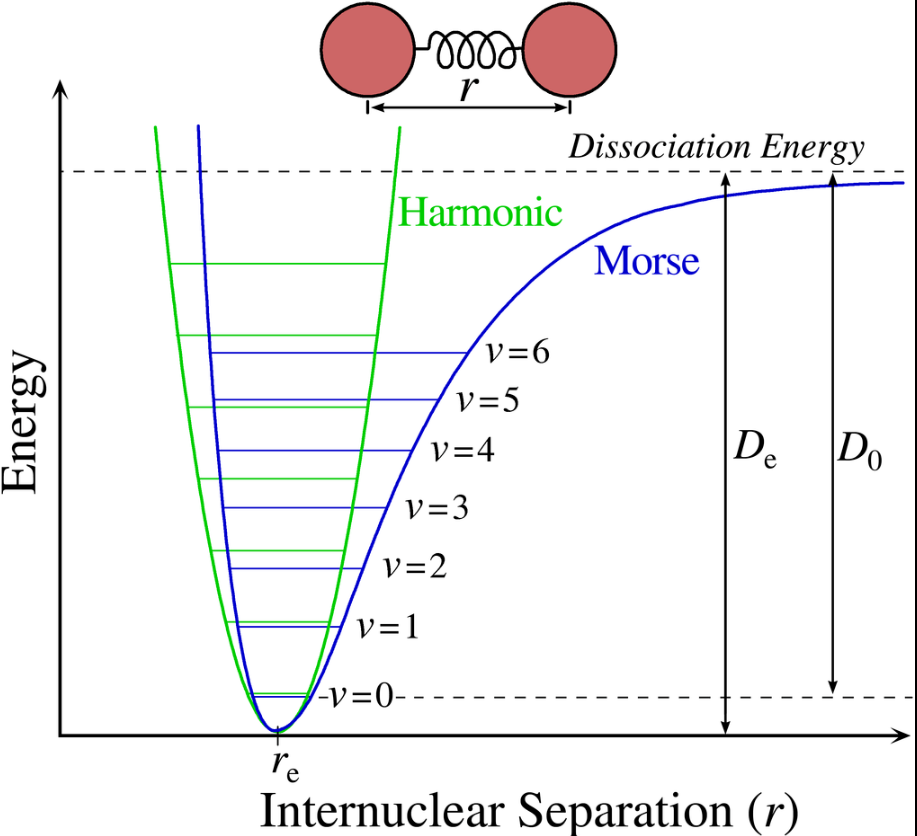
Remember the Morse curve from freshman chemistry? It describes the potential energy versus distance of two atoms at the scale of chemical bonds. The left side of the blue curve shows how steeply the repulsive energy potential rises (exponentially) with diminishing internuclear distance. By contrast, the attractive potential on the right of the blue curve flattens out with increasing interatomic distances. Keep this in mind.
When a fissile uranium-235 nucleus absorbs a neutron, the nucleus momentarily becomes unstable uranium-236. A stable nucleus has repulsive Coulomb forces between nucleons that are balanced at close proximity by the attractive strong nuclear force. The liquid drop model is useful for visualizing a nucleus as it fissions. On absorption of a neutron the uranium nucleus will distort to an elongated dumbbell shape leading to an imbalance of attractive and repulsive forces between nucleons. This can take the nucleus past the distance where the strong nuclear force attraction can hold it together. The strong nuclear force holding together nuclear particles (nucleons) falls off much faster with distance than does the Coulombic repulsion of protons. At the instant the nucleus separates into adjacent fragments, the two highly positively charged nuclei find themselves in very close proximity and are now only subject to net repulsive force. From the left side of the Morse Curve we can see that the repulsive force is exceedingly high in this moment. The highly repulsive potential energy is converted to kinetic energy at the moment the nucleus splits. The nuclear fragments fly apart at high velocity along with neutrons and dump thermal energy into the surrounding bulk material. But the kinetic energy of the fragments is not the only source of energy output.
Nuclear fission fragments are released in a highly excited state. Apart from their kinetic energy, nuclei have different energy levels with differing stabilities. A nucleus can undergo energy transitions from one state to another. These higher energy levels are called nuclear isomers and their stability can be expressed in terms of half-life. As fission fragments are formed they shed energy in the form of alpha, beta, gamma, and neutron emissions. Neutrinos are left out of this discussion for simplicity. As nuclei decay, they get closer to a stable ground state. Unstable nuclear fission products will decay in their characteristic ways, contributing to the overall energy release.
One challenge to weapons designers is to cause as many nuclei as possible to fission before the weapon undergoes “hydrodynamic disassembly” over the first 1 microsecond or less. After ignition the rapidly expanding plasma of the bomb core increases in volume and the probability of neutron collisions with nuclei diminishes rapidly. When a uranium or plutonium nucleus fissions, 2 or 3 neutrons are emitted which go on to strike other nuclei and induce fission in them. The cascading generations result in an avalanche of fissions. One of the ways to ensure that enough generations of fissions occur with enough neutrons flying about inside the supercritical assembly is to surround the core with neutron reflecting material. Ways of doing this can be found elsewhere.
One more thing about the strong nuclear force. This quote is from the Wikipedia entry for the strong interaction–
“The residual strong force is thus a minor residuum of the strong force that binds quarks together into protons and neutrons. This same force is much weaker between neutrons and protons, because it is mostly neutralized within them, in the same way that electromagnetic forces between neutral atoms (van der Waals forces) are much weaker than the electromagnetic forces that hold electrons in association with the nucleus, forming the atoms.“
A nuclear weapon produces a near instantaneous point source of energy release. These bombs can be detonated at or below ground or water level, or they can be set off in the atmosphere or space. The choice of where to do it depends on the intended effects. Subsurface bursts consume much of the explosive energy in moving soil or water which provides some radiation shielding to the surrounding area. Furthermore, bursts in contact with soil or water, especially when the fireball contacts the soil, tend to produce more fallout than air bursts. Air bursts deliver EMP, radiation and blast effects to a wider area, where “radiation” refers to neutrons, gamma and longer wavelengths of electromagnetic radiation. Thermal and blast effects produce considerable prompt destruction in the area surrounding the blast. As an approximate point source of energy, the intensity of the radiant energy falls off as some inverse square law. On an encouraging note, this means that radiation exposure falls off rapidly with distance. Distance is your friend.
There are numerous variations on the nuclear weapons theme. In the early cold war days, so called A-Bombs and H-Bombs were in the news. H-Bombs are also referred to as “hydrogen bombs or thermonuclear weapons.” An A-bomb, A for Atomic, was a basic implosion-type fission explosive and it was the typically the least powerful of the two. The H-Bomb was a nuclear fusion explosive that was triggered by a fission “primary.” That is, a fission trigger would be used to generate x-rays that would be “focused” onto fusion fuel, the “secondary,” which would initiate a runaway nuclear fusion explosion. The explosive yield of these bombs is much higher and can deliver a devastating blast to a larger area. Over time, the efficiency and compactness of these bombs has been greatly optimized.
The fusion explosive element was lithium-6 deuteride. The lithium atom would absorb a neutron, become unstable and decay into a helium-4 nucleus and a tritium (helium-3) nucleus. On a side note, in grad school I attended a seminar by Dieter Seebach from ETH, Zurich, who was talking about mechanistic work they’d done with lithium enolate complexes. He mentioned in passing that at that time, the mid-80’s, they had to be careful with stoichiometry because the commercial lithium that was available was often depleted of lithium-6 which was accumulated by the government for diversion to weapons. It was an unexpected brush with the cold war.
The main deleterious effect of radiation on human tissue lies in the formation of ions and radical pairs along the path of the penetrating radiation. The molecules of life are dissociated into ion pairs or radicals which may or may not collapse back to the original molecules. Given the amount of energy transferred into molecular dissociation along with random diffusion, the molecular destruction cannot be reversed. Heavy radiation particles like alpha particles produce a great many ions per centimeter of tissue penetrated. Penetrating, energetic photons like gamma rays produce relatively few.
There are 6 forms of hazardous radiation commonly considered- alpha, beta, gamma, x-ray, ultraviolet and neutrons. Of these 6, alpha, beta, gamma and neutrons are of nuclear origin. X-ray and ultraviolet are “electronic” in origin, that is they arise from electron transitions outside of the nucleus. The matter of the origin of x-rays is often confused in the literature with some authors implying that x-rays are from the nucleus. I prefer to define x-rays as resulting from electron transitions at the atomic level.
Of the 4 nuclear radiation types mentioned above, alpha, beta, and neutrons are particles. Gamma rays are photons. The atomic nucleus is comprised of so-called nucleons which are protons and neutrons. Nucleons are composite particles comprised of quarks and can bind by the strong nuclear force. Alpha particles are helium-4 nuclei and neutrons are neutral particles with approximately the same mass as a proton or about 1 atomic mass unit. Neutrons are not stable outside of the nucleus and have a half-life of about 15 minutes. Free neutrons will undergo radioactive decay into a proton, an electron, and an electron antineutrino.
Like gamma rays, neutrons are neutral in charge and have great penetrating ability. However, neutrons are effectively scattered by collisions with the hydrogen atoms of biomolecules and water. As a result neutrons can be very destructive to living tissue. As a side note, paraffin wax and water are effective shielding materials for neutrons due to the high concentration of hydrogen atoms. The collisions with hydrogen atoms in living tissues is a means of dumping neutron kinetic energy into the bulk matter, resulting in dissociation of biomolecules.
The so-called “neutron bomb” was an explosive that was designed to produce an abundance of neutrons at the expense of explosive yield. During the early Reagan years in the US there was much public handwringing about these bombs and their ability to kill people but leave buildings standing. People seemed indignant that somehow this reduced the value of human life below that of material things in the grand calculation of destruction.
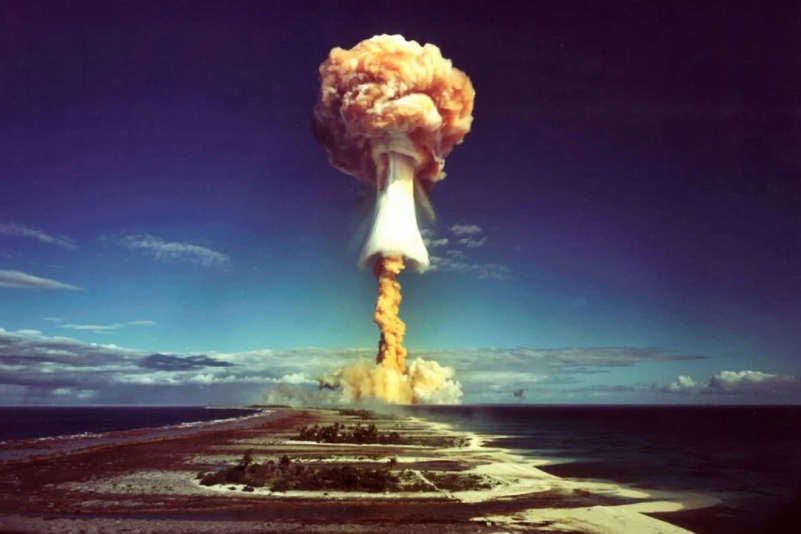
The characteristic mushroom shape rising to the sky after a nuclear air burst is just the result of a rapid release of energy and bomb debris in the air, but close enough to the ground to suck up soil. The “cap” of the mushroom results from the convectively rising point-source expansion of incandescent, debris-filled air from the point of energy release. The “stem” of the mushroom is a column of air that has rushed in to replace the rapidly rising fireball, picking up soil as it does so. There is nothing intrinsically nuclear about a mushroom cloud. Chemical explosives can do this as well.
Initially the fireball produces a strong pulse of thermal radiation. As this fireball develops, there is a momentary drop in radiant thermal energy due to the increasing opacity of the fireball. With further expansion the opacity of the fireball decreases and the thermal output increases. The shock wave and out-rush of air is obviously destructive, but the radiant thermal effects are not to be underestimated.
Another major effect of a nuclear blast is nuclear fallout. A nuclear blast unavoidably produces radioactive substances from the fission process and from neutron activation. A low altitude air burst is particularly troublesome because ground debris is sucked up into the air and contaminated with radionuclides. This material does what all suspended solids do, namely it is carried by the wind and falls back to earth gradually, contaminating a wide swath of ground. The finest particles remain suspended and are transported long distances, eventually falling out with rain or snow.
Finally, there are psychological effects associated with “the bomb.” It inevitably produces dread fear in people. This fear buttresses the idea of Mutually Assured Destruction or MAD.
Now that we are in a nuclear state of mind, let’s turn to what Putin intends to do with his nuclear arsenal. The Russians are not suicidal. Putin is neither crazy nor stupid. Russians have long understood where a nuclear confrontation with the West can go. They know escalation of nuclear war to full-scale would lead to mutual destruction of Russia and the West. The Russians know that the West has a policy of no first use with nuclear weapons and that we are extremely reluctant to use them. For the West, there is a firebreak between conventional and nuclear weapons. For the Russians, it is more of a continuum. They know that sabre rattling with their nuclear arsenal creates a good deal of anxiety in the rest of the world and Putin has been pushing this threat envelope to new levels and will keep doing so. Once a KGB guy, always a KGB guy. Putin obviously understands the pragmatics of coercion and the influential value of torture.
What nobody knows for sure is what happens when a Russian nuclear war shot is released. What does the West do? Respond in kind quickly or play the long game and see what happens next. How much planning has gone into nuclear conflict between two states outside of NATO? When would NATO step in? NATO is presently taking the side of Ukraine in terms of supplying money and arms but is studiously avoiding direct conflict with Russia. On the positive side, at least right now we aren’t bogged down with an endless middle east whack-a-mole exercise.
The best use of nuclear arms has always been and remains the threat of their use. Russia has been using this threat aggressively, even going so far as to blame Ukraine for planning a false flag operation with a “dirty bomb.”
Putin wants to see the alliance of the US and Europe disintegrate. He wants to see the American hegemony in place since WW II collapse. He wants to see the dominance of US culture, military reach, the influential dollar and prevalence of the default English language peel away. He wants to see Novorossiya rise from the ashes of the fallen USSR. But his vision requires the conquest of territory and cultural domination. The armed extinction project for Ukraine in process now will be followed by rebuilding the captured land with Russian infrastructure, political leaders and culture.
Russia, in its constant state of paranoia, wrings its hands about the “threat” of NATO at its border. The cruel irony is that it is hard to imagine that the West would find the conquest Russia possible or even desirable. The US-lead coalition was unable to get the medieval opium poppy kingdom of Afganistan under control with conventional weapons. How is it possible that we could even consider a preemptive invasion of Russia? Russia’s historical paranoia seems entirely self-serving for its authoritarian leaders.
One way to tear apart western alliances is to help them along with the demise of liberal democracy. Quietly support the internal cultural rot of individual nations by encouraging radical nationalism, white supremacy and political disharmony. It is happening all around us and especially here in the US. As badly as I’d love to entirely blame #45, I have to admit that he has only prodded a sleeping dragon. The MAGA and QAnon crowds were already out there. #45 has rallied them and validated their seething anger and indignation.
Today we have many people of great influence like Tucker Carlson, Alex Jones, Sean Hannity, nationalistic religious broadcasters, a stable of fringe political figures, and a mass of MAGA foot soldiers winning down-ticket elections moving their nationalistic and religious conservative agenda forward. Post-war baby boomers are being replaced with crowds and leaders who reject America’s present liberal democratic culture and leadership role in the world. There is growing open admiration for strongman authoritarian leadership. America’s experiment with fascism has already begun. Surprisingly, many Americans have expressed support for Putin.
Putin’s vicious attack on Ukraine, the rise of Trumpism with American fascism and a viral pandemic have overlapped within a narrow window of time- any one of which is a big problem by itself. It seems doubtful that MAGA right-wing crowds will have a change of heart in their vision for America. They will live out their lives within the same closed ideological space they are in presently. A political depolarization of America seems unlikely in the near term.
In this depressing global political climate it is more important than ever for the US to maintain its role as a thriving democratic culture and defender of those seeking democracy. Our leadership role in NATO must not waver against Russian aggression and expansionism. Russian expansionism will not end with Ukraine.
What will Putin do if he sees his internal political power structure collapsing? Will he ramp up the war to distract his opponents and rally the country? The present situation in Russia seems to suggest that rallying the population is more difficult than he anticipated.
It is hard to believe that Putin and his inner circle will change their ways in their lifetimes. They’ve painted themselves into a corner with their aggression and, like a trapped animal, will fight to the death. The cruel and murderous Joseph Stalin died in power. There is no reason to believe that Putin will be any different.
One can learn interesting but off-topic things along the way to a particular subject of research. Below is a compilation of interesting things.
We are all aware of the games Russia is playing with the interruption of natural gas supplies to Europe. A noteworthy consequence of this applies to the refining of petroleum. Evidently, refineries use natural gas in the refining process, likely as a fuel for heating process equipment. A shortage of natural gas may/will have an adverse effect on the ability of European refineries to produce fuels from crude oil.
There is a German theoretical physicist named Sabine Hossenfelder who has been producing short videos for YouTube. I’ve seen a few and they are quite good. She doesn’t pander to the lowest common denominator. Instead she speaks like a theoretical physicist talking to intelligent non-specialists and does a bang-up job of it. She gives a thoughtful and skeptical analysis of current topics in theoretical physics. She always gets back to basic concepts and what is possible for science to understand. She has moved on to subjects of popular interest as well.
And speaking of videos on YouTube, I’ve taken a shine to a channel called Periodic Videos. The presenter is professor Sir Martyn Poliakoff of the University of Nottingham. It may take a few moments to overcome the shock of his wild white hair. Poliakoff has produced a great many short videos over the years specializing in the chemical elements. A good one I viewed recently was about burning magnesium in a nitrogen atmosphere. Yes, it can happen and it will produce magnesium nitride. Contact it with water and you get ammonia. It is easy to think that nitrogen is an all around inert gas and for the most part it is. Lithium metal springs to mind when inert atmosphere questions arise. Better use argon.
With the appearance of COVID and polio the USA, the news has revealed that it is possible to detect and monitor certain viruses in municipal sewage. As a chemist I marvel at this. Sewage is a frightfully complex mixture of biological waste products along with many chemical cleaning products, detergents, grime and pharmaceuticals that go down the drain. How is it that one can collect enough intact virus particles from this fecal hell broth with enough purity to make a positive identification of genetic material?
A recent methodology is given in an article titled Detection of Pathogenic Viruses in Sewage Provided Early Warnings of Hepatitis A Virus and Norovirus Outbreaks and published in Appl Environ Microbiol. 2014 Nov; 80(21): 6771–6781, DOI: 10.1128/AEM.01981-14 by Maria Hellmér,aNicklas Paxéus,bLars Magnius,cLucica Enache,bBirgitta Arnholm,dAnnette Johansson,bTomas Bergström,a and Heléne Nordera,c. As you can see the work is from 2014 so this is not brand-spanking-new technology. It is interesting to note that the material used to sediment the viruses in this article was acidified powdered skim milk proteins. The article was found by a Google search and located at the NIH National Library of Medicine.
Why powdered skim milk? It could be that milk fat interferes with the process or the workers are just removing variables. More likely, it is because the widely available powdered milk that you buy at the grocery store is from skim milk. Dairy fat is too valuable for a business to squander and is used to make more profitable products like ice cream or whipping cream.
In the 2014 article above, the virus particles are extracted from the raw sewage onto acidified powdered skim milk proteins and amplified with quantitative polymerase chain reaction, qPCR. Powdered milk may seem strange but realize that virus particles can be removed by coagulation with metal ions, lime or with other polyelectrolytes, including proteins. The charge distribution on milk proteins will vary with acidity so these methods are very pH dependent. The viruses are naturally coated in proteins and thus will acquire surface charges varying with pH. The coagulation of proteins occurs when dissolved or suspended proteins irreversibly change their secondary structure by unfolding and condense to form a thicker solution or a solid form. The formation of cheese by acidification or solidifying a runny egg with heat are common examples of coagulation.
A 1973 review article by Gerald Berg in Bull World Health Organ. 1973; 49(5): 451–460, reviews methods for the removal of viruses from effluents, so knowledge of the sedimentation, or coagulation, of viruses in sewage has been around for a long while.
These articles are written by specialists in the field and may present considerable difficulty for a few readers. I would urge those so inclined to try to plow through the articles and pick up what you can. This holds true for all scientific papers. See what you can learn.
In a recent issue of ChemistryWorld, an online publication of the Royal Society of Chemistry, a revealing article on work first published in Science describing how the combination of the UV sunscreen active ingredient oxybenzone and UV light together produce something that is toxic to corals reefs.
Researchers (paywall) at Stanford University found in their sea anemone model studies that in the presence of UV light, oxybenzone is modified by the attachment of glucose, forming a water soluble glycoside conjugate. This is a not an uncommon event in metabolism. The oxybenzone-glycoside conjugate was found to be a potent photo-oxidant and quite toxic to the algal symbionts of coral. A methoxy analog proved to be much more potent.
Benzophenones, of which oxybenzone is a variety, are well known photosensitizers and photoinitiators.
Locations like Hawaii and Palau have banned the sale of oxybenzone-containing sunscreens due to the harm they cause to coral reefs.
An image of Sagittarius A*, the black hole in the center of the Milky Way galaxy, has just been published. This is only the second such feat. The first image was of the central black hole of the galaxy M87. The images were captured through the collaboration of 8 synchronized radio telescopes around the world called The Event Horizon Telescope. It is an impressive technical problem to solve. Seeing something the apparent size of the M87 black hole as viewed from earth is said to be like trying to see a bagel on the surface of the moon. And they did it with sub-millimeter radio waves.
The color of the objects is interesting. I wonder how many folks out there think that radio telescopes can record the visual color of an object?
This Earth Day of April 22, 2022, is a good time to stop and reflect a moment on our home in the universe. We live on a gleaming blue and white wet rock hurtling around a yellow star in a cosmos so vast that it is well beyond our ability to comprehend. On February 14, 1990, a photo looking back at Earth was taken from a distance of 4 billion miles by the space probe Voyager 1 on its way out of the solar system. This photo features a tiny, pixel-sized, blue dot. Our lonely home world.
So far, this decade of the 2020’s has begun with global contagion and a growing standoff by nuclear powers over culture and real estate. Many are saying that the conflict will lead to famine in Africa and economic chaos elsewhere. How it unfolds is the question on everyone’s mind. If there was ever a time for us to take a pause to look at the big picture, that time is now. We could all use a bit of humility from time to time.
Someone once joked that the international unit of humility should be called the “Sagan.” Carl Sagan the astronomer was a gifted and popular spokesman for astronomy and space science in a time of great discovery and space exploration in the latter 1900’s. Carl Sagan the writer is said to have published more than 600 scientific papers and 20 books for lay audiences. What’s more, in addition to co-writing and narrating a popular TV series, he wrote a piece of science fiction, Contact, that was turned into a popular movie.
Sagan wrote the following-
“Look again at that dot. That’s here. That’s home. That’s us. On it everyone you love, everyone you know, everyone you ever heard of, every human being who ever was, lived out their lives. The aggregate of our joy and suffering, thousands of confident religions, ideologies, and economic doctrines, every hunter and forager, every hero and coward, every creator and destroyer of civilization, every king and peasant, every young couple in love, every mother and father, hopeful child, inventor and explorer, every teacher of morals, every corrupt politician, every “superstar,” every “supreme leader,” every saint and sinner in the history of our species lived there–on a mote of dust suspended in a sunbeam.
The Earth is a very small stage in a vast cosmic arena. Think of the rivers of blood spilled by all those generals and emperors so that, in glory and triumph, they could become the momentary masters of a fraction of a dot. Think of the endless cruelties visited by the inhabitants of one corner of this pixel on the scarcely distinguishable inhabitants of some other corner, how frequent their misunderstandings, how eager they are to kill one another, how fervent their hatreds.
Our posturings, our imagined self-importance, the delusion that we have some privileged position in the Universe, are challenged by this point of pale light. Our planet is a lonely speck in the great enveloping cosmic dark. In our obscurity, in all this vastness, there is no hint that help will come from elsewhere to save us from ourselves.
The Earth is the only world known so far to harbor life. There is nowhere else, at least in the near future, to which our species could migrate. Visit, yes. Settle, not yet. Like it or not, for the moment the Earth is where we make our stand.
It has been said that astronomy is a humbling and character-building experience. There is perhaps no better demonstration of the folly of human conceits than this distant image of our tiny world. To me, it underscores our responsibility to deal more kindly with one another, and to preserve and cherish the pale blue dot, the only home we’ve ever known.”
I’m posting a link to the story of the astoundingly fast discovery and market entry of Pfizer’s Paxlovid, their small molecule contribution to the treatment of COVID-19. You have to wonder if the emergency use authorization came before the patents were allowed.
Chemical process scale-up is a product development activity where a chemical or physical transformation is transferred from the laboratory to another location where larger equipment is used to run the operation at a larger scale. That is, the chemistry advances to bigger pots and pans, commonly of metal construction and with non-scientists running the process. A common sequence of development for a fine chemical batch operation in a suitably equipped organization might go as follows: Lab, kilo lab, pilot plant, production scale. This is an idealized sequence that depends on the product and value.
Scale-up is where an optimized and validated chemical experimental procedure is taken out of the hands of R&D chemists and placed in the care of people who may adapt it to the specialized needs of large scale processing. There the scale-up folks may scale it up unchanged or more likely apply numerous tweaks to increase the space yield (kg product per liter of reaction mass), minimize the process time, minimize side products, and assure that the process will produce product on spec the first time with a maximum profit margin.
The path to full-scale processing depends on management policy as well. A highly risk-averse organization may make many runs at modest scale to assure quality and yield. Other organizations may allow the jump from lab bench to 50, 200, or more gallons, depending on safety and economic risk.
Process scale-up outside of the pharmaceutical industry is not a very standardized activity that is seamlessly transferable from one organization to another. Unit operations like heating, distillation, filtration, etc., are substantially the same everywhere. What differs is administration of this activity and the details of construction. Organizations have unique training programs, SOP’s, work instructions, and configurations of the physical plant. Even dead common equipment like a jacketed reactor will be plumbed into the plant and supplied with unique process controls, safety systems and heating/cooling capacity. A key element of scale-up is adjusting the process conditions to fit the constraints of the production equipment. Another element is to run just a few batches at full scale rather than many smaller scale reactions. Generally it costs only slightly more in manpower to run one large batch than a smaller batch, but will give a smaller cost per kilogram.
Every organization has a unique collection of equipment, utilities, product and process history, permits, market presence, and most critically, people. An organization is limited in a significant way by the abilities and experiences of the staff who can use the process equipment in a safe and profitable manner. Rest assured that every chemist, every R&D group, and every plant manager will have a bag of tricks they will turn to first to tackle a problem. Particular reagents, reaction parameters, solvents, or handling and analytical techniques will find favor for any group of workers. Some are fine examples of professional practice and are usually protected under trade secrecy. Other techniques may reveal themselves to be anecdotal and unfounded in reality. “It’s the way we’ve always done it” is a confounding attitude that may take firm hold of an organization. Be wary of anecdotal information. Define metrics and collect data.
Chemical plants perform particular chemical transformations or handle certain materials as the result of a business decision. A multi-purpose plant will have an equipment list that includes pots and pans of a variety of functions and sizes and be of general utility. The narrower the product list, the narrower the need for diverse equipment. A plant dedicated to just one or a few products will have a bare minimum of the most cost effective equipment for the process.
Scale-up is a challenging and very interesting activity that chemistry students rarely hear about in college. And there is little reason they should. While there is usually room in graduation requirements with the ACS standardized chemistry curriculum, industrial expertise among chemistry faculty is rare. A student’s academic years in chemistry are about the fundamentals of the 5 domains of the chemical sciences: Physical, inorganic, organic, analytical, and biochemistry. A chemistry degree is a credential stating that the holder is broadly educated in the field and is hopefully qualified to hold an entry level position in an organization. A business minor would be a good thing.
The business of running reactions at a larger scale puts the chemist in contact with the engineering profession and with the chemical supply chain universe. Scale-up activity involves the execution of reaction chemistry in larger scale equipment, greater energy inputs/outputs, and the application of engineering expertise. Working with chemical engineers is a fascinating experience. Pay close attention to them.
Who do you call if you want 5 kg or 5 metric tons of a starting material? Companies will have supply chain managers who will search for the chemicals with the specifications you define. Scale-up chemists may be involved in sourcing to some extent. Foremost, raw material specifications must be nailed down. Helpful would be some idea of the sensitivity of a process to impurities in the raw material. You can’t just wave your hand and specify 99.9 % purity. Wouldn’t that be nice. There is such a thing as excess purity and you’ll pay a premium for it. For the best price you have to determine what is the lowest purity that is tolerable. If it is only solvent residue, that may be simpler. But if there are side products or other contaminants you must decide whether or not they will be carried along in your process. Once you pick a supplier, you may be stuck with them for a very long time.
Finally, remember that the most important reaction in all of chemistry is the one where you turn chemicals into money. That is always the imperative.
Public outreach in science is a important element for the maintenance of our present technology-affected (or afflicted) civilization. Science and engineering (Sci & Eng) activity is continually expanding the scope of the known. The global business sector, without relent, puts new technologies to work and retires others as obsolete. It is as though civilization is in a constant state of catch-up with the tools and materials being made newly available. And the quality of news is quite variable.
When it comes to the electronic and print mass media’s government reporting, the emphasis seems to me to focus on the current budgeting process and political conflict therein. These two subjects are in the “eternal now” in the flow of events. The word “news” is just the plural form of “new” so it is natural that news media focus on present budgeting and in-fighting. Media directors and executives know that reporting must be as concrete as possible and what could be more so than large dollar values and pithy news of political hijinks? Both raise our ire because cost and anger are emotional triggers for people. And emotional triggers bring lingering eyeballs to media.
The public not affiliated with Sci & Eng are quite often unaware of what their tax dollars are actually producing, perhaps many years down the timeline. The eventual outcome of government spending on Sci & Eng may be quite specialized and seem only remotely related to non-Sci & Eng life.
It has been my observation that media equates boring content with failure and compelling content with broadcasting success. The word “compelling” is used to describe something that attracts lingering eyeballs. Modern news broadcasting is the process of jumping from one compelling piece to another. I suppose we cannot blame them for this emphasis on superficiality because apparently it is what “we” want. The big We that draws advertisers and thus cash flow to broadcasters. It keeps the lights on and families fed. Basic stuff that can’t be dismissed with a utopian wave of the hand.
If there is going to be any fundamental change in the tenor and quality of content in media, it will have to come from citizen viewers. This leads me to the thrust of this essay: Those knowledgeable in Sci & Eng must bring the value proposition of current efforts in technological civilization to the citizenry, because broadcast media certainly can’t. By “broadcast media” I mean to include everything right down to what appears on your smart phone. Unfortunately, tech content typically emphasizes consumer goods like automobiles, electronic widgets, space, or miraculous medicine.
Those knowledgeable in Sci & Eng must bring the value proposition of current efforts in technological civilization to the citizenry, because broadcast media certainly can’t in any depth. They’re in showbiz.
Arguments in favor of rational stewardship of our little world won’t influence elected politicians. But informed and persuasive citizens can influence those who are less so and if they apply some leadership. Carefully. Those who may be less educated and less up to date on the sciency subjects do not take kindly to speech that talks down to them. The hand that reaches from above is still above and off-putting. Learn to communicate on even ground.
What works for me in reaching out to all levels of education is to use humor and a bit of showmanship. Reaching out to the public in a way that keeps their attention is hard to do and not everyone is prepared to do it. Lest you think I am describing putting on a show, not entirely. I am saying that by the deft use of knowledge, public speaking skill, and the strength of personality, it is possible to persuade even the scientifically reluctant to perk up and follow your efforts at making a point. But the point must be accessible. Deep detail and meandering monologue will lose your group. Keep your outreach succinct and limit the breadth to a few pearls of wisdom. Get feedback on your presentation. With any luck, they’ll go home and jump on Google for more.
If you need help with public speaking, join Toastmasters to improve. Try acting lessons. Join a theatre group. Learn to relax, pace yourself, and enjoy speaking. The better you get at the mechanics of public speaking, the more effective you’ll become.
[Note: The crummy WordPress text editor used to write this post is just abysmal. Why it was changed to the current revision is a mystery to me. -Th’ Gaussling]