Category Archives: Science

Eclipsing Casper, Wyoming

I found myself up north in Casper, Wyoming, with friends for the 8/21/17 solar eclipse. We were modestly equipped for the spectacle. A member of our small group brought a Celestron 8″ Cassegrain telescope with solar filter and clock drive. We set up in an uncrowded neighborhood and began the wait.

Knowing that Casper would be crowded I had arrived 2 days early to explore some of the local geology. Jeez- I guess that makes me a geotourist. This activity gives a person a mission to complete. Pick some locations to visit and go do it within your time constraints. There is a beginning, a middle, and an end. Success consists of finding the location of interest, getting samples and photographs of unique rocks, stata and general landforms.

I’ve had good luck with the Roadside Geology series of books by Mountain Press Publishing. In the case of the eclipse trip, I secured a copy of the Roadside Geology of Wyoming ahead of time at a local Barnes and Noble. These books are quite well written and illustrated, especially important if you’re not packing a degree in geology.

The unique value of the Roadside Geology books is that the content is divided into state regions then subdivided into stretches of highway that you can drive along. Commonly along the highway can be seen many large-scale features described in the book. Even better, photographs and diagrams of road cuts are frequently highlighted. In hilly or mountainous regions there are many road cuts that allow you to view underground features.

Lately I’ve taken to wearing a yellow reflective vest along the roadside while taking a close look at the exposed formation. People don’t expect to see some yay-hoo walking along the road with a hammer and a notebook as they careen around the curves on a mountain road. Best not to surprise drivers.

Teapot Rock north of Casper, Wyoming.

There is a bit of interesting US history attached to the geology of the Casper area. The Teapot Dome scandal erupted during President Warren G. Harding’s administration in 1922. Harding’s Secretary of the Interior, Albert Bacon Fall, was caught taking bribes in exchange for awarding oil rights to a subsidiary of the Sinclair Oil Company.  The oil field was within the Navy Petroleum Reserve north of Casper.

“Teapot” Dome takes its name from Teapot Rock– a formation that, at the time, had a feature that resembled a spout. This feature is no longer there. “Dome” comes from an anticline fold in the oil bearing strata below. It is part of the larger Salt Creek Oil Field.

The seeing in Casper was good right up to the back third of the eclipse. The Celestron was rigged to throw an image onto a white screen. A chain of sunspots were visible early in the eclipse. As I was equipped with only my Samsung 6 for photography, I did not manage to get great pictures, nor was it really my intent. Sometimes you have to put the camera down and look. Just before totality we saw Baily’s Beads and the diamond ring. The autofocus of the Samsung was unable to produce a sharp image of the beads on the projection owing to the low light level.

Close-up of sunspots early in the eclipse.

When totality arrives you can look at it directly with the naked eye. It’s best to view it without the distraction of equipment. During totality it became noticeably cooler. The eclipsed sun had a wispy corona around it, reaching into space. Around the horizon back on the ground was a beautiful 360 degree sunset. People in the neighborhood were cheering. What a thing to see.


Pinhole projection using aluminum foil and a cereal box.

Here you can see some knucklehead trying to get a view through a pinhole projector cleverly disguised as a box of corn flakes. He commented that the image was only slightly better than nothing. In fact, the image projecting through a colander onto the pavement was superior (below).

Multiple images of eclipse as projected through a colander.


Ferrocene as Insecticide

Enroute to other things I ran across an old Gulf R&D patent, US 3294685, titled “Organic compositions containing a metallo cyclopentadienyl”. Sifting through the description my eye caught the interesting content below:

July 1941. A test spray was prepared by dissolving 2.5 grams (3.2 percent) of iron dicyclopentadienyl in ml. of a typical household insecticide base oil. The tests made with this solution employed a dosage of IO-second discharge. An equilibrium :period of 15 seconds followed by an exposure period of 70 seconds, during which the mist was permitted to settle on adult house flies confined in a screen-covered dish, was employed in the tests. The results of the tests showed that of the flies which had been contacted with the base oil containing 3.2 percent by weight of iron dicyclopentadienyl, 53.6 percent were dead after 24 hours. Of theflies which were contacted with the base oil alone, only 13.0 percent were dead after 24 hours. Check flies which were confined for 24 hours without having been contacted with either the base oil or the base oil containing iron dicyclopentadienyl had a death rate of only 0.4 percent. The better than fifty percent mortality of the flies treated with the base oil containing iron dicyclopentadienyl is indicative of the insecticidal properties of naphthas containing a small amount of iron dicyclopentadienyl. Naturally, the amount of metallo cyclopentadienyl used in insecticidal compositions-will vary with the particular compound employed and also depends upon the particular insects for which the spray is intended. The amount of iron dicyclopentadienyl employed in insecticidal compositions intended for use on flies is between about 1.0 and 10.0 percent by weight.

Ya know, a greater than 50 % kill rate seems to be getting a bit sporty for the flies. The ol’ boys at Gulf were studying the suitability of a variety of ferrocene analogs for fuel additive application. What lead them to go from octane enhancement and smoke control to killing flies is not revealed in the patent.

Notice the nomenclature in the patent language. The word ferrocene is not mentioned. Looking at the timeline we see that the Gulf ‘685 patent was filed April 21, 1952, not long after the publication of this curious iron cyclopentadienyl compound by two groups, Kealy & Pauson on 12/15/51, and Miller, Tebboth, and Tremaine on 1/1/52. Though Pauson and Keely published first, an examination of the papers show that Miller, Tebboth, and Tremaine were first to submit- July 11, 1951 vs August 4, 1951 for Pauson and Kealy.

The day before Gulf filed the patent application, April 20, 1952, a groundbreaking paper by Wilkinson, Rosenblum, Whiting, and Woodward was published on the proposed structure of iron bis-cyclopentadienyl. It is reported that the name ferrocene was invented by Mark Whiting, a student of R.B. Woodward and coauthor of the 1952 paper in JACS. The name derives from the ferrous ion and the aromatic (“benzene”) nature of the cyclopentadienyl ligands.

The curious structure was proposed largely on the strength of a single C-H IR band at 3.25 μ. Since all of the C-H bonds appeared to be equivalent, the only structure compatible with the formula, charges and symmetry was the famous η5 (eta five) sandwich structure. Later the word metallocene finds use for this class of substances.

There is disagreement as to some of the details outlined above. An excellent article by Pierre Lazlo and Roald Hoffmann navigates some of the narrower channels in the history of ferrocene. It is well worth the read. Lazlo & Hoffmann suggest that Woodward is thought to have conceived the sandwich structure.

Ferrocene and derivatives would soon prove useful in many areas. A more obscure application is found in the field of rocket propellant additives and function as burn rate stabilizers. In fact, certain ferrocene derivatives appear on the US Munitions List, 22 CFR 121.1, Category V, (f)(4) Ferrocene Derivatives. A good overview of ferrocene and other metallocenes can be found in Wikipedia.

Circling back to the beginning of this piece, the patent application for Gulf ‘685 was filed 4/21/52, only 4 months after the publication on 12/15/51 of the Pauson & Kealy paper and two weeks later the Miller, et al., paper on 1/1/52. In the 4 months between Pauson & Kealy and the Gulf patent filing, two independent groups had published papers reporting the preparation of iron dicyclopentadienyl by different methods, a Harvard group had postulated a structure for the compound using IR data and a novel bonding type, and the Gulf R&D group had produced various analogues for testing as fuel additives. In this short time interval, the first organo-iron compound was taken from a literature source through industrial R&D and a patent application. As a premium, Gulf even determined that it had insecticidal properties. Much happened in a short time.


Wilkinson, Rosenblum, Whiting, and Woodward J. Am. Chem. Soc., 1952, 74 (8), pp 2125–2126. DOI: 10.1021/ja01128a527

Kealy and Pauson, Nature, 168, 1039 (1951). Received Aug. 7, 1951.  DOI: 10.1038/1681039b0

Miller, Tebboth, and Tremaine J. Chem. Soc., 1952,0, 632-635. Received July 11, 1951. DOI: 10.1039/JR9520000632

Laszlo P., Hoffmann R. ACIEE, 2000 Jan; 39(1):123-124.  DOI: 10.1002/(SICI)1521-3773(20000103)39:1<123::AID-ANIE123>3.0.CO;2-Z

An organic chemist looks at evolution

I wrote this essay a few years ago but did not publish it. I don’t remember why. This is not written for evolutionary biologists. For better or worse, here it is.

On weekends I check in on C-SPAN 1 and 2 to see what folks are talking about. A couple of weekends ago on Earth Day there was a C-SPAN 1 broadcast of an April 19th, 2017, panel discussion on the ” March for Science and Threats to Science.” The segment was hosted by The Heritage Foundation and featured a number of well dressed folks who were quite authoritative and highly skilled in the rhetorical arts. Curious thing that the Heritage Foundation chose this topic to weigh in on.

The discussion followed various lines of conservative analysis of the 4/22/17 March for Science and touched on the New Atheism, Neo-Darwinism, with allusions to a supposed endemic misanthropy of some March for Science participants.

One of the panelists was a fellow named Stephen C. Meyer who is a senior Fellow and founder of the Discovery Institute. Meyer is a very articulate and persuasive proponent of creationism. His contribution to the discussion was a recitation of the pro-creationist argument on the weakness’s of Neo-Darwinism. The thrust of his argument centered on the disagreement among scientists meme in the field of biological evolution and how this delegitimizes the whole concept. This line of argument is a common (dare I say standard?) rhetorical trick used by creationists to cast doubt on the science of evolution.

Pro-creationist adherents have learned that they do not have to prove evolution is incorrect. They need only make a case for disagreement in the scientific community of its veracity or infer scientific misconduct. As a friend once quipped, they stir up a dust cloud and then complain because they can’t see anything.

Darwin and the story of the expedition of the HMS Beagle is a tale of 19th century discovery that is inspirational and iconic. Too often, however, Darwin’s writings on natural selection is not portrayed in the historical context relative to modern molecular biology. When I hear creationists discuss evolution, the discussion seems to remain with the work of Darwin. I would maintain that if Darwin and Lamarck had not developed their work on natural selection, modern molecular biologists would have had to postulate evolution themselves.

Public discussion of evolution in the limited context of Darwin is frequently burdened with misinterpretations and half-truths by adherents and deniers alike. It is not unusual for people to become confused by the use of imprecise language when discussing evolution-as-Darwinism. For instance, I’ve heard knowledgeable people assert “… the species evolved (such and so) in order to adapt …”. Well, yes and no. The species may well have over time evolved some adaptation. However, the words “… the species evolved …” may be misinterpreted by some as meaning that a species, when presented with some survival challenge, may have taken the chance to unsheath some mechanism to respond by rejiggering its genetics in a way that would lead to survival of subsequent generations. A more accurate description might be that fortuitous genetic mutations in the past have allowed the organism to survive challenges presented by a changing environment. There is a critical qualifier, however. The lucky mutation must be survivable and facilitate the continued reproduction of the critical trait to subsequent generations. Mutations occurring after the possibility of reproduction lead only to an evolutionary dead end.  Evolution is blind going forward. Descriptive language must be built around that concept.

Rather than consuming time and bandwidth reciting the history and elements of Darwinism, the reader is invited to pick this up elsewhere. Instead, I would like to throw an idea on the table. Perhaps writers and public figures should deemphasize Darwin’s work and emphasize the mutability of the genome.

If we consider that the large scale structural morphologies of organisms are an emergent phenomenon and arise as a result of molecular and cellular scale structures, then we can begin to see evolution much like a performing symphony orchestra is comprised of many instruments, each with characteristic effects. The overall effect is the sum total of all the contributing instruments. Evolution then becomes a matter of changing the score a bit here and there to produce variants. The notion of life as an emergent phenomenon is itself evolving to a high level of theory. See: Pier Luigi Luisi, The Emergence of Life: From Chemical Origins to Synthetic Biology 2nd Edition, 2016, Cambridge University Press.

With 19th century Darwinian theory, we are limited to observing evidence of change at the macroscopic level but with no credible mechanism for the manner of change or a cause for initiating a change. Without a mechanism, plausibility is a tough sell to students, teachers, and the rest of the lay public. Darwinism is a tidy package with an appealing story. However, without mention of its mechanism it resembles magic. Evolution at the molecular scale can offer mechanisms and measurements. I would offer that Darwinism could be treated in a historical context, but a transition to the level of  molecules appropriate to the intended audience should happen. Evolution rests on the mutability of genes.

Another troublesome aspect of explaining evolution is the plausibility of random change leading to organisms of greater complexity. The notion that the human eye or hand is the result of random change is simply too incredible for non-sciency people to accept. For them, it is an intellectual cul-de-sac that, in parallel with their religion, only validates “creation implies creator”. To folks firmly affixed in concrete reasoning, the notion of non-living, disorganized matter somehow spontaneously organizing to form elaborate life forms is beyond comprehension. This argument is often brought up as a coup de grace against evolution. Randomness as a successful driver seems so implausible.

Perhaps Darwinism is better expressed as only an introduction to the story of  molecular evolution.

Standing in the way of a mature understanding of evolution is the plausibility of random change giving way to greater complexity. What exactly do we mean by random? Does random change imply an infinite range of categories of influence and outcome? What exactly is it that is random? This is difficult even for scientists, let alone the lay public. Let’s consider some relevant aspects of the world of the molecule.

Axiom 1: The initiation of life may be a quite different chemical mechanism from the reproduction of life.

The origin of life and the evolution of life are different processes. The physical conditions and available substances amenable to evolution necessarily diverge from those present when and where life arose.  Origins and subsequent evolution must be pulled apart into separate arguments for the sake of clarity.

Axiom 2: Evolution is a molecular phenomenon.

In order to have macroscopic change there must be microscopic change. The DNA molecule is well established as the repository of stable organizational information necessary for the construction and operation of living things. If change characteristics are to be passed along through successive generations, then DNA has to change accordingly. DNA is ordinary matter and subject to the constraints of chemistry and physics. A part of being subject to chemical change is the effect of adverse conditions to contend with in general (bio)chemical synthesis. Biochemistry is largely aqueous chemistry with all of the constraints and degrees of freedom that follow: Solubility, Gibbs free energy, transition states, polarity, acidity, concentration, catalysis, stability in an aqueous environment, reaction rates, stoichiometry, time, temperature, and reduction/oxidation potential.

All of the parameters listed above represent variables with their own range of values that must be in alignment in order for life to happen. Rather than be overwhelmed by them, they could be considered as a finite number of channels in which a limited range of inputs give rise to a limited range of outputs.

Axiom 3: Atoms and molecules must collide in order to react.

A generalization in chemistry is that atomic and molecular interactions require the components to collide at some range of favorable trajectories. The mobility necessary for atomic and molecular interactions to occur is available in fluids but not solids. If molecules are held in place in a bulk solid phase, then they don’t have the opportunity to bump into one another just right and interact. The most abundant element in the universe is hydrogen. Water, H2O, is comprised of the most cosmically abundant element bonded to oxygen, the most abundant terrestrial heavy element.  A planet that has water with a climate and pressure amenable to the liquid phase is a planet that has a start on supporting life. Life is substantially a solution phase phenomenon.

Axiom 4: There is a menu of limitations in the behavior of molecules.

  1. The set of atoms necessary for constructing life on earth is of limited number and variety
  2. The behavior and properties of a given atom is based on the physics of electric charges and the best description of how and where electrons spend their time. This is successfully described by quantum mechanics.
  3. Because of physics and more to the point, quantum mechanics, the electrons which do the chemistry are capable of a finite variety of allowed states according to selection rules.
  4. There is a limited set of ways that a given atom can attach to other atoms to make chemical bonds under ordinary terrestrial conditions.
  5. Molecules are made of atoms. These atoms naturally form a set of characteristic groupings within a molecule that are energetically preferred and thus common. The groupings are called moieties or functional groups. Examples are stable 5 and 6 member rings of atoms (pentagons and hexagons), carbon chains long and short, single, double, and triple chemical bonds. The variety of connected atoms in living systems include carbon-oxygen, carbon-carbon, carbon-nitrogen, carbon-sulfur, carbon-phosphorus, oxygen-phosphorus, oxygen-hydrogen, carbon-hydrogen, nitrogen-hydrogen, sulfur-hydrogen, and maybe a few more. Atoms can connect or disconnect, but in a finite number of ways. The atoms that make up “biomolecules” have certain features that make them amenable to dissolution in water. In particular nitrogen and oxygen have non-bonding electron pairs that attract certain hydrogen groups to make something called a hydrogen bond. This behavior lends water solubility to biomolecules.
  6. Certain groupings of molecules can intimately comingle indefinitely in the liquid state, but other groupings spontaneously separate into separate “phases” or layers to minimize contact. Consider oil and vinegar and how they spontaneously separate for minimum contact in salad dressing. Molecules that have a charged end and a long water insoluble end may form organized structures called micelles in water. It bears a resemblance to the cell wall. It is an example of spontaneous organization because it is energetically favorable.
  7. The assembly, behavior, and disassembly of biomolecules follows finite, definable chemical interactions. Synthetic biomolecules are indistinguishable from the biological version.
  8. A limited number of liquids are compatible with living systems. Life as we know it requires that molecules are mobile during certain periods. Living things reproduce and grow. This requires changes that are only possible if molecules can move within the system. Movement happens within a fluid system.

The list above sketches out some limitations that atoms and molecules are subject to. It is useful to note that the atoms and molecules of life are subject to constraints that prevent them from behaving in a completely random fashion. Molecules in general will not form in every conceivable connective permutation under terrestrial conditions. Particular routes and end-states are energetically preferred. Things that have only specific behaviors are things that will always behave or react in a particular set of ways to give a limited range of products. Products from molecules that react along alternative pathways will favor the end-state of the fastest pathway. That means that there is exclusion of some molecular products. This is another loss of randomness overall.

Contrary to your camp counselor’s advice, not just anything is possible. What makes the universe sensible and relatively stable is the fact that objects and events interact or unfold in ways characteristic to their building blocks. What follows from the limitations of objects and events is that many forms of behavior or channels of interaction are therefore excluded. That is, there are not an infinite number of ways that a biomolecule can behave. The interactions in which a biomolecule can behave is channeled through a limited number of pathways due to the nature of the chemical pathways that are energetically favorable. The universe is surely chaotic, but not entirely so. Organization in biomolecules, or should we say a finite number of energetically favored structures, are the result of the limited number of ways that molecules can interact under terrestrial conditions.

Is is a common assertion by creationists that the odds of a hand or eyeball spontaneously forming could result from random interactions is 1 in some extremely large number. To the contrary, there is a case to be made that the hand or eyeball is the result of a series of natural molecular collisions, each constrained to a limited range of reaction possibilities over a very, very long period of time. What’s more, a molecule at room temperature is colliding with another molecule at maybe a frequency of 10^12 or 10^14 per second*. Scale that up to 1 million years and you have a tremendous number of opportunities to produce change.

* These frequencies may be off a bit, but it is what I seem to remember.

Lamar, my boy, show ’em how it’s done.

Dear Rep. Lamar Smith,

Yer a smart feller there, Lamar. Ya have a BA from Yale and that JD from SMU. Ya passed the bar exam and started private practice in San Antone. In 11 years ya worked yer way up ta national ‘lected office.  It’s an accomplishment no matter how’ya look at it. And that America Invents Act piled on some mighty fine improvements ta the patentin’ process. That was good work there boy.

As chair of the House Committee on Science, Space and Tech-nology, ya been perty skeptical ’bout them snooty climate science boys with their jar-gon and their uppity attitudes actin’ all high’n mighty-like ’bout climate n’such. A good ole’ boy from the Hill Country ought ta be able to pick up on that fancy c’mputer modelin’, right?

I think that ya ought ta throw some of yer many talents inta climate modelin’ yerself. You’d be doin’ the scientific folks a favor. You’d roll up yer sleeves an’ dig in ta clean’n up that po-litically correct climate data. Darn tootin’ you would. I’m sure the folks at NOAA would give ya a desk er somethin’ ta do yer cipherin’.

Give it some thought, Lamar. Shouldn’t take more’n a few Saturday afternoons ta make a big dent innit. Don’tcha think? Keep yer head on a swivel.

Th’ Gausslin’


(Texican language services provided by Elroy)


The Amateur Scientist by C.L. Stong: A Remembrance.

Of the 1332 posts I have polluted cyberspace with, the most frequently visited is a post on the topic of neutron lethargy written in May of 2008. The post is titled Neutron Lethargy- This Weeks Obscure Dimensionless Quantity. My intent was to write about some of the obscure yet interesting factoids and concepts that I run into in my daily travails.

I’ve been drawn to nuclear topics since junior high school. Sometime in 8th grade I began to to build several scientific projects as described in the Scientific American column The Amateur Scientist written by C.L. Stong. Stong published a collection of articles in a book titled The Scientific American Book of Projects for the Amateur Scientist, 1960, Simon and Shuster. This book was (is) a treasure trove of information on how to assemble equipment for scientific investigation.

In jr high I spent some time trying to assemble an “Atom Smasher” (p 344). It was an evacuated glass tube with filament electron source a meter away from the positively charged target. The target was a 3 x 1/4 inch disk of aluminum with many perforations over which aluminum foil would serve to seal in the vacuum. The aluminum foil was to serve as a window through which electrons could collide with a sample on the exterior. Sadly the project eventually ended due to the lack of access to a McLeod gauge, bulk mercury, and a diffusion pump. The required Van de Graff generator was available for a few hundred dollars. The failure was perhaps fortuitous because even if I had managed to assemble the thing, I might have been exposed to x-rays during the accelerator’s operation.

Turning my attention to more feasible projects I did manage to do some biology experiments. The most interesting was growing protozoans from an infusion of grass and soil in standing water. After several days the water would turn cloudy and fetid. Using a decent Christmas microscope we were able to view a magical world of microorganisms scooting around in their herky-jerky manner. It was mesmerizing.

A glove box project afforded a place for growing microorganisms with petri dishes purchased at a hobby shop. I was able to grow mold and some blend of bacteria on Jello in the petri dishes, but the microscope didn’t have the resolution for bacteria. Since I had no interest in pathogens, the glove box was not really needed. But it looked cool.

By 10th grade I did manage to successfully build the cloud chamber project (p 307). Unfortunately I only witnessed stray cosmic rays and background radiation. As it turned out, the polonium 210 alpha source loaned to me by a physics teacher had long since decayed to inactivity. Building the chamber was a tremendous learning experience made possible through the use of the metal shop at school. It was of sheet metal construction with a dry ice and methanol coolant chamber built in. The actual chamber was made from  the bottom quarter of a Folgers coffee can cut and fitted with a glass viewing port and Plexiglass illumination ports. As I recall, the most problematic aspect of the construction was finding an adhesive that would not detach at dry ice temperature.

An electromagnet was built in an attempt to bend the path of the particles by a magnetic field, but was wholly inadequate for the job. Learned another lesson there too.

The book by Stong was something that lit up my curiosity and put a fire in the belly to explore. This was the beginning of what turned out to be life-long career in science. Strangely, the total lack of interest by the adults around me only strengthened my resolve to build and learn.

Panic in Greenhouse Community

Guapo, AZ. The American Greenhouse Association (AGA) released a statement Friday in response to the Trump Administration’s denial that greenhouse warming is not based on established science. The spokesperson for the AGA, Mr. Harlan Stamen, announced that the greenhouse industry has begun a fundamental reexamination of the science behind the greenhouse effect. The AGA was one of many organizations meeting last week at their industry’s annual conference at Pultroon University.

Mr. Stamen, standing before a packed room of reporters, bluntly stated “we thought we understood how the greenhouse effect worked. Honestly, we thought that problem was solved. Then we hear from the new administration in Washington that as many as a few percent of scientists were unsure.” Stamen went on to say that greenhouse researchers were working feverishly to understand how certain substances, CO2 among them, in fact just do not absorb solar energy as believed. “Clearly”, Stamen allowed, “we have to figure this thing out. We have no clue how our greenhouses get warm in sunlight.”

The spokesperson for the White House Office of Inquisitions,  Olivia Gastly, Esq., released a statement saying that the Office is “aware of many individuals in Democrat science who think they understand these issues of climate- I mean, who knew it was so complicated-  but our belief .. our belief … is backed by many years of assurances by the very best people that using fossil fuels cannot possibly produce global warming.”

Trump’s wrecking crew. The beginning of a new confederacy?

President 45 has chosen a cabinet, with senate confirmation, that outwardly seems chosen specifically to deconstruct the large scale structure of the federal government. This has come out in the open by admission from the likes of Steve Bannon, but serious dialog about the consequences of this has only just started.

If you step back a bit and think about what role the federal government has had in modern US culture, you might realize that the federal governmental superstructure has provided a framework and a shelter for many things citizens and businesses have come to rely on.

Some science oriented services the federal government has provided-

  • Funds for industrial expansion in 2 world wars
  • DARPA, which funds for the development of advanced military hardware, including aviation, communications, orbital platforms, electronics, robotics, computer technology, and more. All of this has spillover benefits to the nation at large.
  • A military establishment that countless young men and women joined that helped them build a career for life after enlistment
  • The GI bill post WWII credited with aiding the formation of the American middle class
  • The FAA regulates the operation of a large scale civilian aviation system, including organizing the airways, aviation safety, air traffic control
  • NIST, which provides for common weights and measures as well as the definition and standardization of many other units of measure for science and industry
  • CDC, which monitors and aids in the identification and containment of diseases
  • NOAA, which provides a large array of satellites and computer capacity for weather forecasting
  • EPA, that agency much maligned by pollution-generating industry, is charged with oversight of surface waters of all kinds as well as the purity of the air we breath.
  • The NIH which serves as an effective national resource for the advancement of medicine in research and in practice
  • The NSF has for many years funded basic scientific research, and in doing so provided many generations of scientists and engineers for industry and academics
  • NTSB is charged with investigating transportation accidents and promoting transportation safety
  • you get the picture …

I am not entirely sure what the slogan “Make America Great Again” really means. It is a brilliant piece of propaganda in the sense that it stirs the emotions of voters, but cannot be pinned down to any one meaning. The image of greatness is in the eye of the beholder.

When I think of this greatness business, my mind naturally goes to the source of our vast science and engineering prowess. The US evolved a unique and effective system of research and development.  The American university/government R&D machine has over many years provided breakthroughs in technology, but also it provides a constant supply of valuable scientific and engineering talent for any and all who need it.

Another benefit of our scientific establishment is the treasure trove of knowledge it leaves behind for posterity. Working in an R&D heavy manufacturing environment, I have at my finger tips the largest collection of international scientific references in the world. This is the CAS registry at the Chemical Abstracts Service and it is in fact national treasure.

I use this resource almost daily to uncover known technology and substances dating back to the late 19th century. A great resource to have because in business, you can’t afford to reinvent the wheel. And a lot of wheels have already been invented. Highly detailed information can be retrieved to provide the knowhow to solve problems encountered in industrial R&D today. Information that is in the public domain. Even better, because of the practice of peer-review, the information usually can be considered highly reliable.

Our government/university R&D complex is the goose that laid the golden egg. It is part of the engine of ingenuity that drives our economy.

Industry benefits from tremendously from a constant supply of talented engineering and scientific talent graduation from the best university research establishment in the world. It is this way in large part because of financial input from federal government funding agencies. Yes, there are monies available from private organizations. But I don’t think it compares in magnitude and breadth to funding from DoE, NSF, NIH, etc.

When I see that the present crew of republican elected officials and their appointees gunning for the large scale teardown of government agencies and reductions in force, I am naturally worried about the future of our education and R&D apparatus. I have trouble believing that the present congressional majority and the White House have the knowledge and intellectual bandwidth to comprehend the consequences of their actions.

This whole deconstruction of the federal government in favor of state control has the smell of a return to confederacy. Ask yourself how a confederate states of America would function when challenged by China or Russia militarily. How would the disunity by strong state control of resources respond in the case of an incremental land grab like the Russian takeover of Crimea. What if China takes over Taiwan and threatens hegemony of the Pacific?

The present political regime in DC threatens to do great harm to a civilization that used to be the envy of the world. Opportunity, wide open spaces, modernity were an attribute of a productive, unified nation. Do a majority of the citizens want what amounts to the libertarian dream of personal responsibility in the form of isolated bubbles of humanity? Does every aspect of our lives have to be a potential profit center for someone? Competition thrives with individual choice. But civilization requires cooperation. I vote for civilization.


Scott Pruitt- A man without scientific credentials. Yet, he speaks.

EPA administrator Scott Pruitt has made clear by his comments that he knows little about science generally, let alone those areas that EPA is charged to oversee. If the Wikipedia site is to be believed, Pruitt’s education and career track in no way qualifies him to direct or make assertions on behalf of the EPA.

I would say that Pruitt does not have the credentials to speak authoritatively on the matter of climate science. This contention should be printed everywhere 24/7.

Plainly, he is the boss man of a wrecking crew for dismantling environmental protection.


Review of the FLIR ONE for Android

A FLIR ONE ® infrared imaging attachment for my Android 6S cell phone arrived at my door the other day. The price was initially a bit high, $350, but had recently dropped to a more attractive price of $249, so I pulled the trigger. The online transaction on the FLIR website was seamless and the delivery time was less than one week. At the time the FLIR ONE® was offered on Amazon for the same price.

The unit has two imaging sensors arranged horizontally side-by-side and one centimeter apart: One optical sensor and one Lepton IR thermal imager detecting in the 8-14 micron wavelength range. According to Optics.org, the Lepton is an “uncooled long-wave infrared (LWIR) microbolometer focal plane array”. The FLIR has its own battery which must be charged separately. It will not energize from your phone’s battery.

FLIR image of our front entrance, April 1, 2016.

FLIR image of our front entrance, April 1, 2016.

The unit arrives nearly ready for plug and play. Before it can be operated the user must download an app from FLIR. This process went smoothly and in a short time I had the unit operating. The compact FLIR unit connects to the Android via the micro USB connector on the phone.

About the imaging. The FLIR ONE superimposes the IR image atop an optical image that consists primarily of edge lines defined through high contrast. This is a useful feature because it improves the image sharpness and helps set the context of the IR image. In a darkened space the optical image is lost and only the IR image will be visible (second image).  The IR image itself is relatively low resolution owing to the limited number of pixels from the IR detector. At close range a significant parallax effect occurs, appearing as shifted overlap of the optical and IR images.

The image above is an example of a false color image captured from the FLIR ONE. The shot of this north-facing door was taken during late afternoon on a sunny day in Colorado. The internal air temperature was ~68 °F and the outside air temp was ~35 °F in the shade. As is customary, the coolest temperatures are indicated in blue and warmer temperatures are indicated by a gradient from red to yellow to white. The IR sensor seems to saturate fairly easily, but the automatic exposure control will get a handle on the image, though not instantaneously. I have found that the best images are had by limiting the frame to avoid including overly IR-bright features. This allows the exposure control to bring out thermal subtleties in the image much as any auto exposure feature would in the optical range.

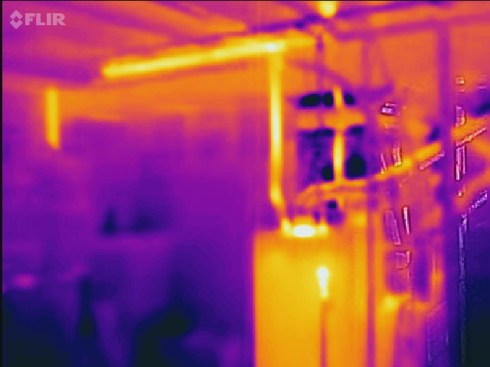
FLIR ONE image of a gas hot water heater under ordinary operating conditions

FLIR ONE image of a gas hot water heater under ordinary operating conditions

The second image shows a basement gas hot water heater and the hot water output line directed upwards to the floor joists. The hot water lines are insulated with closed cell polymer foam insulation from the local hardware store. The water heater has nothing more than the factory equipped insulation.

The FLIR ONE indicates infrared temperatures by way of false color images and spot temperature readings. But temperature readings from IR thermometry are not the whole story when it comes to understanding fugitive heat losses, radiative or otherwise.

An IR image shows surface temperatures based on assumptions on average emissivity and scaling through the Stefan-Boltzmann law. The amount of radiant energy emitted by a black body is defined by the Stefan-Boltzmann law. A plot is shown here. Emissivity is the quotient of emitted energy from a surface divided by that emitted by a black body radiator at the same temperature. Every surface has a characteristic emissivity based on its composition.  According to the linked emissivity table, polished aluminum has an emissivity of 0.095; concrete 0.95; mercury, 0.12; sanded spruce, 0.82; and white lacquer, 0.95. All these values are at 100 °C.

Home water heater. Aluminum foil on vertical hot water feed line

Home water heater. Aluminum foil on vertical hot water feed line

In the third photo, a 1 ft x 1 ft piece of aluminum foil was wrapped around a stretch of the insulated hot water feed line above the heater, as shown in the photo. The foil is in thermal contact with the foam insulation on the 3/4″ copper pipe. Hot water was run for a few minutes to draw heated water into the plumbing. Caution should be taken in that IR radiation does reflect off of surfaces which may lead to inaccurate conclusions about heat flow in the system in question. Above, the aluminum foil is reflecting some IR from another source. Up close and from another angle the foil appears much cooler than it is.

Plainly the emissivity of the highly heat conductive aluminum is different from the foam insulated pipe. The foil is in thermal contact with the foam and should be near the temperature of the foam surface, but the false color image suggests that the foil temperature is lower in temperature. Because of its much lower emissivity (ca. 10 % of foam) the foil only appears to be cooler. The foil is less radiant than the foam which has an emissivity of ~0.90.

Polished aluminum has high thermal conductivity but low IR emissivity. Foam, which has high IR emissivity (see images), is known for it’s insulating properties. And by that we mean, foam is a poor conductor of heat. What aluminum lacks in emissivity, it more than makes up for in conductivity. And while foam lacks in conductivity, it appears to be an efficient emitter of IR.

It is useful to mention the meaning of “insulation“. A material that conducts thermal power poorly can be said to have insulating properties. Thermal power (dq/dt) is the flow rate of thermal energy (q) per second. Thermal power is the rate of flow in Joules per second. For reference, one Joule per second is one Watt. The valuable attribute of a thermal insulator is that it can resist the quantity of power (Watts) flowing through a unit area such as a square meter. The amount of thermal power moving across a unit area, like a surface, is called heat flux and is in units of W/m^2.  It is common to express thermal resistance through a material by the R-value. An R-value is the ratio of the temperature drop (ΔT) across the insulating material to the heat flux through it, Q:  R = ΔT/Q.  So, as the heat flux gets smaller for a given ΔT, R grows larger in magnitude. In practical terms, a large R-value is desirable for insulation.

Looking at the radiant stretch of emissive insulated pipe rising from the water heater, we might initially guess that the IR image shows the whole thermal picture. But really, this guess is muddied by details. A warm pipe will be radiating energy as well as losing heat by conduction to whatever it is in contact with and by air convection.

IR radiation thermometry is useful when measuring a surface temperature is not practical. Accuracy, however, will depend on the emissivity of the surfaces of interest. The FLIR ONE is an economical imaging device for capturing IR images of large areas. The spot temperature feature is useful for recording the temperature of desired objects. Image files are easily downloaded from the phone and manipulated as jpeg files. Users will find many good applications for this affordable and easy to use IR imaging system.

Easy and cheap is great, but it is advisable for those wanting to do commercial work with IR thermography to take credible coursework and obtain some credentials. There are a few subtleties to thermography and it is best to be a little overqualified than not. Thermography courses can be found on the internet.


Magnesium still surprises a fellow

I have spent some time researching basic magnesium chemistry. Not anything synthetic but more safety and thermochemically related. I am not able to give a lot of particulars motivating the study, but I can say that one should consider that nitrogen over activated magnesium may not be as innocent as you think. While lithium is widely known to react with nitrogen gas to form a passivating nitride layer, the reaction of dinitrogen with magnesium is rarely encountered.

Activated magnesium residues from a Grignard or other magnesium metallation reaction may self-heat to incandescence under a nitrogen atmosphere in the right circumstances. Activated residues left isolated on the reactor wall or other features in a nitrogen blanketed reactor during an aqueous quenching procedure may self-heat to incandescence. In the presence of reactive gas-phase components like water vapor in nitrogen, activated metals can self-heat over an induction period of minutes to hours or longer.

Many metals, including magnesium and aluminum, can be rendered kinetically stable to air or humidity by the formation of a protective oxide layer. Once heated to some onset temperature by a low activation reaction, penetration of the protective layer by reactive gas composition can occur, leading to an exothermic reaction.

Performing a “kill reaction” or a quench of a reactive metal at the bench or at scale is always problematic and requires the skill and close attention of the process chemists and operators. I guess what I’d like to pass on is that nitrogen is not an innocent spectator in the presence of finely divided, activated magnesium. Humid nitrogen can support a combustion reaction to produce nitrided magnesium once preheated to an onset temperature.

If you mean to kill any reactive residues, it is important to apply the quenching agent in such a manner that the heat generated can be readily absorbed in the quenching medium itself. A good example of a quenching agent is water. Often a reactive must be killed slowly due to gas generation or some particular. Adding a quenching agent to a solution or slurry by slow feed or titration may be your best bet. If you have another vessel available, a feed to a chilled quenching agent will also work.  Dribs and drabs of water on a neat reactive material will lead to hotspots that may be incendive.