Category Archives: Science

Americans and Distrust of Science

The news feeds are piping articles across the internets about Americans and their views on matters of science. Of particular interest is the finding that 51 % of respondents expressed a lack of confidence in matters of the big bang and cosmic origins and age. Predictably, scientific models of human origins and evolutionary science also elicited a considerable lack of confidence.

As the linked article in The Atlantic suggests, there is nothing new in America about ignorance of science and its panoply of theories, models, images and data. I’ve come to believe that wide spread ignorance of science may be contracting a bit. Some folks might be a little less refractory to science if gently brought into the discussion.  It is especially evident when you engage someone in conversation about the concepts with which they might anonymously criticize in a survey. Often if you can get a person past a key mechanistic concept, their dogmatic view of things may soften.

Scientists tend to look at new things analytically and with skepticism. Others may have a devotional world view. The devotional approach is the programming language of faith in and preservation of doctrines. For the scientist, the goal is to strip doctrines to their bare mathematical essence- a single equation that describes the relationships between variables and fundamental constants. If something is observed, measurements can be taken.

Molecular medicine and microbiology unavoidably force one to come face to face with the plasticity of DNA and the short term variability of genetic change. Resistance to drugs or the spread of BT or glyphosate resistant traits into insect and weed populations are a great entry point for talking about molecular evolution. It also allows one to get away from the troublesome paradigm of Darwin, whose work carries religious baggage for many. Irrespective of what Darwin wrote, modern molecular biologists would have eventually postulated and substantiated evolution from the molecule up, as opposed to the Finch down. The Darwin model of evolution has become tired and a little worn. We really should be giving more credit to molecular biology for advances in the understanding of genetic change.

I think those who have devoted their lives to understanding science tend to forget the tremendous expenditure of time and effort that goes into a deep  and quantitative understanding of nature.  My experience in teaching and in public outreach in science has been that a great many people are willing to be entertained by presentations on extrema, that is, the biggest, the most powerful, the most dangerous, the most poisonous, etc. Folks like to hear about extreme phenomena and scientists are only too happy to talk about the dangers of black holes or volcanoes or ferocious animals.  One can spend an evening talking about such things to a general audience and go home with the impression that the public eats this stuff up.

However, if you closely converse with your audience, you may find in many that their interest is genuine but superficial. They are entertained by the gosh-wow aspects of astronomy, but are unwilling to commit the time and effort to enough study to be competent in a topic. They often only want to see the moon through a large telescope and then go home. This is just human nature and science folk cannot be offended by the slender attention span of the public. Learning science requires a good deal of work and focus. That a large slice of the population is suspicious of the big bang theory suggests that said population has not made the time and energy commitment to learning the science.

Getting the pay out of pay dirt

This is an excerpt from a writing project I’m working on.

The impulse to find and extract gold and silver was one of the drivers of 19th century westward expansion in North America.  The discovery of gold in a California stream bed in 1849 and the subsequent discovery of gold and silver in other territories eastward to Pikes Peak and the Black Hills resulted in waves of migration of prospectors, merchants, investors, and swindlers from all directions, including Europe.

The staking of mineral claims in the American west by people who were engaged in the extraction of mineral wealth lead to an inevitable avalanche of settlers interested in tapping some of the wealth of the miners themselves. The open territory created a void that was filled by industrialists, merchants, government, and perhaps most importantly, the railroad. Miners needed supplies and their ore concentrates required transportation and beneficiation.

As claims were made on valuable mineral deposits, the outline of the geographical distribution of mineral value in a region eventually defined what came to be known as a district. The expansion of the railroad, sweetened by land grants, added permanence to the settlement of many regions around and en route to the mining districts.  The simple logistical requirement of frequent stops to fill the steam locomotive with water lead to the establishment of towns along the railway. This expanding transportation network, along with liberal access to land, lead to settlement by farmers and ranchers who then created a demand for goods exported from long distances by rail.

The history of man’s fascination with gold and other metals is well documented and there is no need to reiterate that saga in the present work. The mania for gold and silver in the west is legendary. Indeed, clues to the history of gold and silver mining in the American west are quite apparent even to the casual observer today. A drive to Cripple Creek or Central City in Colorado will take the motorist past a great many long abandoned mine dumps, prospect holes, adits, and antiquated mineshaft head works. These quiet features of the landscape mark the location of what was in times past a great and bustling industry.

Throughout the American west today there are many “tourist mines” and mining museums operated by individuals and organizations who recognize the importance of keeping this part of our cultural heritage alive. Through their efforts, visitors can view 19th century mining technology on site and experience the dark and eerily silent realm of the miner. Visitors can see for themselves the intense and sustained effort required in hard rock mining and the occupational hazards miners were exposed to.

The tourist mines and museums often focus on the activity of mining itself as well as the specialized equipment needed to blast the rock and muck it out of the mine. This is only natural. The gold and silver rushes left behind a large number of artifacts. These items are of general interest to all.

The technology that is often glossed over relates the matter of getting the pay out of the pay dirt. Indeed, this is a central challenge to gold and silver extraction. Once the streams have been depleted of placer gold and the vein or lode has been discovered somewhere up the mountainside, the business of extracting gold or silver from hard rock becomes technically much more challenging and capital intensive.

The panning and sluicing of placer or alluvial gold, while labor intensive, is conceptually easy to grasp. High density gold particles can be transported by suspension in a water slurry of the water is moving sufficiently fast. Gold particles will tend to settle at low points in a crevice or a gold pan where the stream velocity slows. A gold pan or the bend in a stream for that matter will have a flow gradient that will tend to collect the gold particles where the stream velocity slows.  A sluice or a Wilfley table are just devices designed to trip laminar fluid flow by inducing turbulence to encourage the denser gold particles to settle. Riffles or channels serve to concentrate the gold particles.

While gravity and clever tricks with fluid flow can be used to collect placer gold, isolating gold or silver from a hard rock ore body is quite a different challenge.  Gold and silver may exist in reduced form within the ore. They may also be found alloyed with one another or otherwise combined with other heavy elements. While gold tends to be inert even under oxygenated conditions near the surface, silver is subject to more facile oxidation and may be found in ionic form with several anionic species. Thus technology for the isolation of gold may not serve as an exact template for silver extraction and isolation.

Gold or silver may exist in the metallic form as bodies visible to the naked eye within the solid rock. Or they may be dispersed in microscopic elemental form throughout the ore body. Gold ore may be rich in elements that complicate its isolation even though the gold is in reduced form.  Silver ore is commonly found in ionic form and with numerous ionic base metals present.

Disseminated gold or silver, that is, gold and silver found dispersed in an ore body, were subject to considerable variation in mineral composition. As a result, differences in isolation techniques and process economics arose among the various operations. Today cyanidation predominates with these ores.

In the 19th century a considerable body of chemical knowledge evolved as the gold and silver rushes progressed. This chemical knowledge was put into practice largely through the efforts of mining engineers.  It was not uncommon for the mining engineer to conceive of what today would be considered a process chemistry change, draw up plans, press the ownership for funding, and put the change into operation.

Twenty-first century chemists may recognize much of the nomenclature from this period as well as the intended inorganic transformations. However, the older literature is filled with obsolete nomenclature or that which is confined to the mining industry.  What should be apparent to the observant reader is the level of sophistication possessed by 19th century metallurgists and engineers in what chemists today might refer to as the “workup”.  That is, the series of isolation steps used to remove undesired components to afford a reasonably clean metal product. Mining engineers refer to this as beneficiation or as extractive metallurgy. Beneficiation of lode gold and lode silver involved chemical transformation in batch or continuous processing.

The story of the development of extractive metallurgy is in part the story of redox chemistry on complex compositions like rock. In the mid 16th century Europe, key individuals like Biringuccio, Agricola, and Ercker began to capture mining and extractive metallurgical technology in print. Vannoccio Biringuccio (1480-1539) published his De la pirotechnia in 1540, detailing economical methods of metallurgy and assaying. In 1556, the work of Georg Bauer (“Agricola”, 1494-1555) was published posthumously. His De re metallica is regarded as a classic of metallurgy. Agricola’s book describes the practical issues related to mining, smelting, and assay work and is illustrated with remarkable woodcuts.

By the year 1520, do-it-yourself books like Ein nützlich Bergbüchlein (A useful mountain booklet) and Probierbüchlein were beginning to appear in Europe describing basic mining and metallurgy techniques.[1] By this time methods of cupellation and the separation of gold and silver were committed to print.

Cupellation is an assay technique wherein crucibles made of bone ash were used to fire prepared gold ore samples with an oxidizer, affording base metal oxides which then separated from the gold and absorbed into the crucible to afford an isolated button of gold.


[1] Aaron J. Ihde, The Development of Modern Chemistry, 1964, pp 22-24; Dover Reprint 1984, QD11.I44, ISBN 0-486-64235-6.

The Adenocarcinoma Chronicles.

2/23/14

Five months past treatment for throat cancer I will set aside The Squamous Chronicles and instead post The Adenocarcinoma Chronicles. Having won the advanced prostate cancer lottery as well, my current adventures involve treatment below the beltline.  Here are my impressions of the experience to date.

Physicians, or more specifically in this context, oncologists, are ethically constrained to apply agreed upon treatments for the indications presented by the patient. I have gotten no “off-label” kind of advice up to now. In my case, my PSA was 39 and the biopsy readings from the pathologist were assigned Gleason 9. Well, sonofabitch. That was a fine kettle of fish. Looks like my watchful waiting was long in the waiting and too light in the watchfulness.

The standard treatment regimen in my case is hormone ablation and radiation. For hormone ablation I have had Degarelix and Lupron. For radiation I have begun IMRT (Intensity Modulated Radiation Therapy) with a dose of 76 Gy to the targeted tissue mass. I asked about scatter dose to the testes just because of the obvious proximity. The Rad Onc looked it up and said it was 1 Gy. I then pointed out that I’ve had a goodly bit of radiation in the last year and was there anyone who keeps a running total on the cumulative dose? As expected, the answer was “no” followed quickly by the standard rationale that the disease was far more dangerous than the radiation. I’d say the same thing I suppose.

Things that my docs are reluctant to offer are opinions on how this whole disease plays out. There seem to be several elements to this reticence. First, predicting the future is difficult, especially with a stochastic phenomenon like cancer radiotherapy. Second, there are good reasons for the doc to not focus on gloomy topics like life expectancy, especially if the survival stats are not the best. Most people at some point spontaneously think of cancer as a death sentence. At present I view it as a chronic condition that will play out stepwise in terms of a convergent treatment and remission series that eventually ends with refractory and widespread disease. Seems pretty obvious. It is the time-scale that I am uncertain of.

I am writing about this because my treatment regimen seems relatively ordinary to this point given the status of the condition. Perhaps there are some fellows who have yet to climb on this train who are uncertain of where it goes. This is my journey and I’ll pass along my notes.

Update 3/13/14

Now 14 treatments into radiation. With the help of medical textbooks ordered from Amazon, I have slowly been learning more about the disease and the treatment. During my weekly consult with the Rad-Onc I asked the question- “What was the T number from the pathologists notes?” He replied it was T3c N1.  The N1 means there is a node involved so it’s Stage 4 cancer. No one actually came out and said this to me so I had to ask. It is one thing to suspect it and another to hear it. Hard to say if this knowledge is in some way empowering.

Gaussling’s 15th Epistle to the Bohemians. Thoughts of a Secularist Liberal Scientist.

If you knew me personally, you’d know that as a reductionist my profile can be reduced to that of a liberal atheist scientist with marginally good manners. I broke the shackles of magical thinking in high school after reading a few books by Bertrand Russell and Carl Sagan. Though I have not been the same since, I have come to sympathize a bit with Quakers and their predilection for peace.

My religious upbringing was quite ordinary for a young Iowegian lad in the 1960’s. Confirmation in the Lutheran Church (Missouri Synod) in 8th grade followed by a short stint as a reluctant acolyte. The church seemed firmly footed in bedrock as an institution and adept at indoctrinating the young. In catechism studies I tried to understand the authoritarian system that is outlined by Martin Luther and the strange collection of narratives that make up the King James Bible.

There were abstractions that didn’t make sense then and are still a mystery to me today. The concept of the Holy Trinity always seemed suspiciously anthropomorphic. Then there is the crucifixion as a kind of “ghostly sorting mechanism” for salvation. It stands out against the backdrop of natural phenomena like physics and biology- mechanistic systems which seem to suffice for everything else. Finally, there is God’s seemingly endless requirement for worship and admiration which has always struck me as a vanity unnecessary for a supreme being. The whole scheme reeks of iron-age anthropology.

I remember the day it happened. I was praying for something or other. Trying to have a little spiritual time with the Big Guy. It finally dawned on me that I was talking to myself and in doing so, wishing for some particular outcome to happen. All those years. Praying and wishing were indistinguishable. I’ll admit, I was never one to volunteer a lot of praise to God. Heaping praise on a deity seemed patronizing and wholly unnecessary. Surely if God could elicit wrath, then he’d certainly pick up on being flattered.

Well, in the end, so what? Another tedious atheist commits apostasy. Like most people in US culture, my moral basis was built on what has been described as Judeo-Christian morals or ethics. It’s hard to avoid. But just as the earth does not rest on a foundation, I am not limited to sensibilities derived only by the sons of Abraham in a far earlier age. My culture and my brain tell me that theft, murder, and the other spiritual crimes (sins) are bad for the common good. That respect for others has a pleasurable and sensible aspect that threats of eternal damnation do not improve on.

The reductionist in me can’t resist the following assertion. Deistic religion reduces to cosmology. In the end, a religion offers a theory of the universe. It is a kind of physics that defines relationships between the prime mover and his (?) bipedal subjects imbued with mystical sensitivities. It claims to define the outcome of the disposition of a soul, whatever that may be.  I don’t even believe in the existence of the mind, much less a soul.  As a form of physics, religion lacks means by which theories can be tested. Quantitation of a spiritual element is an idea that has yet to see practice. It seems to lack predictive capability to estimate an outcome that can be validated. It is definitely not a science. It is not about matter or energy. It is about how to conduct ones life against a backdrop of divine authority and within a box of behaviors.

But our brains seem to be constructed in a manner such that religious/spiritual notions are nearly irresistible. Billions of people have claimed to feel its draw and testify to its merits. The projection of anthropomorphic imagery in myth is common in diverse cultures.  The Abrahamic religions congealed from cultures that were apparently unaware of the concept of zero. Where heaven is death with a plus sign, hell is death with a negative sign. To an atheist death is just zero. It has no sign or magnitude. It is unconsciousness and devoid of the awareness of pain or pleasure. Zero sensory processing. It is neither exaltation nor agony. Just zero. Entropy prevails. Such an outlook is hardly appealing enough to gather followers. It is grim and without hope of graduation to eternal bliss.  The take home lesson is to live in the moment, not the future.

Who am I to argue with millennia of religious thought? I don’t know. All I can say is that even as a cancer patient, I remain refractory to the pull of religious and mystical thinking. So it was and so it is.

Post script.

Divinity students! Relax. I’m no threat to your faith. My conclusions on this life of ours offers no ceremony and precious little fellowship. I can say that I’ve had an eye-full of the clockwork of this universe. Adherence to evangelical doctrines could not have provided the amazing insights. And for that I have no regrets.

Lithium Fires

Ran into an interesting recommendation on fighting a lithium fire in Joshi, D.K., et al, Organic Process Research & Development, 2005, 9, 997-1002.

In addition to the usual admonitions on the handling of a reactive metal like Li, they warned that water, sand, carbon dioxide, dry chemical, or halon should not be used. Rather, they suggest dry graphite or lithium chloride instead.  This seems quite reasonable to me, having reacted both silica and CO2 with magnesium powder in chemical demonstrations in a previous life. If Mg will reduce SiO2 and CO2, then hot/burning lithium ought to be reactive as well.

A similar recommendation is given in Furr, A.K. CRC Handbook of Laboratory Safety, 5th Edition, p. 299, ISBN 0-8493-2523-4.

Chemical Process Development

Lots of semi-batch process development and safety work going on in my lab. We use our reaction calorimeter for a variety of studies now. Naturally we want to know about energy accumulation with a given feed rate or any unforeseen induction or initiation problems in a reaction. We can also home in on recommendations for safe feed rates of reactants into a reaction mass.

What I am beginning to learn from the RC1 work is that running a reaction at low temperature is frequently done for sketchy reasons. Unless there are selectivity or side product issues, you really have to question why the reaction is specified to be run at low temperature. I think some of it comes from habit gained in grad school.  Low temperature may introduce dangerous situations with abrupt initiation by accumulation of unreacted reagents. Or it may lead to overly long feed time with the associated costs of added plant time and labor.

There are reagent incompatibilities like nBuLi in THF above – 15 C or so. But you’ll find that MeTHF is a bit more tolerant of temperature than is THF.

The precise temperature management capabilities (Tr) of an RC1 including the ability to lock on a temperature or precision ramping gives insight on solubility questions or on freezing points. The instrument also provides heat capacity data for engineering calculations. it is a very useful apparatus.

The Squamous Chronicles: A flea market of side effects.

So, here I am wide awake trying to recall what the Ambien molecule looks like. I’ll probably have to look it up.

Later this morning is my 3rd chemo treatment of 6. Something is knocking me down. The x- radiation plainly has been doing what it does best- giving a 3-D sunburn. The throat is developing mucositis and Is crazy sore. Blistering should start soon.

I’m using magic mouthwash, comprised of lidocaine, benedryl, and Maalox. This pharmacy concoction has the snotty rheology of melted ice cream.  The throat issue is definitely interfering with getting enough calories for body weight maintenance. Have lost ca 10 lbs to date. I’m gonna get a talkin’ to from the dietitian today.

Other than sore throat, the next unpleasant drug side effects are those from the anti-nausea meds. The anti-emetic meds prevent one from hurling through a sore throat. They are also very effective at constipation. So, one gets to know the offerings at Walgreens.

The Squamous Chronicles. I am a platinum ligand.

This afternoon I’ll get my 7th dose of 1.8 Gy of x-rays on the way to 54 Gy. The machine doing the deed is a Varian IMRT. It is a very impressive bit of technology. It has a continuously variable aperture and intensity. The rad tech opened the access panels up for me yesterday and showed me the innards. There is a rather large microwave generator inside with waveguides piping energy … somewhere. She said this TrueBeam system could also do electron beam therapy. The machine has a built-in CT scanner to verify that the sorry sod strapped in is aligned properly.

Last Monday I officially became a ligand for platinum. Got the first dose of cis-platin. Somewhere I have molecules- DNA- that are ligated as Pt complexes. The first dose hasn’t been much of an issue. The anti-nausea meds definitely have side effects though.

Five more weeks and 5 more cis-platin doses to go. Week one was without serious side effects thanks to Dulcolax.

Ice stalks. A winter oddity.

Yesterday I placed clay sorbent granules on my steep, north facing driveway to add some friction so the car and visitors can negotiate the grade in the snow and ice. The clay granules are used for absorbing oil and are similar to cat litter. I used the granules because I did not have sand.

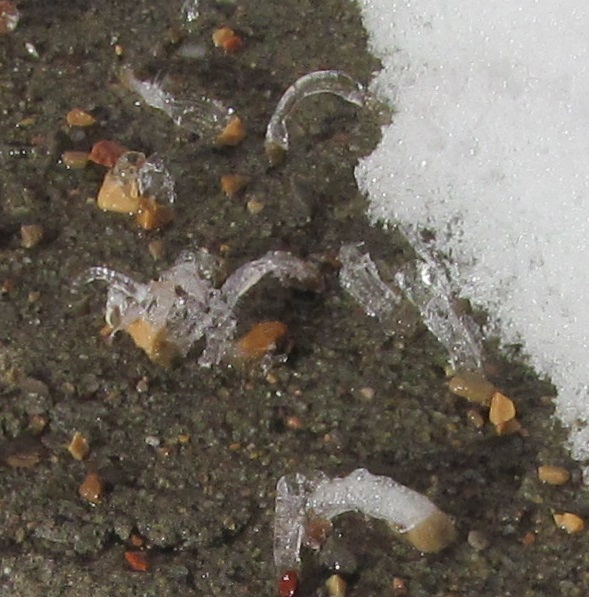
Curious ice formation. Copyright 2013 Th' Gaussling.

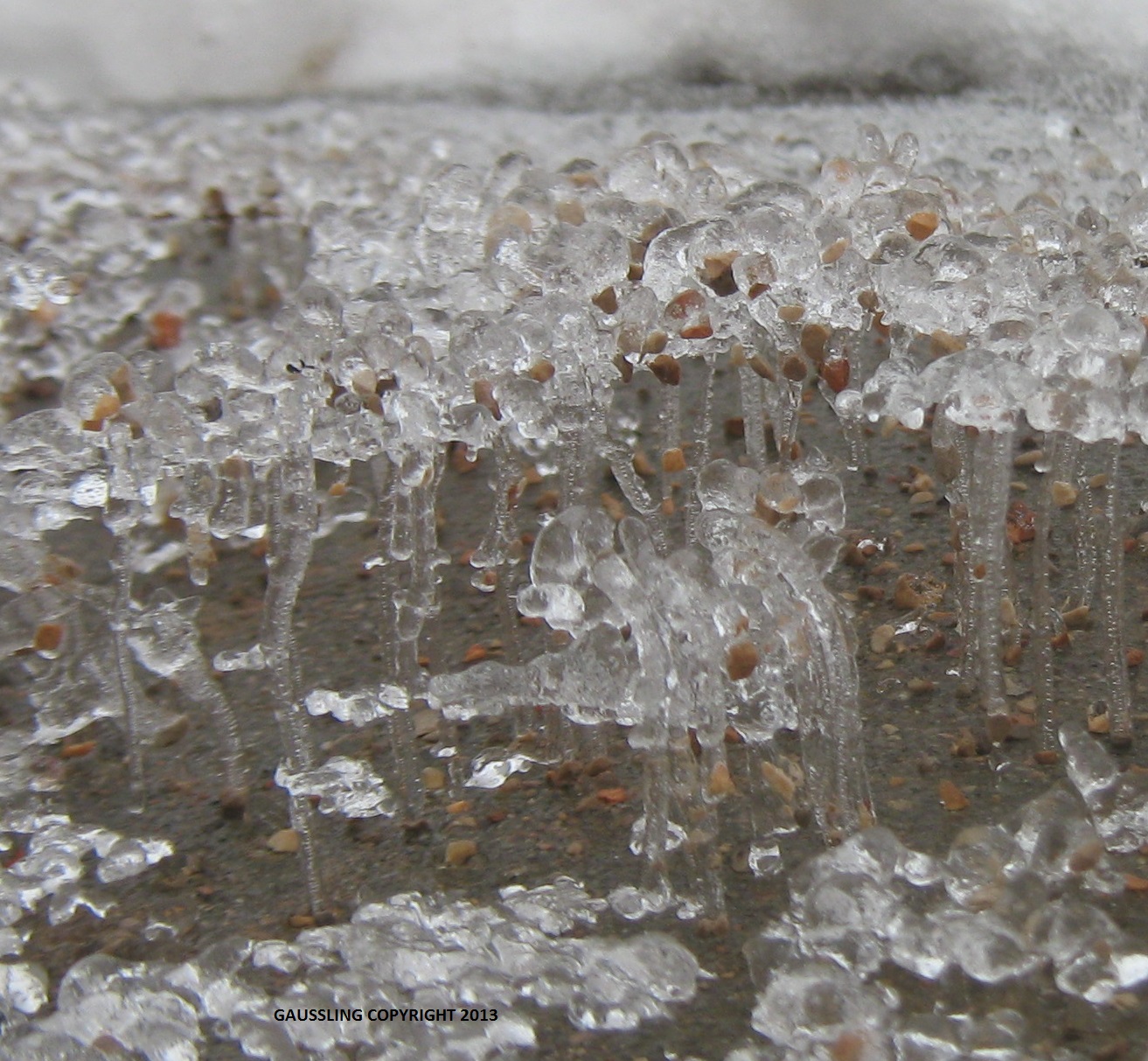
Ice stalk formation. Note that many of the clay granules have been lifted by the slender stalks of ice. Copyright 2013 Th’ Gaussling.

The granules were deposited on freshly shoveled concrete with just a thin layer of clear slush. I would estimate that, overnight, the temperature ranged between 25-32 F. In the morning, the 1-5 cm stalks of ice were observed only where the granules were deposited.

The slender stalks were capped with flat, irregular plates of ice.  Many of the stalks had lifted granules off the ground. Most appear to have arisen from the granules. Obviously, the process forming the stalks lifted some of the granules and ice vertically. Curved ice stalks appear to have extruded gradually from the granule and, under the influence of gradually shifting cover of snow or other ices, have extended produced a curved shaft of ice.

The granules are manufactured with absorbency in mind.  In this circumstance, I will hypothesize that capillary action pulling liquid water from the concrete surface is delivered to the upper surface of the granule where it freezes at the air/water interface by evaporative cooling. Why it doesn’t just stop is puzzling. Perhaps the action of freezing at the granule upper surface reduces the vapor pressure of water enough to induce a small pressure drop through the pores of the clay that draws liquid phase to the surface where is freezes continuously. The heat of fusion at the surface may be sufficient to prevent freezing of the water within the pores of the granule in the subfreezing range of the air and shutting the process down.

Ice Stalks 2

This is a very curious type of ice formation, one that I have observed on two separate occasions. This is another odd thing water can do.