I want to call out Canada’s prime minister Carney for his well crafted speech at the 2026 Davos World Economic Forum. Maybe Canada should annex the USA rather than the other way around.
It is painful, embarrassing and sickening to watch the Trump administration methodically driving our great country off the road and into the weeds of blatant unilateralism. Listening to the despicable White House aid Stephen Miller speaking about the need for the USA to exercise its strength by threatening the world with the Trump administration’s aims at conquest is deeply distressing.
The Trump problem in the USA stems from his ring of back room schemers and, most importantly, the voters who put him in power … twice. Many of us were surprised at the magnitude of MAGA discontent and anger at the status quo. The various polls I’ve seen show that of the fraction of voters responding, about 30 % support Trump consistently. The remaining Trump voters seem to think that he is tolerable and, by default, a less terrible choice than the Democratic candidate.
Not being a political scientist, sociologist, economist or anthropologist I must restrain myself from anything more than superficial commentary. That said, what strikes me is the gap between voter confidence and their grasp of the consequences of having Trump in high office. It appears that many voters possess a wildly insufficient education in civics and history. Instead, that knowledge void is packed with bullshit. Before the internet and instant access to news and opinion, the movement of news was through narrower channels that spread poorly. Controversies were more sluggish and mob mentalities perhaps slower to spread. Today there is a hair trigger on personal political opinion for a great many.
Today any individual with half-baked opinions can potentially incite unrest even at a great distance with fake news and recently with AI produced images. And energized with Christian nationalist ideology, people can cite supernatural powers to justify their insane political views. Political ideology justified by supernatural forces is impossible to reason with.
The people who have been complaining about the poor quality of American education were right all along. A third of the US population is unable to discern why Trump is a disaster for America and the huge hit our democracy is facing. This is largely an education problem and those adults so afflicted can be expected to carry their ignorance and poor judgement to their graves.The critical mass (of idiots) for this disaster is smaller than many of us thought. I am unable to fathom how this might be changed for the better.
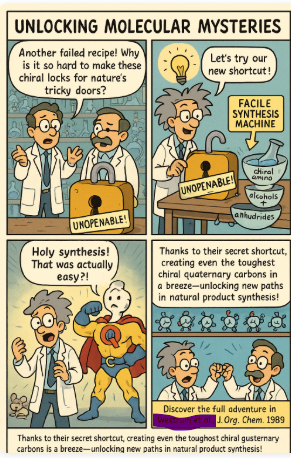
I received an email from Academia.org stating that they could turn a research paper which they suggested into a cartoon. Well, what could I do but give it a try?
Cartoon based on a my paper of mine in JOC (long ago) on the facile synthesis of molecules with chiral, enantiomerically pure quaternary carbons. It was a synthetic methodology paper.
Considering that the cartoon has only 4 panels to it, this isn’t so terrible. The title of the paper did have some ordinary vocabulary in it like: the, of, and pure. Isn’t that enough for everyone? Crimony!
In truth this “service” is meant to tickle my funny bone enough to lower my cheapskate defenses, hopefully causing me to subscribe to their service. It didn’t work, this time.
The “facile synthesis machine” is up there with the “Wayback Machine” in terms of wishful thinking.
Summary: This essay addresses the important role the federal government has played in promoting the American march of progress. The old saying that “Necessity is the Mother of Invention” has a large element of truth to it. It is not enough to identify a problem or challenge. For a person, group or organization to solve a technological problem or challenge, the goal must be understood completely, resources acquired, a plan must be constructed and approved by those who control the purse strings, and skilled people must be organized and set to work on the matter at hand.
The federal government can provide the Necessity needed for attention and resources put to play in achieving a goal. For instance, NASA will set a goal and is able to open a project up for bid. The gov’t can provide seed money to the contractor for prototype equipment to present with their bid. Government grants provide the necessity to stimulate invention, hopefully on a competitive basis.
……………………
I have been a lifelong aerospace enthusiast from Project Mercury forward to the present day. What I’m realizing, however, is that I’m increasingly skeptical of the value of further manned space flight by NASA. Whatever the 6 successful manned Apollo landing missions on the moon may have found tramping around the regolith up there, evidently not enough value was found to compel the USA to go back. Obviously, the Apollo program was partially a geopolitical stunt to rival the USSR for prestige and by many measures the USA won. But what did we win? Prestige and a great many valuable technological spin-offs.
In the early 1960’s the US government financed and organized JFK’s challenge of landing a man on the moon and returning him safely to Earth by the end of the decade. Our government allocated considerable national treasure to the moon landing project and put lives on the line. Arguably, of greater importance than a round trip to the moon was the powerful boost to aerospace, computer, and other technologies. The technology-push advances funded by the government would soon become important economic drivers for industry.
In fulfilling Kennedy’s challenge there was both popular excitement about the space program and more than a little skepticism. The USA was increasingly bogged down with the Viet Nam war. Into the early 1970s, the western geopolitical argument about the advances of communism, the Domino Theory, was still cited, but it was gradually weakened by lack of popular support for the war and the loss of American blood and treasure invested in keeping communist influences out of southeast Asia. By the mid 1970’s, the US had pulled out of Viet Nam leaving behind millions of casualties and little to show for the effort. Added to Southeast Asia was the self-destructive meddling with the Cuban communist state. Castro died of old age in his communist bed.
There is an old saying that went “He’d complain if they hung him with a brand-new rope”. The suggestion was that some folks would complain about simply anything. Beyond the geopolitical and apparent military threat of the USSR beating the US into space were the much-ballyhooed technological benefits of the program. One of the oft-cited spin-offs was a Teflon coating for frying pans. It was an example that most citizens would understand and appreciate. Many incorrectly believed that NASA invented Teflon. Actually, Teflon was discovered unexpectedly in 1938 by the DuPont chemist Roy Plunkett.
Libertarians have argued (to my face) that if we wanted non-stick Teflon frying pans, why not just invent it? The introduction of any new and revolutionary product by a corporation carries financial risk and possible loss of reputation. The vaunted contribution of NASA to perfluorocarbon (PTFE) polymers was to push forward projects that required PTFE specifications. Industry did the rest by finely developing technology for PTFE production to meet the demand. Once there was an inkling of demand, industry kicked into gear. It was market-pull by that time.
NASA is very much in the technology-push world whereas many businesses are more safely oriented to market-pull. Technology-push is about invention of leading-edge vehicles, equipment, substances, instrumentation or services. Technology-push requires early adopters willing to wager that the new tech will give them a competitive edge. Government provides a ready-made early adopter.
Market-pull is where a manufacturer produces known or existing products and services. They compete by offering better availability, price and quality than their competitors.
Technology-push is the world of the tech startup. A start-up founder has a product or service that is sure to be a hit if only their products could get manufactured and pushed into the market. Tech investors will examine the startup’s business and financial plans and take a closer look at the technology or service to be offered. Is there a prototype? Is valuable intellectual property protected under patent? How stable is the supply chain or is there one? Will the company be sustained on the tech product only or will consumables be produced as well.
Importantly, is the technology-push startup looking to produce just a single product or is the technology expandible across a spectrum of applications? What if the product performs below acceptable tolerances or simply fails in the field? A startup with everything invested in a single product model is a “One-Act Pony”. Wonderful though the One-Act Pony may be, it can get sick and die in the marketplace. It can grow old and obsolete, giving way to falling sales and the mad scramble to develop a replacement product. I’ve been a part of 2 startups hoping to produce one-act ponies. The ponies died and we hit the streets.
Investors can analyze market-pull business plans by looking at the economics of demand as well as distribution of existing or similar products. Annual sales can be estimated, EBITDAs calculated, and profit margins uncovered. If the profit picture fits the general business model and timeline of the investors, they can release funding rounds to the startup with benchmarks to be met.
Necessity as the mother of invention?
In normal circumstances, industry operated by ambitious people may be motivated to advance their technology skillset to realize entry into new and promising markets. However, that said, an industry that only acts to match technological advances set by competitors is not showing the mettle required to launch a new paradigm in the technology-push manifold. Merely matching the competition does not quite describe a technology-pusher.
A technology-pusher is likely to find that they must walk the manufacturing highwire without a net and perhaps for a long time. Unless you are quite wealthy, launching a startup will likely hold personal financial risk. Commonly, external funding means that some percentage of ownership or shares will be given to the investors. By the time the product or service hits the market, the founders may find themselves as minority stockholders. Their dreams of grand wealth and influence is tempered by reality.
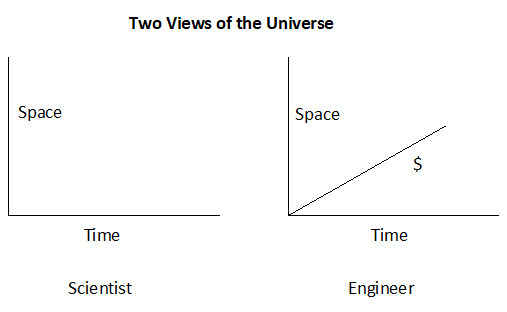
A naïve book-end view of technology pushers. Scientists are by nature more interested in phenomenology and naturally may see a two-dimensional universe of space and time. Scientists may gravitate to precision and accuracy while the engineer is also interested in not just precision and accuracy but also costs. When developing an engineering design, the engineers will constantly consider costs within the boundaries of space and time. Graphics by Arnold Ziffel.
A technology-push company is often started by engineers or scientists with experience in a particular subfield. Scientists commonly receive little or no business education as a degree requirement. Their role is the science guru. Engineers, on the other hand, fully understand the cost imperatives of a project and are able to design to remain within tight cost constraints.
In science, scientists are the main honchos. In business, engineers are the princes of the kingdom. They design projects, lead them, and come in on budget on time. A CEO with an engineering background is not at all unusual. They understand money part.
Everyone who has been through graduate chemistry has views on how to do it. I’m no different.
Here is my view: Advancement in academic chemistry requires a number of sequential situations that are advantageous to be a part of. First, your advanced chemistry degree should be done in the “right” subdiscipline. Everybody wants to attend a highly prestigious school where the faculty consult with the Gods of chemistry on Thursday afternoons. However, these schools are very competitive in their selection processes, and you may be denied admission for reasons that never become clear.
There is no doubt that if you want to become a professor at a major PhD granting institution, it’s best to have an ivy league pedigree in terms of schools and mentors. Having won a named fellowship as a grad student or postdoc is a good endorsement and always helpful. JACS publications are helpful as well.
Of course, there is more to it than that, but a top shelf pedigree can certainly help get an interview. A cutting-edge research proposal in 1 or 2 or 3 “hot” areas of science will be expected. Aim high for the big challenges in your field. Before any interviews, it is well worth reviewing the areas of research and general interest of the chemistry faculty at a prospective school. Examine the department for overall research productivity and balance. Is there a major player in or near your area of interest? Most chemistry departments are looking to staff up with specialists in up-and-coming areas of interest.
To stay alive a graduate chemistry program needs a constant flow of talented students parachuting in to fill the research groups and as TAs to teach undergraduate labs, proctor and grade exams, lead recitation sections between lecture sessions and hold office hours. Some schools will require at least 1 year of TA work and if your graduate mentor has money, he/she will hire you as a research assistant or RA.
Next, find a mentor/prof who is research-active in your area. How do you find them? In my opinion, a good way is to choose a graduate school with a prof/mentor who is well funded, tenured preferably, and has published numerous papers very recently. Put more emphasis on the profs available than the school. Such an individual situated thus has likely found a gold vein of opportunity that is fundable and at the leading edge of fundable science.
An important consequence of a well-funded mentor/prof is that you will likely be paid as a research assistant (RA) rather than as a teaching assistant (TA). A prof in this situation has a good chance of being well connected in academic space which will be very valuable in securing a plum industry, post-doc or academic position after graduation. Some chemistry profs consult for industry which may provide a valuable advantage for a good industrial job after graduation.
Your first job may not relate to your graduate work. Don’t worry, you’ll soon learn that your PhD is a union card that opens many doors. But never forget, there is a good bit of luck involved too. In an interview you never know what kind of faculty research a given school is looking for if any. Chemistry departments often want to swerve to a new area of expertise, or they may want to add to their present strengths. Coming from a renowned professor’s group may be the tipping point for you. Or they are looking for a good replacement candidate who they can also live with day to day. It’s good to know ahead of time.
I once interviewed at a public university chemistry department that was planning 22 contact hours from day 1 and required a healthy, fundable research program, but with not even a square foot of bench space and no NMR. They had a large pharmacy program and needed warm bodies to teach organic chemistry and labs. Two organic faculty members advised independently behind closed doors that I should not take the job. I thanked the department for the interview and declined the offer.
In general, throw your shyness overboard and be more outgoing and sociable. Dress and groom respectably. Be quick to laugh with others but know when to be serious. Always be honest and kind with people. Advancement in the chemical science world is more than knowledge of reaction mechanisms. There is a large social component that may not get you a job but will make your career more fun. Enjoy it.
Note to readers: The post formerly titled ‘Smartphone Chemistry: An Embarrassment of Riches‘ was poorly titled and has been disappeared. This is an updated version and one titled more appropriately.
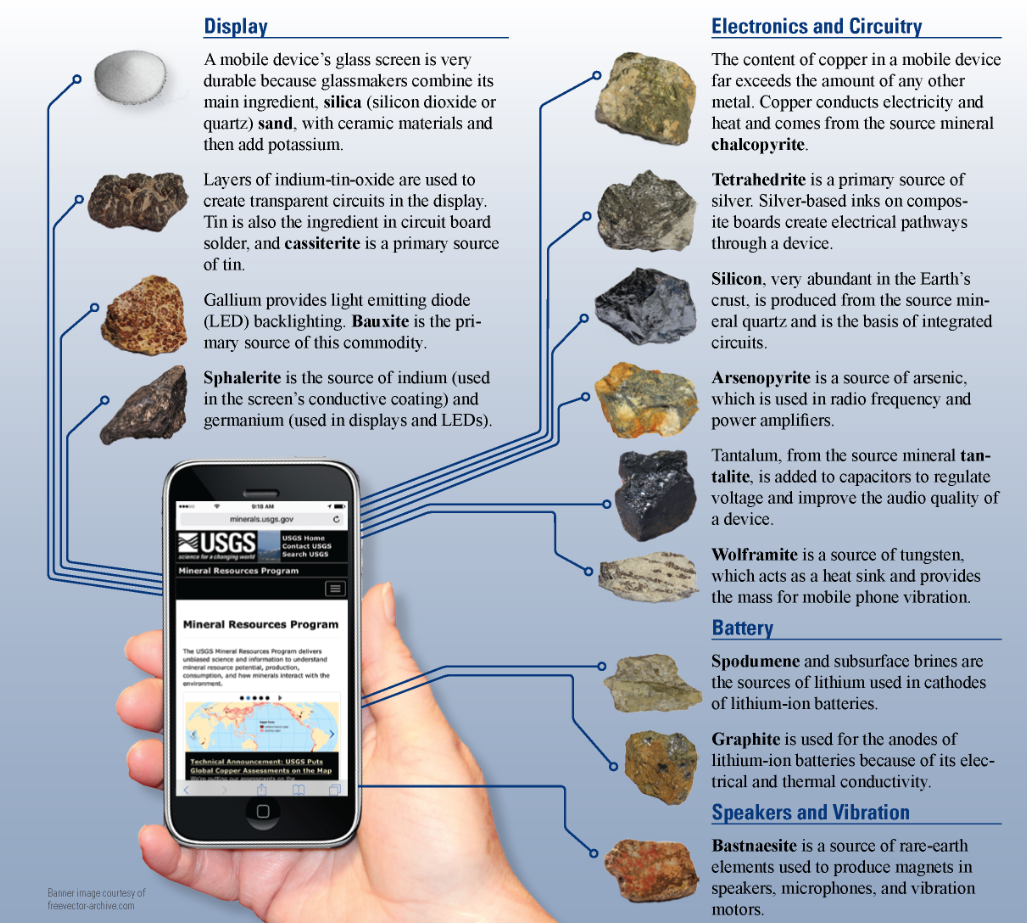
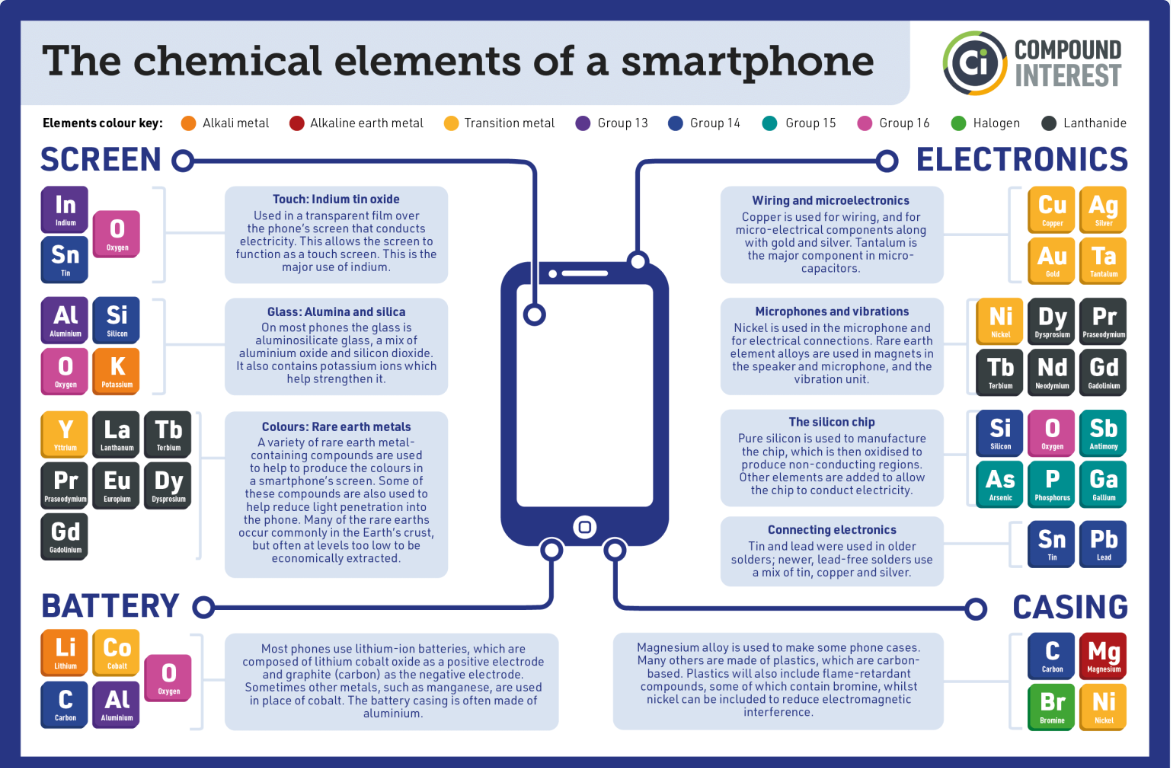
The modern smartphone is made from many different chemical elements, some much more scarce than others. The elements found in a smartphone are distributed around the world, with some countries being more favored by geology than others. With perhaps the exception of silica and silicon, the elements below are found in localized ore bodies that are enriched in particular elements in the form of minerals. ‘Enriched’ is a relative term meaning anywhere between a few 10s of percent to 100 parts per million or less. The word ‘enriched’ also implies another attribute wherein the extraction of the desired element is economically feasible. With the exception of carbon listed below, most of the elements are metals or metalloids. Metalloids are elements that are not entirely metallic but not entirely non-metallic either. Many are found in the p-block of the periodic table.
Source minerals for smartphone manufacture. This public domain image is provided by the USGS.
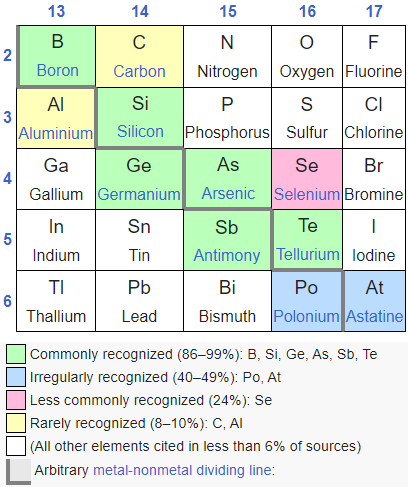
This intermediate chemical nature of the elements we call metalloids may seem a bit dodgy and imprecise, but the term metalloid, while not precisely defined,is thriving out in the big, big world. The metalloids are found in the p-block of the periodic table. Below is a partial chart of p-block elements. Elements polonium and astatine are too rare and too radioactive to be of any practical relevance. It seems as though there is some disagreement as to which elements should be in the set of metalloids.
Source: Wikipedia. The green boxes are the metalloids. They may have some limited ability to conduct electricity or heat, but little of the classic properties of metals like luster, malleability or ductility. The bottom part of the graphic shows that there is some disagreement as to which elements are properly defined as metalloids.
Here is the deal with metalloids. While they may not be used for their physical properties as other metals like in bridge or shipbuilding, their electronic properties provide valuable utility to civilization. By ‘electronic’ I specifically refer to the valence level electrons around the atoms and how they interact.
‘Valence-level’ refers to the outermost layer of atomic or molecular orbitals that are partially filled with electrons. It is at the valence-level where interactions with other atoms and molecules take place. Both the valence-level electrons and empty orbitals are where reaction chemistry occurs.
The black element boxes above represent the Rare Earth Elements (REE) and includes the whole 15 element lanthanide series plus scandium (Sc) and yttrium (Y). Note that Sc and Y are in the same column as lanthanum which is the beginning of the lanthanide series. Generally, elements in the same column share certain chemical properties like in this case the +3 oxidation state, so this is why Sc and Y are considered by some to be in the REE group. The truth is that REE is a woefully antiquated term that just won’t disappear.
“The “rare” in the name “rare earths” has more to do with the difficulty of separating of the individual elements than the scarcity of any of them.” [Wikipedia]
“..,. these elements are neither rare in abundance nor “earths” (an obsolete term for water-insoluble strongly basic oxides of electropositive metals incapable of being smelted into metal using late 18th century technology.” [Wikipedia]
All REEs share the +3 oxidation state, but some of them can have other oxidation states as well. Samarium, europium, thulium and ytterbium can be in the +2 and +3 oxidation states. Cerium, praseodymium, neodymium, terbium and dysprosium all have the +3 and +4 oxidation states. The dissimilarities do not end there. Of the lanthanides, the bookend elements lanthanum and lutetium are often not counted as REEs. The reason is that lanthanum has zero f-block electrons and lutetium has a stable, full f-block of 14 electrons, so neither participates in much f-block chemistry. Lanthanum, [Xe] 5d1 6s2, and lutetium, [Xe] 4f14 5d1 6s2, may be better considered as d-block transition metals.
Snorkeling in Deeper Waters: The notation for the electronic configuration of the elements has a long and an abbreviated form. For heavier elements like lanthanum or lutetium, it is convenient use the abbreviated form showing the nearest noble gas with its orbitals filled- in this case it is xenon, abbreviated [Xe]. Now the orbital levels are filled according to a few rules that look like this for lutetium- [Xe] 4f14 5d1 6s2 . This shows that the f-orbitals are filled with their 14 f-electrons and that the remaining three electrons, 5d1 6s2, are left in partially filled s- and d-orbitals. Filled energy levels (like f14) are very stable and are often quite inert. The three remaining 5d1 6s2electrons are available for chemistry, namely to be removed to form Lutetium (3+).
The lowest energy arrangement in which electrons naturally organize themselves under ‘ordinary’ conditions around an atom, molecule or ion is called the ‘ground state’. In the ground state all electrons occupy the lowest energy and oddly shaped regions of space called orbitals, with a maximum of two electrons per orbital. Orbitals are places, not things. There is plenty of information on this quantum chemistry business on the interwebs.
A walk on the wild side
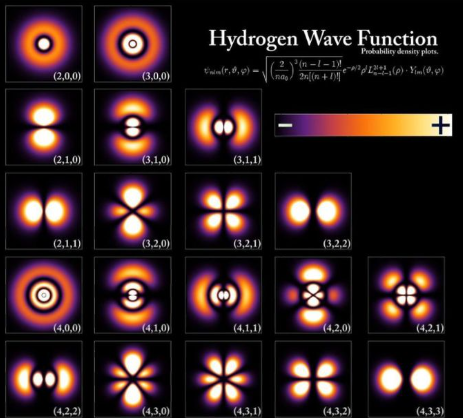
Source: Pinterest. This is a spherical harmonic series of wave functions (orbitals) defining the space that electrons can occupy when in orbit around an atomic nucleus. Each can be occupied by two electrons, but with opposite spins- ‘spin up’ and ‘spin down’.
In the image of atomic orbitals above, each orbital can ‘contain’ one or two electrons. Rather than say ‘contain’, let’s say that the orbitals describe the region of space where the one or two electrons have some probability of being found, depending on their energy. The greater the chance of finding an electron in a particular space, the greater it’s probability density. Note that the orbitals have fuzzy edges. This is because the probability density doesn’t drop abruptly to zero at the edges but rather tapers off. The Uncertainty Principle tells us that it isn’t possible to know both the momentum and the position of a particle simultaneously to high level of accuracy. It turns out that quantum mechanics can’t tell us where an orbital electron is from moment to moment. What it can do is to provide a coherent set of rules for the manner in which electrons are ‘stacked’ in the orbitals as the orbital energy changes.
Alright, we’re back
Scandium and yttrium are d-block transition metals but are sometimes lumped in with REEs because they share the Group IIIB column with lanthanum. The elements cerium through ytterbium do participate in the chemistry of f-block electrons and when REEs are spoken of, there is a good chance that the elements Ce thru Yb are the topic. Is the terminology really as higgledy-piggledy as it appears? Ah, yep.
All of the materials found in electronic devices are there as a result of performance optimization by the manufacturer’s R&D. Many elements are quite expensive, such as indium. The performance uptick from expensive elements must translate into increasing EBITDA. C-suite careers live and die by quarterly and annual EBITDA. Increased performance can be in many forms like longer battery life or increased electronic performance in a chip. Chips require electrical conductors, semiconductors and non-conductors. This is the realm of material science which overlaps with chemistry.
Some of the material science challenges facing smartphone makers might seem a bit arcane. For example, when putting down a layer of material on a chip, will the substrate be wetted by the new layer so that the surfaces contact as desired? An engineering solution may require that a compatibility layer be put down first. Or do the materials have the desired dielectric constants? If you want capacitance in the device, a dielectric layer that is easy and cheap will be required. If you are doing vapor deposition, then the low dielectric material must come from the vapor phase at elevated temperatures. Can it withstand the temperature? Do your semiconductor devices have the desired band gap? What elements affect this? What kind of chemical purity is needed for your CVD or ALD process? Four, five, six or seven nines purity (99.99 % to 99.99999 %)? The more nines of purity specified the more expensive the material and the fewer suppliers there may be.
Companies search all over the periodic table for substances that boost performance and keep Moore’s Law going. All of this must be done in a field full of patent land mines that you don’t want to step on. Invention can lead to big trouble for the unwary.
America’s boob of an ex-president #45 is now grandstanding in the bible business. You know, the guy who said out loud that grabbing women by the p#$$/ has been a successful “dating” strategy for him. He has recently been hawking trading cards, golden sneakers and now an unsuccessful social network. While his worth on paper went up by several billion overnight, it seems to be driven by his fanbase and not by business fundamentals. Stocks go up and stocks go down. Many public offerings start strong and peter out rapidly.
Through the magic of nepotism his daughter-in-law is co-chair of the RNC, guaranteeing the flow of GOP money towards his campaign and legal fund. Between this and the evangelical preachers bloviating every Sunday on hero #45, his support has become the eternal dumpster fire of American politics.
The business failures of #45 are numerous and are easily found on the Google. Despite the lies, civil suits, criminal indictments, encouragement of stochastic terrorism and support of a great many shady characters many of whom are now in prison because of their connection to him, he continues to bank support from millions of admirers. It’s a real phenomenon.
American is the land of opportunity where a huckster can lie his way to become president. Say amen!
This evening I begin my first acting class. What is odd about this is that I’ve been in 17 productions already since about 2011 and, oh yes, retired from acting about 5 years ago. But, on a lark, I’ve decided to heed the advice of a director years ago and take a class out of curiosity. Our text is by Stanislavski.
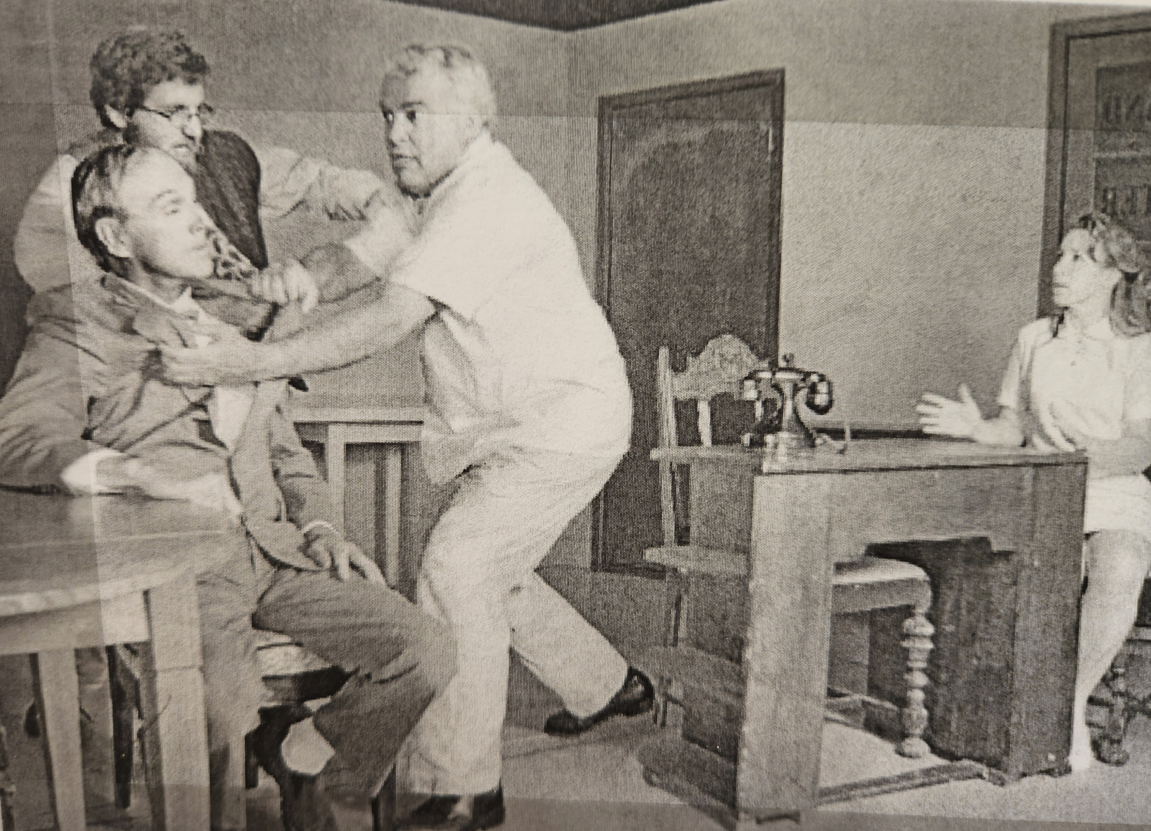
Scene from the play Harvey. I won’t say who I am but this was a memorable scene.
I’ve been on the community theater stage enough to have lost most of my fear of it. I’ve played a drunken Scotsman, several British detectives, sheriff Tate in To Kill a Mockingbird, a mute king in Once Upon a Mattress, a bishop and a cardinal in A Man for All Seasons, and someone in Harvey, among other plays.
Acting is quite a bit more involved than one might think. Obviously, you must memorize your own lines, but you must also know many of the lines of others in order to recognize your cues. The goal is to suspend disbelief and give a convincing portrayal of your character and contribute to the overall emotion of the scene.
One of the most difficult situations to come along on stage is when you or another actor forgets their lines. Unless somebody says something quick, a dark and silent pause washes over the audience, damaging the 4th wall. The other actor may cover for you by continuing with the dialog hoping you can pick up on it. Sometimes the other actor may skip a whole page of dialog leaving you to recognize the unexpected gap and carry on.
The best actors I’ve been around are able to fill a lapse with improvised language that covers the slip up long enough for the other actor to catch up. I’m taking the class because I was never good at improvising to cover a memory lapse. But no matter how good the other actor is, you still must slip back into dialog as seamlessly as possible. Inconceivably, audiences don’t always notice slip ups.
Improvising lines as opposed to sticking with the playwright’s text is very unappreciated and frowned upon. On a fundamental level, the playwright owns the content and every word is put there on purpose by the writer. On a practical level, other actors depend on you to say their cue lines properly. It is a good way to become unwelcome.
Another difficulty for me were the rapid back and forth dialogs with the other actor as would happen an argument. The scene is very satisfying when done fast and with verve, but a total loss of dramatic effect when done slowly.
Theater is a blast and theater people are fun to hang out with.
There is a video on Truth Social posted by Trump or one of his lackies made by a fan with a soundtrack that sounds suspiciously like the radio broadcaster Paul Harvey from the days of old. It is a hagiography, a Valentine to #45 repeating over and over that God chose Trump to rescue America from a long list of troubles nagging at conservatives. Good heavens, there are even Marxists out there!
God took the time to plan this out for the sake of right-thinking Americans. The Big Guy who set the galaxies spinning and is the author of quantum entanglement and irritable bowel syndrome is also mucking about in Republican politics here on the pale blue dot.
This was released just prior to the Iowa caucuses to wheedle the Republican faithful to take heed and turn out to vote ’cause it’d please the Big Guy.
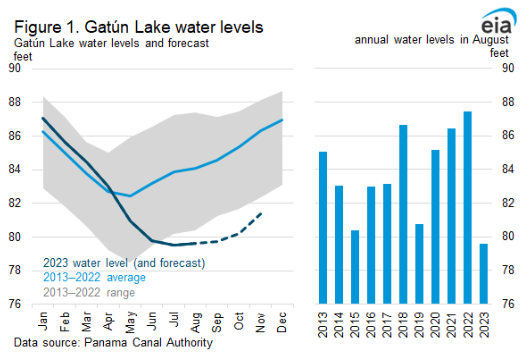
The US Energy Information Agency, EIA, released a notice about low water levels from a historic drought in the Panama Canal region is slowing the passage of large ships. In particular, the Very Large Gas Carrier (VLGC) vessels are restricted which affects the transport and price of Liquified Petroleum Gas (LPG). According to the Panama Canal Authority (APC), water levels in the canal are at their lowest levels since 1995 and are expected to stay low if the drought is prolonged.
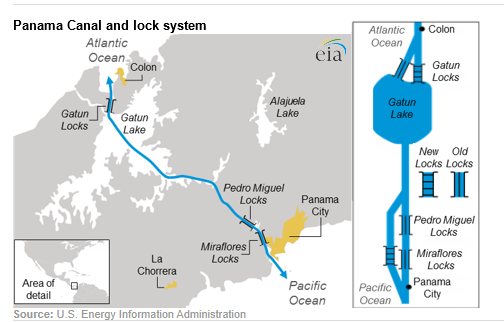
The core of the problem is low water levels at Gatun Lake. This lake is a key part of the system. It is an artificial reservoir that sits between the Atlantic and Pacific oceans providing water and power for the lock system. Due to a prolonged dry season and below normal precipitation, the APC has enacted water saving regulations.
The largest fraction of US-provided hydrocarbons carried through the canal by VLGC vessels is propane which is used for petrochemical applications and highly seasonal heating demand. Increased demand for US propane in East Asia has put pressure on the canal due to increased vessel demand.
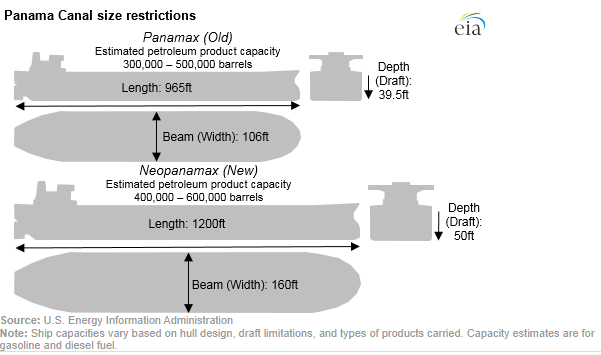
The canal has two types of locks- Panamax and Neopanamax. Ships are rated according to their size and draft as seen in the EIA graphic below.
The base cost of transit for Panamax VLGC vessels is $300,000. A smaller gas or chemical carrier using the Panamax locks has a base cost of $60.000. The low water problem has restricted the flow of traffic through the canal to just 32 transits per day- 10 for the Neopanamax and 22 for the Panamax. Other routes to Asia are around the Cape of Good Hope or through the Suez Canal.
Due to low water, restrictions have led to a waiting time of 13 to 17 days to transit the canal during August. According to Reuters 8/22/23, 125 booked and non-booked vessels were waiting to pass. As of this date, restrictions allow vessels with a maximum 44 foot draft. According to EIA a 6 foot decrease in draft can lead to a 40 % reduction in cargo.
Forward: This essay is directed to my fellow US citizens. The US and its allies are what stand between liberal democracy and rising global authoritarianism. Authoritarian states have proven to be quite resistant to rising democracy. We cannot let it get started without pushback. Just so we are on the same page, here is a description from Wikipedia-
“Liberal democracy or western democracy is the combination of a liberal political philosophy that operates under a representative democratic form of government. It is characterized by elections between multiple distinct political parties, a separation of powers into different branches of government, the rule of law in everyday life as part of an open society, a market economy with private property, universal suffrage, and the equal protection of human rights, civil rights, civil liberties and political freedoms for all people. To define the system in practice, liberal democracies often draw upon a constitution, either codified or uncodified, to delineate the powers of government and enshrine the social contract. “
The United States is on the cusp of making a fateful choice based on the results of the 2024 national election. While there are numerous issues simmering, I refer to the growing movement among conservatives to back off on military support for Ukraine. This group believes that we’ve spent far too much money on military aid for Ukraine’s defense and that these resources should be directed towards the homeland. The fact is that the US and other NATO countries have indeed sent a very large quantity of armaments and cash to Ukraine since the Russian invasion began.
What might the consequences be if the US and others simply backed away and let the two countries duke it out? In other words, we practice some old fashion isolationism. Here are some thoughts-
Putin is a murderous dictator with designs on (re)establishing a more widespread Russian empire. He wants to extinguish what is now Ukraine and meld it into a greater Russia. He believes that Russia is destined become a “great” power again. Suh a dream is not unexpected by a leader, but he began his expansion in 2014 with his quiet annexation of southern Ukraine.
Unfortunately, Ukraine is not where it stops. The eastern European and Baltic states are well aware of this threat and the history behind it.
The question of Putin’s mental state is of great interest to intelligence communities and to heads of state. Barbara S. Held, clinical psychologist and emeritus psychology professor at Bowdoin College, suggests that on the “sad/mad/bad” scale, Putin shows no signs of being sad or mad. What remains is the matter of bad. Coming away from the Held article, one is left with the sense that Putin’s “problem” isn’t legal insanity or a clinical disorder, but rather he is just a really bad person who makes what he thinks are rational choices and occasionally makes misjudgments.
“By all accounts, he [Putin] misjudged the ease of his mission, and shows no remorse about his massive killing in Ukraine. But poor judgment and moral callousness alone don’t constitute legal insanity or madness in the psychological sense.”
Crucially for Putin’s Kremlin, the state has such pervasive control that citizens are existentially afraid to defy the government. Putin is surrounded by many, many layers of loyalists. Putin’s Kremlin is a black box. Who knows what could happen in a power contest? It’s been said that in Russia, the rule of thumb is that if the people stay out of politics, the government will stay out of their lives.
Putin’s Kremlin believes that the mere existence of a successful liberal democracy like the US is an continuous threat to authoritarianism in general and to Putin’s Russia in particular. The Kremlin propaganda organs strenuously broadcast the weak and clumsy machinations in the US on a daily basis. This is very similar to the standard operating procedures of the former Soviet Union.
The Chinese Communist Party (CCP) believes very much the same thing. Liberal democracy in the world, with the US in particular, is an existential threat to Chinese leadership. The CCP can’t very well allow the public to seek greater freedom of speech lest citizens begin to question CCP authority.
An isolationist US is a country that has ceded its global influence to those who mean us harm. As US influence in the world diminishes, China and Russia will gradually move in to take up any slack.
A decision by the US to back-off its aid to Ukraine will create a power vacuum that will be instantly filled by the Putin regime. It will validate the assertions by the Russian and Chinese propaganda organs that the US is morally corrupt and weak and that its hegemony is finally over.
Why is Russia so aggressive? Look the long and complex history of the region and decide for yourself. A place to start might be with the Holodomor.

 Lamentations on Chemistry