Opening Night

The opening night production of Beets went quite well. The house was packed and the cast & crew rose to the occasion.  The audience was quite responsive to the script and as a result we found out where the real laugh lines were. The trick to acting is to lift a 1 dimensional string of characters from a page and give them depth and color.

The only production snag was with the house lights. For some reason the software wasn’t able to call for the house lights to dim. The lighting guy opened the door of an obscure closet in the vaudeville-era backstage to reveal a glowing, LED festooned, 6 ft tower of computerized widgetry. Working feverishly and with green pinpoints of light reflecting off his smudged bifocals (a la Dave Bowman), he finally toggled the right button and got the house lights to darken. Otherwise the software-driven lights and sound worked well.

I wasn’t nervous until 15 minutes before showtime. Standing in the wings I tried to recite my lines in my head, but just couldn’t summon them from the turbid depths. I don’t mind sayin’, this was a distressing development. But after I walked on stage the lines came on cue and we got the thing done.

From the comments at the reception after the show it was apparent that the audience understood the story and were emotionally drawn into it. For two hours we suspended reality and had a shared experience. This is the goal of the writer, director, cast, and crew. When it works it is an amazing thing.

Hot Stage at 7 PM

Hard to believe- our show starts in just a few hours. I’ve given my 2 comp tickets to family. Folks are forkin’ over real money to sit and watch us do this thing. Ticket sales have been strong, so everyone is jazzed. If anything, the cast is a bit over rehearsed. We’re happy just to get the thing going. The sound and lighting cues are set.

Th’ Gaussling plays a sugar beet farmer, which ain’t much of a stretch, havin’ growed up on an Iowa hog and corn farm. Turns out that my step-mother grew up on a beet farm in this area and is aware of the Greeley WWII POW camp’s location. There were supposedly ~155 POW camps in the US by the end of the war.

Beets Poster

It is a decent story and certainly makes for a good dramatic situation. My part is a minor role, though I am in 5 scenes. In terms of the storytelling, my character is a device contrived by the writer to make sure that certain information gets on the table so the audience can get the facts and circumstances in context. This is part of the playwriters craft that I had failed to appreciate previously.

It is a good play and I am lucky to have been a part of it. Quiet backstage!

May Linkfest

A friend sent me the link to Wolfram|Alpha  just a while ago. So far it seems to be a bit lean in textbook-style content in the chemistry area. For instance, when you enter “aromatic solvents” into the dialog box, it returns with

Wolfram|Alpha isn’t sure what to do with your input.

But if you type in “toluene”, suddenly it is the CRC and is flush with data. The stated goals of the Wolfram|Alpha developers are-

Wolfram|Alpha’s long-term goal is to make all systematic knowledge immediately computable and accessible to everyone. We aim to collect and curate all objective data; implement every known model, method, and algorithm; and make it possible to compute whatever can be computed about anything. Our goal is to build on the achievements of science and other systematizations of knowledge to provide a single source that can be relied on by everyone for definitive answers to factual queries.

I do not yet know enough about this resource, but it seems to be a data engine rather than a prose engine.

Landscheidt Cycles Research is a site devoted to the Planetary Influence Theory. This theory pertains to the possible gravitational influence of the planets on solar cycles. it is worth a look.

Watts Up With That? is a blog concerned with global climate issues. The blogger and many of the commentors seem to have their facts straight about global climate change. The site is very data intensive.

If you are a scientist or manage scientists, it is worth considering the file drawer effect.

An online NMR predictor can be found at nmrdb. In my experience the splitting and chemical shifts seem to be in the “not too awful” range.

Biohackers

A recent article in the WSJ solemnly described several amateur biologists who were doing simple molecular biology experiments in their homes. Naturally, this has not escaped the attention of certain authorities and certain deeply conservative establishment news corporations.

What is distressing is the reflexive conclusion that their activity is automatically dangerous and likely to be symptomatic of malevolent intent.  It is common for those in power to look over their ramparts and view the world as a spectrum of threats. And so it is in this case that distrust has arisen and reporters are using the words “weapons of mass destruction” or “ebola virus”. 

Could it not be that some people outside of the heavily in-bred fields of science have a genuine and scholarly interest in molecular biology but no interest in grad school?

The entrance to scientific activity is highly formalized with layers of degree requirements, preferred pedigree, institutional infrastructure, regulatory complications, and a mafia-like oligarchy that disperses the resources and opportunity that is so necessary for buoyancy in science.

How does a creative amateur scientist get to take a jouney of discovery in a field that is institutionally inaccessible to them? And how does an interested individual who is clever enough to conduct experiments deal with a government whose reflex is to see WMD and terrorists behind every lilac bush? There are serious civil liberties problems here that pit the brain stem against the frontal cortex.

It is in the nature of some people to be distrustful and find threats behind every shrub. It has been my observation that people who default into a distrustful posture are very often not trustworthy themselves. The distrustful often invoke slippery slope arguments as rhetorical devices to block their opponents move into new conceptual turf. What the distrustful and paranoid fail to see is that we live every minute of every day on multiple slippery slopes, yet we somehow survive and thrive.

The Venue

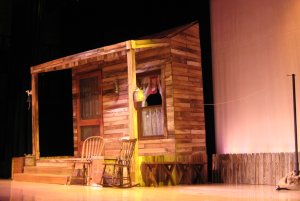
This morning we moved our set into the theatre that we will be performing in for the next two weekends. This is my first acting performance in a decent theatre. It has clean dressing rooms below the stage and reasonably up-to-date lighting and sound capability. The theatre seats 400 and has been well refurbished over the last few years.

We have a tech crew running the lights and sound, a props & costume crew for scene changes, a makeup person, a set builder, and a few other gofers who handle the 10,000 details. All we have to do is remember our lines and avoid falling into the orchestra pit. The lead character has been sick for the last 10 days, so the producers have been nervous. He is a quantum computing physicist who happens to dig acting. The physicist gets the girl. The chemist gets to shout at people and whittle.

Last friday’s local paper featured a full page closeup of me, Th’ Gaussling, hamming it up on stage. Mother of pearl! Today’s thrill of standing on the set and looking into the auditorium was soon replaced by waves of nausea at the realization that this thing is really going to happen. Holy smokes. What have I done?

Cresson Gold Mine, Part 3.

The Cresson Mine in Cripple Creek contains a good deal of fluorite. I was able to casually collect a few samples just lying in the road bed. In the photo below, the rock on the top has the most pronounced blue/purple color indicating CaF2 (fluorite). These specimens are not collectors pieces and are entirely unremarkable other than as indications of fluorite.

Cripple Creek Fluorite Indications (Cresson Mine). Copyright 2009 Gaussling.

Cripple Creek Fluorite Indications (Cresson Mine). Copyright 2009 Gaussling.

The mine business model requires heap leaching as a means of extracting the gold value out of the ore. Given that the ore is peculiar in that it contains gold in the form of gold telluride which cannot be leached out by cyanide, approximately 40 % of the gold remains in the host rock. The cost per toz of gold produced must be kept as low as possible and the way you do that is economy of scale.

The heap sits atop multiple layers of clay barriers and the 14,500 gal per minute of extract that flows out of the heap 24/7 is passed through coconut husk charcoal to trap the gold cyanide and the raffinate is recharged to the desired 100 ppm titer of aq NaCN and pumped back onto the pile. pH adjustment is a constant chore. The crushed rock is mixed with calcuim oxide prior to being dumped on the heap to maintain a high pH.

Building the Heap. Cripple Creek Cresson Mine. Copyright 2009 Gaussling.

Building the Heap. Cripple Creek Cresson Mine. Copyright 2009 Gaussling.

Cresson Gold Mine, Part 2.

We collected samples of the lamprophyre in the bottom of the pit. The formation appeared whitish green in on the weathered surface owing to oxidation. However, if a fresh surface was exposed, the rock was composed of sugary dark xtals with the occasional biotite phenocryst.

Outlined Lamprophyre at bottom of Cresson open pit mine

Outlined Lamprophyre at bottom of Cresson open pit mine. Copyright 2009 Gaussling.

Cresson Mine Lamprophyre Close-up

Cresson Mine Lamprophyre Close-up. Copyright 2009 Gaussling.

Mafic or ultramafic rocks are low in silicates and enriched in Fe and Mg oxides. The lamprophyre above is mafic in composition with a sugary xtal matrix with biotite and other phenocrysts.

Breccia from Cripple Creek Diatreme

Breccia from Cripple Creek Diatreme. Copyright 2009 Gaussling.

The breccia above is characteristic of the Cripple Creek diatreme. Relatively rounded clasts populate the mass of the aggregate, indicating that the clasts were rounded by some process prior to deposition.

The gold is generally too dispersed to see, however, you can see pyrite with a hand lense in many of the samples. Pyrite often accompanies gold.

Cresson Gold Mine, Part 1.

Early saturday morning 50 intrepid geotouristas packed into vans and drove to the CC&V mine in the Cripple Creek district of Colorado. Most of the group were professional geologists- professors, teachers, and geological survey folks. There were only a few interlopers like myself who were interested but untrained in geology. Not surprisingly, a background in chemistry is nearly useless when the discussion turns to stratigraphy and rock morphology.

The Cripple Creek gold district consists of an extinct volcanic structure called a diatreme. A diatreme is characterized by the presence of a volcanic pipe structure filled with brecciated rock. It is thought that the combination of shallow hot rock and ground water lead to violent explosions that resulted in fractured rock. Cripple Creek breccia has rounded clasts, indicating the rock fragments were exposed to rough, erosive treatment leading to attrition and rounding of the clasts prior to consolidation of the breccia.

In the past, gold mining at Cripple Creek was a underground activity. The district contains an extensive network of remnant subsurface works of drifts and shafts. Today, CC&V’s mining activity is limited to high throughput open pit excavation supplying pulverized rock to a cyanide heap leach field. A constant flow of ca 100 ppm aqueous sodium cyanide solution is leached from the top down through as much as 800 vertical ft of gold bearing rubble.

Abandoned Drift and Blue Bird Dike

Abandoned Drift and Blue Bird Dike

Columnar formations can be seen in certain locations of the mine (See photo: some features are enhanced with lines to show the margins). As the pit expands, drifts and shafts are exposed as seen in the photo above. The Blue Bird dike is an igneous intrusion into the surrounding formation. It is no coincidence that the drift in the photo is near the dike. It is common to see disturbed zones along the intrusion where gold can be found in higher abundance. The goal of the drift miner was to follow the enriched rock for more efficient reclamation of value.
Exposed Drifts During Pit Operations

Exposed Drifts During Pit Operations

A feature seen in the pit is a Lamprophyre, or igneous dike comprised of ultramafic, silica-poor, magnesium-rich rock. Biotite phenocrysts can be seen in samples. This is regarded as an unusual feature.

Lamprophyre formation in Cresson Mine

Lamprophyre formation in Cresson Mine

 The big haul trucks carry 300 tons of rock from the mine to the crusher. The crusher is actually a series of crushers that reduce the ore to pieces roughly 3/4 inch in diameter.

Haul Truck Carrying Rock from Blasting Site to Crusher

Haul truck carrying rock from blasting site to crusher The crushed rock is blended with lime and then driven to the leach pile for extraction. Another load for the leach heap.


A Massive Au/AuTe Deposit

Th’ Gaussling attended a geology seminar thursday evening at the Colorado School of Mines. It was given by the chief geologist at the Cripple Creek & Victor gold mine (now AngloGold Ashanti) and was concerned with 3-D modeling of the volcanic formation that forms the center of the deposit.

What is unusual about the CC&V mine is the extent to which tellurium is present. There are a dozen or more tellurium minerals and many of them are present in the ore body. The CC&V load was discovered relatively late- about 1891. Due to the extensive fraction of AuTe and AuAgTe minerals, the presence of the ore body was not detected by placer prospecting. 

Prospectors panning for gold in local streams had no way of knowing that extensive gold was present because AuTe(Ag) minerals do not have a gold-like appearance.  Legend has it that it was discovered by a drunken cowboy who noticed some native gold in an outcropping in the area and took a sample down for assay. As I have mentioned before, the Cripple Creek district has produced about half of all the g0ld to come out of Colorado.

What is key to the formation is the fact that it has zones of extensively altered volcanic rock disturbed both mechanically in the form of fractures and faulting, and chemically in the form of its potassic-alkali nature. The formation has strongly brecciated zones and is desribed as “vuggy”, meaning that there are extensive voids. Native gold and gold telluride mineralization can be found on the surfaces of the vugs. The mineralization was deposited by hydrothermal streams extracting Au and Te from unknown source rock.

Presently the operation is surface mining which feeds to a cyanide leach field for gold extraction. The surface pit mine is working downward, digging through the extensive network of mineshafts. In the early days at Cripple Creek the mining was limited to underground activity. Miners would follow the extensive subsurface network of gold-rich veins in whatever direction they might go. The result is a very complex and extensive matrix of tunnels and shafts that extend downward to as low as 3000 ft. In the early days, the economics of subsurface vein mining were attractive enough to sustain the operation. Today, the economy of scale dominates and pit mining with heap leaching of the lower grade ore is what sustains the operation.

The gold is recovered by a cyanide leach field that is 800 ft thick in places. This method produces ca 300,000 toz/yr. The process does not recover Au from AuTe. It is left untouched in the leach heap and constitutes ca 1/3 of the total gold present.

Curiously, during the many eruption cycles in the distant past (~32 ma), debris from the surface has washed back deep into the formation. Bits of woody debris have been recovered within cementitious rock hundreds of feet below the surface. The CC&V geologist showed a core sample with a wood fragment imbedded within it. For a time reference, the current episode of Rocky Mountains (the Laramide Orogeny) began ~65 ma.

Chemist Gaussling will blend in with a group of geologists tomorrow morning and take an extensive geology tour of the mine site. Hopefully, there will be pictures to share. We’ll be going up to ~10,000 ft, so it will be chilly.

LC Dreamin’

When I get to work this morning I’ll be greeted with a brand spankin’ new Agilent 1200 HPLC sitting on the bench in my lab. It has a diode array detector (no flippin’ MS this time). Pretty sweet.  Gosh, early 1990’s LC capability- already!

It is interesting how the installer assumed I’d be doing reverse phase work. Must be what most of the weenies in pharma are using. Carbon-heteroatom-carbon-heteroatom-carbon-heteroatom-carbon=heteroatom-carbon-heteroatom- … maleate.