PETN in his BVD’s

History will record an underwear bomber and a shoe bomber. Luckily for the passengers of one transatlantic flight, the anonymous martyr on board was incompetent. Like the shoe bomber before him, this murderous buffoon failed to plan for a reliable means of triggering his bomb.

PETN, or pentaerythritoltetranitrate, was found to be the explosive agent used in the attempted inflight bombing of  Northwest Flight 253. This is a relatively common and powerful explosive in the category of aliphatic nitrate esters. It is a colorless powder that can be used in mixed and cast explosives or as the pure material. Like many detonable materials, it does not need to be placed in confinement to produce an explosion. PETN becomes unstable above 71 C, a fact that limits its suitability for some applications. My references do not clarify what is meant by unstable, but the material could be prone to chemical degradation above this temperature which would adversely affect its quality.

Other aliphatic nitrate esters include nitroglycerin, BTTN or 1,2,4-butanetriol trinitrate, EGDN or ethylene glycol dinitrate, and PETRIN, the trinitrate analog of PETN. A nitrate ester has a C-O-NO2 linkage and differs from aliphatic or aromatic nitro compounds which have C-NO2 linkages instead.

Nitrate esters are made from an alcohol or polyol and nitric acid. Nitro aromatics like TNT are made by acid catalyzed nitration of reasonably electron rich aromatic compounds like toluene or phenolics. The oxygen in the C-O-NO2 ester linkage confers some extra measure of instability to the molecule.

PETN is commonly used in Primacord, an explosive cord comprised of a PETN core inside a thin fabric or plastic sleeve. Primacord can be used as a blasting agent itself or it can be used as a fuse or delay line to trigger other explosives from a central point.

PETN is an explosive with a high brisance value. That is, it produces a shock that has a shattering effect on materials. In fact, brisance is quantified by the “sand test” which measures the production of fines from the shattering of 200 g of 30 mesh Ottawa sand. After the test, the sand is re-screened and the finer material that later passes through the screen is weighed. The greater the mass of fines, the greater the brisance.

Explosive         Sand Crush (g)   Heat of Explosion (cal/g) 
Black powder         8                                    684
Lead Azide            19                                  367
Comp C-4             55.7                            1590
TNT                      48                                1080
RDX                  60.2                        1280
Nitroglycerin         51.5                           1600
AN                               nil                                346
Picric Acid              48.5                           1000
PETN                         62.7                            1385
Source:  Cooper & Kurowski, Introduction to the Technology of Explosives, 1996, Wiley-VCH, p76-77. ISBN 0-471-18635-X

Pentolite is a composition prepared from a 50/50 blend of trinitrotoluene (TNT) and PETN with wax as a bonding agent and plasticizer. There are many blends of explosive materials. The composition is adjusted for the application.

The job of an explosive is to do PV work on objects. It does this by generating an abrupt pulse of heat and a large number of small gas molecules like N2 and CO2. The detonation velocity of PETN is ~ 8 km/s, so that a relatively small number of PETN molecules in a small volume are converted rapidly into a larger number of  gas phase molecules, all seeking to occupy the molar volume of 22.4 L/mol. 

The prompt generation of many moles of hot, small molecules results in the expansion of decomposition gases which forcefully press against the surroundings. The gases resulting from the 8 km/s detonation wave in the bulk solid explosive expand and compress the nearby air into a shock front that expands approximately spherically. As it does this the gases cool and the shock dissipates.

Explosive Power is a measure of an explosives ability to do work. Explosive power = Q x V,  Q = heat of explosion and V = volume of gas generated. The Power Index of a material is the ratio of explosive power to that of picric acid times 100 %. The power index of PETN is 167, TNT is 119, and RDX is 169.

Avatar

I’ll be brief. Having viewed James Cameron’s new 3D  movie Avatar, I have to admit that it was simply stunning. It has all of the elements of a blockbuster movie: strong emotional appeal, a compelling story line, just enough character development, and fantastic visuals. And with production and marketing costs that some are estimating to approach half a gigabuck, it’ll need all the buzz it can get to give a blockbuster return to the investors.

As we filed out of the theater last night I couldn’t help but think that we had just witnessed a paradigm shift in the business and technology of cinema. Going forward, the bar has just been raised in the expectation level of audiences. 

Hmmm. I wonder if Unobtainium occurs as the sulfide or the native element?

Mercury Mining

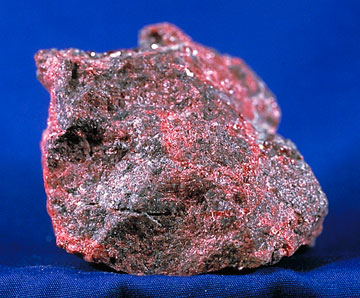
One of the least appreciated aspects of the 19th Century gold mining boom in North America was the necessary and parallel boom in quicksilver, or mercury. Numerous mercury bearing minerals are known, but by far the bulk of historical mercury production has come from cinnabar, or HgS. For clarity, cinnabar is distinct from vermillion which is a pigment derived from cinnabar. 

Recovery of gold can be performed by methods as simple as plucking nuggets from a pan or by gravity separation in the form of sluicing. Unfortunately, in many areas placer gold is quickly exhausted by eager miners. Where there is placer gold there is often a lode formation to be found. Gold in a lode can be much more problematic in its recovery.  

Gold from a lode may be found comingled with quartz in bulk form, partitioned in a vein, or dispersed at high dilution in a host rock at a large scale. Lode gold very often has to be extracted from a problematic matrix. In this circumstance, chemical means are necessary to extract and concentrate the value from the rock.

A chemical solution to gold isolation is limited to only a few economically viable possibilities. Beyond macroscopic placer gold there is amalgamation with mercury, borax, cyanidation with NaCN, and chlorination with Cl2 or NaClO. 

Amalgamation has been attractive historically because of its great simplicity. First, cinnabar is readily coerced to liberate mercury by simple roasting and condensation. Dispersed gold is contacted with mercury and selectively extracted. The resulting solution of Au-Hg is relatively easy to isolate by natural phase separation. Finally, gold is easily recovered from the amalgam by heating in a retort. Chemists would call this a simple distillation.

Some silver will also be amalgamated, but it is separated by roasting to silver oxide followed by amalgamation of the residuals. Unfortunately, gold tellurides are problematic for direct gold amalgamation. Gold tellurides must be roasted first to liberate volatile tellurium oxides and native gold residues. Energy becomes a major cost driver at this stage.

Cinnabar ore (Image from Mineral Information Institute)

US cinnabar ore deposits are found predominantly  in California and to a lesser extent in Nevada, Oregon, Arizona, Texas, and Arkansas. The geology of cinnabar ore bodies share a few general features. Cinnabar ore is found in zones historically associated with volcanic activity and alkaline hydrothermal flows.  Ascending flows of metal sulfide saturated water infiltrated faults and fractures and deposited HgS rich mineral.  This is a common ore forming mechanism and is responsible for diverse metalliferous deposits, including mercury. 

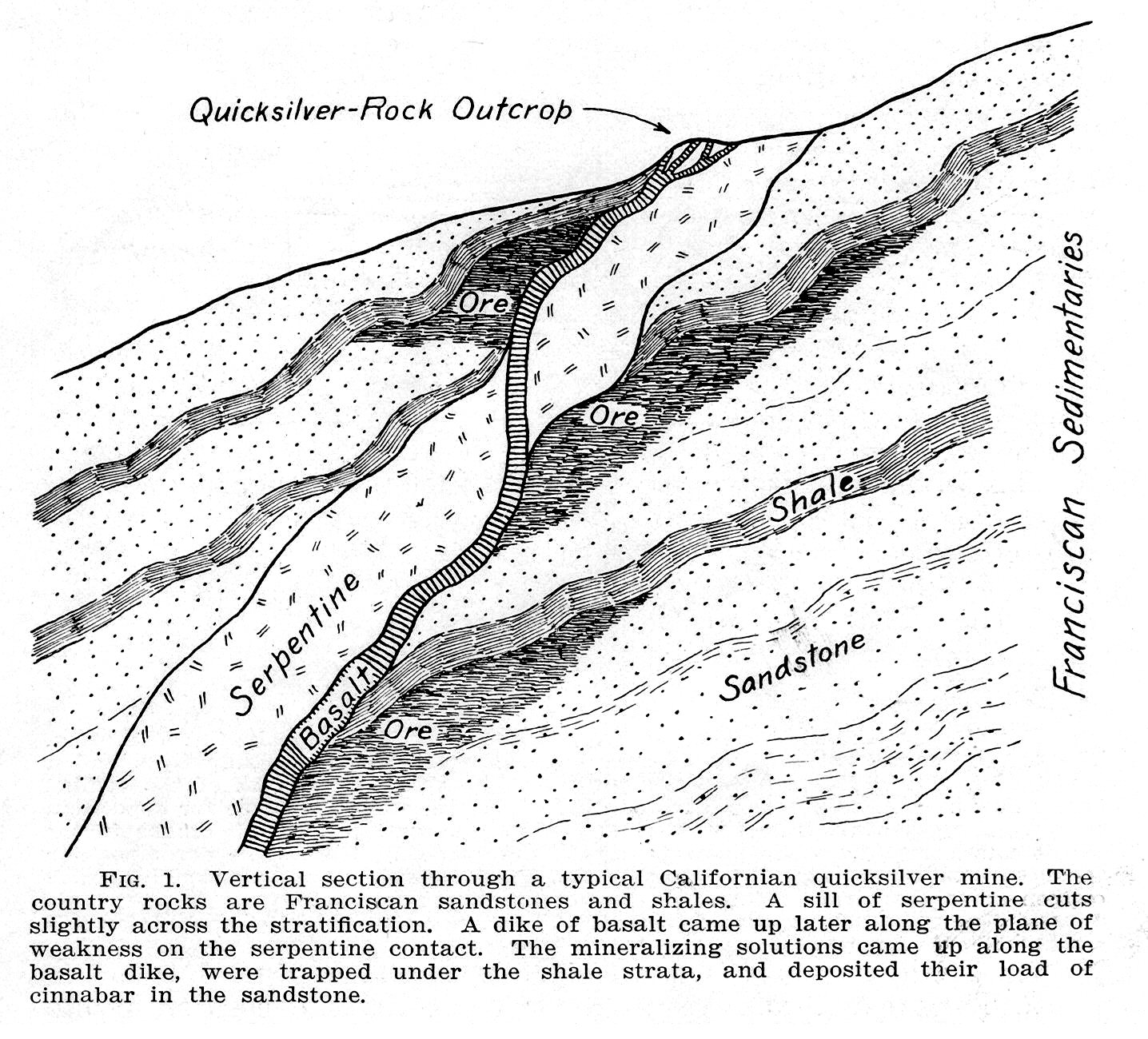
Figure 1. Franciscan Quicksilver Ore Body Structure (C.N. Schuette, The Geology of Quicksilver Ore Deposits, Report XXXIII of the State Mineralogist, January 1937.)

According to Schuette, a common feature to economically viable cinnabar occurrences was the presence of a cap rock formation over the ore body. The infiltration of cinnabar laden hydrothermal fluids into fissures and shrinkage cracks in basalt intrusions as well as deposition in brecciated rock in the fault zones lead to enrichment of the mineral.  An impermeable layer above caused a pooling accumulation of mineral and a barrier to oxidation. 

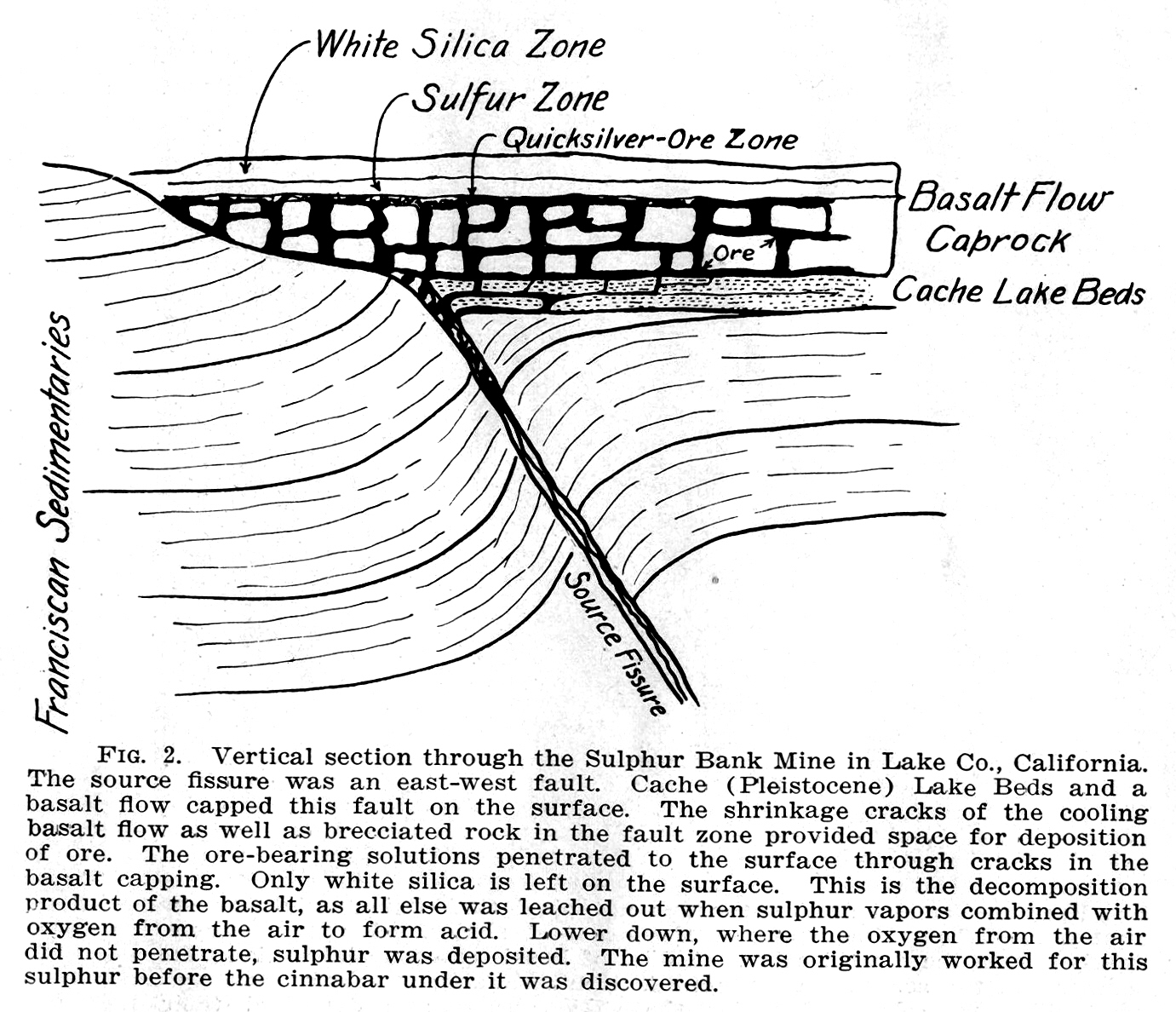
Figure 2. Diagram of Sulphur Bank Mine (C.N. Schuette, The Geology of Quicksilver Ore Deposits, Report XXXIII, of the State Mineralogist, January 1937.)

In these California formations cinnabar is regarded as a primary mineral, meaning that it is the direct result of transfer from deeper source rock. An example of secondary rock would be serpentine (Fig 1) which is formed as a result of aqueous alteration of another mineral. Serpentine is a group of minerals comprised of hydrated silicate which may contain some combination of  Mg, Fe, Al, Mn, Ni, Ca, Li, or Zn. According to Schuette, serpentine is often found associated with cinnabar formations. 

The Sulphur Bank Mine near Clearlake Oaks in Northern California offers an interesting example of cinnabar mineralization. Figure 2 shows a fault that provided a channel for fluid flow to upper level rock formations. Over time oxygen and water caused the oxidation of sulfur to sulfuric acid which aided the decomposition of cinnabar and the host rock. 

Note that the uppermost layer is said to be white silica which resulted from extensive demineralization of solubles from a silicate matrix. Further down, native sulfur was discovered in more reducing conditions and was actually recovered in early mining operations. Cinnabar was located below the layers of oxidized mineral. 

This phenomenon of surface oxidation of an exposed ore body is observed in gold and silver mines as well. Miners often lamented that the nature of the lode changed as the mine operations got deeper. Of course, what was happening was that oxidized formations are encountered near the surface and as the mine gets deeper, progressively greater reducing conditions are found with a corresponding change in mineral species present. 

Air oxidation or infiltration of meteoric water with dissolved air and CO2 would cause the alteration of sulfide minerals to more water soluble H2S and sulfates, leaving native gold behind. But at greater depths, the composition of the ore changes to afford heavier sulfide loading and therefore a requirement for a different kind of milling. 

As it happens, the recovery of mercury from cinnabar is quite simple and has been done since Roman times. Typically, the ore was crushed and roasted in the combustion gases of a reverberatory furnace. This kind of furnace was constructed to isolate the fuel from the ore by a partition and rebound or reflect the hot gases off the ceiling of the furnace onto a heap of ore. Despite the name there is no acoustic aspect to the process. 

The hot gases would produce HgO and sulfides which would oxidize in the gas stream to volatile sulfur oxides. Thermal decomposition of HgO at ca 500 C produced mercury which was condensed out of the exhaust gas stream and collected as the liquid. 

Keeping up with the data stream

After many years of immersion in technical work I still marvel at how an organization can become mired in raw data. Smart people can easily succumb to the notion that data equals knowledge. Especially in circumstances where data is accumulated faster than it can be assimilated.

It is relatively easy to collect data in a chemical lab. You take a set of samples and prep them for testing, load the sample vials into the sample tray, and let the automated sampling widget move through its paces. In a few minutes or hours the software has accumulated files bulging with data points.  It is even possible to construct graphs with all sorts of statistical manipulations on the data, but still not morph the data into usable knowledge. I’ve been to meetings where graphs are presented but were not backed up with interpretation. What was the presenters point in showing the graph?

Computerized chromatography stations will spew data all day long onto hard drives based on selections from a cafeteria-style menu. With hyphenated instrumentation, an innocent looking 2-dimensional chromatogram is actually just a part of a higher dimensional data set with corresponding mass spectra or UV/Vis spectra.

The task for the technical manager is to get control of this stream of data and render some of it into higher level knowledge that will help people run the organization and get product or research out the door. This is the true work product of the experimental scientist: knowledge woven from a data cross-fire and supported by accepted theory.

I do not know what others do when confronted by a data tsunami. I can only speak for myself on this. When the data flow gets ahead of me, it usually means that I am spread too thin. It indicates that I am not taking enough time to properly devise experiments for maximum impact and am skimping on the analysis in favor of other duties.

Another issue relating to managing diverse data output is the matter of storing accumulated data and knowledge for easy retrieval. It is easy to throw things into folders and file away. But in a few months, the taxonomy used for filing a given bundle of data becomes murky. Soon, one is forced to rummage through many files to find data because you’ve forgotten details on how you organized the filing system.

There are ways around this problem. Laboratory Information Systems (LIMS) are offered by numerous vendors. A good LIMS package goes a long way towards managing data and distributing knowledge. We have a homebrew LIMS system (built in MS Access) that seems to work rather well for analytcial data. However, it was not constructed with process safety information in mind.

What I have constructed for my process safety work is an Access-based application that structures various kinds of information graphically into regions on a form. Within each region is a set of data fields that are subordinate to a given heading or context. The form is devised to prompt the user to consider many types of thermokinetic experiments and provides fields that are links to specific documents. The form provides both actual data and links to source documents. It can be used to enter data or to retrieve it.

This is what Access is designed to do, so I have described absolutely nothing conceptually new. Access allows me to aggregate related kinds of experimental results, reports (the knowledge part), and source documents in one field of view so as to allow the users visual processing capability the chance to browse more efficiently.

An example of “related kinds of experimental data” would be DSC, TGA, ARC, and RC1 reports. What connects these fields is the domain of thermal sensitivity of a compound or reaction mixture.

Another aggregation of fields would be the conditions related to an incident. I like to select key descriptors to an incident so as to aid in incident type studies at a  later date. It is useful to be able to sort incidents resulting from a blown rupture disk or a spill, fire, triangulated drum, etc.

A database is rather like a garden. In order to be useful it must be planted and then cultivated. Ignore it and it will lose its comprehensiveness, casting into doubt its continued use.

Next up is the development of an in-house Wikipedia style browser application for aggregating product, process, and safety information. This offers the best opportunity yet for making information and diverse data available to employees. It can be written in narrative form so as to impart knowledge and history. Why was a particular vendor chosen or how did we decide on that specification? What was the rationale for the process change in step 4.2?  The ability to explain and link to in-house source documents from a familiar and single point of access is key to potential success.

CT scan abuses. Who is actually in charge of the use of X-rays?

The latest news  about CT scan abuse and the subsequent excessive radiation exposure to the public is very disturbing. A recent issue of the Archives of Internal Medicine features 2 articles describing their findings in regard to the use and possible misuse of CT x-rays. There is no point in my regurgitating the details of the two articles. The reader can study the articles without my noisy input.

What I would like to point out is that this is a case of faulty administrative control over the exposure of patients to hazardous energy. Who is the gatekeeper for access to a CT scan-  the primary care doc or a consulting radiologist? If it is the primary care doc, is he/she up to speed on the exposure/dose details? Does the primary care doc know the dose and variability in radiation exposure for a given workup? Does the dose vary with the model of CT scanner? How much resolution is really necessary, anyway? Does half the dose give half the resolution, or is there some other law relating transmitted energy to resolution?

Maybe the gatekeeper should be the radiologist. The radiologist should be able to calculate a radiation dose and speak knowledgeably about the details of the risk. But should the radiologist be in a position to second guess the primary care doc? Does anybody provide feedback to the primary care doc as to the wisdom of a given CT scan? Doesn’t sound like that would work very well.

So, who is really the gatekeeper in regard to the merits of any given CT scan given to the patient? But more importantly, how the hell can it transpire that radiation exposures are far higher than anybody apparently realized??? Radiation technology and radiation biology are mature sciences now. And presumably, radiologists are trained to pay attention to these kinds of details.

Where the HELL were the radiologists when these instances of excessive exposure were accumulating?? Isn’t that why we train them … to provide expertise in the use of ionizing radiation in medicine??  Were they busy? Did they have something else to do besides monitoring the use of radiation on actual patients?

Could it be that people in the CT business are more captivated by the industrial light and magic of imagery and special effects rather than the grubby details of dosimetry?

Green Hummus

Since converting to vegetarianism two months ago I have begun to notice curious bursts of dietary defensiveness in friends, family, and coworkers. First let me say that I am not evangelical about my shift to vegetarianism. Others can eat what ever they please with no lecture from me. I’m happy to discuss this choice if asked, but I generally prefer to remain silent about it.

I’m finding that people will quiz me in conversation about the particulars of a vegetarian diet, perhaps looking for apparent contradictions or logical flaws in my response. Some are quick to mark out their meat eating territory so that it is known far and wide that they really dig being an unrepentant carnivore. They’ll ask “if we’re not supposed to eat animals, then why are they made of meat”?

Others just shake their heads and marvel at how someone could make such a silly choice.  I can’t say how many times I’ve been asked if my choice of vegetarianism was based on some political philosophy or ecological theory.

Nope.

I’ll explain that with my new menu, cycling, and running I’ve lost 11 % of my body weight and am still dropping weight. Yada yada. I’ll ask if they had ever seen my likeness on a Rubens painting and their eyes will glaze over and the topic will turn to the Broncos.

Something interesting to do with chick peas- Green Hummus.

1 Can drained chick peas
1/8 cup olive oil
1 tablespoon vinegar
1 cup washed fresh spinach
4 or 5 fresh basil leaves
salt to taste
1-2 cloves garlic
1 heaping tablespoon of pine nuts
1 pinch each of cayenne pepper and fresh ground black pepper (gives it some kick)

Place ingredients in blender or food processor and process to a smooth paste. If blending is difficult, add just a dash of orange or lemon juice to loosen the paste for efficient mixing. Enjoy as a zesty spread on a garden vegetable sandwich of cucumber, spinach, tomato, onion, and feta cheese. Don’t be shy with the cayenne.

Phase Change for Chemistry?

Disclaimer: Combichem or HTE is definitely not my area of expertise. It is, therefore, inevitable that I’ll say something blindingly ignorant about it. Despite my admitted ignorance, is appears to me that there is something happening, some kind of phase shift, in the small molecule discovery marketplace that is of general interest to the chemical R&D community. In fact, it may just be part of an overall change in how we do chemistry in general.

I’ve been hearing no small amount of buzz from chemists in the job market about the flattening or even downturn of US pharma R&D in general and of combichem or High Throughput Experimentation (HTE) in particular.  It is not that HTE is in any particular danger of extinction, but rather certain companies who offer the equipment platforms and tech packages seem to be evolving away from supplying equipment as a core business activity. Many of the big customers who could afford the initial cash outlay for HTE technology are doing their work in-house, dampening the demand for discovery services by HTE players at their aggressive prices.

One company I know has evidently shifted emphasis into the drug discovery field rather than try to continue marketing HTE equipment.  Near as I can tell, they are betting that having their own drug candidates in the pipeline is a better strategy than being strictly a technology or R&D services supplier. Time will tell the tale.

What the honchos in the board rooms of America’s big corporations forget is that the art they export so profitably was in all likelihood developed by people educated in US taxpayer subsidized institutions with US government grants. American citizens subsidize the university research complex in this country and by extension, supply a brain subsidy to industry. To export chemical R&D is to subsidize the establishment of a similar R&D capacity in other nations.  I think if you poll most US citizens, they’ll say that this is not the outcome they expected.

Software for HTE has become a derivative product that, for at least one HTE player, is proving to be rather successful. It isn’t enough to have the wet chemical equipment to make hundreds and thousands of compounds. You must be able to deal with the data storm that follows.

The business of HTE technology is evolving to a mature stage as the market comes to understand how to make and lose money with it.  There is always a tension between “technology push” and “market pull”.  It is often easier to respond to concrete demand with existing tools that to get new adopters to invest in leading edge tools to discover risky drug or catalyst candidates.

The extent to which the US chemical industry (all areas, including pharma and specialties) is outsourcing its R&D or simply moving it offshore is distressing. R&D is our magic. And promoting its execution offshore is to accelerate the de-industrialization of the USA.  It is folly to train the workers of authoritarian nations like China to execute your high art. American companies must learn to perform R&D in an economically accessible way and keep the art in-house. 

What makes R&D so expensive in the USA? Well, labor for one thing. In the end, our dependence on expensive PhD’s to do synthesis lab work may be a big part of our undoing. But there is much more to it than that. Look at the kinds of facilities that are built for chemical R&D. In the US and EU they are usually very expensive to build and maintain. Regulations and litigation avoidance are trending industry in the direction of ever more complex and high-overhead facilities in which to handle chemicals and conduct research. 

Then there is the cost of every widget and substance associated with chemistry. Look at the pricing in the Aldrich catalog or get a quote from Agilent. Have a look at the actual invoice from your latest Aldrich order and look at the shipping cost. High isn’t it? We’ve accelerated our demand for ready-made raw materials and hyphenated instrumentation. To what extent are we gladly buying excess capacity? Who doesn’t have an instrument with functions and capabilities that have never been understood or used?

It is possible to conduct R&D under lean conditions. But it can’t be done cheaply in existing industrial R&D campuses. Cost effective R&D will require a recalibration for most chemists in terms of the kinds of working conditions and administrative services they expect. But business leaders will have to recalibrate as well. Prestige can be manifested in product quality and a sense of adventure and conviviality rather than in an edifice. There are companies all over the world doing this every day. They set up shop in a commercial condo or old industrial building with used office furniture and grubby floors. What matters in chemistry is what is happening (safely) in the reactor. Everything else is secondary.

Heads on a Stick

As one of those poindexters who actually likes to watch Book TV on C-SPAN-2, I blundered into an interview of Naomi Prins. The host was Senator Bernie Sanders (I-VT). Prins is presently a Senior Fellow at Demos and has had careers at Goldman Sachs and Bear Stearns.

Prins has a good deal of interesting insight into how securities are engineered from subprime loans and stamped with ratings. What stands out is how artificial securities are as an asset. It’s like putting a step ladder on a canoe. The view is good, but evenually you’re going to get wet.

Securities are synthesized from dung and straw, drenched in investment sauce, and then nestled in decorative tins by white gloved MBA castrati to afford a “product”. Naturally, banks and ratings agencies assure us that the rating on the security is meaningful. After all, who is more sober and conservative than a banker?

Perhaps investment banking as it is now practiced should be regarded as a pathological condition- a form of predatory, sociopathic behavior worthy of a psychiatric profile? Investment banking is a profession dedicated to the proposition that the mere repackaging and skimming of the wealth of others is the desired outcome. It is a bubble industry specializing in puffery and deception.

My libertarian friends assure me that the free market place is the most natural and efficient form of economic intercourse. Of course, the problem is that there isn’t a substantially free market anywhere. We have regulated markets because some people invariably game the system at the expense of others, resulting in a convulsive discharge of legislation.

One could take a Darwinistic view and say that the victims of investment shenanigans are to blame for being greedy and uninformed. There is truth in caveat emptor, but one of the reasons we have civilization is to buffer out the harshness of life. How do you protect the greedy and uninformed from the greedy and deceitful? It is the eternal problem.

The most despicable part of the 2008-9 financial collapse is the lack of accountability on the part of the skunks who invented and promulgated the unstable investment devices.  Their heads should be impaled on sticks and planted in the financial districts for all to see. Figuratively, I suppose.