Category Archives: Chemistry

The Illuminating History of Producing Brighter Flames

This is a reprint of an October 25, 2010, piece that I wrote about illumination with flames. I did tweak the title a bit for the sake of accuracy. -Th’ Gaussling

Until the invention of the electric lamp, the illumination of living and working space was very much the result of sunlight or of combustion.  Since the development of fire making skills in prehistoric times, the combustion of plant matter, fossil fuels, or animal fat was the only source of lighting available to those who wanted to illuminate the dark spaces in their lives.

From ancient times people had to rely on flames to throw heat and an agreeable yellowish light over reasonable distances. A good deal of technology evolved here and there to optimally capture the heat of combustion to do useful work (stoves, furnaces, and boilers) from readily available fuels. 

Lighting technology also evolved to maximally produce illumination from flame.  High energy density fuels that offered a measure of convenience for lamp users evolved as well. Liquid fuels like vegetable oils, various nut oils, whale oil and kerosene could flow to the site of combustion and were in some measure controllable for variable output. The simple wick is just such a  “conveyance and metering device” for the control of a lamp flame. Liquid fuels flow along the length of a wick by capillary action to a combustion zone whose size was variable by simple manipulation of the exposed wick surface area.

The first reported claim of the destructive distillation of coal was in 1726 by Dr Stephen Hales in England. Hales records that a substantial quantity of “air” was obtained from the distillation of Newcastle coal. It is possible that condensable components were generated, but Hales did not make arrangements to collect them.  Sixty years earlier an account of a coal mine fire from flammable coal gases (firedamp) highlighted the dangerous association of coal with volatiles. So, flammable “air’ was associated with coal for some time.

By 1826 a few chemists and engineers were examining the use of combustable gases for illumination. The historical record reveals two types of flammable gas that were derived from coal- coal gas and water-gas. Both gases came from the heating of coal, but under different conditions. Coal gas was the result of high temperature treatment of coal in reducing conditions. It is a form of destructive distillation where available volatiles are released.  Depending on the temperature, there was the possibility of pyrolytic cracking of heavies to lights as well. 

Water-gas was the result of the contact of steam with red hot coal or coke. The water dissociates into H2 and CO. Water gas is a mixture of hydrogen and carbon monoxide, both of which are combustible. The formation of water-gas is reported to have been discovered by Felice Fontana in 1780. 

One of the properties of burning coal gas or water-gas was the notably meager output of light from the flame. Workers like Michael Faraday and others noted that these new coal derived gases provided feeble illumination, but if other carbonaceous materials could be entrained, then a brighter flame could result. It was during the course of investigations on illumination with carburized water-gas that Faraday discovered bicarburet of hydrogen, or benzene.

About this time, an engineer named Donovan also noted that if other carbonaceous materials were to be entrained into water-gas, then the light output was enhanced. So, in 1830, engineer Donovan installed a “carburetted” water-gas lighting system for a short run in Dublin.

Coal gas was first exploited for lighting by the Scottish engineer William Murdoch.  Murdoch began his experiments in 1792 while working for Watt and Boulton in England. By the late 1790’s, Murdoch was commercially producing coal gas lighting systems. His home was the first to be lit with coal gas.

The carburization of water gas eventually became an established industry in America in the second half of the 19th century. The treatment of gases, especially with the discovery of natural gas in Ohio, increased the commercial viability of lighting with gas. Carburization of water gas was aided by the discovery of hydrocarbon cracking to afford light components that could be used for this purpose.

Thorium is frequently found in the ores of rare earth elements (REE) and the connection of REE’s to the issue of illumination begins in the laboratories of Berzelius in about 1825. Berzelius had observed that when thoria and zirconia were heated in non-luminous flames, the metal oxides glowed intensely.  But this was not a new phenomenon. Substances like lime, magnesia, alumina, and zinc oxide were known to produce a similar effect. Goldsworthy Gurney had developed the mechanism of the Limelight a few years before. In the limelight, a hydrogen-oxygen flame played on a piece of lime (calcium oxide) to produce a brilliant white glow.  This effect was soon developed by Drummond to produce a working lamp for surveying.

The work of Berzelius was an important step in the development of enhanced flame illumination. He had extended the range of known incandescent oxides to include those that would eventually form the basis of the incandescent mantle industry.  Thoria (mp 3300 C) and zirconia (mp 2715 C) are refractory metal oxides that retain mechanical integrity at very high temperature. This is a key attribute for commercial feasibility.

Numerous forms of incandescent illumination enhancements were tried in the middle 19th century. Platinum wire had the property of glowing intensely in non-luminous flames. But platinum was not robust enough for extended use and was quite rare and consequently very expensive. By 1885, a PhD chemist named Carl Auer von Welsbach patented an incandescent mantle which was to take the gas light industry to a new level of performance. Welsbach studied under professor Robert Bunsen at the University of Heidelberg. 

Welsbach fashioned the incandescent mantle into the form that is familiar to anyone today who has used a Coleman lantern. The original mantle was comprised of a small cellulose nitrate bag that had been impregnated with magnesium oxide, lanthanum oxide, and yttrium oxide in the ratio of 60:20:20.  The mantle gave off a greenish light and was not very popular.

By 1890, Welsbach produced an improved incandescent mantle containing thoria and ceria in a ratio of 99:1. This mantle emitted a much whiter light and was very successful. Many combinations of zirconia, thoria, and REE metal oxides were tried owing to their refractory nature, but the combination of thoria-ceria at the ratio of 99:1 was enduring.

Welsbach made another contribution to the commercialization of REEs. Welsbach had experimented with mischmetal and was interested in its pyrophoric nature. He had determined that a mixture of mischmetal and iron, called ferrocerium, when struck or pulled across a rough surface, afforded sparks. In 1903 Welsbach patented what we now call the flint.  In 1907 he founded Treibacher Chemische Werke GesmbH. Today Treibacher is one of the leading REE suppliers in the world.

See the earlier post on REE’s.

REE’s in Greenland.

REE Bubble?

REE’s in Defense.

REE’s at Duke.

Big Prize for Quantum Spots

Poltroon University will soon host a lecture by Big Prize Laureate Dr. Professor Guss Badeen of the Swiss Federal Institute of Quantum Spot Studies in Outerlocken, Switzerland. Dr. Badeen began his work at the Soviet All-Union Agriculture and Artillery Institute in Pissov-on-Don, USSR. After the entertaining implosion of the Soviet Union, Academician Badeen made his way to Switzerland where he is now Emeritus Langweilig Professor of Quantum Agriculture. He will speak on the topic of “My Journey to Sweden with Quantum Spots.”

Admission is free but due to limited seating in the Alderaan auditorium, tickets will be required. Tickets can be obtained online at poltroon_univ.org/QSpot.

Poltroon University is located in Guapo, Arizona, adjacent to the scenic Desiccated Wasteland National Monument. Poltroon is a selective private illiberal arts institution serving the educational needs of junior varsity students. On campus visits are welcome.

Katalin Karikó and Drew Weissman Win 2023 Nobel Prize for Medicine and Physiology

Congratulations are in order to Katalin Karikó and Drew Weissman for their Nobel Prize winning work with a COVID-19 vaccine using modified mRNA. The image below shows the component changes that were made to the uridine nucleotide. The change to the middle molecule was that they swapped positions of a carbon and a nitrogen atom in the ring and moved a double bond. In the third molecule they added a methyl (H3C-) group to one nitrogen of the pyrimidine ring.

Source: Frontiers in Cell and Developmental Biology 04, Nov. 2021, vol 9-2022 Volume 9 – 2021 https://doi.org/10.3389/fcell.2021.78942. Graphics reproduced from journal and modified by Gaussling.

In general, if you can change the shape of a molecule, particularly with peptide or nucleotide polymer molecules, you will change the physical properties and the reactivity properties. The Psi nucleotide adds another hydrogen bonding group into the mRNA. These changes add up to lowering the immune response to the vaccine.

The other noteworthy aspect is the very short time it took to get vaccines on the market. This was only possible because decades of research in molecular biology continuously advanced the state of the art. The various funding agencies whose support of basic research over the long haul deserve thanks as well for the timely production of the COVID-19 mRNA vaccine.

ExxonMobil Evolving with Declining Gasoline and Diesel Demand

An article by Kevin Crowley, Bloomberg News, 9/23/23, reports that ExxonMobil Corp. has already begun to adapt to the decline in demand for gasoline and diesel as the switch to electric vehicles and renewable energy progresses. ExxonMobil operates the largest oil refining network in the world with 13 refineries presently in operation. It sold 5 refineries in the last 4 years in order to focus on cost cutting and improvements in performance of the highest performing facilities. ExxonMobil’s interest in refining dates back to the early days of its progenitor, Standard Oil Company, founded by John D. Rockefeller.

The oil majors are not blind and deaf to the swing towards the replacement of gasoline and diesel powered vehicles. In the case of ExxonMobil, they are planning on switching to production of petrochemical feedstocks in their refineries. They expect that their high-performance chemicals will see 7 % growth per year. Exxon believes the key to its success will be in chemical products. These chemicals are used in manufacturing of industrial and consumer products, from lubricants to pharmaceutical raw materials. Many of the ingredients you see in consumer products have their beginning as crude oil flowing out of the ground somewhere.

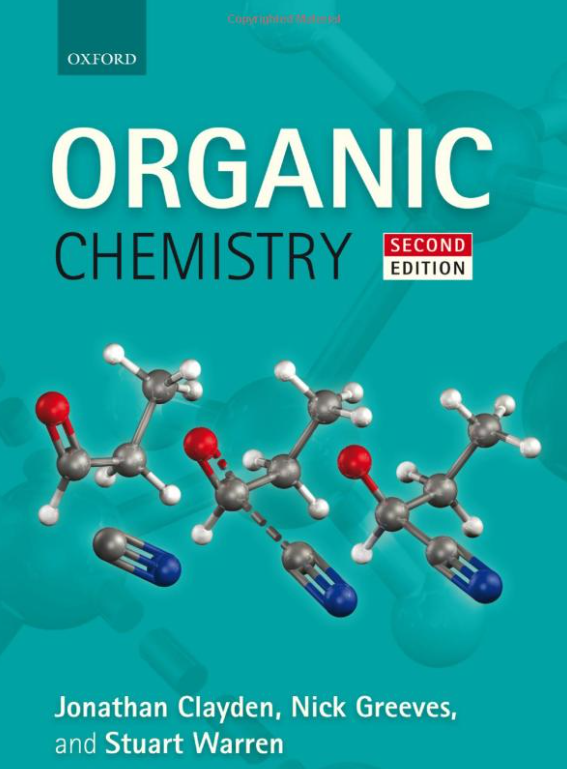
A Second Edition Organic Chemistry Textbook

On occasion I step off the industrial hamster wheel for a few minutes to have a look around. In Linkedin this morning I saw a post for the 2nd edition of Organic Chemistry by Jonathan Clayden (Author), Nick Greeves (Author), Stuart Warren (Author), Oxford University Press, ISBN-13 ‏ : ‎ 978-0199270293. From inside the hole along the creek where I spend my free time, I was never aware that Warren had an O-chem textbook.

Amazon allows you to examine a bit of content on-line. If you teach O-chem, this text is worth a look in my estimation.

Many of us are familiar with Warren from his book Organic Synthesis: The Disconnection Approach, 1st edition 1982. A second edition was released in 2008. Retrosynthesis was spreading around to the far-flung corners of the chemistry polygon then. Warren’s book was quite useful in demonstrating that technique for devising an organic synthesis.

An interesting interview of Warren can be found at The Skeptical Chymist from 2009. Warren died in 2021 at age 81.

Chemical Emergencies and Safety Data Sheets in Education

Note: Below is a quick safety brain-dump from a career in academic chemistry labs and chemical manufacturing facilities. It is not meant to be an unabridged guide to lab safety. Look elsewhere for that. it is easy to overlook Safety Data Sheets that come with chemical purchases.

At some time in their chemistry education the student should have had a good look at the chemical Safety Data Sheet or SDS for the chemicals and solvents they are using. While not necessarily very informative in terms of reaction chemistry, these documents are taken very seriously by many groups who can/will have an impact on your chemistry career and safety. Regardless of your walking-around-knowledge about a chemical substance, you should understand that the people who respond to emergency calls for a chemical incident will place a high reliance on what is disclosed on an SDS. A student who is connected with an incident won’t be the first point of contact when the fire department or ambulance arrives and wants information. In fact, it is highly unlikely that a student will ever have direct contact with a responder unless it is with an EMT.

Know where the SDS folder is. It may be in print or online.

When emergency responders arrive at the scene of your chemical incident, they will have protocols built into a strict chain of command. All information will pass through the responder’s single point of contact. The fire fighter with the fire hose is not the person you should try to communicate with. Information regarding the incident must be communicated up the chain of command from your site incident commander. The person responsible for the lab should know who that is. The staff at the incident site (your college) will also have protocols built onto a chain of command. Again, “ideally” the incident commander at the incident site will ask for information from others on the site regarding details on the event including the headcount (!) and communicate it to the incident commander of the responders. This is done to avoid confusing the responders with contradictory or useless information. Do not flood the responders with extraneous information. Don’t speak in jargon. If there are important points like “it’s a potassium fire”, pass it along. If there are special hazards like compressed hydrogen cylinders present, they’d like to know that too. Answer their questions then step back and let them do their job.

When responders arrive at the scene of a chemical incident, the first question they will ask is if everyone is accounted for. If everyone is accounted for, they will not risk their lives in the emergency response. However, if there are people unaccounted for or known to be trapped in a dangerous place or incapacitated, the responders will take greater chances with their own safety to rescue the victims. They will act to minimize property damage only if it can be done without risk to life and limb. Nobody wants to die saving property.

College chemistry departments that I have been involved with have had a flat policy of evacuating everyone from the building and congregating them at a defined location in response to an alarm. That way there is at least some reasonable chance that an accurate head count can be made. If technical advice is needed, faculty connected with the incident site should be consulted. The college will have an Environmental Health and Safety (EH&S) group or person who presumably will take charge of the incident on the incident side. The leader of EH&S should be informed of any hazards unique to the substance of concern if there is no SDS. Let them communicate with the responders. Generally, we chemists help most when we keep out of the way.

College chemistry departments are famous for housing one-of-a-kind chemical substances in poorly labeled bottles in faculty labs. These substances almost never have any kind of safety information other than perhaps cautionary advice like “don’t get it in your eye.” Luckily, university research typically uses small quantities of most substances except perhaps for solvents. Solvents can easily be present at multiples of 20 liters. These large cans are properly kept in a flammables cabinet. While research quantities may not represent a large fire hazard initially, there could easily be enough to poison someone. When you get to the hospital, the ER folks will have to figure out what to do with your sorry ass lying there poisoned by your own one-of-a-kind hazardous material.

In principle, the professor in charge of a chemistry research lab should be responsible for keeping an inventory of all chemicals including research substances sitting on the shelf. Purchased chemicals always have an SDS shipped with them. These documents should be filed in a well-known location and available to EH&S and responders.

The chemistry stockroom is a special location. Chemicals are commonly present at what an academic might call “bulk” scale, namely 100 to 1000 grams for solids and numerous 20 L solvent cans. The number of kg of combustibles and flammables per square meter of floor space is higher here. The stockroom manager should have a collection of SDS documents on file available to responders.

Right or wrong, people positively correlate the degree of hazard to the nastiness of an odor. Emergency responders are no different. This is another reason why it is critical for them to have an SDS. People need to adjust their risk exposure to the hazard present as defined by an SDS. We all know that some substances that are bad actors actually have an odor that is not unpleasant for a short time, like phosgene. Regardless of this imperfect correlation, if you can smell it, you are getting it in you and this is to be avoided. Inhalation is an important route of exposure.

In grad school we had an incident where a grad student dropped a bottle in a stairwell (!) with a few grams of a transition group metal complex having a cyclooctadiene (COD) ligand on it. Enough COD was released into the stairwell to badly stink it up. They didn’t know if it was an actual chemical hazard or not, so they pulled the fire alarm handle. The Hazardous Material wagon showed up right next to 50-60 chemistry professors, postdocs, and grad students. The responders were told what happened and with what, so they dutifully tried to find information on the hazards in their many manuals. They did not find anything.

They had 50-60 chemists within spitting distance but didn’t ask us any questions. This is because they are trained to respond as they did. This was a one-off research sample of a few grams but it had an obnoxious smell with unknown hazards. Finally they sent in some guys in SCBA gear and swept up the several grams of substance and set up a fan for ventilation. Don’t be surprised if the responders don’t have special tricks up their sleeves for your chemical event. They can’t anticipate every kind of chemical incident.

HazMat Team. Credit: https://en.wikipedia.org/wiki/Hazardous_materials_apparatus

Long story short, both the responders and the chemists didn’t have any special techniques tailor made for this substance. There was not evident pyrophoricity or gas generation. It was a dry sample so no flammable liquids to contend with. The responders used maximum PPE and practiced good chemical hygiene in the small clean up. Case closed.

An SDS is required for shippers as well. It shows them how to placard their vehicles according to the hazards. Emergency responders need to see the SDS in order to safely respond to an overturned 18-wheeler in the road or to a spill on a loading dock. It could also be that the captain of container ship wants to know precisely what kind of hazardous materials are visiting his/her ship.

Finally, an SDS should be written by a professional trained to do it properly. By properly I mean by someone who understands enough about regulatory toxicology, emergency response, relevant physicochemical properties, hazard and precautionary statements and shipping regulations to provide responders with enough information to respond to an incident. Here, incident means an unexpected release with possible exposure to people, a release into the environment or a fire or possible explosion.

In my world, the word “accident” isn’t used so much anymore. With the advent process hazard analysis (PHA) required by OSHA under Process Safety Management prior to the startup of a process, potential hazards and dangers are anticipated by a group of experienced experts and adjusted for. So, it is getting harder to have an unexpected event. “Accident” is being replaced with the word “incident.”

Toxicology is a specialty concerned with poisons. Regulatory toxicology refers to the field where measurements and models are used to define where a substances belongs in the many layers of applicable regulations. Toxicity is manifested in many ways with many consequences and each way is categorized into levels of severity. There is acute toxicity and there is chronic toxicity. Know the difference. That said, dose and exposure are two different things. Exposure relates to the presence of external toxicants, i.e., ppm in water or micrograms per cubic meter of air. Dose relates to the amount of toxicant entering the body based on the exposure time in the presence of a toxicant and the route of entry.

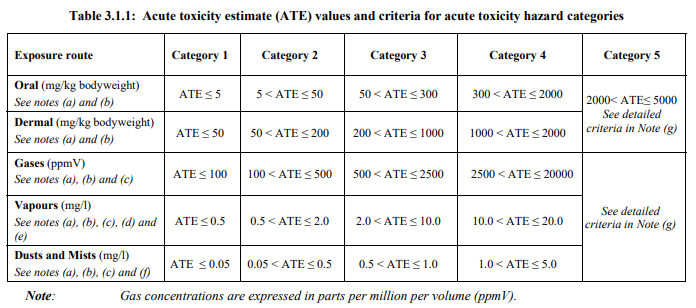
An SDS uses signal words like “Caution”, Warning”, or “Danger”. A particular standard test is needed to narrow down the type and magnitude of the toxicity. The figure below from the GHS shows the thresholds for categorization of Acute Toxicity.

Credit: Globally Harmonized System of Classification and Labeling of Chemicals.

Hazard and precautionary statements are important for an SDS. Rather than having everybody dreaming up their own hazard descriptions and precautions, this has been standardized into agreed upon language. Among other sources, Sigma-Aldrich has a handy list of Hazard Statements and Precautionary Statements available online.

Regulatory toxicology is very much a quantitative science enmeshed with a web of regulations. The EPA for instance does modeling of human health and environmental risks based on quantitative exposure or release inputs. Without toxicological and industrial hygiene testing data, they may fall back on model substances and default, worst case inputs to their models. In reality the certain hazard warnings you see on an SDS may or may not be based on actual measurement. The EPA can require that certain hazard statements be put on a given SDS based on their assessment of risk using models or actual data.

To be clear, hazard information reported on an SDS are considered gospel to emergency responders. Chemists of all stripes should be conversant with Safety Data Sheets and have a look at them the next time a chemical arrives. Your lab or facility should have a central location for SDS documents, paper or electronic.

In the handling and storage of chemicals, some thought should be given as to how a non-chemist would deal with a chemical spill. Is the container labeled with a CAS number or a proper name rather than just a structure? A proper name or CAS # could lead someone to an SDS. Is there an HMIS or other hazard warning label? There are many tens of thousands of substances that are either a clear, colorless or amber liquid or a colorless solid. If not for the sake of emergency responders then for the poor sods in EH&S who will likely have to dispose of the stuff when you are long gone. Storing chemicals, liquids especially, with some kind of secondary containment is always a plus. Keep the number of kilograms of combustibles and flammables in the lab to a minimum. A localized fire is better than a fire that quickly spreads to the clutter on the benchtop or the floor.

The Refinery Crack Spread

Reuters has reported that the crack spread enjoyed by oil refiners is currently sitting around $37.50. The crack spread is the difference between the price of crude oil and the petroleum products coming from it. This number is an indicator of the profitability of refinery output.

Cracking is a major operation at oil refineries where heavy, long chain hydrocarbons are broken into shorter chain hydrocarbons. Crude oil naturally contains a limited amount of components suitable for modern engines. An important attribute is branching. The goal is to produce the most valuable products from otherwise longer chain, lower value hydrocarbons.

A Scratch in the Surface of Gas Chromatography

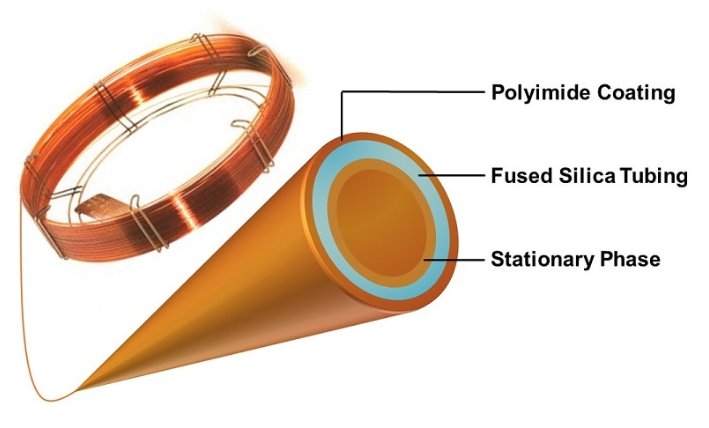
The analytical workhorse of the petroleum refinery is the gas chromatograph, or GC. The GC consists of a precisely controlled oven and within it is a coiled, small diameter hollow fiber many meters in length. It is called a capillary GC column. At one end of the column is an injection chamber with a silicone septum that samples are injected through via syringe. This chamber is hot enough to flash evaporate the sample but not so high that it decomposes. For instance, I have usually used a 250 oC injector temperature. A common volume of liquid to be injected is 1 microliter. The sample can be neat or a solution and must be scrupulously free of particles.

Inside the injector is the carrier gas input- helium is often used. A large amount of the vaporized sample is flushed out of the injector leaving only a small quantity of sample to be injected. Connected to the injector is the entrance of the capillary column. The goal is to inject a very narrow plug of sample into the capillary column all at once. After the injection, the detector is activated and the data collection begins. Progress can be followed in real time or not. Once the sample is on the column the GC run must be taken to completion. There is no reset for the column.

Capillary column. Source: Agilent.

The inside surface of the long capillary column can be just fused silica or it can have a coating. In any case, the components of the sample each have a different affinity for the inner wall of the capillary. As the carrier gas pushes the vaporized sample components along, the components with the least affinity for the inner column surface advance through the column fastest and arrive at the detector earlier. Generally, the higher the molecular weight, the lower the volatility and the longer it takes to exit the column.

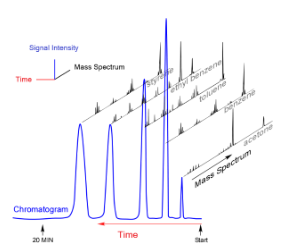
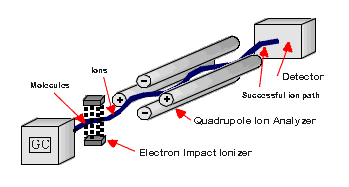
At the terminus of the capillary column is the detector. There are a variety of methods used to detect sample and send a signal to the plotter or computer. A particularly useful type of GC system uses a mass spectrometer as a detector. The flow of components enters an ionization chamber and positive ions are generated by electron impact and sent through the mass analyzer and on to the detector. This is occurring continuously as the sample components exit the column. As the components are detected, a regular chromatogram is collected and displayed. The difference with the mass spec detector is that along the timeline, mass spectra are also collected. It is possible to select any given peak in the chromatogram and display the mass spectrum.

A mass spectrum for every peak. Source: God I hope they don’t mind my using this graphic. American Chemical Society. I don’t need ACS goons banging on my door again!
Graphic from NASA showing schematic of the GC Mass Spec aboard the Huygens probe to Titan.

A mass spectrum detector offers the possibility of identifying the individual peaks from the molecular ion mass and the fragmentation pattern. That said, not all mass spectra are easily interpreted. Only cation fragments are visible. Neutral fragments must be inferred.

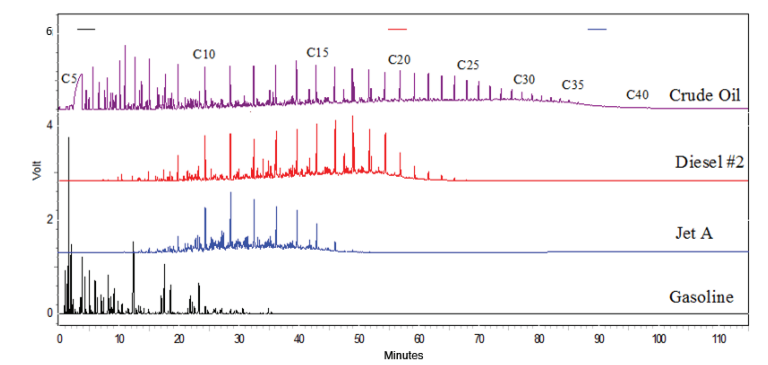
A stack of gas chromatograms showing the components of crude oil and several derived products below it. Each peak indicates a single component with the intensity along the y-axis and time in minutes along the x-axis. The area under each peak is proportional to the % composition in the sample. On the left side of the chromatogram are the components that are more volatile and exit the GC column earliest. The right side shows the components that exited the column after longer intervals. They are the longer chain molecules. Source: IRTC.

Back to the Crack

The most valuable refinery products are gasoline, fuel oil (including diesel), and aviation fuel. Within these three areas are subcategories that split into different product lines. These fuel product categories are defined by the number of carbon atoms in the blend of hydrocarbon molecules, saturation, and branching.

Refineries produce blended fuels affording certain properties according to their use. These properties include boiling point and vapor pressure specifications, octane or cetane numbers, viscosity, and pour point specifications. Between distillation, cracking, aromatization and reforming a wide variety of hydrocarbon substances are available from refining for formulation. A refinery is engineered to produce the largest volume of the most valuable hydrocarbons from continuous flow processes at the greatest profit.

Oh, I was just joking about the ACS goons. They don’t bang on your door.

RIP Albert Eschenmoser

A very accomplished organic chemist has died. Albert Jakob Eschenmoser, 97, retired professor of chemistry at ETH, Zurich (the Swiss Federal Institute of Technology) and The Skaggs Institute for Chemical Biology at The Scripps Research Institute in La Jolla, California. ETH Zurich is regarded as one of the best universities in the world. It is focused primarily on science, technology, engineering, and mathematics.

Eschenmoser is perhaps best known for his work on the synthesis of vitamin B12 along with Robert B. Woodward of Harvard University. Between the two groups this synthesis was accomplished over many years and required the labor of more than 100 students and postdocs grinding through their short times in the lab. This landmark synthesis was published in 1973.

Forms of vitamin B12. Source: MDPI.

This was perhaps the most complex organic synthesis of the time in 1973. Note that the wedge lines are meant to indicate that the feature is coming up out of the page and the dashed lines are jutting behind the page. Natural B12 has only 1 configuration of chemical bonds. Swapping something with a wedge with a dashed line group produces a different substance called a diastereomer. This all by itself makes the synthesis of B12 very difficult. Not only do the atoms have to be connected properly, but their arrangement in space must be correct also. This is called stereochemistry.

Junior RFK and Thimerosal

My, my, my. Rober F. Kennedy Jr. really screwed the pooch with his comments on ethnically targeted COVID-19. Reportedly, he said “there is an argument that (COVID-19) is ethnically targeted”, adding “Covid-19 is targeted to attack Caucasians and Black people. The people who are most immune are Ashkenazi Jews and Chinese …. we don’t know whether it’s deliberately targeted or not.” If this quote is correct, he did not actually say that COVID-19 was ethnically targeted, but rather that “there is an argument …”. It is much like saying “is Bob still beating his wife? I just don’t know …” Whether he endorses the targeting theory or not isn’t clear, but he was willing to trot out this provocative statement to make his point. There was much blowback. Given the racial undertones, it was a large blunder.

RFK Jr. is well known as an advocate for conspiracy theories, some of which are whoppers. The online news magazine Slate has an article that compiles them. I find that his portfolio of mania is exhausting. The thought of pushing back against such seems like a fool’s errand. It reminds of a line in the movie True Grit: “What have you done when you have bested a fool?” What is the point in debating him?

RFK Jr. is a Harvard grad and went the University of Virginia School of Law to get his JD degree. He had a few slip ups early in his career but recovered. He spent most of his career as an environmental lawyer and has fought many laudable battles for environmental justice. Somewhere along the line he went off the rails and landed in the crackpot ferry to conspiracy land. RFK Jr. is a penetrating anti-vaccine voice who can draw large crowds if for no other reason just to see him.

The substance of concern behind much of the anti-vaccine Sturm und Drang is Thimerosal. It is a synthetic organomercurial compound that is effective against bacteria and fungi. Its biocidal properties have been known since the around 1930. Mercurials have been used since the time of the Swiss alchemist Paracelsus (Philippus Aureolus Theophrastus Bombastus von Hohenheim) in the 1500’s. Paracelsus is known for the pronouncement that “only the dose makes the poison.” This remains a fundamental principle of toxicology.

The early mercurial medicaments used by Paracelsus were simple inorganic salts of mercury(II) like mercuric chloride, HgCl2, or mercury(I) like mercurous chloride, Hg2Cl2, also known as the mineral calomel. Mercuric chloride is prepared by treating liquid mercury with sulfuric acid followed by addition of sodium chloride for anion exchange. Mercurous chloride is prepared by heating mercuric chloride with mercury to do the reduction of Hg++ to Hg+.

Thimerosal is sometimes wrongly compared to methylmercury, a known and tragically toxic compound with the formula CH3Hg+X. The X anion can be chloride, hydroxide or a thiol, depending on the source. It is an easy comparison to make because of the similarity of methyl (CH3) to the ethyl (CH3CH2) hydrocarbon group in Thimerosal, but research has proven it to be a poor comparison. Methylmercury compounds can be produced by aquatic microorganisms in water bodies in the presence of inorganic mercury. The methylation of natural biomolecules is a well-known process.

Like many metals, mercury has an affinity for sulfur, occurring naturally as mercury (II) sulfide, HgS, as deposits of Cinnabar or as a minor constituent with other minerals. It also has an affinity for sulfur-containing amino acids such as methionine, cysteine and homocysteine found in proteins. In the bloodstream mercury binds with proteins like albumin to the extent of 95-99 %. While in the body and exposed to water it decomposes to thiosalicylate and ethylmercury. Ethylmercury cation (CH3CH2Hg+) disperses widely and can cross the blood-brain and placental barriers.

Cinnabar crystal, HgS. Source: Mindat.org

According to Doria, Farina, and Rocha (2015) in Applied Toxicology, a comparison of effects between methylmercury and ethylmercury gave essentially the same outcomes in vitro for cardiovascular, neural and immune cells. Under in vivo conditions, however, there was evidence of different toxicokinetic profiles. Ethylmercury showed a shorter half-life, compartmental distribution and elimination compared to methylmercury. Methylmercury and ethylmercury toxicity profiles show different exposure and toxicity risks.

For many years, Thimerosal was sold as an antiseptic under the name Merthiolate as a tincture (an ethanol solution) by Eli Lilly and Co. Like most households in the 1960’s, we had it in the medicine cabinet or its cousin Mercurochrome. They were used for topical application to burns, cuts and scratches. Thimerosal has been used as a preservative in many health-related preparations such as vaccines, eye drops and contact lens disinfecting solutions. While the CDC has cleared it of doing harm, anti-vaccine mania hit the fan well before COVID-19 and RFK Jr. put his credibility and name recognition behind it.

Thimerosal was first prepared by chemist Morris Kharasch at the University of Maryland in 1927. An interesting technical summary of the substance can be found on Drugbank Online.

Morris Selig Kharasch. Photo credit: National Academy of Sciences, 1960.

Kharasch is known for his pioneering work in free radical chemistry in the 1930’s at the University of Chicago but before that began his work with organomercury chemistry during the 1920’s while at the University of Maryland. His development of Thimerosal was a result of his organomercury work. He is also credited with opening the door to organic free radical chemistry leading to improvements in rubber polymer chemistry and manufacture. His work led to the use of peroxides to reliably induce the so-called anti-Markovnikov addition of a protic acid (HX) to olefins. The presence of trace peroxides was behind the unexpected “reverse” Markovnikov addition of seen in work with the addition of hydrogen bromide to bromopropene.

Kharasch’s early work in organomercury chemistry led to the invention (and patenting) of what became known as Merthiolate (thimerosal). Kharasch later worked as a successful consultant for Eli Lilly, the Du Pont Company, US Rubber, the US Army and others. In many cases these companies were the assignees of the patents.

Little mention is made of Morris Kharasch as a prolific and wide-ranging inventor with, by my count, 117 US patents with him as the inventor. So, why did Kharasch bother to patent Thimerosal? Did he anticipate its biocidal and preservative properties?

Kharasch references make mention of a 1931 patent regarding Thimerosal. That patent is STABILIZED BACTERICIDE AND PROCESS OF STABILIZING IT, US 1862896, appln. filed August 22, 1931, assignee: no party disclosed. The patent claims a process for and claims of water-soluble solution compositions. Numerous additives include antioxidants, alkyl amines, ethanolamine and borax. Claim 19 is telling. It claims the composition of sodium ethyl mercurithiosalicylate (Thimerosal), monoethanolamine, borax as a buffer and enough sodium chloride to make the composition sufficiently isotonic with the body fluids. In this patent the Thimerosal composition itself is not claimed, but as a component of a stabilized water solution. Claim 14 claims a water solution composition of sodium ethyl mercurithiosalicylate and an antioxidant which tends to “inhibit the acquisition” (odd choice of words) of burning properties by the solution. This plus the claim of an isotonic composition strongly suggests anticipated medicinal applications.

STABILIZED ORGANO-MERCUR-SULFUR COMPOUNDS, US 2012820, appln. Feb 17, 1934, assignee: Eli Lilly and Company. Claims a stabilized solution of alkyl mercuric sulfur compounds in water with aliphatic 1,2-diamines. Also claims Ethylenediamine ethylmercurithiosalicylate composition. This is similar to the ‘896 patent but specified ethylenediamines.

As mentioned above, the biocidal nature of inorganic mercurials had been known for a long time. There was actually limited success in the treatment of syphilis. But they were long known for being very harsh on the patient and grew out of favor when better treatments came along.

The antiseptic properties of Mercurochrome were discovered in 1918 at Johns Hopkins Hospital by urologist Hugh H. Young. Mercurochrome is essentially a dye molecule with an attached mercury warhead. There are three groups on the organic structure that aid in its solubility in water- NaO, CO2Na, and HgOH. Water solubility is often an important attribute in medicinal substances.

Source: Wikipedia.

Given that antiseptic properties of organomercurials were known, it is perhaps not surprising that an enterprising Ukrainian immigrant with an interest in organomercurials like Morris Kharasch might want to patent his invention.

Hydrogen and its Spin

Atomic hydrogen (the major isotope protium) is the simplest, lightest and most abundant neutral atom in the universe. Molecular hydrogen, H2, is the simplest neutral molecule in the universe. Seems very simple. Well, hold on. Turns out that molecular hydrogen has two distinct forms and it relates to the business of nuclear spin.

Quantum mechanics (QM) is a basket of wavy weirdness. It is a model of the universe at the atomic and nuclear levels that is wildly different from the larger scale Newtonian universe of colliding billiard balls we humans casually observe. The QM model of the microscopic universe dates back to the early 1900’s and has been endlessly supported by experimental data, and it continues to surprise to this day. One of the fundamental QM quantities is ‘spin.’

Fundamental particles like electrons and protons have something referred to as spin angular momentum. In the larger scale Newtonian universe spinning is something that we equate with an object that is rotating about an axis. Protons have a measurable diameter- it is a finite sized object with mass, charge and spin. Electrons have mass, charge and spin also. However, electrons do not have a measurable size. They appear to be a point charge. So, how does an electron with no measurable size actually spin? What is it that spins? A point of clarification: Quantum spin has nothing to do with a rotating internal mass. It is a quantized wave property expressed in units the same as classical angular momentum (N·m·sJ·s, or kg·m2·s−1). So, what the hell is quantum spin?

Spin angular momentum was inferred experimentally by the Stern-Gerlach experiment, which was first conducted in 1922. In this experiment, silver atoms were passed through a magnetic field gradient towards a photographic plate. Particles with no magnetic moment** would pass straight through unaffected. Particles with non-zero magnetic moment would be deflected by the magnetic field. In the experiment, the photographic plate revealed two distinct beams rather than a continuous distribution. The results indicate that the magnetic moment was quantized into two states. The magnetic moment at the time was thought to be due to the literal spinning of an electrically charged particle. They deduced that there were two spin configurations- i.e., they were quantized.

Schematic of the Stern-Gerlach experiment. Credit: https://www.youklab.org/teaching/mites_2010/mites2010_quantumSlides.pdf

If you want to go deeper down the QM rabbit hole, be my guest. We’ll go forward with the notion of spin up and spin down. You’ll see how it works.

Atomic Hydrogen- Things Get Sciency

First, let’s look at a neutral hydrogen atom made of a proton and an orbiting electron. Both particles have spin and each can be in one of two states relative to the other- parallel and antiparallel or simply spin up and spin down for the sake of illustration. The spin combinations are up-up and down-up as shown in the figure below. Think of the arrows as bar magnets, so up-up would be two magnets with the north poles in parallel and the down-up would be bar magnets with magnetic poles facing opposite directions, or antiparallel. The arrangement where the magnets are aligned with identical poles in the same direction is less energetically favorable than when they are antiparallel. Since it is energetically down-hill, the up-up will want to flip to down-up or antiparallel lower energy state. The energy difference is lost as radio frequency radiation in the microwave band.

A spin flip to lower energy level results in the emission of a 1420 MHz (21 cm wavelength) radio frequency emission. This can be detected by a radio telescope though with some difficulty due to poor signal to background noise. Credit: http://hyperphysics.phy-astr.gsu.edu/hbase/quantum/h21.html

The spin transition energy is 9.411708152678(13)×10−25 Joules. Regions of space with more intense 21 cm radiation are thought to be regions of greater hydrogen atom abundance. These regions can be examined for redshifting to give clues about relative motion in space. The spiral structure of the Milky Way galaxy was discovered with 21 cm radio observations.

Molecular Hydrogen, H2

Molecular hydrogen consists of two hydrogen atoms that share a pair of electrons which provide the bonding force. The two electrons spend a finite amount of time between the protons canceling the repulsive force between them. It’s called a sigma bond. So far, so good. The bond is springy so the molecule can/does vibrate.

An unfortunate reality of chemistry– Like most topics, the more background you have on a chemistry principle, the more unifying and elegant it becomes. This means that sharing the beauty of the molecular world is a little more difficult that many would like. I regret this most sincerely. Most freshman chemistry involves balancing equations and PV=nRT math. Necessary but not always captivating. Freshman chemistry is much like the Hobbit in the Lord of the Rings trilogy. It’s a necessary prelude.

First, a Dive Down the QM Rabbit Hole

Ok. I couldn’t ignore the QM rabbit hole. The two electrons of an H-H bond must have opposite spins in order to form a covalent bond. An orbital represents a specific occupancy space for one or two electrons around an atom or molecule. They are places, not physical objects. The atomic orbital model is a mathematical construct based on spherical harmonics to define the shapes of space that electrons will occupy around the nucleus, depending on their energy and quantum numbers. The likelihood of finding an electron is wavelike within a region of space.

Two electrons can occupy one orbital if they have opposite spins. It’s referred to as spin pairing. (Note: I posted on the orbital stuff a few posts back.) This hard and fast rule of antiparallel spins occupying the same orbital is formalized by the Pauli Exclusion Principle. The Pauli Principle says specifically that “no two fermions with half-integral spins can occupy the same quantum state within the same quantum system“. Electrons are fermions and the upshot is that only 2 electrons of antiparallel spin can occupy a single orbital. If two or more orbitals of equal energy level are available, the electrons will occupy separate orbitals with the same spin. The manner of the filling of orbitals with electrons is covered by Hund’s Rule.

Finally, QM gives a number to an electron’s spin- the spin quantum number. According to the Pauli Exclusion Principle, two electrons in a single orbital must have different half-integral quantum spin numbers: +/- 1/2, or antiparallel- to occupy the same orbital space.

Credit: Wikipedia.

Because the two H-H electrons are spin paired, there is no net spin from them. However, the protons are a different matter. Their spins can be parallel (up-up or down-down) or anti-parallel (up-down). The anti-parallel spins cancel to give no net proton spin to the H-H. But, in the case of spin parallel, the H-H molecule definitely has net spin.

Spin Isomers of H-H. Credit: Wikipedia, https://en.wikipedia.org/wiki/Spin_isomers_of_hydrogen

The spin parallel H-H molecules are called orthohydrogen and spin antiparallel H-H molecules are called parahydrogen. They are referred to as spin isomers or allotropes and are each distinct substances. There can be interconversion from orthohydrogen to parahydrogen molecules. The transition does not emit radiation, but it is exothermic. The parahydrogen is more stable by 1.455 kiloJoules (kJ/mol) per mole. Heating hydrogen will bring the composition to a maximum of 25 % ortho to 75 % para. When hydrogen is liquified, there is a slow conversion of ortho to para. It is worth noting that the enthalpy of evaporation of normal hydrogen (1:3 ortho to para) is 0.904 kJ/mol which is smaller than the 1.091 kJ/mole for 1:3 ortho to para conversion enthalpy for “normal” hydrogen. The conversion of orthohydrogen to parahydrogen in liquid form is exothermic and can result in hydrogen boil-off, leading to hydrogen loss and possibly causing a hazardous pressure rise. Those who regularly handle liquid hydrogen must be aware of this phenomenon. Orthohydrogen can also be catalytically converted to parahydrogen by contact with certain substances like ferric oxide, chromic oxide as well as several materials.

** Magnetic moment (from Wikipedia): magnetic moment is the magnetic strength and orientation of a magnet or other object that produces a magnetic field.