Category Archives: Chemistry

Virus Detection in Sewage

With the appearance of COVID and polio the USA, the news has revealed that it is possible to detect and monitor certain viruses in municipal sewage. As a chemist I marvel at this. Sewage is a frightfully complex mixture of biological waste products along with many chemical cleaning products, detergents, grime and pharmaceuticals that go down the drain. How is it that one can collect enough intact virus particles from this fecal hell broth with enough purity to make a positive identification of genetic material?

A recent methodology is given in an article titled Detection of Pathogenic Viruses in Sewage Provided Early Warnings of Hepatitis A Virus and Norovirus Outbreaks and published in Appl Environ Microbiol. 2014 Nov; 80(21): 6771–6781, DOI: 10.1128/AEM.01981-14 by Maria Hellmér,aNicklas Paxéus,bLars Magnius,cLucica Enache,bBirgitta Arnholm,dAnnette Johansson,bTomas Bergström,a and Heléne Nordera,c. As you can see the work is from 2014 so this is not brand-spanking-new technology. It is interesting to note that the material used to sediment the viruses in this article was acidified powdered skim milk proteins. The article was found by a Google search and located at the NIH National Library of Medicine.

Why powdered skim milk? It could be that milk fat interferes with the process or the workers are just removing variables. More likely, it is because the widely available powdered milk that you buy at the grocery store is from skim milk. Dairy fat is too valuable for a business to squander and is used to make more profitable products like ice cream or whipping cream.

A more recent methodology has been reported in PLoS One. 2017; 12(1): e0170199. Published online 2017 Jan 18. doi: 10.1371/journal.pone.0170199. The article, by Mathis Hjort Hjelmsø,#1,* Maria Hellmér,#2 Xavier Fernandez-Cassi,3 Natàlia Timoneda,3,4 Oksana Lukjancenko,1 Michael Seidel,5 Dennis Elsässer,5 Frank M. Aarestrup,1 Charlotta Löfström,2,¤ Sílvia Bofill-Mas,3 Josep F. Abril,3,4 Rosina Girones,3 and Anna Charlotte Schultz2 and titled Evaluation of Methods for the Concentration and Extraction of Viruses from Sewage in the Context of Metagenomic Sequencing. The article cites potential sedimentation substances as Iron(III) Chloride, powdered milk flocculation, PEG, and glass wool filtration. More extraction sources can be found online.

In the 2014 article above, the virus particles are extracted from the raw sewage onto acidified powdered skim milk proteins and amplified with quantitative polymerase chain reaction, qPCR. Powdered milk may seem strange but realize that virus particles can be removed by coagulation with metal ions, lime or with other polyelectrolytes, including proteins. The charge distribution on milk proteins will vary with acidity so these methods are very pH dependent. The viruses are naturally coated in proteins and thus will acquire surface charges varying with pH. The coagulation of proteins occurs when dissolved or suspended proteins irreversibly change their secondary structure by unfolding and condense to form a thicker solution or a solid form. The formation of cheese by acidification or solidifying a runny egg with heat are common examples of coagulation.

A 1973 review article by Gerald Berg in Bull World Health Organ. 1973; 49(5): 451–460, reviews methods for the removal of viruses from effluents, so knowledge of the sedimentation, or coagulation, of viruses in sewage has been around for a long while.

These articles are written by specialists in the field and may present considerable difficulty for a few readers. I would urge those so inclined to try to plow through the articles and pick up what you can. This holds true for all scientific papers. See what you can learn.

Simple PFAS Destruction Process Disclosed

An article titled Low-temperature mineralization of perfluorocarboxylic acids, Dichtel and Houk, et al., Science, 18 August 2022, Vol 377, Issue 6608, pp. 839-845, DOI: 10.1126/science.abm8868, came out yesterday with a method for defluorination and chain scission of per- and polyfluoroalkyl substances (PFAS). Blessedly, the article is available without charge.

The article describes the mineralization of reactive perfluorocarboxylic anions with NaOH in water and dimethylsulfoxide, DMSO, at 80 to 120 C and ambient pressure.

Ok. If the prefixes “per” and “poly” are unknown to you, read below, otherwise skip ahead.

==================

First, some clarification of the name “PFAS” for you non-chemists out there. The “P” in PFAS stands for either prefix “poly” or “per”. Both prefixes appear in common use. The prefix “per” is used to abbreviate the name when some atom or fragment is attached at every possible alkyl (see below) carbon connection point in a molecule or specified fragment of the molecule. The much lengthier proper name would have a number of the position of each separate fluorine atom on the molecule. “Per” and “poly” saves everyone from having to trip over a great many tongue-twisting syllables.

Hydrocarbons consist of only hydrogen atoms on a carbon skeleton. Hydrocarbon carbon atoms can have 0 to 3 hydrogen atoms attached to each skeleton atom. The exception would be methane, CH4, which has 4 hydrogen atoms attached. “Alkyl” refers to a subclass of hydrocarbon fragments or molecules that are absent multiple bonds between atoms of a carbon skeleton. A molecule with a carbon skeleton having no multiple bonds between carbon atoms and linked to hydrogen atoms only is called an “alkane”. An alkane fragment that is connected to something else is called an “alkyl” group.

Gasp! So, a perfluoroalkyl molecule or fragment would have 2 or more of its hydrogen atoms replaced with 2 or more fluorine atoms on a given carbon atom (see definition below).

From WikipediaAccording to the Organisation for Economic Co-operation and Development (OECD): “PFASs are defined as fluorinated substances that contain at least one fully fluorinated methyl or methylene carbon atom (without any H/Cl/Br/I atom attached to it), i.e. with a few noted exceptions, any chemical with at least a perfluorinated methyl group (–CF3) or a perfluorinated methylene group (–CF2–) is a PFAS.

The prefix “poly” is much simpler. It is meant to indicate that the word it is attached to has many units of something, as in polyfluoroalkyl, which means many fluorine atoms attached to alkyl carbon atoms. Or it could refer to a string of repeating units as in a polymer.

Outside of the narrow PFAS world, the prefix per in “perfluoroalkyl” would indicate in common usage that the alkyl fragment is completely saturated with fluorine atoms.

==================

If we were at the bar during happy hour slamming well drinks after a long day of shaking separatory funnels, washing glassware and trying to vacuum distill something useful out of tar, someone might have groused that the PFAS destruction process is simply a process where you heat the piss out of a DMSO/water mixture of NaOH and PFAS to destruction. Ok, the word they used is “mineralization” rather than the more chaotic sounding words “destruction” or “digestion”. Everyone has thermally decomposed a reaction mixture in the past. We would pause for a moment, shrug our shoulders and say “well, of course that works”. DMSO is a highly polar, high-boiling solvent which supports the formation of ionic decomposition products at elevated temperature. Kendall Houk even did some snazzy DFT calculations on decomposition mechanisms. Now, that is how to develop a new approach to decomposition! Get out the big stick of quantum mechanical computing power and swing it around! The rascals Dichtel and Houk worked it out first so we’d raise our glasses and drink in their honor. Here’s to you, boys and girls!

As we stagger out to the Uber for the ride home, somebody mutters “I wonder how far along the patent application is and who will be the assignee?”

Some Pragmatics of Green Chemistry

After following a chat room discussion on process safety, I find myself mixed on the matter of what is called green chemistry. In the present example, a fellow wanted to methylate a phenol but didn’t want to use dimethylsulfate or some similar methylating agent. He wanted something that was “green”.

Suggestions were varied, including a recommendation on the use of dimethyl carbonate as methylating agent and a few other approaches through aromatic substitution. One contributor wisely reminded contributors about going into the weeds with low atom efficiency.

Green chemistry is the design of chemical products and processes that reduce or eliminate the use or generation of hazardous substances. Green chemistry applies across the life cycle of a chemical product, including its design, manufacture, use, and ultimate disposal. Green chemistry is also known as sustainable chemistry.”  -EPA

When green organic chemistry is the goal in synthesis, it pays to be sure that there is an accepted definition of green chemistry on site.  The merits and definitions are explained elsewhere. Difficult questions come up when a non-green substance is replaced with something that may be “more green” but needs 2 steps instead of 1. Or when green but more expensive reagents and solvents are needed. What is best? In this case, greater safety, lower cost, higher space yields, reduced waste generation, and fastest reaction times will be the real drivers. The business to business market will not pay more for a green product while a cheaper non-green alternative is present. If you want to get an existing customer to requalify an existing product from a new green process, be prepared to discount the price in exchange for the customer having to go through a requalification process. Customers do not like change at all.

Under what conditions would management allow a process choice that is greenish but obviously more costly? Possibly never. A greener process needs to give a cost savings somewhere. Barring draconian regulation, a successful green process will have a cost benefit. The benefit may be in lower direct cost of manufacture, satisfaction of a process requirement by a customer, or a hedge against future regulatory restrictions.

Solvents may be one of the easier opportunities for green chemistry. For a given process, there may be a bit of latitude with the solvent. Sometimes the issue of solvent residues in the product may arise. Some solvents are easier to strip away than others. No one will choose a green solvent that is hard to remove from the product. Again, the drivers will be those mentioned above.

Another green opportunity is when we automatically choose a stoichiometric reducing agent when we could have looked at a catalytic system with hydrogen. Catalyst costs per kilogram of product can range from negligible to high. One advantage of using expensive platinum group metal catalysts is that the metal is usually recyclable, which is greenish. However, any organic ligand present does get incinerated producing non-green emissions in the process of energy intensive metal refining. If catalytic hydrogenation requires the installation of new capital equipment, then the installation costs in time and money may prevent a switch.

For green oxidation, oxygen in the air is cheap and abundant but carries a big problem. Using an oxidizing gas in the presence of a flammable liquid reaction mass can give rise to an explosive atmosphere in the headspace of the reactor. This is a non-starter in industry. Catalytic oxidation using a greenish primary oxidant in solution is a good place to start. I’ve heard of hydrogen peroxide or peroxyacetic acid referred to as greenish.

The big problem with green synthetic organic chemistry is that in order to synthesize a molecule, the structural precursors must be sufficiently green, reactive and selective to run on a reasonable timescale and at acceptable cost. And they must not produce non-green side products or wastes that spoil the advantage of the target green step. A weighing of the pros and cons of any attempt to do green chemistry will always be needed and subjective decisions will be made on what constitutes green.

While we are all struggling to be greener, let’s not forget to remind ourselves and others that reduced consumption of almost everything is a green step we can all take right now.

Oxybenzone and Coral Reefs in the Light of Day

In a recent issue of ChemistryWorld, an online publication of the Royal Society of Chemistry, a revealing article on work first published in Science describing how the combination of the UV sunscreen active ingredient oxybenzone and UV light together produce something that is toxic to corals reefs.

Researchers (paywall) at Stanford University found in their sea anemone model studies that in the presence of UV light, oxybenzone is modified by the attachment of glucose, forming a water soluble glycoside conjugate. This is a not an uncommon event in metabolism. The oxybenzone-glycoside conjugate was found to be a potent photo-oxidant and quite toxic to the algal symbionts of coral. A methoxy analog proved to be much more potent.

Benzophenones, of which oxybenzone is a variety, are well known photosensitizers and photoinitiators.

Locations like Hawaii and Palau have banned the sale of oxybenzone-containing sunscreens due to the harm they cause to coral reefs.

For Students. Thoughts on Chemical Process Scale-Up.

Chemical process scale-up is a product development activity where a chemical or physical transformation is transferred from the laboratory to another location where larger equipment is used to run the operation at a larger scale. That is, the chemistry advances to bigger pots and pans, commonly of metal construction and with non-scientists running the process. A common sequence of development for a fine chemical batch operation in a suitably equipped organization might go as follows: Lab, kilo lab, pilot plant, production scale. This is an idealized sequence that depends on the product and value.

Scale-up is where an optimized and validated chemical experimental procedure is taken out of the hands of R&D chemists and placed in the care of people who may adapt it to the specialized needs of large scale processing. There the scale-up folks may scale it up unchanged or more likely apply numerous tweaks to increase the space yield (kg product per liter of reaction mass), minimize the process time, minimize side products, and assure that the process will produce product on spec the first time with a maximum profit margin.

The path to full-scale processing depends on management policy as well. A highly risk-averse organization may make many runs at modest scale to assure quality and yield. Other organizations may allow the jump from lab bench to 50, 200, or more gallons, depending on safety and economic risk.

Process scale-up outside of the pharmaceutical industry is not a very standardized activity that is seamlessly transferable from one organization to another. Unit operations like heating, distillation, filtration, etc., are substantially the same everywhere. What differs is administration of this activity and the details of construction. Organizations have unique training programs, SOP’s, work instructions, and configurations of the physical plant. Even dead common equipment like a jacketed reactor will be plumbed into the plant and supplied with unique process controls, safety systems and heating/cooling capacity. A key element of scale-up is adjusting the process conditions to fit the constraints of the production equipment. Another element is to run just a few batches at full scale rather than many smaller scale reactions. Generally it costs only slightly more in manpower to run one large batch than a smaller batch, but will give a smaller cost per kilogram.

Every organization has a unique collection of equipment, utilities, product and process history, permits, market presence, and most critically, people. An organization is limited in a significant way by the abilities and experiences of the staff who can use the process equipment in a safe and profitable manner. Rest assured that every chemist, every R&D group, and every plant manager will have a bag of tricks they will turn to first to tackle a problem. Particular reagents, reaction parameters, solvents, or handling and analytical techniques will find favor for any group of workers. Some are fine examples of professional practice and are usually protected under trade secrecy. Other techniques may reveal themselves to be anecdotal and unfounded in reality. “It’s the way we’ve always done it” is a confounding attitude that may take firm hold of an organization. Be wary of anecdotal information. Define metrics and collect data.

Chemical plants perform particular chemical transformations or handle certain materials as the result of a business decision. A multi-purpose plant will have an equipment list that includes pots and pans of a variety of functions and sizes and be of general utility. The narrower the product list, the narrower the need for diverse equipment. A plant dedicated to just one or a few products will have a bare minimum of the most cost effective equipment for the process.

Scale-up is a challenging and very interesting activity that chemistry students rarely hear about in college. And there is little reason they should. While there is usually room in graduation requirements with the ACS standardized chemistry curriculum, industrial expertise among chemistry faculty is rare. A student’s academic years in chemistry are about the fundamentals of the 5 domains of the chemical sciences: Physical, inorganic, organic, analytical, and biochemistry. A chemistry degree is a credential stating that the holder is broadly educated in the field and is hopefully qualified to hold an entry level position in an organization. A business minor would be a good thing.

The business of running reactions at a larger scale puts the chemist in contact with the engineering profession and with the chemical supply chain universe. Scale-up activity involves the execution of reaction chemistry in larger scale equipment, greater energy inputs/outputs, and the application of engineering expertise. Working with chemical engineers is a fascinating experience. Pay close attention to them.

Who do you call if you want 5 kg or 5 metric tons of a starting material? Companies will have supply chain managers who will search for the chemicals with the specifications you define. Scale-up chemists may be involved in sourcing to some extent. Foremost, raw material specifications must be nailed down. Helpful would be some idea of the sensitivity of a process to impurities in the raw material. You can’t just wave your hand and specify 99.9 % purity. Wouldn’t that be nice. There is such a thing as excess purity and you’ll pay a premium for it. For the best price you have to determine what is the lowest purity that is tolerable. If it is only solvent residue, that may be simpler. But if there are side products or other contaminants you must decide whether or not they will be carried along in your process. Once you pick a supplier, you may be stuck with them for a very long time.

Finally, remember that the most important reaction in all of chemistry is the one where you turn chemicals into money. That is always the imperative.

Reactive Hazards Seminar

One of the safety seminars I teach is on the general topic of reactive hazards. There is a bit of a challenge to this because the idea is to cultivate informed caution rather than allow broadband fear to rule. It is challenging because my class is generally populated with non-chemist plant operators or other support staff. Out in the world the word “chemical” is generally taken to be an epithet and indicative of some malign influence. We who work with chemicals are in a position to bear witness to the reality of chemistry in our lives and to speak calmly and reasonably about it, without crass cheerleading.

Here is how I look at this. There are hazards and there are dangers. A hazard is something that can cause harm if it was to be fully expressed by way of physical contact with people or certain objects, unbounded access to an ignition source, exposure to air, etc. A critical feature of the hazard definition is that there are layers of protection preventing undesired contact. Hazards can be contained. A contained hazard is safer to be around than an uncontained hazard.

An uncontained hazard is that which can cause harm without the interference of effective layers of protection. A hungry tiger in a cage is hazardous in that there is the potential for trouble if the cage is breached. Being openly exposed to that tiger is what I’ll call dangerous.

Likewise, a stable chemical in a bottle has a physical layer of protection around it. A policy on the use of that bottled chemical constitutes a concentric administrative layer of protection. The bottle sitting in a proper cabinet within a room with limited access has more layers of protection. The policy of selling that chemical only to qualified buyers is a further layer of protection.

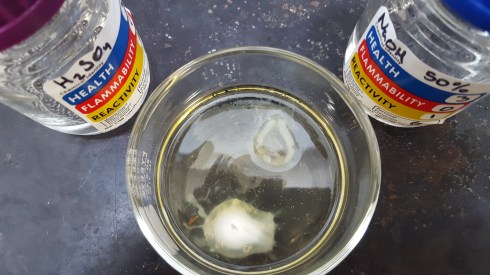
Egg white to which has been added several drops of conc H2SO4 (bottom) and 50 % caustic (top). Two minutes have elapsed. The point of this demo is to show what might happed to a cornea on contact with these reagents. The clouding is irreversible. People remember demonstrations.

It is possible to work around contained hazards safely and most of us do this outside of work without giving it much thought. Hazardous energy is exploited by most of us in the form of moving automobiles, spinning jet turbines, rotating machinery of all kinds, compressed gases and springs, and flammable liquids. Safe operation around these hazards is crucial to the conduct of civilization right down to our daily lives.

It is very easy for experts to frighten the daylights out of people by an unfortunate choice of words or simply dwelling on the hazardous downside too much. Users of technology should always be versed in the good and bad elements as a matter of course.

Risk can be defined as probability times consequence. So, to reduce risk one can reduce probability, diminish undesired consequences, or both.  This is the purpose of LOPA, or Layers of Protection Analysis. LOPA can provide a quantitative basis for safety policy. The video below will explain.

https://youtu.be/L3kQ9DKHS5A

Designing for tolerable risk is something that all of us in industry must come to grips with.


Convincing Industry of the Utility of Your Chemical Method or Reagent

It is not uncommon to read in chemistry papers or hear speakers from academic institutions making the assertion that certain problems exist that their method or reagent may solve. Perhaps a particular catalyst may give rise to a set of useful transformations or said catalyst may be fished out and reused in many other runs. Or, maybe the reagent in development affords spectacular yields or stereoselectivity. Given that an industry might have blockbuster products that share certain features or pharmacophores, an efficient method for synthesizing that feature is likely to be of genuine interest.

Chemical research coming from an academic institution in the USA is almost always executed by students and/or postdocs. In the case of graduate students, the work is done as part of their degree program and is designed to achieve certain goals or to explore a question. Regardless, it is not done to achieve a commercial purpose with product sales in mind. Student research is conducted with training and publication success as the goal. Graduate success and publication are the work products of academics.

If it transpires that a particular academic wants to do work that is also of commercial interest, that work should include certain commercial sensibilities associated with chemical production. Every business has its own list of development criteria in use. It will have a basis on in-house equipment and skills, company policy, safety, economic imperatives, working capital, required profit margins, environmental permits, available economies of scale, specialty or commodity products, etc.

Adopting a new reagent for an existing chemical product can be very problematic for a business. For production pharmaceuticals, it is likely to be impossible for management to actually contemplate the trouble involved in changing an approved process. For other industries a similar problem exists. Changing a reagent in an existing process will likely require the customer to approve the change and the drafting of an updated specification. And, for their trouble they are going to demand a reduced price. I’ve received and given that talking to on a few occasions myself.

If the change is very early in the reaction sequence of a lined-out process, there may be a chance to do a replacement or change a step. Maybe. Remember that customers usually do not like change in regard to the chemical product they are purchasing. They want and need consistency. Even improving purity can be bad if it results in the final product surprising the end-user in some way.

I would offer that if an academic worker wants to make a difference in commerce, they should concentrate on the final product in the application. It may be that an existing product could be made cheaper by your wonder reagent, or perhaps some me-too congener. Your reagent may be superior in a functional group transformation, but that is likely to draw yawns. How does your reagent add value to a process in concrete terms?

By adding value I mean to say, increasing profit margins. Costs in manufacturing are broadly divided into raw materials, labor, cost of sales and other overhead. They are not all easy to minimize. For instance, a mature product may be priced according to commodity scale pressures. That is, there are numerous suppliers and low margins in the market for producers. If the cost of goods sold is driven strongly by raw material costs, unless you can wangle a breakthrough in raw mat prices, staying price competitive may involve a race to the bottom of the lake. However, if labor is the major driver of cost, you may have a chance to increase margins by reduction in man-hours per unit. That reduction would come from any of a number of labor saving strategies.

Labor savings can come in many forms. More efficient use of existing equipment can lead to an increase of capacity and throughput over the year if the turnaround time between runs is shortened. Process intensification can also increase throughput and consequently reduced labor hours per kg of product. Higher reaction temperatures benefit kinetics as do increased space yields by running at higher concentrations. Just beware of the reaction enthalpy per kg of reaction mass (specific enthalpy). It is very possible to over-intensify and bring on problems with safe operation and side reactions.

For the academic aiming to be technologically relevant in a concrete way you have to think like the owner of big equipment. Idle equipment is not earning revenue. Busy equipment at least has a chance if it is done efficiently. Telescoping a process so that more steps can be run in the same vessel without solvent changes or excessive purification is always desirable. Moving material between vessels is time consuming and likely labor intensive.

More questions to consider. Does a reaction really require an overnight stir-out. And at reflux? Do you have a method of in-process checks that allow the next step to proceed? What is the minimum solvent grade you can get away with? Can you replace methylene chloride with anything else? What is the minimum purity raw material you can get away with? Unnecessarily high purity specs can be very expensive. Your customer will suffer from this as well.

Learn to get pricing from bulk suppliers. Use those unit prices for your cost calculations. For God’s sake, don’t use the Aldrich catalog for pricing. Remember, you’re trying to make a case for your technology. There should be a costing spreadsheet in your write up.

That’s enough for now. I gotta go home.


Pragmatics of effective science outreach

Public outreach in science is a important element for the maintenance of our present technology-affected (or afflicted) civilization. Science and engineering (Sci & Eng) activity is continually expanding the scope of the known. The global business sector, without relent, puts new technologies to work and retires others as obsolete. It is as though civilization is in a constant state of catch-up with the tools and materials being made newly available. And the quality of news is quite variable.

When it comes to the electronic and print mass media’s government reporting, the emphasis seems to me to focus on the current budgeting process and political conflict therein. These two subjects are in the “eternal now” in the flow of events. The word “news” is just the plural form of “new” so it is natural that news media focus on present budgeting and in-fighting. Media directors and executives know that reporting must be as concrete as possible and what could be more so than large dollar values and pithy news of political hijinks? Both raise our ire because cost and anger are emotional triggers for people. And emotional triggers bring lingering eyeballs to media.

The public not affiliated with Sci & Eng are quite often unaware of what their tax dollars are actually producing, perhaps many years down the timeline. The eventual outcome of government spending on Sci & Eng may be quite specialized and seem only remotely related to non-Sci & Eng life.

It has been my observation that media equates boring content with failure and compelling content with broadcasting success. The word “compelling” is used to describe something that attracts lingering eyeballs. Modern news broadcasting is the process of jumping from one compelling piece to another. I suppose we cannot blame them for this emphasis on superficiality because apparently it is what “we” want. The big We that draws advertisers and thus cash flow to broadcasters. It keeps the lights on and families fed. Basic stuff that can’t be dismissed with a utopian wave of the hand.

If there is going to be any fundamental change in the tenor and quality of content in media, it will have to come from citizen viewers. This leads me to the thrust of this essay: Those knowledgeable in Sci & Eng must bring the value proposition of current efforts in technological civilization to the citizenry, because broadcast media certainly can’t. By “broadcast media” I mean to include everything right down to what appears on your smart phone. Unfortunately, tech content typically emphasizes consumer goods like automobiles, electronic widgets, space, or miraculous medicine.

Those knowledgeable in Sci & Eng must bring the value proposition of current efforts in technological civilization to the citizenry, because broadcast media certainly can’t in any depth. They’re in showbiz. 

Arguments in favor of rational stewardship of our little world won’t influence elected politicians. But informed and persuasive citizens can influence those who are less so and if they apply some leadership. Carefully. Those who may be less educated and less up to date on the sciency subjects do not take kindly to speech that talks down to them. The hand that reaches from above is still above and off-putting. Learn to communicate on even ground.

What works for me in reaching out to all levels of education is to use humor and a bit of showmanship. Reaching out to the public in a way that keeps their attention is hard to do and not everyone is prepared to do it. Lest you think I am describing putting on a show, not entirely. I am saying that by the deft use of knowledge, public speaking skill, and the strength of personality, it is possible to persuade even the scientifically reluctant to perk up and follow your efforts at making a point. But the point must be accessible. Deep detail and meandering monologue will lose your group. Keep your outreach succinct and limit the breadth to a few pearls of wisdom. Get feedback on your presentation.  With any luck, they’ll go home and jump on Google for more.

If you need help with public speaking, join Toastmasters to improve. Try acting lessons. Join a theatre group. Learn to relax, pace yourself, and enjoy speaking. The better you get at the mechanics of public speaking, the more effective you’ll become.

[Note: The crummy WordPress text editor used to write this post is just abysmal. Why it was changed to the current revision is a mystery to me.  -Th’ Gaussling]

College chemistry coursework that has been of enduring value

As I look back on the chemistry coursework I took as an undergrad, a few classes stand out as especially useful over my career. First some qualifications: I became an organic chemist because I found it to be a good “fit” for my brain. So, organically oriented courses were obviously useful. The chemistry department at my alma mater followed guidelines for the ACS Certified curriculum. Thus required coursework was prescribed and completed.

Chemistry coursework of enduring value.

Sophomore Organic Chemistry:  Fortuitously, I took 2/3 of my general chemistry in the preceding summer, so I was able to take organic chemistry in my freshman fall term. This was the great awakening. It was crystal clear that this was what I was meant to do. The benefits from a course on organic chemistry are many. Foremost on the list is that it is structurally and mechanistically oriented. The cognitive benefit is that a structural and mechanistic approach can render the subject a bit less abstract. At least to highly visual people like myself.

Molecules are tiny objects with even tinier places on them where certain things can happen. Reaction chemistry is revealed as a graphic sequence of specific events on specific objects. This allows the mind to put together patterns of functional groups and reaction motifs. In my view, a year of organic chemistry is the reward for slogging through a year of general chemistry. Gen Chem doesn’t make you a chemist. A tech perhaps. But gen chem is to the chemistry curriculum as The Hobbit is to The Lord of the Rings- a necessary prelude. That is what I used to tell students, anyway.

Qualitative Analysis: This was the third quarter of a 3-quarter sequence of freshman chemistry. It was heavily lab oriented with a focus on the separation and identification of inorganic cations and anions. It was substantially descriptive chemistry where clever schemes were used to isolate ionic species.

Analytical Chemistry: This is where you really begin to feel like a chemist. We all learn skills in this class that last. It is measurement science and error analysis. Every chemical scientist should have a solid foundation in wet chemistry.

Instrumental Analysis: This class was taken after Analytical Chemistry and built upon learnings from it. I’d offer that time spent on learning how your detectors work and their limitations is invaluable.

Organic Qualitative Analysis: I’ve come to learn that this class was an unusual experience. We learned to identify organic substances using fundamental means for 1982. Melting points, melting points of derivatives, NMR (60 MHz!!) & IR spectra, solubility, sodium fusion, Lucas Test, 2,4-DNP-hydrazones etc. We were required to get three data points per unknown to conclude that we had identified the substance. An indispensable resource was a compendium of derivative properties. A challenging but good experience.

Undergraduate Research: Two years of this experience was invaluable as a prelude to grad school. The asymmetric reduction of ketones (1982-84) work here lead to my doing a doctorate in asymmetric C-C bond forming chemistry and a postdoc in catalyzed C-H insertion chemistry. This activity is a must for those who want to pursue post-graduate work.

Advanced Organic Chemistry: What can I say?

Advanced Inorganic Lab: Good experience. Did some glass blowing. Worked on a vac line, tube furnace, and in a glove box. Good intro to airless work which would be important in grad school.

Chemistry coursework that was inadequate.

Inorganic Chemistry: I took this class in a time when symmetry and spectroscopy topics were an emphasis in the textbooks. Maybe it is still like that. But I wish we could’ve spent more time on descriptive and preparative inorganic chemistry.

Physical Chemistry: At the time it seemed as though the mathematical manipulations were more important than what the relationships actually meant. Statistical mechanics was played down in favor of more time on quantum mechanics. On entrance to grad school of the 5 qualifier exams taken, stat mech was the only one I failed.

Coursework outside of chemistry that has been of enduring value.

Microbiology: My only college bio class. I swear that this class has saved me from food self-poisoning more than I realize. That is a lifelong benefit, but so was the insight into a fascinating world. The course included an intro to immunology which also has been useful.

Communications: I made great strides in learning how to do public speaking.

Russian Language:  Took only 1 year- just enough to be dangerous. It was of nearly zero help when I eventually visited Russia years later on a business trip.  I was interested in the history and politics of Soviet Russia in that slice of time during the cold war.

Computer Programming: Should have taken more classes. In the early eighties we had to use either punch cards or the DEC terminal. Oh, I hear that FORTRAN still sucks.

Air Force ROTC: The biggest benefit was that I learned I am not military material in any sense. But, the communication skills and the history of air power were useful. I couldn’t march to save my life. I was Gomer Pyle.