In a recent issue of ChemistryWorld, an online publication of the Royal Society of Chemistry, a revealing article on work first published in Science describing how the combination of the UV sunscreen active ingredient oxybenzone and UV light together produce something that is toxic to corals reefs.
Researchers (paywall) at Stanford University found in their sea anemone model studies that in the presence of UV light, oxybenzone is modified by the attachment of glucose, forming a water soluble glycoside conjugate. This is a not an uncommon event in metabolism. The oxybenzone-glycoside conjugate was found to be a potent photo-oxidant and quite toxic to the algal symbionts of coral. A methoxy analog proved to be much more potent.
Benzophenones, of which oxybenzone is a variety, are well known photosensitizers and photoinitiators.
Locations like Hawaii and Palau have banned the sale of oxybenzone-containing sunscreens due to the harm they cause to coral reefs.
I’m posting a link to the story of the astoundingly fast discovery and market entry of Pfizer’s Paxlovid, their small molecule contribution to the treatment of COVID-19. You have to wonder if the emergency use authorization came before the patents were allowed.
Chemical process scale-up is a product development activity where a chemical or physical transformation is transferred from the laboratory to another location where larger equipment is used to run the operation at a larger scale. That is, the chemistry advances to bigger pots and pans, commonly of metal construction and with non-scientists running the process. A common sequence of development for a fine chemical batch operation in a suitably equipped organization might go as follows: Lab, kilo lab, pilot plant, production scale. This is an idealized sequence that depends on the product and value.
Scale-up is where an optimized and validated chemical experimental procedure is taken out of the hands of R&D chemists and placed in the care of people who may adapt it to the specialized needs of large scale processing. There the scale-up folks may scale it up unchanged or more likely apply numerous tweaks to increase the space yield (kg product per liter of reaction mass), minimize the process time, minimize side products, and assure that the process will produce product on spec the first time with a maximum profit margin.
The path to full-scale processing depends on management policy as well. A highly risk-averse organization may make many runs at modest scale to assure quality and yield. Other organizations may allow the jump from lab bench to 50, 200, or more gallons, depending on safety and economic risk.
Process scale-up outside of the pharmaceutical industry is not a very standardized activity that is seamlessly transferable from one organization to another. Unit operations like heating, distillation, filtration, etc., are substantially the same everywhere. What differs is administration of this activity and the details of construction. Organizations have unique training programs, SOP’s, work instructions, and configurations of the physical plant. Even dead common equipment like a jacketed reactor will be plumbed into the plant and supplied with unique process controls, safety systems and heating/cooling capacity. A key element of scale-up is adjusting the process conditions to fit the constraints of the production equipment. Another element is to run just a few batches at full scale rather than many smaller scale reactions. Generally it costs only slightly more in manpower to run one large batch than a smaller batch, but will give a smaller cost per kilogram.
Every organization has a unique collection of equipment, utilities, product and process history, permits, market presence, and most critically, people. An organization is limited in a significant way by the abilities and experiences of the staff who can use the process equipment in a safe and profitable manner. Rest assured that every chemist, every R&D group, and every plant manager will have a bag of tricks they will turn to first to tackle a problem. Particular reagents, reaction parameters, solvents, or handling and analytical techniques will find favor for any group of workers. Some are fine examples of professional practice and are usually protected under trade secrecy. Other techniques may reveal themselves to be anecdotal and unfounded in reality. “It’s the way we’ve always done it” is a confounding attitude that may take firm hold of an organization. Be wary of anecdotal information. Define metrics and collect data.
Chemical plants perform particular chemical transformations or handle certain materials as the result of a business decision. A multi-purpose plant will have an equipment list that includes pots and pans of a variety of functions and sizes and be of general utility. The narrower the product list, the narrower the need for diverse equipment. A plant dedicated to just one or a few products will have a bare minimum of the most cost effective equipment for the process.
Scale-up is a challenging and very interesting activity that chemistry students rarely hear about in college. And there is little reason they should. While there is usually room in graduation requirements with the ACS standardized chemistry curriculum, industrial expertise among chemistry faculty is rare. A student’s academic years in chemistry are about the fundamentals of the 5 domains of the chemical sciences: Physical, inorganic, organic, analytical, and biochemistry. A chemistry degree is a credential stating that the holder is broadly educated in the field and is hopefully qualified to hold an entry level position in an organization. A business minor would be a good thing.
The business of running reactions at a larger scale puts the chemist in contact with the engineering profession and with the chemical supply chain universe. Scale-up activity involves the execution of reaction chemistry in larger scale equipment, greater energy inputs/outputs, and the application of engineering expertise. Working with chemical engineers is a fascinating experience. Pay close attention to them.
Who do you call if you want 5 kg or 5 metric tons of a starting material? Companies will have supply chain managers who will search for the chemicals with the specifications you define. Scale-up chemists may be involved in sourcing to some extent. Foremost, raw material specifications must be nailed down. Helpful would be some idea of the sensitivity of a process to impurities in the raw material. You can’t just wave your hand and specify 99.9 % purity. Wouldn’t that be nice. There is such a thing as excess purity and you’ll pay a premium for it. For the best price you have to determine what is the lowest purity that is tolerable. If it is only solvent residue, that may be simpler. But if there are side products or other contaminants you must decide whether or not they will be carried along in your process. Once you pick a supplier, you may be stuck with them for a very long time.
Finally, remember that the most important reaction in all of chemistry is the one where you turn chemicals into money. That is always the imperative.
One of the safety seminars I teach is on the general topic of reactive hazards. There is a bit of a challenge to this because the idea is to cultivate informed caution rather than allow broadband fear to rule. It is challenging because my class is generally populated with non-chemist plant operators or other support staff. Out in the world the word “chemical” is generally taken to be an epithet and indicative of some malign influence. We who work with chemicals are in a position to bear witness to the reality of chemistry in our lives and to speak calmly and reasonably about it, without crass cheerleading.
Here is how I look at this. There are hazards and there are dangers. A hazard is something that can cause harm if it was to be fully expressed by way of physical contact with people or certain objects, unbounded access to an ignition source, exposure to air, etc. A critical feature of the hazard definition is that there are layers of protection preventing undesired contact. Hazards can be contained. A contained hazard is safer to be around than an uncontained hazard.
An uncontained hazard is that which can cause harm without the interference of effective layers of protection. A hungry tiger in a cage is hazardous in that there is the potential for trouble if the cage is breached. Being openly exposed to that tiger is what I’ll call dangerous.
Likewise, a stable chemical in a bottle has a physical layer of protection around it. A policy on the use of that bottled chemical constitutes a concentric administrative layer of protection. The bottle sitting in a proper cabinet within a room with limited access has more layers of protection. The policy of selling that chemical only to qualified buyers is a further layer of protection.
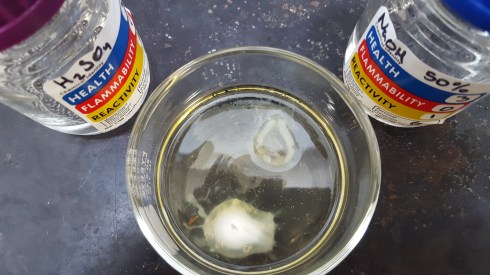
Egg white to which has been added several drops of conc H2SO4 (bottom) and 50 % caustic (top). Two minutes have elapsed. The point of this demo is to show what might happed to a cornea on contact with these reagents. The clouding is irreversible. People remember demonstrations.
It is possible to work around contained hazards safely and most of us do this outside of work without giving it much thought. Hazardous energy is exploited by most of us in the form of moving automobiles, spinning jet turbines, rotating machinery of all kinds, compressed gases and springs, and flammable liquids. Safe operation around these hazards is crucial to the conduct of civilization right down to our daily lives.
It is very easy for experts to frighten the daylights out of people by an unfortunate choice of words or simply dwelling on the hazardous downside too much. Users of technology should always be versed in the good and bad elements as a matter of course.
Risk can be defined as probability times consequence. So, to reduce risk one can reduce probability, diminish undesired consequences, or both.ย This is the purpose of LOPA, or Layers of Protection Analysis. LOPA can provide a quantitative basis for safety policy. The video below will explain.
It is not uncommon to read in chemistry papers or hear speakers from academic institutions making the assertion that certain problems exist that their method or reagent may solve. Perhaps a particular catalyst may give rise to a set of useful transformations or said catalyst may be fished out and reused in many other runs. Or, maybe the reagent in development affords spectacular yields or stereoselectivity. Given that an industry might have blockbuster products that share certain features or pharmacophores, an efficient method for synthesizing that feature is likely to be of genuine interest.
Chemical research coming from an academic institution in the USA is almost always executed by students and/or postdocs. In the case of graduate students, the work is done as part of their degree program and is designed to achieve certain goals or to explore a question. Regardless, it is not done to achieve a commercial purpose with product sales in mind. Student research is conducted with training and publication success as the goal. Graduate success and publication are the work products of academics.
If it transpires that a particular academic wants to do work that is also of commercial interest, that work should include certain commercial sensibilities associated with chemical production. Every business has its own list of development criteria in use. It will have a basis on in-house equipment and skills, company policy, safety, economic imperatives, working capital, required profit margins, environmental permits, available economies of scale, specialty or commodity products, etc.
Adopting a new reagent for an existing chemical product can be very problematic for a business. For production pharmaceuticals, it is likely to be impossible for management to actually contemplate the trouble involved in changing an approved process. For other industries a similar problem exists. Changing a reagent in an existing process will likely require the customer to approve the change and the drafting of an updated specification. And, for their trouble they are going to demand a reduced price. I’ve received and given that talking to on a few occasions myself.
If the change is very early in the reaction sequence of a lined-out process, there may be a chance to do a replacement or change a step. Maybe. Remember that customers usually do not like change in regard to the chemical product they are purchasing. They want and need consistency. Even improving purity can be bad if it results in the final product surprising the end-user in some way.
I would offer that if an academic worker wants to make a difference in commerce, they should concentrate on the final product in the application. It may be that an existing product could be made cheaper by your wonder reagent, or perhaps some me-too congener. Your reagent may be superior in a functional group transformation, but that is likely to draw yawns. How does your reagent add value to a process in concrete terms?
By adding value I mean to say, increasing profit margins. Costs in manufacturing are broadly divided into raw materials, labor, cost of sales and other overhead. They are not all easy to minimize. For instance, a mature product may be priced according to commodity scale pressures. That is, there are numerous suppliers and low margins in the market for producers. If the cost of goods sold is driven strongly by raw material costs, unless you can wangle a breakthrough in raw mat prices, staying price competitive may involve a race to the bottom of the lake. However, if labor is the major driver of cost, you may have a chance to increase margins by reduction in man-hours per unit. That reduction would come from any of a number of labor saving strategies.
Labor savings can come in many forms. More efficient use of existing equipment can lead to an increase of capacity and throughput over the year if the turnaround time between runs is shortened. Process intensification can also increase throughput and consequently reduced labor hours per kg of product. Higher reaction temperatures benefit kinetics as do increased space yields by running at higher concentrations. Just beware of the reaction enthalpy per kg of reaction mass (specific enthalpy). It is very possible to over-intensify and bring on problems with safe operation and side reactions.
For the academic aiming to be technologically relevant in a concrete way you have to think like the owner of big equipment. Idle equipment is not earning revenue. Busy equipment at least has a chance if it is done efficiently. Telescoping a process so that more steps can be run in the same vessel without solvent changes or excessive purification is always desirable. Moving material between vessels is time consuming and likely labor intensive.
More questions to consider. Does a reaction really require an overnight stir-out. And at reflux? Do you have a method of in-process checks that allow the next step to proceed? What is the minimum solvent grade you can get away with? Can you replace methylene chloride with anything else? What is the minimum purity raw material you can get away with? Unnecessarily high purity specs can be very expensive. Your customer will suffer from this as well.
Learn to get pricing from bulk suppliers. Use those unit prices for your cost calculations. For God’s sake, don’t use the Aldrich catalog for pricing. Remember, you’re trying to make a case for your technology. There should be a costing spreadsheet in your write up.
Public outreach in science is a important element for the maintenance of our present technology-affected (or afflicted) civilization. Science and engineering (Sci & Eng) activity is continually expanding the scope of the known. The global business sector, without relent, puts new technologies to work and retires others as obsolete. It is as though civilization is in a constant state of catch-up with the tools and materials being made newly available. And the quality of news is quite variable.
When it comes to the electronic and print mass media’s government reporting, the emphasis seems to me to focus on the current budgeting process and political conflict therein. These two subjects are in the “eternal now” in the flow of events. The word “news” is just the plural form of “new” so it is natural that news media focus on present budgeting and in-fighting. Media directors and executives know that reporting must be as concrete as possible and what could be more so than large dollar values and pithy news of political hijinks? Both raise our ire because cost and anger are emotional triggers for people. And emotional triggers bring lingering eyeballs to media.
The public not affiliated with Sci & Eng are quite often unaware of what their tax dollars are actually producing, perhaps many years down the timeline. The eventual outcome of government spending on Sci & Eng may be quite specialized and seem only remotely related to non-Sci & Eng life.
It has been my observation that media equates boring content with failure and compelling content with broadcasting success. The word “compelling” is used to describe something that attracts lingering eyeballs. Modern news broadcasting is the process of jumping from one compelling piece to another. I suppose we cannot blame them for this emphasis on superficiality because apparently it is what “we” want. The big We that draws advertisers and thus cash flow to broadcasters. It keeps the lights on and families fed. Basic stuff that can’t be dismissed with a utopian wave of the hand.
If there is going to be any fundamental change in the tenor and quality of content in media, it will have to come from citizen viewers. This leads me to the thrust of this essay: Those knowledgeable in Sci & Eng must bring the value proposition of current efforts in technological civilization to the citizenry, because broadcast media certainly can’t. By “broadcast media” I mean to include everything right down to what appears on your smart phone. Unfortunately, tech content typically emphasizes consumer goods like automobiles, electronic widgets, space, or miraculous medicine.
Those knowledgeable in Sci & Eng must bring the value proposition of current efforts in technological civilization to the citizenry, because broadcast media certainly can’t in any depth. They’re in showbiz.ย
Arguments in favor of rational stewardship of our little world won’t influence elected politicians. But informed and persuasive citizens can influence those who are less so and if they apply some leadership. Carefully. Those who may be less educated and less up to date on the sciency subjects do not take kindly to speech that talks down to them. The hand that reaches from above is still above and off-putting. Learn to communicate on even ground.
What works for me in reaching out to all levels of education is to use humor and a bit of showmanship. Reaching out to the public in a way that keeps their attention is hard to do and not everyone is prepared to do it. Lest you think I am describing putting on a show, not entirely. I am saying that by the deft use of knowledge, public speaking skill, and the strength of personality, it is possible to persuade even the scientifically reluctant to perk up and follow your efforts at making a point. But the point must be accessible. Deep detail and meandering monologue will lose your group. Keep your outreach succinct and limit the breadth to a few pearls of wisdom. Get feedback on your presentation.ย With any luck, they’ll go home and jump on Google for more.
If you need help with public speaking, join Toastmasters to improve. Try acting lessons. Join a theatre group. Learn to relax, pace yourself, and enjoy speaking. The better you get at the mechanics of public speaking, the more effective you’ll become.
[Note: The crummy WordPress text editor used to write this post is just abysmal. Why it was changed to the current revision is a mystery to me.ย -Th’ Gaussling]
As I look back on the chemistry coursework I took as an undergrad, a few classes stand out as especially useful over my career. First some qualifications: I became an organic chemist because I found it to be a good “fit” for my brain. So, organically oriented courses were obviously useful. The chemistry department at my alma mater followed guidelines for the ACS Certified curriculum. Thus required coursework was prescribed and completed.
Chemistry coursework of enduring value.
Sophomore Organic Chemistry:ย Fortuitously, I took 2/3 of my general chemistry in the preceding summer, so I was able to take organic chemistry in my freshman fall term. This was the great awakening. It was crystal clear that this was what I was meant to do. The benefits from a course on organic chemistry are many. Foremost on the list is that it is structurally and mechanistically oriented. The cognitive benefit is that a structural and mechanistic approach can render the subject a bit less abstract. At least to highly visual people like myself.
Molecules are tiny objects with even tinier places on them where certain things can happen. Reaction chemistry is revealed as a graphic sequence of specific events on specific objects. This allows the mind to put together patterns of functional groups and reaction motifs. In my view, a year of organic chemistry is the reward for slogging through a year of general chemistry. Gen Chem doesn’t make you a chemist. A tech perhaps. But gen chem is to the chemistry curriculum as The Hobbit is to The Lord of the Rings- a necessary prelude. That is what I used to tell students, anyway.
Qualitative Analysis: This was the third quarter of a 3-quarter sequence of freshman chemistry. It was heavily lab oriented with a focus on the separation and identification of inorganic cations and anions. It was substantially descriptive chemistry where clever schemes were used to isolate ionic species.
Analytical Chemistry: This is where you really begin to feel like a chemist. We all learn skills in this class that last. It is measurement science and error analysis. Every chemical scientist should have a solid foundation in wet chemistry.
Instrumental Analysis: This class was taken after Analytical Chemistry and built upon learnings from it. I’d offer that time spent on learning how your detectors work and their limitations is invaluable.
Organic Qualitative Analysis: I’ve come to learn that this class was an unusual experience. We learned to identify organic substances using fundamental means for 1982. Melting points, melting points of derivatives, NMR (60 MHz!!) & IR spectra, solubility, sodium fusion, Lucas Test, 2,4-DNP-hydrazones etc. We were required to get three data points per unknown to conclude that we had identified the substance. An indispensable resource was a compendium of derivative properties. A challenging but good experience.
Undergraduate Research: Two years of this experience was invaluable as a prelude to grad school. The asymmetric reduction of ketones (1982-84) work here lead to my doing a doctorate in asymmetric C-C bond forming chemistry and a postdoc in catalyzed C-H insertion chemistry. This activity is a must for those who want to pursue post-graduate work.
Advanced Organic Chemistry: What can I say?
Advanced Inorganic Lab: Good experience. Did some glass blowing. Worked on a vac line, tube furnace, and in a glove box. Good intro to airless work which would be important in grad school.
Chemistry coursework that was inadequate.
Inorganic Chemistry: I took this class in a time when symmetry and spectroscopy topics were an emphasis in the textbooks. Maybe it is still like that. But I wish we could’ve spent more time on descriptive and preparative inorganic chemistry.
Physical Chemistry: At the time it seemed as though the mathematical manipulations were more important than what the relationships actually meant. Statistical mechanics was played down in favor of more time on quantum mechanics. On entrance to grad school of the 5 qualifier exams taken, stat mech was the only one I failed.
Coursework outside of chemistry that has been of enduring value.
Microbiology: My only college bio class. I swear that this class has saved me from food self-poisoning more than I realize. That is a lifelong benefit, but so was the insight into a fascinating world. The course included an intro to immunology which also has been useful.
Communications: I made great strides in learning how to do public speaking.
Russian Language:ย Took only 1 year- just enough to be dangerous. It was of nearly zero help when I eventually visited Russia years later on a business trip. ย I was interested in the history and politics of Soviet Russia in that slice of time during the cold war.
Computer Programming: Should have taken more classes. In the early eighties we had to use either punch cards or the DEC terminal. Oh, I hear that FORTRAN still sucks.
Air Force ROTC: The biggest benefit was that I learned I am not military material in any sense. But, the communication skills and the history of air power were useful. I couldn’t march to save my life. I was Gomer Pyle.
One of my work duties is to give safety training on the principles of electrostatic safety: ESD training we call it. The group of people who go through my training are new employees. These folks come from all walks of life with education ranging from high school/GED to BS chemists & engineers to PhD chemists & engineers. In order to be compliant with OSHA and with what we understand to be best practices, we give personnel who will be working with chemicals extensive training in all of the customary environmental, health and safety areas.
I have instructed perhaps 80 to 100 people in the last 6 years. At the beginning of each session I query the group for their backgrounds and ask if it includes any electricity or electronics study or hobbies. With the exception of two electricians in the group, this survey has turned up a resounding zero positive responses.
Admittedly, there could be some selection bias here. It could be that people with electrical knowledge generally do not end up in the chemical industry. My informal observations support this. But I’m not referring to experts in the electrical field. I refer to people who recall ever having heard of Ohm’s law. One might have guessed that the science requirements for high school graduation may have included rudimentary electrical concepts. One might have further suspected that hobby electronics could have occupied the earlier years of a few attendees. Evidently not. And it does not appear that parents have been very influential in this matter either.
I’m struggling to be circumspect rather than righteous. It is not necessary for any given individual to have learned any particular field of study. It is not even necessary for most people to have studied electricity. But it is important for a core of individuals to have done so. So, where are they? And why aren’t more people curious enough to strike out on their own in the acquisition of electrical knowledge?
Back to electrostatics. In order to have a working grasp of electrostatic principles, the concept of the Coulomb has to be conveyed. Why the Coulomb? Because it is the missing piece that renders electrostatic concepts as mechanistic. It is my contention that a mechanistic grasp of anything can help a person to reason their way through a question. The alternative is rote memorization. The mechanistic approach is what drives learning in the natural sciences.
To be safe but still effective as an employee, a person needs to be able to discriminate what will and what will not generate and hold static charge to at least some degree in a novel circumstance. By that I mean how accumulated or stranded charge can form and what kind of materials can be effectively grounded. If you are working with bulk flammables, your reflexes need to be primed continuously to recognize a faulty ground path in the equipment around you. At the point of operation, somebody’s head has to be on a swivel looking for off-normal conditions.
It is possible to cause people to freeze in fear and over-react to unseen hazards like static electricity. But mindless spooking is a disservice to everyone. To work around flammable materials safely requires that a person understand and respect the operating boundaries of flammable material handling. Those boundaries are grounding and bonding (see NFPA 77), avoiding all ignition sources, good housekeeping, and maintaining an inert atmosphere over the flammable material.
Much of electrostatic safety in practice rests on awareness of the fire triangle and how to avoid constructing it.
Back to electrical education. There are numerous elements of a basic understanding of electricity that will aid in a person’s life, including safely working around flammable materials. One element is the concept of conduction and what kinds of materials conduct electric current. Another is the concept of a circuit and continuity. Voltage and its relationship to current follows from the previous concepts.
I would offer that the ability to operate software or computers is secondary to basic knowledge of how things work.
Connecting these ideas to electrostatics are the Coulomb and the Joule. One volt of potential will add one Joule of energy to one Coulomb of charges. One Ampere of current is one Coulomb of charges passing a point over one second. Finally, one Ohm is that resistance which will allow one Ampere of charge to move by the application of one volt.
For a given substance- dust or vapor- a minimum amount of spark energy (Joules) must be rapidly released in order to cause an ignition. This is referred to as MIE, Minimum Ignition Energy, and is commonly measured in milliJoules, mJ.
A discussion on sparking leads naturally into the concept of power as the rate of energy transfer in Watts (Joules per second), connecting to both the Joule and Ohm’s Law. Rapid energy transfer is better able to be incendive owing to the finite time needed for energy to disperse. Slow energy transfer may not be incendive simply because the energy needed to initiate and sustain combustion promptly disperses into the surroundings.
A discussion of energy and power is useful for a side discussion on how the electric company charges for energy in units of kilowatt hours (kWh). This is a connection of physics to money.
The overall point is that a rudimentary knowledge of electrical phenomena is of general use, even in the world of chemical manufacturing. I often hear people talk about the importance of “tech” in regard to K-12 education. By that they seem to say that using software is the critical skill. I would offer that the ability to operate software or computers is secondary to basic knowledge of how things work. Anyone with a well rounded education should be able to learn to use software as they need it.
Addendum 8/16/18. Since I wrote this essay, I’ve taught another 2 groups of trainees and not a single one of the 12 individuals could say that they had heard of Ohm’s law. All were high school grads over an age range of 22 to ~50. One had fresh BS Chem. E. degree. Evidently none had enough inclination in their travels to noodle their way through a rudimentary grasp of volts, ohms, amperes and basic electronic components. I find this incredible given the penetration of electrical contrivances in our lives.
This feeds into a pet theory of mine that true expertise is being replaced with software skills. I know this because it seems to be happening to me as well. Is this an aspect of the Dunning-Kruger effect?
In the course of my forays into chemical sourcing or searching for data, I have begun to notice something about product entries in the online Sigma-Aldrich catalog. I’m finding that since the acquisition of Sigma Aldrich by Merck KGaA, MilliporeSigma as it is now known, many of the compounds that I find listed say the product has been discontinued. Is it just fortuitous, or is it not? Is the catalog collection being trimmed?
Have I been collecting data? Pffft! Of course not, silly. It’s just the subjective experience of having found few if any Aldrich catalog entries labeled as discontinued over the past few decades. Recently I’m landing on the pages of discontinued products. Hmmm.
Over the many years, buying reagents from Aldrich has saved countless chemist-days in lab productivity. In fact, the availability of their huge collection of chemicals has driven the direction of much research out there based simply on the availability of reagents for purchase.
I blame the MBA’s. This has the smell of overly smart weasels marketing people.
I’ve been using a Mettler-Toledo (MT) RC1e reaction calorimeter for about 6 years. Our system came with MT’s iControl software, RTCal, and 2 feed pumps with balances. Overall it has proven its worth for chemical process safety and has helped us understand and adjust the thermal profile of diverse reactions. Like everything else, MT’s RC1e has many strengths and a few weaknesses.
The RC1e’s mechanical side seems reasonably robust. Our instrument sits in a walk-in fume hood resting on a low lab benchtop supported by an excess of cinder blocks- it is a heavy beast. During installation we discovered that the unit would not achieve stable calibration with the hood sash closed. The control box mounted on the instrument didn’t work properly on installation. After a trip to the repair shop, the box was returned as functional but without finding the fault.
Recently we had a mixing valve fail in the heat transfer plumbing, resulting in down time. Diagnosis of this was unsuccessful over the email and phone, necessitating a service call. Parts may not be inventoried in the US and consequently must come from Switzerland. Expect Swiss prices and less than snappy delivery. Hey, it’s been my experience.
Addendum, 5/4/22:ย After a nearly 1 year period of down time the RC1 was reinstalled at another location. Due to temperature regulation problems after the move, a technician from MT visited and repaired the instrument. It turns out that swapping one of the hot legs on theย 208 3 phase feed for another can cause the stir motor to reverse direction. A relief valve related to the heat transfer system had failed in the partially open condition. It was fixed and the instrument now performs as expected.
Addendum 2, 6/10/22: The RC1 has failed again. The “fix” didn’t work. Same problem as before. Maybe in the next repair they’ll replace the bloody valve rather than just “unstick” it. Unrelated gripe- Getting parts from Mettler-Toledo in Switzerland has been frustrating. They have always been very slow. So much for Swiss efficiency.
A chiller unit is required for RC1 operation and can add 15-30 k$ to the setup cost. Users will have to contend with the loss of floor/hood space in the lab for the chiller and RC1. The chiller must be powerful enough to contend with the exotherms that may be generated in the instrument. Chillers can take many hours to get down to the set temperature. Given that RC1 experiments can also be lengthy, plan accordingly. Our (brand new Neslab 80) chiller requires nearly 2 and 1/2 hours to get from +20 C to -20 C, which is the lower chiller temperature we use, depending on the reaction chemistry. For reactions that are on the sporty side, we’ll drop the chiller to – 50 C.ย This is near theย minimum temperature for the water-based chilling fluid we use. Early on I opted for an aqueous potassium formate solution with a very low freezing point. The instrument comes with a panic button that switches to full cooling in an emergency.
The chiller required the wiring-in of a dedicated single-phase 208 VAC circuit. With the chiller using single-phase and the RC1e using 3-phase 208 VAC, it is important to assure that one cannot inadvertently connect into the wrong power circuit (idiot proofing). The chiller plug design should already prevent this. It is critical that the electrician is alert to this and does NOT jury-rig the plugs to use the same style of connectors because he has only one style in the parts bin.
Some comments on the collection and interpretation of RC1 thermograms.
It is critical that those who request RC1 experiments understand the limitations of the instrument. For instance, we use a 2 Liter reaction vessel with a 400 mL minimum fill volume. Refluxing is not allowed owing to the huge thermal noise input from the reflux return stream. Special equipment is said to be available for reflux.
Experiments must be carefully designed to elicit results that can answer questions about feed rates and energy accumulation.
Like many instruments, the RC1 needs a dedicated keeper and contact person for inside and outside communication. A maintenance logbook should be kept next to the instrument if for no other reason than to pass along learnings from previous issues.
If thermokinetic measurement is part of your organization’s development SOP, someone on staff should be reasonably familiar with some chemical thermodynamics. That can be a chemical engineer, as may often be the case.
The users of thermal data are likely to need help with interpretation of the results. Be prepared to offer advice on interpreting the data, taking care not to over-interpret. If you don’t know, say so. It is easier to claw back “I don’t know” than “yeah, go ahead and do that …”.
Do not be anxious to singlehandedly bear the weight of responsibility for safety. Safety is a group responsibility.
Be curious. How do the insights and learnings from the data translate into best practices? What changes, if any, can the process chemists make to nudge the process for better safety and yields? A credible specialist in RC can make comments or ask questions that lead to better discussions on thermal hazards. Be a fly in the ointment.
Never forget that a reaction calorimeter is a blunt instrument for the understanding of a reaction. An RC1 thermogram is a composite of overlapping solution-phase phenomena. Interpretation of results can be greatly refined by pulling timely aliquots for NMR, GC/MS, or HPLC analysis.
A database should be constructed to collect and immortalize learnings from all safety work and RC1 learnings fall into that group.
There is the question of who collects and presents the data. An engineer or a chemist? Engineering thermodynamics is a big part of a chemical engineer’s education and skill set. As a plus, an engineer can take thermal data and apply it to scale-up design for safety and sizing of equipment and utilities. You know, the engineering part. On the down side, there may not be many chemical engineers who are comfortable with doing reaction chemistry.
Do not be anxious to singlehandedly bear the weight of responsibility for safety. Alpha males- are you listening??ย Safety is a group responsibility that should originate from a healthy group dynamic.
There’s a good argument for a chemist to conduct RC experiments as well. A trained synthesis chemist is qualified to conduct chemical reactions within their organization. That includes sourcing raw materials, handling them, running the reaction, and safely cleaning up the equipment afterwards. But interpreting RC1 data has a physical chemistry component. In my experience, run of the mill inorganic/organic synthesis people may have seen PChem as an obstacle rather than a focus in their college education. Their skill set is in instrumental analysis like NMR and chromatography, mechanisms, and reaction chemistry. I would recommend having a PhD chemist in a leadership role when calorimetry is a key part of a busy process safety environment.
Safety data can be collected and archived all day long. The crucial and often tricky part is how to develop best practices from the data. I would offer that this is inherently a cross-disciplinary problem. Calorimetric data from reaction chemistry can be collected readily, especially with the diverse and excellent instrumentation available today. Adiabatic temperature rise, ฮTad, is a key measurement. A lab group may be interested in the maximum (adiabatic) heat rise for a given reaction. A smooth and efficient technology transfer from lab to plant happens when good communication skills are used. Yes, SOP’s must be in place for consistency and safety. But the positive effect of individuals who have good social skills and are prone to volunteering information cannot be underestimated.