
Category Archives: Chemistry

The Adenocarcinoma Chronicles.

2/23/14

Five months past treatment for throat cancer I will set aside The Squamous Chronicles and instead post The Adenocarcinoma Chronicles. Having won the advanced prostate cancer lottery as well, my current adventures involve treatment below the beltline.  Here are my impressions of the experience to date.

Physicians, or more specifically in this context, oncologists, are ethically constrained to apply agreed upon treatments for the indications presented by the patient. I have gotten no “off-label” kind of advice up to now. In my case, my PSA was 39 and the biopsy readings from the pathologist were assigned Gleason 9. Well, sonofabitch. That was a fine kettle of fish. Looks like my watchful waiting was long in the waiting and too light in the watchfulness.

The standard treatment regimen in my case is hormone ablation and radiation. For hormone ablation I have had Degarelix and Lupron. For radiation I have begun IMRT (Intensity Modulated Radiation Therapy) with a dose of 76 Gy to the targeted tissue mass. I asked about scatter dose to the testes just because of the obvious proximity. The Rad Onc looked it up and said it was 1 Gy. I then pointed out that I’ve had a goodly bit of radiation in the last year and was there anyone who keeps a running total on the cumulative dose? As expected, the answer was “no” followed quickly by the standard rationale that the disease was far more dangerous than the radiation. I’d say the same thing I suppose.

Things that my docs are reluctant to offer are opinions on how this whole disease plays out. There seem to be several elements to this reticence. First, predicting the future is difficult, especially with a stochastic phenomenon like cancer radiotherapy. Second, there are good reasons for the doc to not focus on gloomy topics like life expectancy, especially if the survival stats are not the best. Most people at some point spontaneously think of cancer as a death sentence. At present I view it as a chronic condition that will play out stepwise in terms of a convergent treatment and remission series that eventually ends with refractory and widespread disease. Seems pretty obvious. It is the time-scale that I am uncertain of.

I am writing about this because my treatment regimen seems relatively ordinary to this point given the status of the condition. Perhaps there are some fellows who have yet to climb on this train who are uncertain of where it goes. This is my journey and I’ll pass along my notes.

Update 3/13/14

Now 14 treatments into radiation. With the help of medical textbooks ordered from Amazon, I have slowly been learning more about the disease and the treatment. During my weekly consult with the Rad-Onc I asked the question- “What was the T number from the pathologists notes?” He replied it was T3c N1.  The N1 means there is a node involved so it’s Stage 4 cancer. No one actually came out and said this to me so I had to ask. It is one thing to suspect it and another to hear it. Hard to say if this knowledge is in some way empowering.
On the 4-Methylcyclohexanemethanol Spill

The fouling of public waters in West Virginia by 4-methylcyclohexanemethanol (MCHM) is regrettable and my heart goes out to all of the families whose lives have been and are disrupted by the spill. In my judgment the descriptions of the substance found in Wikipedia and ChemSpider seem very evenhanded given what is known presently about the toxicology of the substance. The SymBioSys LASSO numbers found in ChemSpider are reassuring in the sense that the structure of MCHM does not line up well with the receptors in the list. The low scores are suggestive of substrate mismatch with these receptors based on calculation. That is a good thing. So is the relatively high flash point of 80 °C.

There are several uses of this substance. At the large scale its use has been patented as a frothing agent for coal beneficiation (US 4915825). That patent is now expired. It is useful for separating coal particles from inorganic mineral particles. Other uses include the preparation of ester derivatives to produce plasticizers either as a stand alone ester or, as a listing in SciFinder shows, a hydrophobic co-monomer.

From what I have heard in the media, the secondary containment failed, allowing material to discharge into the nearby river. This is easy to figure out. A visual inspection by plant EH&S should have noticed failure of the secondary containment during periodic inspection and flagged it for repairs. The US Chemical Safety Board is investigating and will eventually publish a finding.

It seems to me that the people of WV must be willing to publically demonstrate en mass if anything is to change there. The lack of regulatory oversight on facilities like this is not surprising. It is exactly as intended by the power brokers of the state.

Lithium Fires

Ran into an interesting recommendation on fighting a lithium fire in Joshi, D.K., et al, Organic Process Research & Development, 2005, 9, 997-1002.

In addition to the usual admonitions on the handling of a reactive metal like Li, they warned that water, sand, carbon dioxide, dry chemical, or halon should not be used. Rather, they suggest dry graphite or lithium chloride instead.  This seems quite reasonable to me, having reacted both silica and CO2 with magnesium powder in chemical demonstrations in a previous life. If Mg will reduce SiO2 and CO2, then hot/burning lithium ought to be reactive as well.

A similar recommendation is given in Furr, A.K. CRC Handbook of Laboratory Safety, 5th Edition, p. 299, ISBN 0-8493-2523-4.

Chemical Process Development

Lots of semi-batch process development and safety work going on in my lab. We use our reaction calorimeter for a variety of studies now. Naturally we want to know about energy accumulation with a given feed rate or any unforeseen induction or initiation problems in a reaction. We can also home in on recommendations for safe feed rates of reactants into a reaction mass.

What I am beginning to learn from the RC1 work is that running a reaction at low temperature is frequently done for sketchy reasons. Unless there are selectivity or side product issues, you really have to question why the reaction is specified to be run at low temperature. I think some of it comes from habit gained in grad school.  Low temperature may introduce dangerous situations with abrupt initiation by accumulation of unreacted reagents. Or it may lead to overly long feed time with the associated costs of added plant time and labor.

There are reagent incompatibilities like nBuLi in THF above – 15 C or so. But you’ll find that MeTHF is a bit more tolerant of temperature than is THF.

The precise temperature management capabilities (Tr) of an RC1 including the ability to lock on a temperature or precision ramping gives insight on solubility questions or on freezing points. The instrument also provides heat capacity data for engineering calculations. it is a very useful apparatus.

The Squamous Chronicles, part deux: Into the beam we go.

My adventure with Head and Neck Squamous Cell Carcinoma, HNSCC, soon enters a third phase.  A week from this writing I’ll don my custom prepared plastic mesh mask and they’ll strap me onto an x-ray machine. Oh yes, one other thing. There’ll be a weekly dose of cis-platin coincident with irradiation. Turns out that there is a synergistic effect with radiation and platinum poisoning cis-platin chemotherapy. No doubt it is related to the fact that platinum is a heavy atom with a lot of electron density ripe for scattering. Platinum ligated to DNA during irradiation is a bonus as well I suppose. Your own DNA as a ligand for platinum. A funny thought for someone in the catalyst business.

The first phase was the identification of a swollen lymph node and its subsequent removal from its cozy perch on my right carotid artery. Here I learned first hand why cancer is destructive. Mutant squamous cells from some molecular-genetic train wreck are washed away from their birthplace to lodge in distant locations. In my case, the aloof cells got hung up in a lymph node. There, they invaded the node and proliferated to the point where much of the lymphatic tissue became necrotic, likely from blood starvation. The node was not especially painful. Well, until the biopsy needle went in. Then it became very, very angry. But I digress.

The second phase, post surgery, was the adventure of finding suitable oncologists. This is a little bewildering. It is easy to get overwhelmed by information. I went for a second opinion and soon thereafter chose the Anschutz Cancer Center at the University of Colorado in Aurora. I’ve already had medical students and residents sitting in on consultations and exams.  The medical oncologist is a research professor specializing in head and neck cancer. He sees patients on Fridays too. The radiation oncologist sees a lot of HNSCC and seems knowledgeable and confident.

More to follow.

Suggestions for future customers

Being a grey haired chemist in the manufacturing field, allow me to make a few suggestions regarding the design of custom chemicals. If you as a customer would like to have a custom product that has minimal cost, maximum quality, and minimum variability, please consider the following attributes of an ideal custom synthetic chemical product.

Boundary conditions must be set on my comments:  custom or proprietary product; produced under batch or semi-batch conditions; non-pharma-food-neutriceutical related.

To the greatest extent possible the raw materials for your product are preferably-

  1. existing items of commerce unencumbered by composition of matter or process claims.
  2. available in a grade suitable for direct use.
  3. unencumbered by import restrictions, law enforcement watch lists, and relevant EPA restriction lists.
  4. TSCA and REACH listed already.
  5. those free of problematic isomers.
  6. those not requiring tight fractional distillation to purify.
  7. free of explosaphors like azide or nitro esters.

Your costs are best contained if your product-

  1. does not require enantiomeric purity or is not subject to facile isomerism affecting the specification.
  2. does not require more than one protection/deprotection scheme.
  3. does not require tight fractional distillation for final purity.
  4. does not require bulk high pressure chemistry (shops that can do this are limited).
  5. is air stable.
  6. is soluble enough in process solvents to maximize space yields (if it is, say, <10 wt %, batch costs will start to get high).
  7. does not require solvent changes in a process unit operation.
  8. is amenable to parallel synthetic strategy.
  9. does not require serious chilling of the reaction mixture (say, < -20 C).
  10. has been screened for real purity requirements rather than those based on the desire for tidiness.
  11. can be isolated by a simple Buchner filtration rather than, say, a centrifuge or other more elaborate solids isolation scheme.
  12. can be isolated by simple distillation.

It is important not to underestimate the cost of excess purity. A process may afford 96 % absolute purity on first isolation with say, 1 % solvent and 3.5 % side products or starting materials. The cost of taking this to >99.5 % is often very high in plant time and in product losses from added operations. Maybe you can get by with 98.5 % purity with some constraints on certain contaminants for your application.

Products and their intermediates may be designed in the early development stage to have properties that aid in low cost manufacturing without too much alteration of utility. For example, consider not using an n-octyl ester group in favor of 2-ethylhexyl ester. There are many structural motifs that derive from large scale items of commerce. Products that are strictly polyaromatic with or without hetreroatoms, are zwitterions or salts, or have a large heteroatom-to-carbon ratio, often have organic solubility problems. Will a bit of aliphatic shrubbery in a side group enhance processability? Maybe. If it allows your vendor to have better process economics, that helps everyone.

Does the process require nitromethane as a solvent? Does it require an exotic PGM catalyst that is patented? Do you have to use a patented transformation in the scheme that requires pencil-necks from the University IP office to audit annually? If so, try to find a better way.

Ice stalks. A winter oddity.

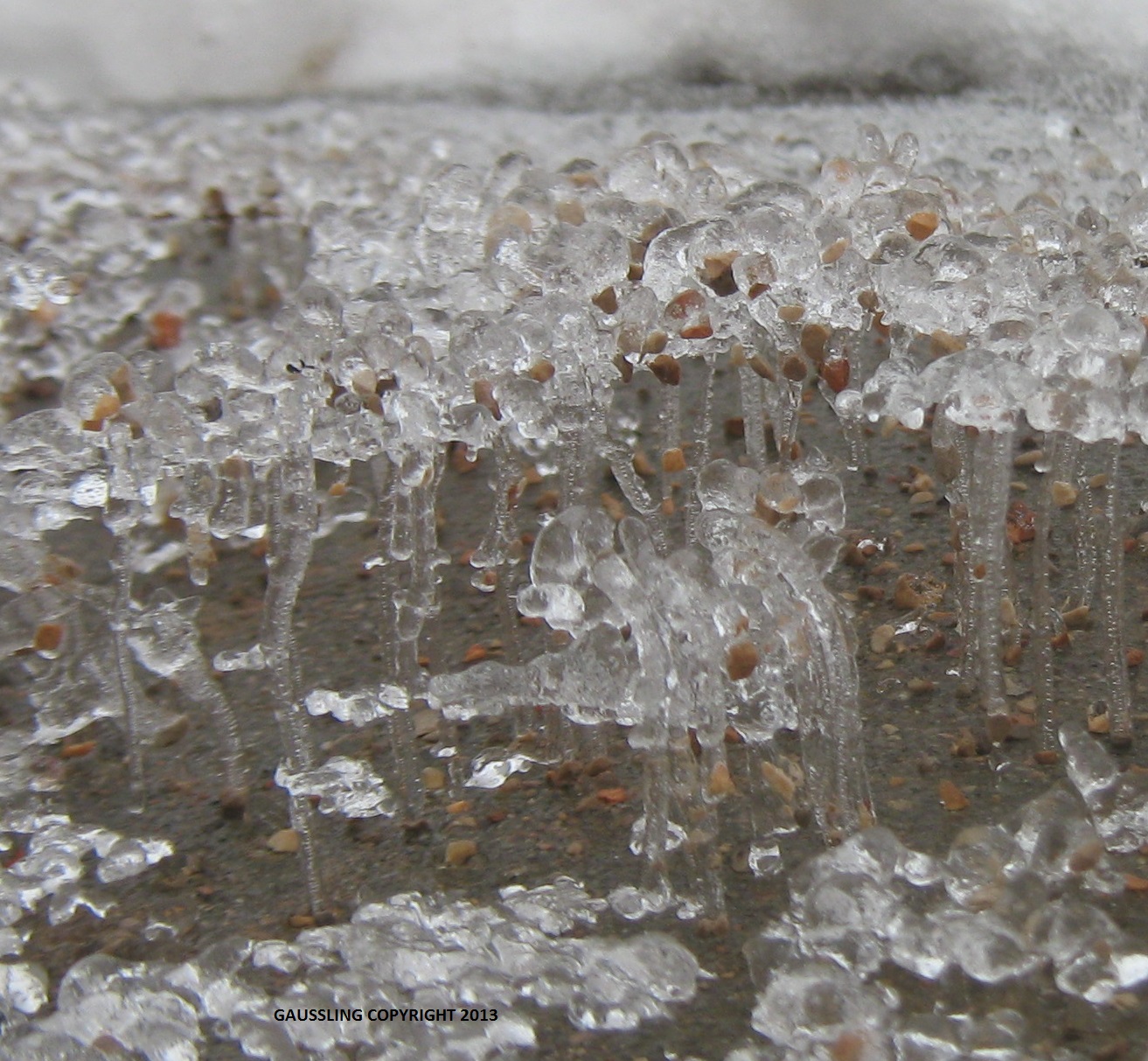
Yesterday I placed clay sorbent granules on my steep, north facing driveway to add some friction so the car and visitors can negotiate the grade in the snow and ice. The clay granules are used for absorbing oil and are similar to cat litter. I used the granules because I did not have sand.

Curious ice formation. Copyright 2013 Th' Gaussling.

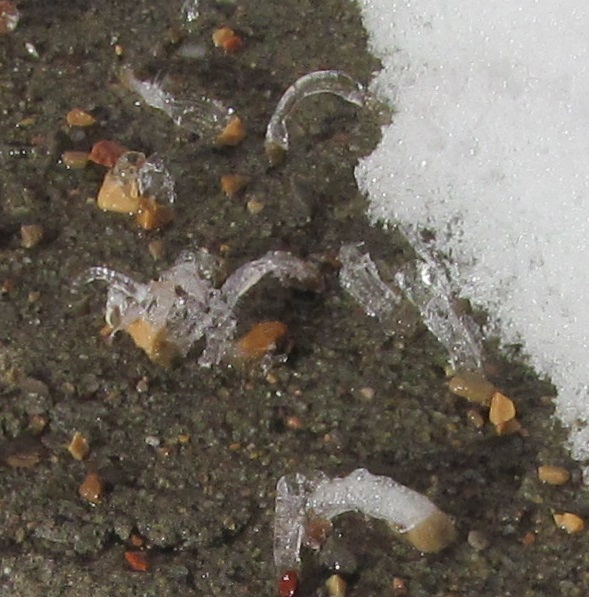
Ice stalk formation. Note that many of the clay granules have been lifted by the slender stalks of ice. Copyright 2013 Th’ Gaussling.

The granules were deposited on freshly shoveled concrete with just a thin layer of clear slush. I would estimate that, overnight, the temperature ranged between 25-32 F. In the morning, the 1-5 cm stalks of ice were observed only where the granules were deposited.

The slender stalks were capped with flat, irregular plates of ice.  Many of the stalks had lifted granules off the ground. Most appear to have arisen from the granules. Obviously, the process forming the stalks lifted some of the granules and ice vertically. Curved ice stalks appear to have extruded gradually from the granule and, under the influence of gradually shifting cover of snow or other ices, have extended produced a curved shaft of ice.

The granules are manufactured with absorbency in mind.  In this circumstance, I will hypothesize that capillary action pulling liquid water from the concrete surface is delivered to the upper surface of the granule where it freezes at the air/water interface by evaporative cooling. Why it doesn’t just stop is puzzling. Perhaps the action of freezing at the granule upper surface reduces the vapor pressure of water enough to induce a small pressure drop through the pores of the clay that draws liquid phase to the surface where is freezes continuously. The heat of fusion at the surface may be sufficient to prevent freezing of the water within the pores of the granule in the subfreezing range of the air and shutting the process down.

Ice Stalks 2

This is a very curious type of ice formation, one that I have observed on two separate occasions. This is another odd thing water can do.

Priestley Medal 2013

Congratulations to Professor Peter J. Stang on winning the 2013 Priestley Medal. The C&EN bio at this link reveals quite an interesting career.

Oh, by the way.  Am I the only one to notice some faint resemblance between the Medal winner and Ambassador Sarek from Star Trek? Face it. Being a JACS editor is about the same status as an ambassador.