
Th’ Gaussling, Ph.D.
We have all heard of radon gas and the radiation hazard it poses here in Colorado. Any given amount of radon decays to half in just a matter of 3.82 days. If that is the case, shouldn’t it be just a matter of waiting a few weeks for it to disintegrate and go away? Seems reasonable. But the problem is that radon is constantly forming by the radioactive decay of uranium found naturally in rocks like granite, and Colorado has a whopping large amount of exposed surface and subsurface of granite.
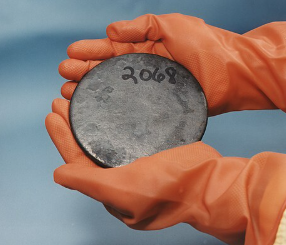
Uranium is a silvery-grey metal named after the planet Uranus (YOUR un us). Uranium doesn’t exist in nature as the silvery-grey metal. It is found in a handful of mineral substances. Colorado has the third highest abundance in the USA behind Wyoming and New Mexico. It is helpful to understand that uranium has two common chemical varieties as well as two common nuclear varieties.
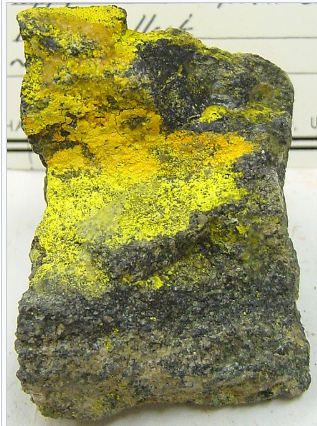
Uranium minerals
Uranium minerals finds their way into deposits that have migrated there by hot, high-pressure water from deep underground. This water travels through underground faults and fractures, dissolving surface minerals along the way. As the water moves upward through the fault it cools and depressurizes, dropping out dissolved minerals as solids that attach to the walls of the fault. Over time, the fault may be filled with solidified minerals and the flow shut. Over the depths of time erosion grinds away the surface rock, bringing the surface closer to the minerals. Other times the uranium solution may find its way into porous sandstone and migrate within the sandstone.
This water flow mechanism is also how gold veins form.
Ground water carrying oxygen from rain and snow can cause the uranium to migrate horizontally and concentrate into lens-shaped deposits called “roll-fronts”. A large amount of uranium is mined from these roll fronts. A subsurface roll-front deposit of uranium has been found near Nunn, Colorado.
Chemical uranium
Uranium occurs in minerals in two distinct chemical varieties- uranyl (YURA neel) and uranous (YURA nus). The difference is in the electric charge of the uranium atom, or ion as it’s called. Uranium (+6) is the “uranyl” form and uranium (+4) is the “uranous” form. The uranyl and the uranous forms have different chemical properties and produce different kinds of chemistry. The most common natural variety is the +6 form and the least is the +4 form. The uranyl varieties tend to have the greatest water solubility and therefore the greatest mobility in ground and surface water. Oxygen in ground water can convert uranium (+4) to (+6) and cause it to migrate faster through sandstone. Deep underground uranium can shuttle back and forth between +4 and +6 depending on what else is present.
Nuclear uranium
The two major nuclear varieties are U-238 and U-235. By nuclear we refer to the atomic nucleus. The U-238 form has a 99.3 % natural abundance and U-235 with 0.7 %. Both U-238 and U-235 have uranyl and uranous chemical forms as well. U-(235) is the critical isotope used for fuel in nuclear reactors. U-(238) is isolated for several reasons. It can be bred into plutonium-239 in breeder reactors for weapons use. Depleted uranium, U-238, finds considerable use in kinetic weapons. A high velocity projectile made of uranium has considerably more kinetic energy, KE = 1/2 (mv2), than a metal of lower density like lead or steel. The half-life of U-238 is 4.47 billion years and the specific [radio]activity is 12.4 thousand disintegrations per second per gram (12.4 kBq/g). While not zero activity, it is considered to be “minimal” as these things go.
So, what do the uranium numbers 235 and 238 mean? They refer to the number of particles- protons and neutrons- in the atomic nucleus. It is called atomic weight. The two numbers refer to isotopes. If you make a list of elements from lightest to heaviest, hydrogen with its one proton will be #1. Uranium, the heaviest natural element, tops out at 92 protons and is #92. Every metal heavier than uranium has to be man-made.
Chemical weathering
The Rocky Mountains have rock and soil surfaces that have been exposed to erosion by wind, oxygen, rain water and snow for countless millennia. Rain water picks up traces of carbon dioxide which forms mildly corrosive carbonic acid which can slowly dissolve certain minerals in rock. The entire landscape exposed to the weather is subject to the destructive forces of the freeze/thaw cycle over time. The action of freezing water on surface rock has the effect of accelerating the fracturing of exposed rock formations, extending erosion. The effects of oxygen and dissolved carbon dioxide on newly exposed rock surfaces from erosion lead to chemical alteration of the individual mineral surfaces of the rock.
A mineral is a naturally occurring inorganic solid with a specific chemical composition which can be described with a chemical formula. A rock is a solid aggregation of one or more minerals (Google).
Weathered rock surfaces can be chemically different from the unexposed interior of a rock. The individual mineral components of the rock exposed to weathering will be altered chemically in ways unique to the particular mineral. Individual minerals in the rock which are otherwise insoluble in water may change into soluble new chemical substances and gradually wash away with water runoff. Over time this chemical weathering will slow down as the available mineral is consumed.
 Lamentations on Chemistry