Atomic hydrogen (the major isotope protium) is the simplest, lightest and most abundant neutral atom in the universe. Molecular hydrogen, H2, is the simplest neutral molecule in the universe. Seems very simple. Well, hold on. Turns out that molecular hydrogen has two distinct forms and it relates to the business of nuclear spin.
Quantum mechanics (QM) is a basket of wavy weirdness. It is a model of the universe at the atomic and nuclear levels that is wildly different from the larger scale Newtonian universe of colliding billiard balls we humans casually observe. The QM model of the microscopic universe dates back to the early 1900’s and has been endlessly supported by experimental data, and it continues to surprise to this day. One of the fundamental QM quantities is ‘spin.’
Fundamental particles like electrons and protons have something referred to as spin angular momentum. In the larger scale Newtonian universe spinning is something that we equate with an object that is rotating about an axis. Protons have a measurable diameter- it is a finite sized object with mass, charge and spin. Electrons have mass, charge and spin also. However, electrons do not have a measurable size. They appear to be a point charge. So, how does an electron with no measurable size actually spin? What is it that spins? A point of clarification: Quantum spin has nothing to do with a rotating internal mass. It is a quantized wave property expressed in units the same as classical angular momentum (N·m·s, J·s, or kg·m2·s−1). So, what the hell is quantum spin?
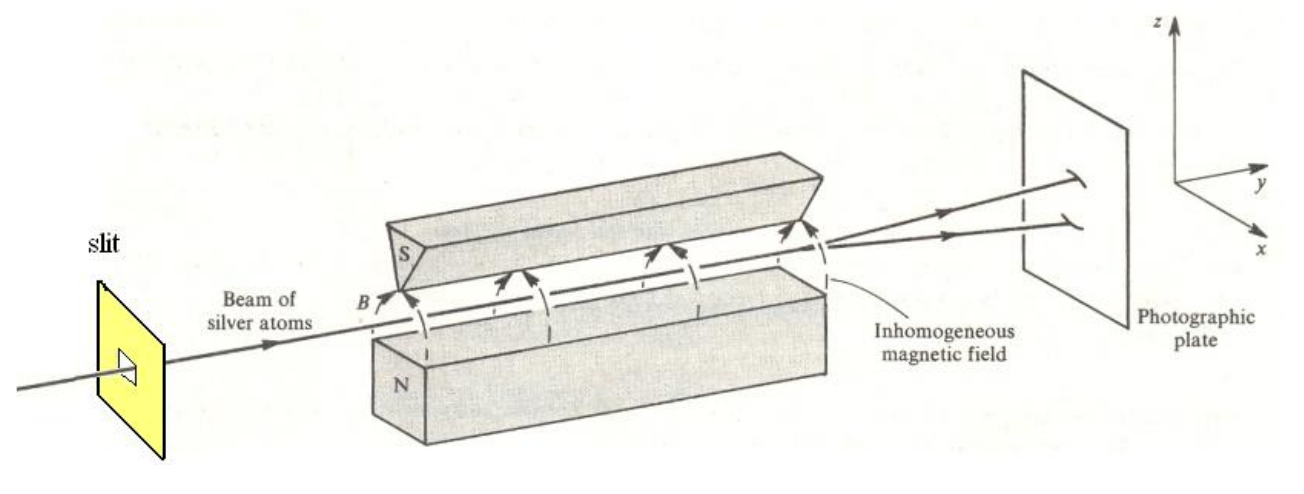
Spin angular momentum was inferred experimentally by the Stern-Gerlach experiment, which was first conducted in 1922. In this experiment, silver atoms were passed through a magnetic field gradient towards a photographic plate. Particles with no magnetic moment** would pass straight through unaffected. Particles with non-zero magnetic moment would be deflected by the magnetic field. In the experiment, the photographic plate revealed two distinct beams rather than a continuous distribution. The results indicate that the magnetic moment was quantized into two states. The magnetic moment at the time was thought to be due to the literal spinning of an electrically charged particle. They deduced that there were two spin configurations- i.e., they were quantized.
If you want to go deeper down the QM rabbit hole, be my guest. We’ll go forward with the notion of spin up and spin down. You’ll see how it works.
Atomic Hydrogen- Things Get Sciency
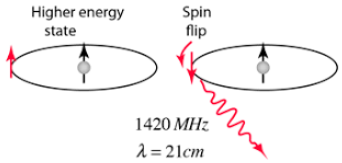
First, let’s look at a neutral hydrogen atom made of a proton and an orbiting electron. Both particles have spin and each can be in one of two states relative to the other- parallel and antiparallel or simply spin up and spin down for the sake of illustration. The spin combinations are up-up and down-up as shown in the figure below. Think of the arrows as bar magnets, so up-up would be two magnets with the north poles in parallel and the down-up would be bar magnets with magnetic poles facing opposite directions, or antiparallel. The arrangement where the magnets are aligned with identical poles in the same direction is less energetically favorable than when they are antiparallel. Since it is energetically down-hill, the up-up will want to flip to down-up or antiparallel lower energy state. The energy difference is lost as radio frequency radiation in the microwave band.
A spin flip to lower energy level results in the emission of a 1420 MHz (21 cm wavelength) radio frequency emission. This can be detected by a radio telescope though with some difficulty due to poor signal to background noise. Credit: http://hyperphysics.phy-astr.gsu.edu/hbase/quantum/h21.html
The spin transition energy is 9.411708152678(13)×10−25 Joules. Regions of space with more intense 21 cm radiation are thought to be regions of greater hydrogen atom abundance. These regions can be examined for redshifting to give clues about relative motion in space. The spiral structure of the Milky Way galaxy was discovered with 21 cm radio observations.
Molecular Hydrogen, H2
Molecular hydrogen consists of two hydrogen atoms that share a pair of electrons which provide the bonding force. The two electrons spend a finite amount of time between the protons canceling the repulsive force between them. It’s called a sigma bond. So far, so good. The bond is springy so the molecule can/does vibrate.
An unfortunate reality of chemistry– Like most topics, the more background you have on a chemistry principle, the more unifying and elegant it becomes. This means that sharing the beauty of the molecular world is a little more difficult that many would like. I regret this most sincerely. Most freshman chemistry involves balancing equations and PV=nRT math. Necessary but not always captivating. Freshman chemistry is much like the Hobbit in the Lord of the Rings trilogy. It’s a necessary prelude.
First, a Dive Down the QM Rabbit Hole
Ok. I couldn’t ignore the QM rabbit hole. The two electrons of an H-H bond must have opposite spins in order to form a covalent bond. An orbital represents a specific occupancy space for one or two electrons around an atom or molecule. They are places, not physical objects. The atomic orbital model is a mathematical construct based on spherical harmonics to define the shapes of space that electrons will occupy around the nucleus, depending on their energy and quantum numbers. The likelihood of finding an electron is wavelike within a region of space.
Two electrons can occupy one orbital if they have opposite spins. It’s referred to as spin pairing. (Note: I posted on the orbital stuff a few posts back.) This hard and fast rule of antiparallel spins occupying the same orbital is formalized by the Pauli Exclusion Principle. The Pauli Principle says specifically that “no two fermions with half-integral spins can occupy the same quantum state within the same quantum system“. Electrons are fermions and the upshot is that only 2 electrons of antiparallel spin can occupy a single orbital. If two or more orbitals of equal energy level are available, the electrons will occupy separate orbitals with the same spin. The manner of the filling of orbitals with electrons is covered by Hund’s Rule.
Finally, QM gives a number to an electron’s spin- the spin quantum number. According to the Pauli Exclusion Principle, two electrons in a single orbital must have different half-integral quantum spin numbers: +/- 1/2, or antiparallel- to occupy the same orbital space.
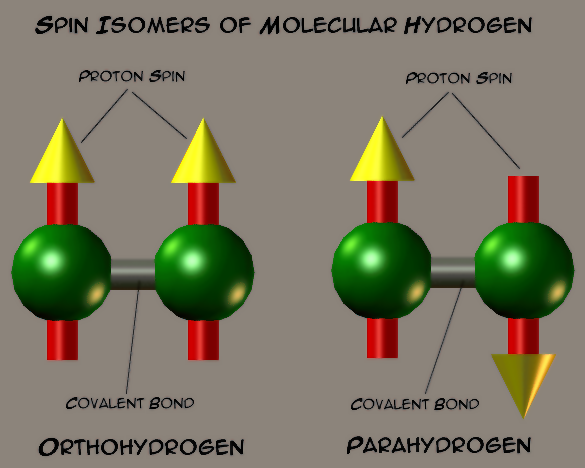
Because the two H-H electrons are spin paired, there is no net spin from them. However, the protons are a different matter. Their spins can be parallel (up-up or down-down) or anti-parallel (up-down). The anti-parallel spins cancel to give no net proton spin to the H-H. But, in the case of spin parallel, the H-H molecule definitely has net spin.
The spin parallel H-H molecules are called orthohydrogen and spin antiparallel H-H molecules are called parahydrogen. They are referred to as spin isomers or allotropes and are each distinct substances. There can be interconversion from orthohydrogen to parahydrogen molecules. The transition does not emit radiation, but it is exothermic. The parahydrogen is more stable by 1.455 kiloJoules (kJ/mol) per mole. Heating hydrogen will bring the composition to a maximum of 25 % ortho to 75 % para. When hydrogen is liquified, there is a slow conversion of ortho to para. It is worth noting that the enthalpy of evaporation of normal hydrogen (1:3 ortho to para) is 0.904 kJ/mol which is smaller than the 1.091 kJ/mole for 1:3 ortho to para conversion enthalpy for “normal” hydrogen. The conversion of orthohydrogen to parahydrogen in liquid form is exothermic and can result in hydrogen boil-off, leading to hydrogen loss and possibly causing a hazardous pressure rise. Those who regularly handle liquid hydrogen must be aware of this phenomenon. Orthohydrogen can also be catalytically converted to parahydrogen by contact with certain substances like ferric oxide, chromic oxide as well as several materials.
** Magnetic moment (from Wikipedia): magnetic moment is the magnetic strength and orientation of a magnet or other object that produces a magnetic field.
A paper is out comparing the resources needed to send women vs men on a trip to Mars. The paper, appearing in Nature publication Scientific Reports is: Scott, J.P.R., Green, D.A., Weerts, G. et al. Effects of body size and countermeasure exercise on estimates of life support resources during all-female crewed exploration missions. Sci Rep13, 5950 (2023). https://doi.org/10.1038/s41598-023-31713-6.
The paper is worth a look, but I’ve cut and pasted the conclusions below-
When compared at the 50th percentile for stature for US females and males, these differences increased to − 11% to − 41% and translated to larger reductions in TEE, O2 and water requirements, and less CO2 and Hprod during 1080-day missions using CM exercise. Differences between female and male theoretical astronauts result from lower resting and exercising O2 requirements (based on available astronaut data) of female astronauts, who are lighter than male astronauts at equivalent statures and have lower relative VO2max values. These data, combined with the current move towards smaller diameter space habitat modules, point to a number of potential advantages of all-female crews during future human space exploration missions.
A female crew would require less energy and less weight in provisions than men just from the benefits of smaller scale metabolism alone. Looks like hurtling women to Mars is an all-around winning idea.
A few years ago I found myself wandering through the Denver Museum of Nature and Science where I happened upon a robotics exhibition. In terms of the museum arts and sciences it was well conceived and executed, complete with a topical gift shop in the exit. All of the displays were accessible to the public in terms of language or hands-on widgetry. At each hands-on exhibit there stood a determined 5 to 8 year old yanking the controls around in a frantic effort to steer the robotic device away from the wall of the test area while onlookers yawned, waiting their turn. A visitor might have concluded that the purpose of the robot was to become stuck against an obstacle- a task it performed well.
These kinds of future technology exhibits are always popular at the museum. The lead-up to the exhibit is given all of the ballyhoo that the museum could afford. The theme of the exhibit is supercharged with the promise of a brighter tomorrow through the use of snazzy technology. If automobiles can be tied in, so much the better. It is a celebration of the triumph of technology for the everyman. The subtext was that only by the clever application of technology will we continue to improve our lives. These wonderful robots with their mechanical limbs and primate form would free humans from the dangers and tedium of the work-a-day world.
As I threaded my way through the exhibit I was struck by a sad realization. We’re celebrating the replacement of people with automation. The exhibit was a valentine to all of the entrepreneurs, engineers, investors and vendors who are trying their best to render obsolete much of the remaining workforce. This planned obsolescence has been going for many, many years.
Despite being against our own best interest, we patrons excitedly embrace these “futurama” style exhibitions, perhaps because secretly all of us believe that we will evade the job title of “obsolete”. Absent in the exhibit was a display on what the redundant workers would be doing with their involuntary free time. Fishing or golfing no doubt.
The top-level beneficiaries of robotics are the owners of the factories that make and use them. The driver is that robotics properly done may extend margin growth into the future. A way to overcome foreign competition is by reducing overhead, especially labor costs. Robotics and AI are economic bubbles in the same manner that computers and smart phones have been. The early adopters could enjoy a competitive advantage by the way they use their resources. Profits are unlikely to be channeled into hiring because, well, they’re profiting from the use of robotics. Once automation becomes normalized, there is no going back.
Insider business tip: Healthy companies match labor to the demand for product. More demand, more labor. Increased profits may go towards growth and acquisition, or it may go to the stockholders or to bonuses for management. But rarely if ever a price reduction to the public. If you are making a dandy profit and sales are strong, why hire or reduce prices?
The secondary level beneficiaries will be the consumer who will likely be oblivious to the fact that widget prices have not risen lately. Lower overhead does not automatically result in price savings for the end user. Extra margins will be absorbed by the manufacturer or seller. Just as likely, extra margins may be consumed by the manufacturer in wholesale price negotiations with retailers in the eternal battle for retail shelf space.
Many will offer that the history of man’s use of tools from the stone axe and wheel to AI driven automation is/was inevitable. The ascent of mankind is driven in part by our ability to use tools and develop a command of energy. It is difficult to think of a progressive industrial technology that did not result in the reduction of labor contribution to the overall cost of production. Nobody mourns the loss of the mule team and wagon, steam locomotives, or whale oil. We celebrate obsolescence and we take rapid progress for granted. Technological triumphalism is what we all celebrate.
But we should remind ourselves that there exists a substantial negative aspect of the story of technological progress. It is the very thing it enables: the reduction of labor hours per unit of production. The drive to raise profit margins is relentless, partly because the cost of doing business rises always rises and eats into margins. Labor costs in particular are always front and center in the mind of business owners.
The situation today is different than when Henry Ford developed his form of mass production. Then there was a smaller population with a significantly larger fraction of people living on farms capable of growing their own food. Many common goods and services were in the hands of local business operators who produced locally and distributed locally. Restrictions on manufacturing and business operations were less onerous than today allowing for greater flexibility in methodology. It may be fair to say that mass production is now widespread and optimized to some degree as a whole. Early automation with just limit switches and relays has given way to microprocessor-controlled process machinery. What is happening presently is the introduction of artificial intelligence (AI). This is the natural progression of technology.
However, we can look a step or two ahead further and ask the question, when will an AI system take over the total management of a factory? When will an AI system have human subordinates? How tight of a leash would we allow an AI system to have on the management of people? The presence of slack in the organization no doubt makes many job descriptions tolerable. What if AI tightened all of the slack in business operations where every half second is accounted for? Would people consent to working for an AI? Companies like Amazon are getting close to this, but there is still human oversight. Extrapolating, it is easy to predict that one day, very quietly, human management will disappear at some level and in its place will be an AI system.
AI has to be taught. Will there be standards of behavior built-in governing how AI interacts with its human subordinates? Will everyone want their companies managed by an AI programmed to have a Jack Welch profile? My god, I hope not.
Another awful thought is the possibility of government and the military run by AI. Let that roll around in your mind for a bit.
There is a need to get back to basic principles here. What is our purpose in life? For most I think it is to love and be loved as well as to participate in some kind of rewarding activity. We all want to be useful and to leave behind some kind of legacy. There is no doubt that the replacement of human labor by AI-driven systems will continue to move forward, encroaching on all of our lives. Ultimately this is driven by a few people at the top who will reap the rewards to the greater concentration of wealth by a few trillionaires. Is concentrated control of limited resources a good thing? Is there any choice?
There is also a large fraction of the population that is not very progressive or forward looking at all. While they enjoy the devices and comforts of advanced technology, they neither understand or care about what is needed to develop a drug or design a new semiconductor chip. Behind our modern civilization is an educated and skilled workforce. However, the US is comprised of many people who are anti-intellectual by nature. This trait has been there all along and will into the future.
In some ways these people are disruptive to the progress and stability of the American experiment and, as of this writing, it isn’t at all clear how this will play out. The USA may well not be a stable enough environment in the future to sustain the continued, very expensive growth of technology. Technological advance requires highly educated workforce who can afford the training to get there. Just to stay even with what we already have, the pipeline of educated people needs to be full.
Forward looking people, the ones who want to sustain our advanced civilization, must step up and be counted or the thing will expire. For all of its problems, the US has nonetheless been a productive incubator of innovation and a great many positive aspects of advanced civilization in the form of a noisy, somewhat chaotic liberal democracy. The goose that laid the golden egg is still alive. Shouldn’t we keep it going?
One of Montana’s ‘elite’ conservative thinkers, State Senator D. Emrich has submitted 2023 Senate Bill No. 235 to limit science instruction in Montana to the teaching of scientific fact and not the teaching of scientific theory. The Bill reads-
2023 Montana Legislature
SENATE BILL NO. 235
INTRODUCED BY D. EMRICH, S. HINEBAUCH, T. MCGILLVRAY
A BILL FOR AN ACT ENTITLED: “AN ACT ESTABLISHING REQUIREMENTS FOR SCIENCE INSTRUCTION IN PUBLIC SCHOOLS; DEFINING “SCIENTIFIC FACT”; AND PROVIDING AN IMMEDIATE EFFECTIVE DATE.”
(2) The board of public education may not include in content area standards any standard requiring curriculum or instruction in a scientific topic that is not scientific fact.
(3) The superintendent of public instruction shall ensure that any science curriculum guides developed by the office of public instruction include only scientific fact.
(4) (a) The trustees of a school district shall ensure that science curriculum and instructional materials, including textbooks, used in the district include only scientific fact.
(b) Beginning July 1, 2025, a parent may appeal the trustees’ lack of compliance to subsection (4)(a) to the county superintendent and, subsequently, to the superintendent of public instruction under the provisions for the appeal of controversies in this title pursuant to 20-3-107 and 20-3-210.
(5) The legislature intends for this section to be strictly enforced and narrowly interpreted.
(6) As used in this section, “scientific fact” means an indisputable and repeatable observation of a natural phenomenon.
NEW SECTION. Section 2.Transition. The board of public education, the superintendent of public instruction, and school district boards of trustees shall fully implement the requirements of [section 1] no later than July 1, 2025.
NEW SECTION. Section 3.Codification instruction. [Section 1] is intended to be codified as an integral part of Title 20, chapter 7, part 1, and the provisions of Title 20, chapter 7, part 1, apply to [section 1].
A lot of the kerfuffle stems from a misunderstanding of the word “theory”. According to Wikipedia–
A scientific theory is an explanation of an aspect of the natural world and universe that has been repeatedly tested and corroborated in accordance with the scientific method, using accepted protocols of observation, measurement, and evaluation of results. Where possible, theories are tested under controlled conditions in an experiment.
Now for a moment of reductionism. This is a bill that seeks to control how people think and to prepare a cozy nest for religious teaching in the schools. Florida is off and running with this ball. They are aiming at what they believe is the source- public education. Youth tend to be hungry for new ideas and open vistas. Science naturally fills some of this void. Science education aims to inform people on how the universe works based on measurement and analysis. You might suppose that this would appear to be neutral in terms of ideology. It doesn’t rely on ancient writings and the acceptance of a spirit world. It is the absence of theology in science that ruffles feathers.
It seems plain that the sponsors are focused on a few concepts that are most troublesome to them, evolution being one of them. Perhaps Critical Race Theory is another. Christians in particular have been riled up about evolution ever since the notion first appeared. You can explain the biochemistry and biology of evolution to religious followers until you are blue in the face. Unless they are willing to dive into a personal journey of discovery to learn about it for themselves, they will never see that it makes sense without having to invoke a universe driven by magic.
It isn’t clear that this bill will work its way into law. However, it would seem to be another thinly veiled attempt to pierce the delicate membrane between church and state. My guess is that the GOP Senator must be checking off all of the boxes to establish his conservative bona fides to the lunatic fringe.
We are all born ignorant. Some choose to live out their lives and die that way too.
March 22, 2022. Swiss drugmaker Novartis has released Pluvicto, “the first FDA-approved targeted radioligand therapy (RLT) for eligible patients with mCRPC that combines a targeting compound (ligand) with a therapeutic radioisotope (a radioactive particle). Pluvicto is expected to be available to physicians and patients within weeks.“
Pluvicto features a chelated Lutetium-177 ion (half-life 6.7 days) which is the source of the molecule’s radioactivity. Lutetium is the heaviest of the lanthanide elements and the name comes from the Latin Lutetia Parisiorum which was the predecessor to the city of Paris, France.
The drug has been approved in the US for the treatment of metastatic prostate cancer. Several things are notable about the Pluvicto molecule. The molecule contains a PSMA-specific peptidomimetic feature with an attached therapeutic radionuclide, where PSMA stands for Prostate Specific Membrane Antigen. Peptidomimetic refers to a small chain that resembles a stretch of protein forming amino acids. This peptidomimetic fragment, which interestingly contains a urea linker, is designed as the tumor targeting piece of the drug. Connected to it is a radioactive Lutetium-177 cation (below, upper right). The tumor targeting fragment binds to the cancer cell. While bound to the cell, the short-lived radioisotope undergoes two modes of decay. The Lu-177 emits a medium energy beta particle (Eβmax = 0.497 MeV) which is limited to a maximum of 2 millimeters of travel. This is the kill shot that will damage the attached target cell. The short path length of the beta ray in vivo limits the extent of surrounding damage by any given decay.
The other mode of decay is gamma emission by Lu-177. Gamma rays are much more penetrating than beta particles. They can be detected from the exterior allowing monitoring of dose and location of the drug. Even though gamma rays are more penetrating than beta rays, they produce many fewer ion pairs per centimeter as they traverse the tissue making them less effective in tissue destruction compared to alpha and beta particles. For instance alpha particles from therapeutic radionuclides like Radium-223 use to treat prostate cancer are much more destructive because they produce many ion pairs per centimeter. This is why getting alpha emitters like radon inside you is not a good thing.
A Google search of Pluvicto or Lutetium-177 will produce many good links of a technical and non-technical nature.
Pluvicto, PSMA-targeted radiotherapy (lutetium 177Lu vipivotide tetraxetan) for PSMA-positive prostate cancer 7.4 GBq (200 mCi) IV Q6W up to 6 doses
Novartis PluvictoTM (lutetium Lu 177 vipivotide tetraxetan)
A piece in the Washington Post by Prashnu Verma appeared reporting progress with Meta’s Cicero artificial intelligence (AI) system. The thrust of the report is that Cicero can play a game called Diplomacy better than humans. The article is worth reading- I know nothing about AI so all I can do is link readers to the article.
Quoting from the Post article-
“Researchers at Meta, Facebook’s parent company, have unveiled an artificial intelligence model, named Cicero after the Roman statesman, that demonstrates skills of negotiation, trickery and forethought. More frequently than not, it wins at Diplomacy, a complex, ruthless strategy game where players forge alliances, craft battle plans and negotiate to conquer a stylized version of Europe.”
Further down …
“It’s a great example of just how much we can fool other human beings,” said Kentaro Toyama, a professor and artificial intelligence expert at the University of Michigan, who read Meta’s paper. “These things are super scary … [and] could be used for evil.”
The nations of the world have civil and criminal laws to discourage and punish people who use their natural intelligence to commit crimes and misdeeds. What about those who use- or unleash- AI to achieve ends that would otherwise be ruled as unethical or even illegal? Pet owners can be held liable for the damage their pets do. Why shouldn’t AI owners have at least the same liability? Could a court order the alteration of an AI’s algorithms in a way that would shut down objectionable or unlawful “behavior”.
If the work product in the application of any intelligence includes action, then where does that leave an AI that can make decisions independently? When could we let it loose to do things that may affect people in novel circumstances? And what kind of ethical responsibility do programmers have in anticipating negative outcomes and acting to arrest them? Lots of questions.
One of the consequences of technological advance has always been the elimination of jobs. That is, getting the same or better results with a lower headcount. It represents cost savings and added margins for an organization. AI will be a valuable tool in the eternal drive for faster-better-cheaper.
AI will almost certainly change many experiences in life. AI systems will manage and replace people in the workplace. It is likely to improve multitasking in many job descriptions, boosting productivity over human counterparts. AI will produce a more effective sales force because the art of persuasion will become much more highly refined. Just what we need- craftier salespersons humping our legs for a sale.
On the positive side, AI has the potential for executing better judgement in many situations. For example, law enforcement could be polished to a point where many errors in judgement can be avoided. This applies across the board in all activities.
AI will also enable criminal intent. The ability to execute crimes will be improved with better judgement, knowledge and fewer mistakes.
Soon, if not already, wars will be guided and fought between AI systems. Cold war type activity could be refined to produce better intelligence and undercover schemes to outwit the other side. Leaders could put AI to use in the darker side of governance. It could be used to keep better track of individuals and information related to them. It could also be used to apply punishment to people without the messy issue of personal morals.
Any dark human activity you can imagine can be made more effective with the application of AI. If it can be tried, it will be tried.
In this post I’ll feature a particularly well-done group of videos on precious metals prospecting, milling and smelting. The producer of this content is Jason Gaber at Mount Baker Mining and Metals, MBMM. The website says that Jason is a geophysicist. His company manufactures small-scale industrial grade equipment for the processing of ore. He produces videos that show how things are done in prospecting, mining, and even smelting. His videos give long, lingering views of the milling and smelting processes in operation. I was interested in particular in the process of cupellation, which has always been a bit of a mystery.
Gold ore is dropped into a crusher then pulverized to millimeter-size with a hammer mill. The finely divided ore is then fed onto a shaker table for separation by density with flowing water. The shaker table is a mechanical separation method that allows the isolation of metal fines without chemical processing methods. No cyanide or mercury here. The only waste materials are the pulverized ore tailings.
Editorial comment: To be sure, there is nothing innocent about ore tailings. The large surface area along with the presence of sulfides and water allow air to oxidize the sulfur to strong mineral acid and accelerate the leaching of hazardous metals into streams over the long term. It is very damaging to wildlife and municipalities that draw water from the stream and rivers. Water pollution is a problem all around the American West. Metals are forever.
The smelting videos are interesting for a chemist to watch. Jason uses his knowledge of pyrometallurgy to extract the values and partition impurities away from the target metal. Of course, chemists will recognize this as high temperature inorganic chemistry. Before watching this, I had a poor understanding of the importance of fluxes and slag. Jason quantitatively formulates custom fluxes to fit the problem as he sees it. He uses iron bars for redox processes to change the chemical composition of the melt and give a better partitioning of components.
The goal in smelting is to get a clean separation of the metal value from the ore by partitioning between liquid phases. Lead is often used as a “collector” metal to accumulate reduced metal species as a separate liquid phase on the bottom of the melt. The upper slag phase is a complex mixture of the ore matrix material and contains silicates, aluminates, and a dog’s lunch of other undesirable substances. And. not all metals are miscible or highly soluble in the collector phase, so there is some art in this.
Jason also discusses matte and how to deal with it. Matte is frequently discussed in 19th century works on gold smelting, but this was before atomic theory or sophisticated analytical chemistry. Matte was something to place in a reverberatory furnace and calcine. Sulfides in the matte were converted to oxides and gold residues.
Cupellation is a technique that he uses in the final isolation of gold, silver or PGMs from the collector metal. At the scale of material handling Jason works with, a small cupel and a muffle furnace is all that is necessary for this step. Cupellation for gold isolation was described by Agricola in the 16th century. The lead collector mass selectively oxidizes to the PbO, or litharge, and diffuses into the cupel leaving behind the precious metal. Cupels were formerly made of bone ash or other materials that will not combine with the molten PbO to produce a viscous layer that would prevent seeping of the PbO into the container. This is also how gold was isolated in the old days by the assay office to determine the gold content of ore samples. Today several methods are available to assayers, including x-ray fluorescence.
Vlad Putin has been ominously reminding us that he will not rule out the use of nuclear weapons if the Russian state is under existential threat, whatever that means. Maybe now is a good time to review just a few basics of nuclear weapons and what they do.
There are a large number of internet sites that go into great detail about the dark art and history of nuclear weapons. No need to duplicate that here. I’ll just give my take on a few points.
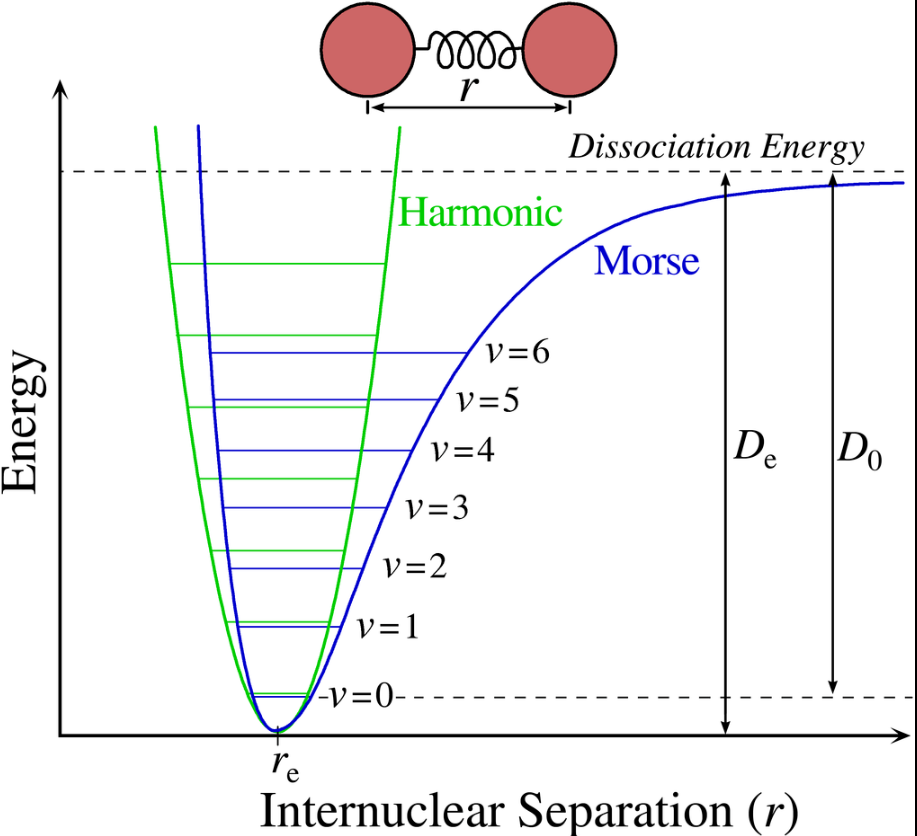
Remember the Morse curve from freshman chemistry? It describes the potential energy versus distance of two atoms at the scale of chemical bonds. The left side of the blue curve shows how steeply the repulsive energy potential rises (exponentially) with diminishing internuclear distance. By contrast, the attractive potential on the right of the blue curve flattens out with increasing interatomic distances. Keep this in mind.
When a fissile uranium-235 nucleus absorbs a neutron, the nucleus momentarily becomes unstable uranium-236. A stable nucleus has repulsive Coulomb forces between nucleons that are balanced at close proximity by the attractive strong nuclear force. The liquid drop model is useful for visualizing a nucleus as it fissions. On absorption of a neutron the uranium nucleus will distort to an elongated dumbbell shape leading to an imbalance of attractive and repulsive forces between nucleons. This can take the nucleus past the distance where the strong nuclear force attraction can hold it together. The strong nuclear force holding together nuclear particles (nucleons) falls off much faster with distance than does the Coulombic repulsion of protons. At the instant the nucleus separates into adjacent fragments, the two highly positively charged nuclei find themselves in very close proximity and are now only subject to net repulsive force. From the left side of the Morse Curve we can see that the repulsive force is exceedingly high in this moment. The highly repulsive potential energy is converted to kinetic energy at the moment the nucleus splits. The nuclear fragments fly apart at high velocity along with neutrons and dump thermal energy into the surrounding bulk material. But the kinetic energy of the fragments is not the only source of energy output.
Nuclear fission fragments are released in a highly excited state. Apart from their kinetic energy, nuclei have different energy levels with differing stabilities. A nucleus can undergo energy transitions from one state to another. These higher energy levels are called nuclear isomers and their stability can be expressed in terms of half-life. As fission fragments are formed they shed energy in the form of alpha, beta, gamma, and neutron emissions. Neutrinos are left out of this discussion for simplicity. As nuclei decay, they get closer to a stable ground state. Unstable nuclear fission products will decay in their characteristic ways, contributing to the overall energy release.
One challenge to weapons designers is to cause as many nuclei as possible to fission before the weapon undergoes “hydrodynamic disassembly” over the first 1 microsecond or less. After ignition the rapidly expanding plasma of the bomb core increases in volume and the probability of neutron collisions with nuclei diminishes rapidly. When a uranium or plutonium nucleus fissions, 2 or 3 neutrons are emitted which go on to strike other nuclei and induce fission in them. The cascading generations result in an avalanche of fissions. One of the ways to ensure that enough generations of fissions occur with enough neutrons flying about inside the supercritical assembly is to surround the core with neutron reflecting material. Ways of doing this can be found elsewhere.
One more thing about the strong nuclear force. This quote is from the Wikipedia entry for the strong interaction–
“The residual strong force is thus a minor residuum of the strong force that binds quarks together into protons and neutrons. This same force is much weaker between neutrons and protons, because it is mostly neutralized within them, in the same way that electromagnetic forces between neutral atoms (van der Waals forces) are much weaker than the electromagnetic forces that hold electrons in association with the nucleus, forming the atoms.“
A nuclear weapon produces a near instantaneous point source of energy release. These bombs can be detonated at or below ground or water level, or they can be set off in the atmosphere or space. The choice of where to do it depends on the intended effects. Subsurface bursts consume much of the explosive energy in moving soil or water which provides some radiation shielding to the surrounding area. Furthermore, bursts in contact with soil or water, especially when the fireball contacts the soil, tend to produce more fallout than air bursts. Air bursts deliver EMP, radiation and blast effects to a wider area, where “radiation” refers to neutrons, gamma and longer wavelengths of electromagnetic radiation. Thermal and blast effects produce considerable prompt destruction in the area surrounding the blast. As an approximate point source of energy, the intensity of the radiant energy falls off as some inverse square law. On an encouraging note, this means that radiation exposure falls off rapidly with distance. Distance is your friend.
There are numerous variations on the nuclear weapons theme. In the early cold war days, so called A-Bombs and H-Bombs were in the news. H-Bombs are also referred to as “hydrogen bombs or thermonuclear weapons.” An A-bomb, A for Atomic, was a basic implosion-type fission explosive and it was the typically the least powerful of the two. The H-Bomb was a nuclear fusion explosive that was triggered by a fission “primary.” That is, a fission trigger would be used to generate x-rays that would be “focused” onto fusion fuel, the “secondary,” which would initiate a runaway nuclear fusion explosion. The explosive yield of these bombs is much higher and can deliver a devastating blast to a larger area. Over time, the efficiency and compactness of these bombs has been greatly optimized.
The fusion explosive element was lithium-6 deuteride. The lithium atom would absorb a neutron, become unstable and decay into a helium-4 nucleus and a tritium (helium-3) nucleus. On a side note, in grad school I attended a seminar by Dieter Seebach from ETH, Zurich, who was talking about mechanistic work they’d done with lithium enolate complexes. He mentioned in passing that at that time, the mid-80’s, they had to be careful with stoichiometry because the commercial lithium that was available was often depleted of lithium-6 which was accumulated by the government for diversion to weapons. It was an unexpected brush with the cold war.
The main deleterious effect of radiation on human tissue lies in the formation of ions and radical pairs along the path of the penetrating radiation. The molecules of life are dissociated into ion pairs or radicals which may or may not collapse back to the original molecules. Given the amount of energy transferred into molecular dissociation along with random diffusion, the molecular destruction cannot be reversed. Heavy radiation particles like alpha particles produce a great many ions per centimeter of tissue penetrated. Penetrating, energetic photons like gamma rays produce relatively few.
There are 6 forms of hazardous radiation commonly considered- alpha, beta, gamma, x-ray, ultraviolet and neutrons. Of these 6, alpha, beta, gamma and neutrons are of nuclear origin. X-ray and ultraviolet are “electronic” in origin, that is they arise from electron transitions outside of the nucleus. The matter of the origin of x-rays is often confused in the literature with some authors implying that x-rays are from the nucleus. I prefer to define x-rays as resulting from electron transitions at the atomic level.
Of the 4 nuclear radiation types mentioned above, alpha, beta, and neutrons are particles. Gamma rays are photons. The atomic nucleus is comprised of so-called nucleons which are protons and neutrons. Nucleons are composite particles comprised of quarks and can bind by the strong nuclear force. Alpha particles are helium-4 nuclei and neutrons are neutral particles with approximately the same mass as a proton or about 1 atomic mass unit. Neutrons are not stable outside of the nucleus and have a half-life of about 15 minutes. Free neutrons will undergo radioactive decay into a proton, an electron, and an electron antineutrino.
Like gamma rays, neutrons are neutral in charge and have great penetrating ability. However, neutrons are effectively scattered by collisions with the hydrogen atoms of biomolecules and water. As a result neutrons can be very destructive to living tissue. As a side note, paraffin wax and water are effective shielding materials for neutrons due to the high concentration of hydrogen atoms. The collisions with hydrogen atoms in living tissues is a means of dumping neutron kinetic energy into the bulk matter, resulting in dissociation of biomolecules.
The so-called “neutron bomb” was an explosive that was designed to produce an abundance of neutrons at the expense of explosive yield. During the early Reagan years in the US there was much public handwringing about these bombs and their ability to kill people but leave buildings standing. People seemed indignant that somehow this reduced the value of human life below that of material things in the grand calculation of destruction.
The characteristic mushroom shape rising to the sky after a nuclear air burst is just the result of a rapid release of energy and bomb debris in the air, but close enough to the ground to suck up soil. The “cap” of the mushroom results from the convectively rising point-source expansion of incandescent, debris-filled air from the point of energy release. The “stem” of the mushroom is a column of air that has rushed in to replace the rapidly rising fireball, picking up soil as it does so. There is nothing intrinsically nuclear about a mushroom cloud. Chemical explosives can do this as well.
Initially the fireball produces a strong pulse of thermal radiation. As this fireball develops, there is a momentary drop in radiant thermal energy due to the increasing opacity of the fireball. With further expansion the opacity of the fireball decreases and the thermal output increases. The shock wave and out-rush of air is obviously destructive, but the radiant thermal effects are not to be underestimated.
Another major effect of a nuclear blast is nuclear fallout. A nuclear blast unavoidably produces radioactive substances from the fission process and from neutron activation. A low altitude air burst is particularly troublesome because ground debris is sucked up into the air and contaminated with radionuclides. This material does what all suspended solids do, namely it is carried by the wind and falls back to earth gradually, contaminating a wide swath of ground. The finest particles remain suspended and are transported long distances, eventually falling out with rain or snow.
Finally, there are psychological effects associated with “the bomb.” It inevitably produces dread fear in people. This fear buttresses the idea of Mutually Assured Destruction or MAD.
Now that we are in a nuclear state of mind, let’s turn to what Putin intends to do with his nuclear arsenal. The Russians are not suicidal. Putin is neither crazy nor stupid. Russians have long understood where a nuclear confrontation with the West can go. They know escalation of nuclear war to full-scale would lead to mutual destruction of Russia and the West. The Russians know that the West has a policy of no first use with nuclear weapons and that we are extremely reluctant to use them. For the West, there is a firebreak between conventional and nuclear weapons. For the Russians, it is more of a continuum. They know that sabre rattling with their nuclear arsenal creates a good deal of anxiety in the rest of the world and Putin has been pushing this threat envelope to new levels and will keep doing so. Once a KGB guy, always a KGB guy. Putin obviously understands the pragmatics of coercion and the influential value of torture.
What nobody knows for sure is what happens when a Russian nuclear war shot is released. What does the West do? Respond in kind quickly or play the long game and see what happens next. How much planning has gone into nuclear conflict between two states outside of NATO? When would NATO step in? NATO is presently taking the side of Ukraine in terms of supplying money and arms but is studiously avoiding direct conflict with Russia. On the positive side, at least right now we aren’t bogged down with an endless middle east whack-a-mole exercise.
The best use of nuclear arms has always been and remains the threat of their use. Russia has been using this threat aggressively, even going so far as to blame Ukraine for planning a false flag operation with a “dirty bomb.”
Putin wants to see the alliance of the US and Europe disintegrate. He wants to see the American hegemony in place since WW II collapse. He wants to see the dominance of US culture, military reach, the influential dollar and prevalence of the default English language peel away. He wants to see Novorossiya rise from the ashes of the fallen USSR. But his vision requires the conquest of territory and cultural domination. The armed extinction project for Ukraine in process now will be followed by rebuilding the captured land with Russian infrastructure, political leaders and culture.
Russia, in its constant state of paranoia, wrings its hands about the “threat” of NATO at its border. The cruel irony is that it is hard to imagine that the West would find the conquest Russia possible or even desirable. The US-lead coalition was unable to get the medieval opium poppy kingdom of Afganistan under control with conventional weapons. How is it possible that we could even consider a preemptive invasion of Russia? Russia’s historical paranoia seems entirely self-serving for its authoritarian leaders.
One way to tear apart western alliances is to help them along with the demise of liberal democracy. Quietly support the internal cultural rot of individual nations by encouraging radical nationalism, white supremacy and political disharmony. It is happening all around us and especially here in the US. As badly as I’d love to entirely blame #45, I have to admit that he has only prodded a sleeping dragon. The MAGA and QAnon crowds were already out there. #45 has rallied them and validated their seething anger and indignation.
Today we have many people of great influence like Tucker Carlson, Alex Jones, Sean Hannity, nationalistic religious broadcasters, a stable of fringe political figures, and a mass of MAGA foot soldiers winning down-ticket elections moving their nationalistic and religious conservative agenda forward. Post-war baby boomers are being replaced with crowds and leaders who reject America’s present liberal democratic culture and leadership role in the world. There is growing open admiration for strongman authoritarian leadership. America’s experiment with fascism has already begun. Surprisingly, many Americans have expressed support for Putin.
Putin’s vicious attack on Ukraine, the rise of Trumpism with American fascism and a viral pandemic have overlapped within a narrow window of time- any one of which is a big problem by itself. It seems doubtful that MAGA right-wing crowds will have a change of heart in their vision for America. They will live out their lives within the same closed ideological space they are in presently. A political depolarization of America seems unlikely in the near term.
In this depressing global political climate it is more important than ever for the US to maintain its role as a thriving democratic culture and defender of those seeking democracy. Our leadership role in NATO must not waver against Russian aggression and expansionism. Russian expansionism will not end with Ukraine.
What will Putin do if he sees his internal political power structure collapsing? Will he ramp up the war to distract his opponents and rally the country? The present situation in Russia seems to suggest that rallying the population is more difficult than he anticipated.
It is hard to believe that Putin and his inner circle will change their ways in their lifetimes. They’ve painted themselves into a corner with their aggression and, like a trapped animal, will fight to the death. The cruel and murderous Joseph Stalin died in power. There is no reason to believe that Putin will be any different.
One can learn interesting but off-topic things along the way to a particular subject of research. Below is a compilation of interesting things.
We are all aware of the games Russia is playing with the interruption of natural gas supplies to Europe. A noteworthy consequence of this applies to the refining of petroleum. Evidently, refineries use natural gas in the refining process, likely as a fuel for heating process equipment. A shortage of natural gas may/will have an adverse effect on the ability of European refineries to produce fuels from crude oil.
There is a German theoretical physicist named Sabine Hossenfelder who has been producing short videos for YouTube. I’ve seen a few and they are quite good. She doesn’t pander to the lowest common denominator. Instead she speaks like a theoretical physicist talking to intelligent non-specialists and does a bang-up job of it. She gives a thoughtful and skeptical analysis of current topics in theoretical physics. She always gets back to basic concepts and what is possible for science to understand. She has moved on to subjects of popular interest as well.
And speaking of videos on YouTube, I’ve taken a shine to a channel called Periodic Videos. The presenter is professor Sir Martyn Poliakoff of the University of Nottingham. It may take a few moments to overcome the shock of his wild white hair. Poliakoff has produced a great many short videos over the years specializing in the chemical elements. A good one I viewed recently was about burning magnesium in a nitrogen atmosphere. Yes, it can happen and it will produce magnesium nitride. Contact it with water and you get ammonia. It is easy to think that nitrogen is an all around inert gas and for the most part it is. Lithium metal springs to mind when inert atmosphere questions arise. Better use argon.
With the appearance of COVID and polio the USA, the news has revealed that it is possible to detect and monitor certain viruses in municipal sewage. As a chemist I marvel at this. Sewage is a frightfully complex mixture of biological waste products along with many chemical cleaning products, detergents, grime and pharmaceuticals that go down the drain. How is it that one can collect enough intact virus particles from this fecal hell broth with enough purity to make a positive identification of genetic material?
A recent methodology is given in an article titled Detection of Pathogenic Viruses in Sewage Provided Early Warnings of Hepatitis A Virus and Norovirus Outbreaks and published in Appl Environ Microbiol. 2014 Nov; 80(21): 6771–6781, DOI: 10.1128/AEM.01981-14 by Maria Hellmér,aNicklas Paxéus,bLars Magnius,cLucica Enache,bBirgitta Arnholm,dAnnette Johansson,bTomas Bergström,a and Heléne Nordera,c. As you can see the work is from 2014 so this is not brand-spanking-new technology. It is interesting to note that the material used to sediment the viruses in this article was acidified powdered skim milk proteins. The article was found by a Google search and located at the NIH National Library of Medicine.
Why powdered skim milk? It could be that milk fat interferes with the process or the workers are just removing variables. More likely, it is because the widely available powdered milk that you buy at the grocery store is from skim milk. Dairy fat is too valuable for a business to squander and is used to make more profitable products like ice cream or whipping cream.
In the 2014 article above, the virus particles are extracted from the raw sewage onto acidified powdered skim milk proteins and amplified with quantitative polymerase chain reaction, qPCR. Powdered milk may seem strange but realize that virus particles can be removed by coagulation with metal ions, lime or with other polyelectrolytes, including proteins. The charge distribution on milk proteins will vary with acidity so these methods are very pH dependent. The viruses are naturally coated in proteins and thus will acquire surface charges varying with pH. The coagulation of proteins occurs when dissolved or suspended proteins irreversibly change their secondary structure by unfolding and condense to form a thicker solution or a solid form. The formation of cheese by acidification or solidifying a runny egg with heat are common examples of coagulation.
A 1973 review article by Gerald Berg in Bull World Health Organ. 1973; 49(5): 451–460, reviews methods for the removal of viruses from effluents, so knowledge of the sedimentation, or coagulation, of viruses in sewage has been around for a long while.
These articles are written by specialists in the field and may present considerable difficulty for a few readers. I would urge those so inclined to try to plow through the articles and pick up what you can. This holds true for all scientific papers. See what you can learn.



 Lamentations on Chemistry