An ionizing death

The mind boggles at the recent passing of Alexander Litvinenko in London.  This poor sod was evidently dosed with some radiological hellbroth, possibly at a sushi bar. Crimony. Authorities found the radionuclide Polonium-210 in his urine.  According to the Radiological Health Handbook, US Department of Health, Education, & Welfare, January 1970, Po-210 is an alpha emitter (5.31 MeV) with a half-life of 138.4 days. It decays to Lead-206 which is stable. The specific activity of Po-210 is about 4,500 Curies per gram. 

This bad actor has a half-life long enough to handle, but short enough to be intensely radioactive.  Like the proverbial ice dagger, the evidence rapidly decays to the asymptote of the background.  And, alpha particles are more problematic in their detection, given their low penetration ability.  Not all survey counters will pick up alpha’s, so samples must be taken and prepared for analysis.  And, someone must first have cause to suspect radiological mischief. 

Obviously, this is the work of some fiendish mind. 

 Decay Table from Radium to Lead

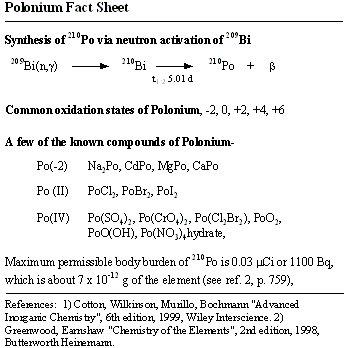
The decay table shows the decay events from Radium-226 to Lead-206.  The decay of Polonium-210 is the last decay in the series.  This graphic is from the Radiation Health Handbook.  Unfortunately, the 1970 edition of the Handbook does not give a target organ.  I have no clue as to common chemical forms of polonium compounds.  However, given it’s high specific activity, chemical toxicity may be negligable relative to the radiological insult. 

I show the decay table only because some might find it interesting to see where Po-210 comes from.  Hopefully, the health physics people who investigate this might find other nuclides that could give a hint as to the production source of the Po-210.

This reprehensible action reminds us that civilization is a veneer that is only a millimeter in thickness.  A radiological assault of this sort is especially sneaky in its execution and savage in its effects.

(*Weasel words- I am not a health physics person. My experience is limited to a semester course in radioisotope techniques and safety in grad school given by a radiation biology department.*)

Propinquity

Process development and scale-up isn’t one of those things a young, freshly minted synthesis chemist generally aims for.  I recall the heady days in grad school when we thought “drug design” was the ultimate gig for a synthetic organic chemist.  Landing a slot in a first tier pharmaceutical discovery group was like landing a spot on the cast of a Broadway play.  And, in fact it is like that.  I have many friends and fellow students who have found fantastic careers doing just such a thing.

In the late 80’s and early 90’s, asymmetric synthesis was hitting its stride and anyone who could make heterocycles with chiral shrubbery attached somewhere was golden. Even better, if you had studied “Enzymatic Reaction Mechanisms” by Christopher Walsh and you could name all of the amino acids, you definitely had a future.  Most of us were lucky to be able to pronounce propinquity after consuming four pounds of Killians after a long day of research.

This time period that I refer to is before the introduction of high throughput experimentation (HTE), or CombiChem.  It was a kind of gilded age where reductionists prevailed.  If only we had enough data on the geometry of the active site, we could design a suicide substrate inhibitor to shut the enzyme down. We had CAChe(R) and SAR to help with the design of pharmacophores- it was a heady time.

It was an age when giants walked the laboratories- Corey, Evans, Nakanishi, Seebach, OppolzerMeyers, etc.  Some of these fellows still do.  But things would fundamentally change when a new experimental methodology rolled into town. The age of automation had arrived.

HTE would spawn new ways of thinking in discovery.  To methyl, ethyl, butyl, … futyl would be attached an exponent.  It would become possible to do and analyze a thousand reactions in a day.  Pharma companies invested heavily in this technology and, I understand, some of it is actually paying off.

But while the elite discovery krewes were spending down these giant R&D budgets that exceeded the GNP of a third world nation, a different group was quietly laboring with that most favored transformation of all.  Actually turning chemicals into money.  The most prized alchemy.

The activity to which I refer is, of course, process development and scale-up.  This field requires a slightly different mind-set.  It is not the domain of the show-horse. It is the world of the plow horse. And, by the prinicple of propinquity, I have developed a taste for it. 

More to follow.

NASA! Where is the Beef?

This post is about NASA. Yes, the National Aeronautics and Space Administration.  I have been watching NASA-TV for a few months and have experienced a kind of crippling inverse rapture.  NASA-TV is video pageantry designed to spread the gospel of rocketry and aerospace and I guess that is fine.  But it is mostly whizbang content that lacks a bit of substance.

Well, duh.  Of course.  They’re in the launch business, dummy.

I’m actually not going negative on NASA.  I believe in what the agency is doing and I’m pleased to pay taxes to support it.  But if you listen to what NASA people say, much of what they do is related to supporting the “science package”.  This is because space scientists need rocketeers to hurtle things out of the gravity well for them.

But this NASA venue never seems to pony up the science itself.  I have yet to see NASA-generated programming that offers much of the actual scientific grits and gravy.  Obviously, every morsel is written up in journal articles and fashioned into PowerPoint presentations to be scrutinized by squinting fuss-budgets (you know, “scientists”) in colloquia everywhere.  If you want to see the actual scientific results then you have to plop down at a university library with a journal and read the article or pay to download copy.  That’s fine, but this only serves the specialists.

It may be due to the nature of the funding. A PI comes in with a big wad of cash from a grant and basically NASA just provides the launch and control services.  NASA has no particular claim over the data or its disposition. Perhaps someone can set me straight on this.

Irrespective of how NASA works, here is what I’m frustrated with. Seeing the drama of the launch, the machinations of getting a probe to it’s destination, and then receiving the pretty pictures as the only reward. It puts me into insulin shock.  NASA is good at programming this kind of content- the Hope and Crosby road trip angle. But what are the results? What measurements were taken and what did we learn? NASA teases us with the show business end of space exploration but comes up short in communicating the scientific results.

So, here is what I’d like to see.  I would like to see a few researchers, with the support of NASA, periodically present their results to the public on NASA TV. I’d like to see the data and their conclusions and uncertainties- warts and all.  The public needs to see this.  Endless footage of exuberant space reseachers gushing at the potential benefits for mankind have worn thin.  It is time for these folks to tell us exactly what they are finding.

But some suggest that maybe raw science is too advanced for the public audience.  I’ve heard this sentiment before and can only argue that it is not NASA’s job to decide if we’re smart enough to understand the results from this research.  If the launch is important enough to spend $300 million on, then lets see what we learned.

The message we give people is that space science is the science of telescopes and rockets. This equipment is inportant, but it is not the focus of the activity. We launch these packages so we can study the stuff that is out there. How much stuff is there, what is the stuff doing and, what is that stuff anyway?  Let’s hear more about the stuff.

The public needs to see how data is collected and how it is reduced to some kind of conclusion.  Much of NASA TV consists of video feed from the ISS.  It is often mind numbing in it’s tedium, watching astronauts floating in front of a work station twiddling this or that. To hell with that.  Let’s see some data.  Let’s hear the scientists interpret their results.  Let’s all experience the buzz of enlightenment as a new concept washes over our consciousness. That is the true excitement of science.   

On the Road

I often think back to my college days and wonder what coursework I might have taken that would have been beneficial for a more lucrative mid-career.  I am presently over the great plains in the suborbital arc of my career- somewhere between Memphis and Kansas City, westbound to that Golden State on the horizon.  At some point in a chemists career he must mix metaphors and make a choice at the great fork in the road.  To remain in the lab or to move on to the crystal city on the hill:  Sales & marketing.  I chose sales and marketing, well, because I had to.   

Chemical sales is a odd field. One is neither a full member of the R&D tribe or the business tribe.  You become a chimera- a half man, half beast of burden that lopes through the B2B high plains sniffing for the stray morsel or rotting carcass.  In principle you are a member of an elite strike force, one in possession of the sacred knowledge of molecule marketing. On business trips you can mingle in the company of professors or supply-chain managers with equal ease. Your tongue can bend words with both the old ones- the blessed faculty- and those keepers of the elusive coin. 

But in your sterile cubicle, you are just another salesman.  Many companies have computer software that can be rigged to specifically to watch your every keystroke, even how frequently you move the mouse. This malevolent utility will time your calls, refuse to budge unless you set a deadline for a task, and collate every infraction from your self-imposed calendar into a tidy report for review by the taskmaster. Back in the dreamtime, you crafted covalent bonds and imbued molecules with chirality.  Today you fuss about “making the numbers”. 

As a sales man you take short courses on telemarketing and you learn how to deftly worm your way into the calendars of decision makers.  You develop a script for making the dreaded cold-call.  Your daytimer brims over with business cards. Early on you learn how to get past cold hearted administrative assistants who screen your calls and stonewall your well honed charms. 

You have become a road warrier, conversant in the codespeak of frequent flyer miles, airport hotels, and rental car companies. You learn to navigate in strange cities and how to find your way through the squirrel warren industrial parks. Your heart hardens in some ways and softens in others.  Welcome to the fabulous life of the sales man.

Due Diligence rev 1.1

In the fabulous world of business, there is thunderous demand and there is sweet supply.  People start businesses to satisfy some particular demand.  Along the way they hope to recover some of the elusive spondulix.  This is what makes the world go round.

In the glamorous world of custom chemical manufacture, a company seeks to make new material exclusively for a single customer or application.  Let me say that this essay is not about the byzantine world of pharmaceutical manufacturing or drug development. Pharma is a brutal and cutthroat business and it absolutely escapes me why any sane person would launch a pharma business today.

Bringing a new chemical entity to the market for commercial use is technically challenging and increasingly complicated due to regulatory requirements.  We’ll leave the regulatory nightmare for another time and focus on intellectual property.

Here is a common scenario:  Customer X emails and makes the following query- “Gimme a price for 10, 100, and 500 kg of QRT”.  The sales guy squints at the email and says “Cripes, we gotta figure out how to make this stuff, if we can make it, and SWAG (Scientific Wild-Assed Guess) a price!” It is the “if we can make it” part that is of concern today.

Before a manufacturer can actually offer a material or use a process to execute a sale, they must first perform their Due Diligence.  Due diligence has many manifestations and if you want a lecture on it, just get a recent MBA drunk and ask for a detailed explanation (I am preparing a blistering diatribe on MBA’s for a later essay).

In the matter of intellectual property, a manufacturer has a responsibility to determine if they are barred from practicing some process or making a particular composition of matter.  Given the gigantic body of literature that can be searched by SciFinder or Beilstein, you’d think getting a clear answer would be an easy, if not tedious, thing to do. Sometimes it is easy.  Other times you follow Alice down the rabbit hole.

The key question for the chemical vendor to resolve is this: Are there patent claims out there that are in force that would bar a manufacturer from practice?  To resolve this, we have to deconvolute the query into at least four questions- 1) Can we think of key words or structures that, when put into the sorting hierarchy, will lead us to the answer set? 2) Do the claims cover a process or a composition of matter? 3) Is the patent still in force? And 4) If we fail to find claims, are we confident in our search?

The USPTO website may not be that helpful and, in my experience, might give a false sense of security when your search comes up empty. The search engine at the PTO site will search for character strings in a variety of fields, and while this is useful, it is possible to miss a compound if it has an unanticipated name or is represented in some other fashion.

A common thing to find in the chemical patent literature is the Markush claim. In this representation, a set of analogs are claimed from which a preferred embodiment may be taken. A Markush group is depicted by a formula with generic substituents and each generic substituent is subsequently defined as being comprised of particular groups in chemical taxonomy, e.g., hydrocarbyl groups.  Here is a simple example of a Markush Group- “QR(4-n)Xn, where n= 0 to 4. Q is a tetravalent member of Group IV of the Periodic Table of the Elements; R is a hydrocarbyl group consisting of C1 to C12; and X is a member of Group VII of the periodic Table fo the Elements”. 

I’ve noticed that lawyers and USPTO people tend to use the patent classification system to sort the technology or the composition. Lawyers may also use specialists who have proprietary databases or some dark art known only to them.  Unless a chemist has spent time with the PTO system of taxonomy, it may be a bit daunting and less than useful. 

SciFinder collates patent data into patent family output and provides a very useful entry into the patent literature. Nevertheless, it is still a fairly blunt instrument and many patents may have to be viewed by hand.  Perhaps someone can comment.

It would be great if SciFinder had a way of flagging any given compound for the presence of process claims and composition of matter claims. This would be extremely useful to those trying to verify that they are not in infringement. 

A very useful tool for those seeking pdf downloads of patents can be found on pat2pdf.org.  It takes the individual pdf pages from the PTO site and assembles them into a single pdf  file. And it’s free.

Sick Pups at News Corp.

There are some pretty sick kids working over at News Corp.  They’re the ones behind the O.J. Simpson freakshow that will air on Fox over the thanksgiving holiday, Nov. 26 & 27.  There is supposedly a book as well. 

I refuse to waste many more heartbeats thinking about it so I’ll be  brief.  At some point, a genius at Rupert Murdoch’s shop decided it would be a good idea to get OJ Simpson to, in lieu of a confession, fabricate some morbid story describing how he would have (hypothetically) committed the infamous double homicide. 

There is almost nothing new to say about OJ Simpson so we’ll leave that alone.  The really twisted part is that somebody at Fox committed resources to put together this “show” to air over the holiday.  OJ’s sickness speaks for itself. And so does the pathological state that exists in the “newsroom” at Fox.  Some cynical producer imagined that among their viewers there is enough prurient, gawking, morbid interest in this that the market share in viewers would bring a handsome profit to them.

Fox will make some lame-ass statement that the pubic demands this crap and that they are just giving us what they want.  Fox and News Corp have just shown us who they really are and what they think of us. 

In which I was found to be decidedly odd

I’m used to being an oddball.  Well, perhaps I should rephrase that.  I’m accustomed to marching to a different drummer. I can actually hear the cosmic ratta-tat-tat snare drum beat over the cacophany of familiar voices in my head.  All of the history and justifications for this assertion will have to wait for another time.  Just assume for now that I am odd.

I love books and when an opportunity to write one came I took the bait.  A smooth editor plied her magic ways in recruiting me and I  agreed to consider the process.  Oh, this wasn’t to be some work of haute literature.  No, no, tsk. This was to be a chemistry book.  One of those “Advances in _____ Chemistry” type volumes.  It is with a respected publisher that the reader would recognize instantly.  I would serve as editor and write a few chapters.  My head was spinning with the thought of occupying library shelves along with the many familiar names of our science.  Heady thoughts. But to do this, I would need access to the literature.

So, at the recent ACS meeting in San Francisco, I happened by the CAS pavilion where I made an innocent query.  A question that would eventually bring down the whole house of cards.  You see, CAS- Chemicals Abstracts Service- is a type of business. They are in the business of abstracting every single chemically-related publication in the known universe.  Periodicals, patents, poster abstracts, toilet graffitti, symposium series, etc.  To do this requires an army of fastidious people with typing skills.  These people expect compensation commensurate with their skills, and so it costs real money to provide this service. 

So, the universe of customers for the services of CAS is broken into two domains- penurious Academia and fabulous Industry.  Academia, it turns out, pays approximately nothing. Industry pays through the nasal passages.  Now (camera zooms in on me) I’m standing there on the padded carpet in business casual attire with my badge screaming out my affiliation (INDUSTRY!!!).   A representative of CAS dutifully approaches me and politely asks “may I help you”?  By now I’m in full schmooze configuration and I explain my need to purchase SciFinder services for a book project. I explain that this project is my own and my employer has no obligation to fund it.

It was as though I had spoken in some archaic Portuguese dialect.  The CAS person listened to me respectfully and with patience. I can expect no more. I could tell that this story I put forth was considered unconventional or … odd.  But it was quickly determined that I was in the industrial bin and hitherto subjected to the full broadband blast of industrial charges.  I was DOA.

Point of clarification. If you have been on booth duty at a trade show, you know that the first thing you do with a contact is to qualify them.  If they have no potential for decent sales, you politely eject this spent round and load another cartridge.

The representative was done with me. In desparation, I pointed out the grim economics of writing a book.  I would make about $4500 over 5 years and the literature search could easily cost that much at industry prices.  But the door was shut. I was industrial and that was that (crickets in background).

So there I was. Standing there, rudder disabled by an errant torpedo.  Dreams slipping under the cold greasy waves of the north sea.  I needed the economics of academic SciFinder prices and it wasn’t to be.  Crap-a-matic.

The question I have is this.  How does a non-academic write a book summarizing the literature? I guess I have to forget SciFinder and camp out at the nearest unversity library. Interesting problem.

Alas, poor ether, I knew it well …

I’m sorry to witness the slow demise of diethyl ether.  A wonderful solvent it is.  Or perhaps the past tense is more in order.  Righteous organizations are fleeing from this magnificent ethereal fluid.  It will dissolve a Grignard reagent, mighty LAH, or bovine lipids from hamburger.  It’s low melting point and low boiling point has helped to solve ten thousand problems.  Yet despite its advantages, ethers dark side is its undoing.

Ethers “spirited” volatility, that very property that allows for its facile removal, is largely to blame for its doom.  It’s celebrated aptitude for finding ignition sources far from its point of origin has sealed its fate.  Ethers broad explosability window, its distant lower and upper explosion limits, will cause strong men to tremble openly at its supersonic possibilities.  Space explosion, they’ll say in hushed voice.  Poor-mans nuke.  And in the hands of the clumsy, the uncaring, or the plain unlucky, they’re probably right. 

So if you need an extra tanker of ether soon, you may not get it.  It may be on allocation. Serious executives in corner offices with furrowed foreheads and great fuzzy caterpillar eyebrows will anxiously lean forward to explain that it’s really not their fault.  They’ll plead that market demand has shifted its attention to other commodity solvents and that they feel the radiant heat of potential liability for all of the ether product that is out there in plants and on the road. Yes, on the road.  Yet one more reason not to swerve in front of an 18-wheeler.

So, young turks of R&D, consider the multitude of splendid possibilities before you and be not attached to the ether diethyl. For it has gone the way of the buggy whip and cathode ray tube. And above all, take heed the advice of the blessed sage of Stanford, the Cardinal d’efficacité d’atome, Professor Trost and his divine doctrine of atom efficiency.  Verily, he hath cast his pearls before the swine. Blessed is he who substitutes nickel for platinum and chloride for iodide.  And blessed is he who raiseth his space yields, for his pot shall not runneth over.  And exalted is he who spares his rupture disc, for many shall be his days before the Pfaudler.

2-Methyltetrahydrofuran Idea Clearinghouse

I would like to invite readers to share their non-proprietary experiences with the solvent 2-methyltetrahydrofuran, 2-MeTHF.  This is an ethereal solvent that has been around for a while.  While my personal experience with it is admittedly scarce, I have been eyeing this solvent for product use and process chemistry for some time. The manufacturer is concerned that they have a great solvent that will solve some problems for the folks out there, but are a bit flummoxed as to how to spread the word.

Most all synthesis folks will agree that tetrahydrofuran (THF) is a very useful solvent and, no doubt, have their favorite applications for it. I for instance prefer THF in LAH reductions.  THF is a polar, non-protic solvent that offers great solvating capability and a not unreasonable boiling point.  Sterically, THF seems to have a solvating aptitude that is different from diethyl ether. This is seen in the case of Grignard reagents, just to name one example. 

But despite all of the advantages THF offers as a solvent, a non-trivial downside is its water miscibility.  The aqueous workup and extraction of a THF reaction mixture can be complicated by the difficulty in getting a phase separation.  Various tricks can be performed, such as salting out the water layer, adding an aliphatic solvent, or solvent exchange. But these things amount to a workaround to compensate for this unfortunate attribute of THF.

These workaround techniques are not so bad on the benchtop, but at plant scale, they amount to complications that add cost to the process.  Extra expenses in terms of raw mat costs, storage & handling, and waste disposal costs.  A solvent that behaved like THF but allowed for easier workup will definitely help keep the costs of processing down.

MeTHF seems to have some aptitude for solving the THF-water miscibility issue.  But, what do you think?  Have you tried it?  Need to find a supplier? Do you have an anecdote you can share?   Let’s hear what is going on out in the world.

The Calculus of Power

What an amazing thing it is to see, the great ship of state shifts its mighty rudder and the bow turns a few degrees in another direction. With the US House of Representatives under a Democratic majority, the whole calculus of power changes sign. The house that Gingrich built has found unruly new tenants.  Congressional oversight of the executive branch will begin in earnest.  The revolution will be televised.  Subpoena’s will swarm up Pennsylvania Avenue like the swallows of San Juan Capistrano.  

Verily, pity not the wretched and rejected Republicans, for they still own the Executive branch, the Senate, and the supreme court.  And Lo! Malleable though the Senate may be, the smirking majority voting bloc of SCOTUS- Scalia, Roberts, Alito, and Thomas- are tenured unto their last breath. 

Thus spake Zarathustra.

(*End Dream Sequence*)